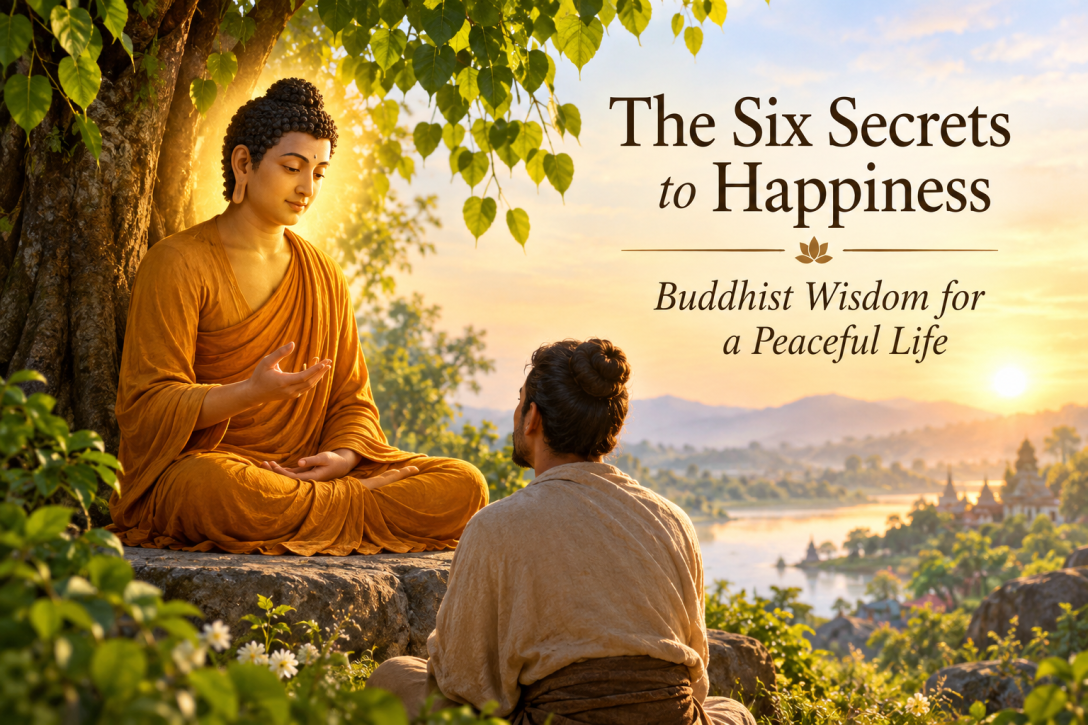
The Six Secrets to Happiness: A Timeless Lesson from the Buddha

The Six Secrets to Happiness: A Timeless Lesson from the Buddha

Long ago, in a small village not far from where the Buddha was teaching, there lived a wealthy merchant named Ananda.

He owned a beautiful house, several shops, and fields filled with crops. His servants attended to his needs, and his neighbors often praised his success.

Yet, despite everything he possessed, Ananda was rarely happy.

Every morning, he worried about making more money. When someone criticized him, he became angry. When another merchant became more successful, jealousy filled his heart. He spent hours arguing with people who disagreed with him and constantly worried about what others thought of him.

Even when he sat in his beautiful garden, surrounded by flowers and birdsong, his mind was never at rest.

One afternoon, Ananda heard that the Buddha was staying at a nearby monastery. Hoping to find an answer to his unhappiness, he decided to visit him.

After paying his respects, Ananda sat before the Buddha and spoke honestly.

“Blessed One, I have worked hard all my life. I have wealth, property, and people who respect me. Yet my heart is restless. I see people with far less than I have who seem happier than I am. What am I missing?”

The Buddha looked at him with a gentle smile.

“Tell me, Ananda,” he asked, “when you wake each morning, where does your mind go?”

Ananda thought for a moment.

“I think about my business, the people who owe me money, the people who criticize me, and the things I still need to accomplish.”

“And when someone speaks unkindly about you, what do you do?”

“I become angry, Blessed One. I spend much of my time thinking about what they said and how I might answer them.”

The Buddha nodded.

“Then perhaps your suffering does not come from what you lack, but from what you continually give your attention to.”

Ananda lowered his head.

The Buddha continued.

“Let me tell you about six ways a person can make room for happiness in the heart.”

First, the Buddha said, “Learn to speak less, but let your words carry more kindness.”

He explained that not every thought needed to be spoken. Some words create understanding, while others create wounds that may take years to heal.

“A wise person does not speak simply to be heard. Before speaking, consider whether your words are true, helpful, and kind. Sometimes silence is more valuable than winning an argument.”

Second, the Buddha said, “Never stop learning.”

He pointed toward a young monk sweeping leaves beneath a tree.

“Look at that young monk. Each day, he learns something new. The mind that remains curious continues to grow. Do not believe that wisdom belongs only to the young. As long as you are alive, there is always something to understand, something to improve, and something to discover.”

Third, the Buddha said, “Do not give your peace away to every person who challenges you.”

“People will criticize you. Some will misunderstand you. Others will try to provoke you simply because they are unhappy themselves. If you allow every unkind word to control your mind, you will spend your entire life carrying the burdens of others.”

He paused before adding:

“You do not have to answer every insult. You do not have to attend every argument. Sometimes the wisest response is to walk away without anger.”

Fourth, the Buddha said, “Remember those who have less than you.”

“Do not measure your life only by what you possess. Look around you. There are people who are hungry, lonely, frightened, or struggling to survive. When you offer food to someone who is hungry, comfort to someone who is suffering, or kindness to someone who feels forgotten, your heart discovers a happiness that money cannot purchase.”

Ananda listened carefully.

Fifth, the Buddha said, “Do not forget to laugh.”

“Life contains difficulties, disappointments, and moments of sorrow. But do not become so consumed by your worries that you forget the simple joys of being alive. Enjoy the sunshine. Appreciate the sound of rain. Smile with your friends. Find happiness in ordinary moments.”

The Buddha’s eyes were filled with warmth.

“A peaceful heart does not mean a life without difficulties. It means learning not to let every difficulty steal your ability to appreciate life.”

Finally, the Buddha said, “Do not spend your life trying to prove your worth to others.”

“Some people seek praise. Others want everyone to admire their wealth, knowledge, or achievements. But praise is temporary, and the opinions of others constantly change. If your happiness depends on their approval, you will never be free.”

He continued:

“A tree does not announce how many fruits it bears. It simply grows and offers its fruit to the world. In the same way, let your goodness speak through your actions. You do not need an audience to live a meaningful life.”

Ananda sat quietly.

For the first time in many years, he felt that someone had shown him something more valuable than all the treasures in his house.

He looked at the Buddha and asked, “Blessed One, are these six things enough to make a person happy?”

The Buddha replied gently:

“Ananda, happiness is not something you can collect like gold or store inside a beautiful house. It grows through the way you live, the thoughts you nurture, and the kindness you offer to others.

When you speak with care, your relationships become gentler.

When you continue learning, your wisdom grows.

When you stop feeding unnecessary arguments, your mind becomes lighter.

When you help those who suffer, compassion fills your heart.

When you remember to laugh, you rediscover the beauty of life.

And when you stop seeking approval from everyone, you begin to understand the freedom of being at peace with yourself.”

Ananda bowed deeply.

On his journey home, he began to notice things he had ignored for years.

He noticed an elderly woman struggling to carry a basket and stopped to help her. He smiled at a child playing beside the road. When a merchant spoke rudely to him, he chose not to argue. Instead of spending the evening boasting about his success, he listened to his family and shared a simple meal with them.

Nothing about his wealth had changed that day.

His house was still the same. His businesses were still the same. The world around him had not suddenly become perfect.

But something inside him had begun to change.

As the days passed, Ananda discovered that he did not need to win every argument, receive everyone’s admiration, or possess everything he desired.

He began to understand that a meaningful life was not measured by how much he could accumulate, but by how much kindness, wisdom, and peace he could bring into the world.

And slowly, the restless man who once had everything but happiness began to experience a joy he had never known.

The lesson of the story

We often spend our lives searching for happiness in more money, more possessions, more recognition, and more approval.

But perhaps happiness has been waiting for us in the things we have overlooked.

Speak with kindness. Keep learning. Protect your peace. Help those in need. Laugh while you can. And never feel that you must prove your worth to the world.

The greatest wealth is not what we keep in our hands, but the peace we cultivate in our hearts.

Sometimes, the secret to a happier life is not learning how to get more, but learning what is truly worth our attention.

Link: https://wisdombread.wordpress.com/2026/10/30/the-six-secrets-to-happiness-a-timeless-lesson-from-the-buddha/

When Darkness Took Away the Light: A Story of the Buddha and the Power of Compassion

When Darkness Took Away the Light: A Story of the Buddha and the Power of Compassion

The night Daniel lost everything, he thought his life was over.

For fifteen years, he had worked hard to build a small family business. He had sacrificed holidays, missed family dinners, and worked through countless sleepless nights. He believed that if he worked hard enough and treated people fairly, life would eventually reward him.

But one unexpected event changed everything.

A business partner whom Daniel had trusted had secretly taken the company’s money and disappeared. The bank called. The bills piled up. His employees worried about their jobs, and his family wondered how they would pay their mortgage.

Daniel felt as though a shadow had swallowed his world.

He could not sleep. He could not eat. Every time he closed his eyes, he imagined the future collapsing before him.

Most of all, he was consumed by anger.

“I trusted him,” Daniel whispered one night. “How could he do this to me? If I ever see him again, I’ll make him suffer the way he made me suffer.”

His wife sat beside him, but she had no words that could ease his pain.

Days passed, and Daniel became a prisoner of his own resentment. Even when he was at home, his mind returned to the betrayal. Even when his children laughed, he could barely hear them. The person who had hurt him was no longer beside him, yet that person’s actions continued to control his life.

One evening, Daniel visited a small Buddhist temple in his neighborhood.

He had not been there for years. As a child, he had sometimes accompanied his grandmother, who used to tell him that the Buddha taught people how to face suffering without allowing suffering to destroy their hearts.

That evening, Daniel sat quietly before a statue of the Buddha.

“I don’t know what to do,” he whispered. “I’ve lost so much. I want justice, but I don’t want to become a bitter person. Please, help me find a way forward.”

An elderly monk sitting nearby heard his words.

After a while, the monk approached him and asked, “What troubles you so deeply?”

Daniel told him everything.

The monk listened without interrupting. When Daniel finished, the monk looked at him gently.

“Tell me,” he said, “if someone set fire to your house, would you carry the burning wood in your hands just to prove how much you hated the person who started the fire?”

“Of course not,” Daniel replied. “It would burn me, too.”

The monk nodded.

“Yet every day, you carry the fire of your anger inside your heart. The person who betrayed you may be far away, but you continue to suffer from what happened.”

Daniel lowered his eyes.

“Are you telling me to forgive him?” he asked. “How can I forgive someone who destroyed everything I worked for?”

“I’m not asking you to pretend that nothing happened,” the monk answered. “Compassion does not mean allowing others to harm you. You can seek justice, protect your family, and take the steps necessary to rebuild your life. But you do not have to let hatred decide who you become.”

Daniel remained silent.

The monk continued, “There is an old Buddhist story about the Moon Deity, Candima. One night, Rahu, a powerful lord of the Asuras, seized the moon and swallowed its light. Candima could not free himself, so he called upon the Buddha for refuge.”

“What happened?” Daniel asked.

“The Buddha spoke to Rahu and called upon him to release Candima. He reminded Rahu that the Buddhas radiate compassion throughout the world. Rahu released the moon and hurried away in fear.”

The monk paused.

“Even the moon, which gives light to the world, can be swallowed by darkness. But being covered by darkness does not mean that its light has ceased to exist.”

Daniel looked toward the Buddha’s statue.

For the first time in many weeks, he allowed himself to breathe slowly.

“Then what should I do?” he asked.

“Begin with what you can do today,” the monk replied. “You cannot change yesterday. You cannot control the choices another person has made. But you can choose whether your next action will be guided by wisdom or by anger.”

Those words stayed with Daniel.

The following morning, he began making difficult phone calls. He contacted a lawyer, spoke honestly with his employees, and met with his family to explain their financial situation. He stopped hiding from his problems and began facing them one by one.

The road ahead was still painful. He had debts to repay and trust to rebuild. There were days when anger returned, and nights when fear threatened to overwhelm him.

But whenever his mind returned to the man who had betrayed him, Daniel remembered the monk’s question about carrying burning wood.

He reminded himself that seeking justice and feeding hatred were not the same thing.

He could hold someone accountable without wishing for that person’s suffering. He could learn from his mistakes without allowing them to define his future. He could protect the people he loved without becoming cruel to others.

Months later, Daniel found a new job and slowly began rebuilding his life. His business was gone, but his family remained beside him. He discovered that he could still work honestly, still help others, and still find moments of happiness.

One evening, his young daughter asked him, “Dad, are you still angry with the man who hurt you?”

Daniel thought carefully before answering.

“Sometimes,” he admitted. “But I’m learning not to let that anger control me.”

His daughter climbed onto his lap.

“Does that mean you’ve forgiven him?”

Daniel smiled sadly.

“It means I’m trying to make sure that what he did to me doesn’t turn me into someone who hurts other people.”

He held her close, realizing that although he had lost the life he once imagined, he had not lost the opportunity to choose what kind of person he would become.

Outside their window, the moon shone quietly in the night sky.

Daniel looked at its silver light and remembered the ancient story of Candima.

The moon had been seized, but it had not disappeared forever. And when the darkness finally released it, the light returned to the world.

Perhaps human hearts are not so different.

We may be swallowed by grief, betrayal, fear, or anger. We may find ourselves in situations we never wanted and cannot immediately change. We may even believe that the darkness will last forever.

But we can still seek wisdom. We can still choose compassion. And we can still refuse to let suffering turn us into the very thing that wounded us.

The Buddha’s teaching does not promise that life will never hurt us. It reminds us that even in painful circumstances, we can learn to respond with greater understanding and freedom.

Sometimes, courage means standing up for what is right.

Sometimes, healing means letting go of the desire for revenge.

And sometimes, the first step toward freedom is simply deciding that the darkness will not have the final word.

You may not be able to stop someone from bringing darkness into your life. But with wisdom and compassion, you can choose not to carry that darkness into the lives of others.

May we all learn to protect what is good within our hearts, even when life gives us every reason to abandon it.

Link: https://wisdombread.wordpress.com/2026/10/22/when-darkness-took-away-the-light-a-story-of-the-buddha-and-the-power-of-compassion/

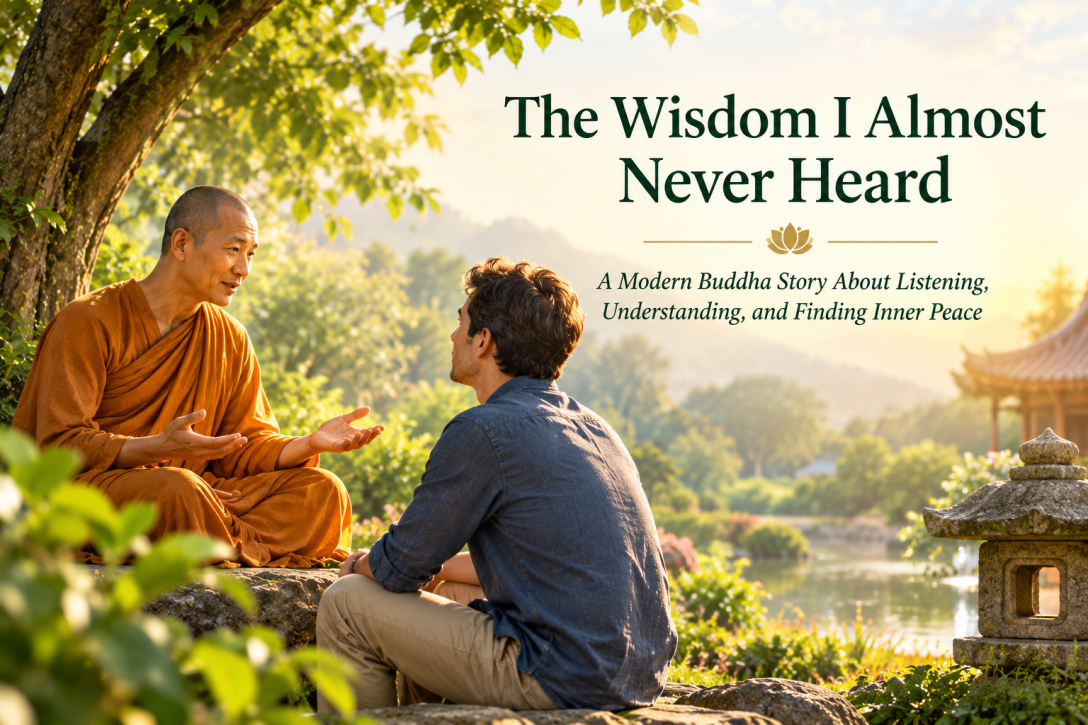
The Wisdom I Almost Never Heard

The Wisdom I Almost Never Heard

Daniel had everything people told him he should want.

He had a good job, a comfortable home, a car he was proud to drive, and a family who loved him. His social media pages were filled with photographs of vacations, restaurant dinners, and smiling faces.

Yet every night, when the house grew quiet and he lay in bed, his mind refused to rest.

He worried about money, even though he earned enough. He compared his life with people who seemed more successful. He replayed arguments in his head, imagining all the things he wished he had said.

Sometimes, he woke in the middle of the night with a strange emptiness in his chest.

He would reach for his phone, scroll through endless posts, and tell himself he was simply tired.

But deep down, he knew something was missing.

One Saturday morning, after another sleepless night, Daniel argued with his wife over something trivial. She asked him whether he had remembered to pay a bill. He snapped at her, accusing her of always criticizing him.

She stared at him in silence.

“I wasn’t criticizing you,” she finally said. “I was just asking a question.”

Daniel had no answer.

His wife turned away, and he saw the sadness in her face. It was not the first time he had hurt someone he loved because he could not manage the turmoil inside himself.

Later that afternoon, while driving through his neighborhood, he noticed a small sign outside a Buddhist meditation center.

A Dhamma Talk: Learning to Find Peace in a Restless World. Everyone Is Welcome.

He almost drove past it.

He had always thought Buddhism was something for monks, not people like him. Besides, he had read plenty of self-help books and watched countless motivational videos. They had inspired him for a few days, but eventually his old worries always returned.

What could listening to another teaching possibly change?

Still, something made him stop the car.

Inside the center, people sat quietly on cushions and chairs. There were elderly people, young professionals, parents, and students. No one appeared especially important or impressive. They had simply come to listen.

Daniel chose a seat near the back.

An elderly monk entered the room and greeted everyone warmly. He spoke without a microphone, without dramatic gestures, and without promising that anyone’s life would become perfect.

He spoke about suffering, the restless mind, and the importance of understanding our own thoughts and actions.

Daniel listened politely, but at first, the words seemed familiar. He had heard people talk about kindness, patience, and letting go before.

Then the monk shared a teaching of the Buddha:

“There are five rewards in listening to the Dhamma. One hears what one has not heard before. One clarifies what one has heard before. One gets rid of doubt. One’s views are made straight. One’s mind grows serene.”

The monk paused.

“Sometimes,” he said, “we believe we already understand life. We have opinions about our families, our problems, and the people who disappoint us. Yet we may never have stopped to examine whether those opinions are true.

“Listening deeply does not mean accepting every word without thought. It means giving wisdom a chance to reach us before our habits decide what we will believe.”

Daniel looked up.

For the first time that afternoon, he felt that the teaching might have something to do with him.

The monk continued.

“Imagine a person who has spent years carrying a heavy bag. Because he has carried it for so long, he no longer questions why it is there. He believes the weight is simply part of his life.

“Then one day, someone asks him to look inside the bag.

“He discovers that he has been carrying old anger, fear of failure, jealousy, and painful memories. Some of those things began with real suffering. Others grew from misunderstandings and assumptions he never questioned.

“The bag does not become lighter merely because he hears about it. But listening gives him the opportunity to see what he carries—and to learn what he may finally put down.”

Daniel felt an uncomfortable tightness in his throat.

He thought of the resentment he carried toward his older brother, who had once criticized his career choices. For years, Daniel had believed his brother considered him a failure. He had stopped calling him, convinced that keeping his distance protected his dignity.

He had never asked his brother what he truly meant.

The monk invited everyone to sit quietly and reflect on a simple question:

“When was the last time you listened to someone without preparing your reply?”

Daniel almost laughed. He was always preparing a reply. During conversations at work, he thought about how to defend his ideas. During arguments at home, he searched for weaknesses in the other person’s words. Even when someone tried to help him, he often heard criticism.

He realized that he had been hearing many voices but listening to very few.

After the talk, Daniel approached the monk.

“Sir,” he said, “I’ve heard people say that we should be patient and let go of anger. I understand the words, but I don’t know how to live them. Every time someone hurts me, I become angry again. Does that mean I haven’t really learned anything?”

The monk smiled.

“Have you ever learned how to drive a car?”

“Yes.”

“Did you learn everything in a single lesson?”

“No. I had to practice.”

“And when you first learned, did knowing the rules automatically make you a skilled driver?”

“Of course not.”

“In the same way,” the monk replied, “hearing the Dhamma is a beginning. You listen, reflect, examine your experience, and practice. Gradually, understanding becomes something you live, rather than something you merely remember.”

Daniel nodded slowly.

The monk continued, “The Buddha’s teaching offers us five rewards in listening to the Dhamma. Let us consider them carefully.”

“First, we hear what we have not heard before. Sometimes one new teaching reveals a possibility we never considered. We may discover that our anger is not the only possible response to pain.

“Second, we clarify what we have heard before. We may already know that kindness matters, but listening deeply helps us understand what kindness requires when we are tired, disappointed, or provoked.

“Third, we get rid of doubt. As we learn and reflect, questions that once troubled us may become clearer. We begin to distinguish what we know from what we merely fear or assume.

“Fourth, our views are made straight. We learn to see situations more wisely. We recognize that winning an argument is not always the same as resolving a conflict, and that another person’s success does not make our own life a failure.

“Fifth, our minds grow serene. As confusion lessens and we practice letting go of unwholesome thoughts, the mind can become calmer, clearer, and less easily disturbed.”

Daniel sat quietly.

He had come expecting advice that would make his problems disappear. Instead, he was beginning to understand that the first step was to see his problems honestly.

Before leaving, he thanked the monk and promised himself that he would return.

For the next several weeks, Daniel attended the Dhamma talks whenever he could. He did not suddenly become a different person. His old reactions still appeared, sometimes before he even noticed them.

But he began practicing small changes.

When his wife asked him a question, he tried to hear the question instead of imagining an accusation.

When a colleague disagreed with him, he asked himself whether there might be something worth learning instead of immediately defending his position.

When jealousy arose as he looked at other people’s lives online, he reminded himself that he was seeing only a small part of their stories.

And when anger appeared, he practiced pausing before speaking.

Sometimes he succeeded. Sometimes he failed.

But now, instead of using his mistakes as reasons to condemn himself or blame others, he tried to understand what had happened and begin again.

One evening, his wife found him sitting quietly at the kitchen table. His phone lay face down beside him.

“Are you all right?” she asked.

Daniel looked up.

“Yes,” he said. Then he paused. “Actually, I’ve been thinking about how I spoke to you the other day. I was angry about things that had nothing to do with you. You didn’t deserve that. I’m sorry.”

His wife looked surprised.

For a moment, neither spoke.

Then she pulled out a chair and sat beside him.

“Thank you,” she said softly. “I’ve missed being able to talk to you without worrying that we’ll end up fighting.”

Daniel felt something loosen inside his chest.

The problems of their lives had not vanished. There were still bills to pay, responsibilities to manage, and difficult conversations ahead.

But for the first time in a long while, he was not trying to win. He was trying to understand.

A few days later, Daniel called his older brother.

The conversation was awkward at first. Daniel had rehearsed what he wanted to say, but when his brother answered, he decided to listen instead.

Eventually, he found the courage to ask, “Years ago, when you criticized my career, did you really think I was a failure?”

His brother was silent for a moment.

“No,” he replied. “I was worried about you. I thought you were working too hard and making yourself miserable. I didn’t know how to say it without sounding judgmental.”

Daniel closed his eyes.

For years, he had carried a belief that had never been tested. That belief had shaped his feelings, his decisions, and his relationship with someone he loved.

He could not recover the years they had spent apart. But he could stop feeding the misunderstanding.

That night, Daniel sat beside his window and listened to the sounds of the neighborhood. A car passed in the distance. Someone laughed outside. A gentle breeze moved through the trees.

His mind was not perfectly still. Thoughts came and went, as they always had.

But he no longer felt compelled to chase every thought, defend every opinion, or solve every uncertainty before allowing himself to rest.

He remembered the monk’s words: listening gives wisdom a chance to reach us before our habits decide what we will believe.

Now he understood something he had missed before.

Listening to the Dhamma was not simply about hearing a teaching. It was about allowing the teaching to question the way he lived.

He had heard something new: that he could respond to pain without adding unnecessary suffering.

He had clarified something familiar: that kindness required practice, especially when it was difficult.

He had begun releasing doubt: not by pretending to know everything, but by examining the assumptions that had controlled him.

His views were becoming straighter: he was learning to distinguish understanding from judgment, and peace from merely getting his own way.

And little by little, his mind was growing serene.

Daniel thought about the people who were still searching for happiness in the same places he once had—in recognition, possessions, arguments won, and approval from others.

He wished he could tell them that they did not need to abandon their responsibilities or escape from the world to begin finding peace.

Sometimes, they only needed to become quiet enough to hear a little wisdom.

Not every problem would disappear. Not every question would receive an immediate answer. Not every person would treat them kindly.

But they could learn to meet life with a clearer mind and a more compassionate heart.

The next Saturday, Daniel returned to the meditation center. This time, he arrived early and sat near the front.

As the monk began speaking, Daniel placed his phone in his pocket and took a slow breath.

He was ready to listen.

Not because he believed he already knew the truth.

But because he had finally understood how much he still had to learn.

And in that willingness to listen, something within him had begun to change.

Sometimes, the first step toward a peaceful life is not finding another answer. It is learning to listen deeply enough to see what we have been missing all along.

Link: https://wisdombread.wordpress.com/2026/10/16/the-wisdom-i-almost-never-heard/

What am I planting in my heart right now?

What am I planting in my heart right now?

There was once a man who wondered why his life seemed to grow more bitter with every passing year.

No matter how hard he worked, he found something to complain about. When others succeeded, he felt jealous. When someone criticized him, he became angry. When he made a mistake, he blamed someone else.

He believed the world was unfair, that people could not be trusted, and that kindness was a weakness that others would eventually exploit.

“If only people would change,” he often said, “my life would finally be peaceful.”

Yet the more he blamed the world, the more bitterness he carried inside his own heart.

One afternoon, while walking along a country road, he passed an old farmer kneeling beside a patch of moist earth. The farmer was carefully placing seeds into the soil.

The man stopped and watched him.

“What are you planting?” he asked.

“Some bitter melon seeds,” the farmer replied.

The man laughed. “Why would you plant something bitter? Surely you would rather grow something sweet.”

The old farmer smiled gently.

“Of course. But these are the seeds I have. And when they grow, they will give me bitter melons.”

The man shook his head. “Then you should not expect anything sweet from them.”

“Exactly,” said the farmer. “A seed cannot give what is not in its nature.”

The man continued down the road, giving little thought to the conversation. But those words would return to him in a way he never expected.

Several days later, he heard that the Buddha was teaching in a nearby grove. Curious, he went to listen.

He found the Buddha seated beneath the trees, surrounded by monks and villagers. The atmosphere was peaceful, and people listened with quiet attention.

After the teaching, the man approached the Buddha.

“Master,” he said, “I have tried to live a good life, yet I feel surrounded by suffering. People disappoint me. My efforts often fail. Even when I get what I want, I cannot enjoy it for long. Why does my life seem so bitter?”

The Buddha looked at him with compassion.

“Tell me,” the Buddha asked, “when you see someone succeed, what happens in your heart?”

“I feel jealous,” the man admitted.

“And when someone speaks harshly to you?”

“I become angry and want to hurt them with my words.”

“And when you make a mistake?”

“I try to hide it. Sometimes I blame others so that I will not be ashamed.”

The Buddha listened without judgment.

“Then tell me, my friend. If you plant bitter seeds in the earth, can you expect sweet fruit?”

“No,” the man replied. “That would be impossible.”

“And if you water those seeds every day, will they become sweet simply because you wish them to?”

“No, Master.”

The Buddha paused before speaking again.

“In the same way, the thoughts you nurture, the words you speak, and the actions you take are like seeds planted in the soil of your life. When you act from hatred, dishonesty, or harmful understanding, you encourage suffering to grow. When you act from wisdom, kindness, and truth, you cultivate the conditions for peace.”

The man lowered his eyes.

“But Master, I cannot control what other people do to me. How can I make my life better when the world itself is so difficult?”

The Buddha answered gently, “You may not be able to choose every circumstance that comes to you. But you can learn to choose how you understand it, how you respond, and what you cultivate in your heart.”

He continued, “A person who sees wrongly may believe that revenge will bring peace, that dishonesty will bring lasting happiness, or that harming another will make the heart stronger. But such choices carry their own bitterness. A person who sees rightly begins to understand the value of compassion, honesty, harmlessness, and wisdom. From that understanding, better intentions arise, better words are spoken, and better actions become possible.”

The Buddha then offered an example.

“Imagine two farmers. One plants bitter seeds, while the other plants rice, sugar cane, and grapes. Both farmers must work. Both must water their fields. Both must wait patiently for their crops to grow.

“But although they share the same earth and the same rain, their harvests will be different. The earth does not turn bitter seeds into sweet fruit, nor does it turn sweet seeds into bitterness. Each seed grows according to its nature.

“So it is with the path a person follows. Wrong understanding leads toward harmful choices and suffering. Right understanding supports wholesome intentions and actions that lead toward well-being. This is why the path of wisdom matters so deeply.”

The man sat quietly, allowing the words to settle into his heart.

For the first time, he began to wonder whether the bitterness he saw everywhere had also been growing inside himself.

He remembered his younger brother, whom he had not spoken to for years. They had quarreled over their father’s inheritance. The man had believed that winning the argument mattered more than preserving their relationship. He had spoken cruelly, refused to apologize, and spent years telling himself that his brother was entirely to blame.

Yet even after winning his share of the inheritance, he had never found the peace he expected.

He remembered the workers he had humiliated when they made mistakes, the lies he had told to protect his reputation, and the kindness he had refused because he feared being taken advantage of.

He had spent years trying to harvest happiness from seeds of resentment.

His eyes filled with tears.

“Master,” he whispered, “I have spent so much of my life blaming the world. I never thought to ask what I was planting within myself.”

The Buddha did not condemn him.

“To recognize an unwholesome seed is the beginning of wisdom,” he said. “You cannot change the seeds you planted yesterday, but you can begin to cultivate something different today.”

The man bowed deeply and returned home.

His life did not transform in a single afternoon. Old habits did not disappear simply because he had heard a beautiful teaching. Sometimes anger still rose in him. Sometimes pride persuaded him that he was right. Sometimes he caught himself preparing a sharp reply before remembering the Buddha’s words.

But now he had begun to notice the seeds before watering them.

When jealousy arose, he practiced wishing others well.

When anger appeared, he paused before speaking.

When he made a mistake, he tried to acknowledge it instead of hiding behind excuses.

And when he remembered his brother, he finally found the courage to send him a letter.

He did not write to prove that he had been right. He did not demand an apology. He simply admitted the hurtful things he had said and asked whether they might begin again.

For a long time, no reply came.

The man was disappointed, but he reminded himself that an apology was not a purchase with forgiveness as its reward. He had chosen to do what was right because it was right, not because he could control what happened next.

Several weeks later, a letter arrived.

His brother had accepted his apology. He, too, had carried years of sadness and regret. They agreed to meet.

When they finally stood face to face, neither knew what to say. Then the older brother reached out and embraced him.

Both men wept.

The past could not be erased, and the years they had lost could not be returned. But something new had begun to grow where bitterness had once taken root.

As the months passed, the man discovered that the world had not suddenly become fair. People still disappointed him. Difficulties still arose. He still experienced loss, criticism, and pain.

Yet something within him had changed.

He no longer believed that every insult required an answer, that every disagreement had to end in victory, or that another person’s happiness diminished his own.

He discovered that telling the truth brought a different kind of strength. That kindness did not require him to abandon wisdom or healthy boundaries. That admitting a mistake could restore a dignity that pride had never given him.

Most importantly, he learned that peace was not something he could demand from the world while continuing to feed the anger within his own heart.

Peace had to be cultivated.

One spring morning, the man returned to the old farmer’s field. The farmer was there again, placing seeds into the moist earth.

This time, the man carried a small bag of rice seeds.

“I would like to plant something wholesome,” he said. “Will you show me how?”

The farmer smiled and made room beside him.

Together, they knelt in the soil.

As the man pressed the tiny seeds into the earth, he thought of the Buddha’s teaching. He understood that a seed was small, but its future could be enormous. A single thought could become a word. A word could become an action. An action, repeated over time, could shape a character, a relationship, and even the course of a life.

He also understood that planting a wholesome seed did not mean he would never experience hardship. A farmer could care for a field and still face storms. But he could choose what to plant, tend the soil with care, and refuse to nourish what he knew would bring harm.

From that day forward, whenever anger or resentment threatened to take root, he remembered the field.

He would ask himself:

“What am I planting in my heart right now?”

And that simple question often changed what he did next.

The Buddha’s teaching had not promised him a life without pain. It had shown him a path toward living with greater wisdom, compassion, and freedom from the habits that deepened his suffering.

Years later, when people asked the man how he had become so peaceful, he would tell them about the farmer, the bitter seeds, and the Buddha who taught him to look within.

Then he would offer them the question that had changed his life:

“Every day, through our thoughts, words, intentions, and actions, we plant seeds. Some grow into bitterness, and some grow into kindness. We may not see their fruit today, but what we nurture matters.

“So before you speak in anger, before you act out of hatred, before you choose a lie because the truth feels difficult, pause for a moment.

“Ask yourself what kind of fruit you hope to harvest.

“And then plant accordingly.”

For in the end, the garden of the heart is cultivated one choice at a time.

The seeds we plant today become part of the world we live in tomorrow.

Link: https://wisdombread.wordpress.com/2026/10/09/what-am-i-planting-in-my-heart-right-now/