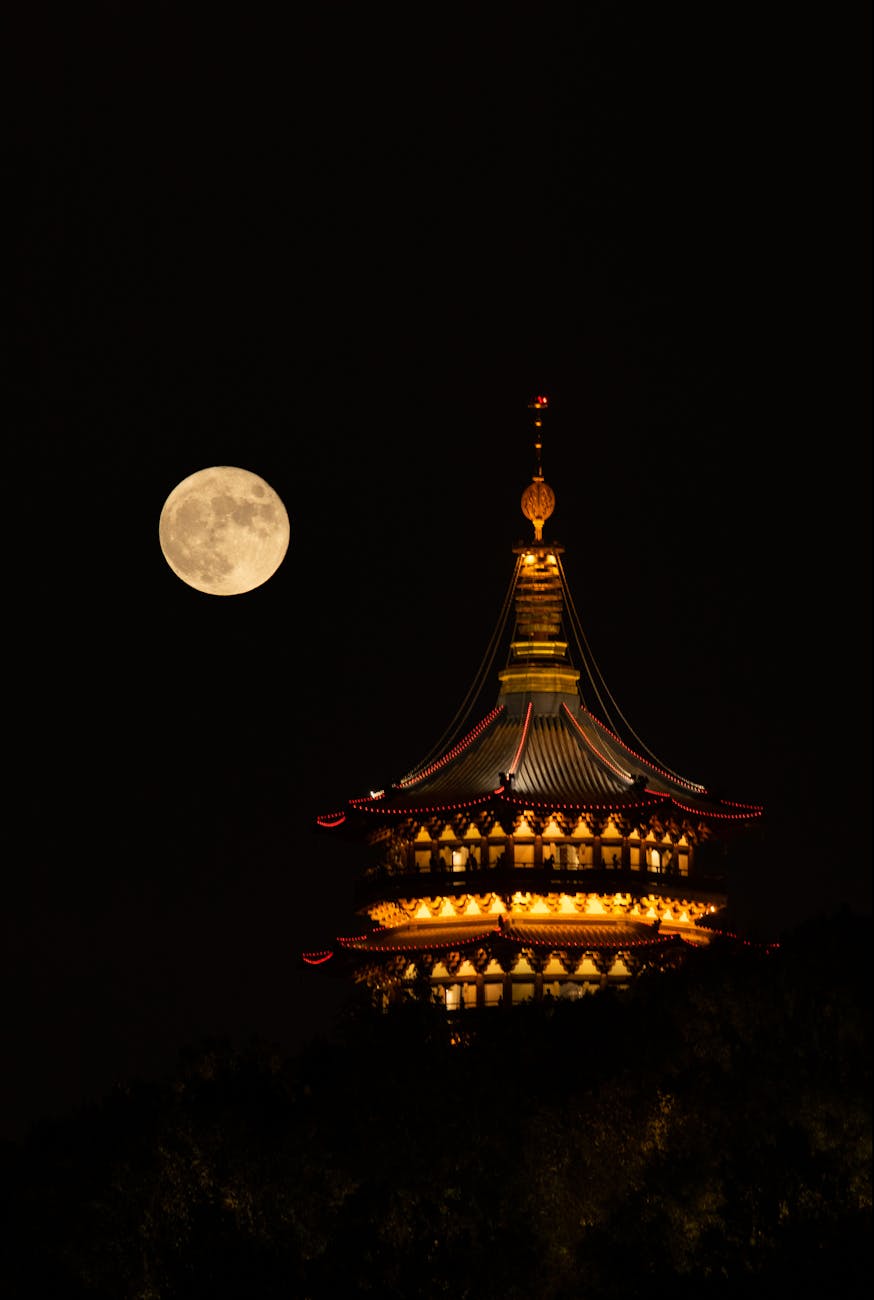
The Lesson of Impermanence

The Lesson of Impermanence

At the edge of a quiet forest monastery, where the earth still held the warmth of the day and the wind moved through bamboo like a whispered teaching, a young monk named Sāra approached his teacher at dusk.

The evening bell had just faded into silence, its last vibration dissolving into the wide sky. Sāra bowed low, his forehead touching the wooden floor.

“Master,” he said, his voice carrying both urgency and weariness, “my mind is unsettled. At times, joy rises in me so vividly that I wish it would never end. Then, without warning, sorrow follows, heavy and suffocating. And between these two, there are long stretches where I feel nothing at all—only a dull, drifting emptiness. I do not understand what is happening within me. I cannot find peace.”

The elder monk, Venerable Tissa, did not answer immediately. He sat quietly, as if listening not to Sāra’s words, but to the space between them.

At last, he gestured gently. “Come. Sit with me.”

They walked together to a small wooden platform overlooking a pond. The water was still, holding the last light of the sky like a fragile mirror. Crickets had begun their evening chant, and somewhere in the distance, a night bird called.

“Tell me, Sāra,” the elder began softly, “what do you see in the water?”

“I see the sky, Master—the clouds, the fading light.”

“And is it truly the sky?”

Sāra hesitated. “No… it only appears so.”

At that moment, a breeze passed over the pond. The reflected sky shattered into ripples, the clouds breaking into fragments.

“Look closely,” Tissa said. “When the wind comes, the sky seems to break. When the water is still, the sky appears whole again. Yet the real sky above has not been broken, nor restored. It has not suffered from the movement of the water.”

Sāra watched in silence, his brow slightly furrowed.

“In the same way,” Tissa continued, “what you call your feelings—pleasant, painful, and neutral—are like these reflections. They arise dependent on conditions: contact with sights, sounds, memories, the body, and the habits of the mind. They are compounded, woven together from countless causes. Because they are built, they must also fall apart.”

The elder reached down and picked up a small pebble. He dropped it into the pond.

Ripples spread outward, distorting everything.

“Did you command the ripples to appear?” he asked.

“No, Master.”

“Can you command them to stop immediately?”

Sāra shook his head.

“Feelings are the same. When a pleasant feeling arises, you say, ‘This is good. Let it stay.’ You grasp at it, like trying to hold the reflection of the moon in your hands. But the tighter you grasp, the more it slips away.”

Sāra lowered his gaze.

“And when pain arises,” Tissa went on, “you resist it. You say, ‘This should not be here.’ You push against it, struggle with it, and in doing so, you deepen its roots.”

The elder’s voice softened further.

“And when neither pleasure nor pain is strong, you fall into forgetfulness. You drift, unaware, as though nothing is happening. Yet even that quiet dullness is a feeling—subtle, conditioned, and impermanent.”

The sky above them darkened, deepening into shades of indigo. One by one, the first stars appeared.

“Master,” Sāra said slowly, “are all these feelings truly so unstable?”

Tissa nodded. “They are impermanent, dependently arisen, liable to fading away, to cessation. Pleasant feeling changes. Painful feeling changes. Even neutral feeling, so easily overlooked, is quietly shifting moment by moment.”

He paused, then added, “Consider the morning dew. At dawn, it glistens like jewels on the grass. By midday, it is gone. Or think of a bell—when struck, it sings clearly, but the sound does not remain. It fades into silence. Feelings are like this.”

Sāra closed his eyes, letting the words settle.

“Then how should I meet them?” he asked. “If I cannot hold on to the pleasant, and cannot escape the painful, what is the way?”

The elder turned toward him, his gaze steady and kind.

“You must learn to know them as they are,” he said. “Not as ‘mine,’ not as ‘self,’ but simply as experiences arising and passing.”

He continued:

“When pleasure arises, know it clearly: ‘This is pleasant feeling.’ Do not cling. See its arising, its changing, its fading.”

“When pain arises, know it clearly: ‘This is painful feeling.’ Do not resist. Observe its movement, its texture, its eventual dissolution.”

“And when neither stands out—when there is a quiet, neutral tone—know that too: ‘This is neutral feeling.’ Do not drift into ignorance. Stay present.”

Sāra listened deeply, as though hearing something both new and strangely familiar.

“Master,” he said, “it sounds simple… but in the moment, it feels difficult.”

Tissa smiled gently. “It is simple, but not easy. The mind has long been trained to grasp and reject. To see clearly requires patience, like watching a seed grow into a tree.”

The night deepened. The moon rose, casting a pale silver path across the pond. The air cooled, and the scent of earth and leaves became more vivid.

“Stay here tonight,” Tissa said. “Watch the mind as you would watch this water. Do not interfere. Do not chase. Do not turn away.”

Sāra bowed.

Left alone, he sat by the pond. At first, his thoughts came quickly—a memory of laughter with fellow monks earlier that day. A warmth spread through his chest.

“Pleasant feeling,” he whispered inwardly.

He noticed how the warmth lingered, then subtly shifted, then faded, like a flame losing fuel.

Soon after, a worry arose—an image of failure, of not progressing in his practice. His chest tightened.

“Painful feeling,” he noted.

Instead of pushing it away, he stayed with it. He felt its edges, its heaviness, its pulsing nature. To his surprise, it did not remain solid. It changed, softened, and eventually dissolved into something quieter.

Then came a long stretch where nothing seemed particularly strong. The night sounds blended together. His body felt neither comfortable nor uncomfortable.

“Neutral feeling,” he observed.

At first, his mind wanted to wander, to seek something more stimulating. But he gently returned, again and again, to simple knowing.

Hours passed.

The moon climbed higher. The pond shimmered.

Again and again, feelings arose—subtle pleasures, faint discomforts, quiet neutrality. Each one appeared, lingered briefly, and passed.

For the first time, Sāra began to see not just the content of his experience, but its nature.

Everything was moving.

Everything was changing.

Nothing stayed.

And yet, something within him was beginning to feel unmoved—not as a fixed thing, but as a clear, open knowing that did not grasp at what appeared within it.

Just before dawn, as the first light touched the horizon, a deep stillness settled over him. Not the dull stillness of before, but a vivid, wakeful calm.

In that moment, a gentle understanding arose:

Feelings were like waves.

But he did not have to be the wave.

He could know the wave.

When the elder returned in the early morning, he found Sāra still seated, eyes open, quietly present.

“Well, Sāra,” Tissa asked, “what have you seen?”

Sāra bowed, his voice steady.

“Master, I have seen that what I once chased and feared are only passing reflections. Pleasant feeling does not stay. Painful feeling does not stay. Even neutrality does not stay. They arise and vanish like ripples on water.”

He paused, then added softly,

“And I have begun to see that peace is not found by controlling them… but by understanding them.”

The elder nodded.

“Good,” he said. “This is the beginning of wisdom—not the end of feeling, but freedom within it.”

The wind moved once more through the bamboo, but now Sāra heard it differently—not as something to hold or escape, but as a fleeting song, complete in its arising and its passing.

And above it all, vast and untouched, the sky remained.

Link: https://wisdomtea.org/2026/04/23/the-lesson-of-impermanence/

The Light That Never Sets

The Light That Never Sets

The Buddha was staying at the Jetavana Monastery when a group of monks began to debate which of the world’s lights was the most powerful. One monk argued for the sun, which awakens the earth. Another insisted on the moon, which guides the traveler through the forest. A third spoke of the fire, which offers warmth and protection from the wild.

The Buddha stepped toward them and said, “There are these four types of brightness, monks. The brightness of the sun, the brightness of the moon, the brightness of fire, and the brightness of discernment. Of these four, the foremost is the brightness of discernment.”

To help them understand, he told of a group of merchants lost in a dense, sunless jungle during a heavy monsoon. The merchant leader, a man named Ananda, relied on the sun to find the east, but the clouds remained thick for days. His second-in-command waited for the moon to show the mountain peaks, but the sky stayed black. The third merchant tried to keep a great fire lit to ward off the shadows, but the torrential rain extinguished every flame.

As panic grew, a quiet traveler named Sobhita stood up. He did not look at the sky or struggle with wet wood. Instead, he sat in silence, calming his mind. Using the brightness of discernment, he realized that the water from the rain always flowed toward a specific river, and that the birds, though silent, always nested on the side of the trees protected from the northern wind.

“The sun is hidden, the moon is obscured, and the fire is dead,” Sobhita told the merchants. “But the truth of the forest is still visible to the mind that is still.”

By observing the subtle patterns of the earth that required no external light, Sobhita led the caravan safely to the edge of the jungle.

The Buddha concluded, “The sun sets, the moon wanes, and the fire goes out. But the light of a wise mind, seeing things as they truly are, can never be extinguished by any storm. It is the only light that can lead one out of the darkness of suffering.”

He then looked at the monks, his presence as steady as a mountain. “Just as a small lamp is useless in a great gale, the lights of the world—the sun, the moon, and the fire—eventually fail when the storms of life arrive. They can illuminate the road, but they cannot illuminate the heart.”

He raised his hand, pointing toward the flickering oil lamps of the monastery. “Do not be like the man who waits for the morning to find his way, or the one who fears the clouds that cover the moon. Instead, cultivate the light that is internal. When you see greed as greed, when you see hatred as hatred, and when you see the true nature of change, you are using the brightness of discernment.”

“This light,” the Buddha concluded, “does not depend on fuel, nor does it set behind the horizon. It is the only radiance that pierces the thick darkness of ignorance. Therefore, monks, be islands unto yourselves. Be your own lamps. Hold fast to the truth as a lamp, and you shall never truly be in the dark.”

The monks bowed in silence, the weight of the teaching settling into their hearts like a flame that would never flicker out.

Link: https://wisdomtea.org/2026/04/16/the-light-that-never-sets/

Healing Through the Four Noble Truths

Healing Through the Four Noble Truths

These two verses can be understood as pointing to the healing power at the heart of the Buddha’s teaching. In many traditional images, the Buddha is portrayed as a great physician—one who looks out upon the world and sees clearly the widespread condition of suffering that touches all beings. Rather than turning away, he responds with care and precision, offering a method as practical as it is profound. This method is expressed through the framework of the Four Noble Truths: first, to honestly recognize and describe the symptoms of suffering; second, to investigate and understand its underlying causes; third, to realize that these causes can be reversed, making healing possible; and finally, to lay out a path of practice—a flexible and compassionate treatment plan—that leads a person out of distress and toward a lasting well-being of both body and mind.

Yet even the most skillful medicine has no effect if it is never taken. This is a central and often overlooked point. The Buddha’s teaching is not meant to remain at the level of philosophy or intellectual admiration. While its analysis of the human condition is subtle, elegant, and deeply compelling, its true purpose is practical transformation. Just as a doctor can diagnose and prescribe but cannot swallow the medicine for the patient, the Buddha can only point the way. Each of us must take the step ourselves. We must “drink the medicine,” so to speak, by engaging in the practice. This is why meditation and the steady, moment-to-moment cultivation of wholesome states of mind are so essential. They are not optional additions—they are the means by which the teaching becomes alive within us.

When we look more closely, we begin to see that our suffering does not arise randomly. It grows from patterns of attachment (upādāna)—the ways we grasp, hold on, and build a sense of identity around our experiences. From these attachments, we construct layers of mental and emotional formations (upadhi), shaping how we perceive ourselves and the world. These constructions may feel solid and real, but they are in fact conditioned and ever-changing. The path to freedom, sometimes described as nibbuta—the cooling or extinguishing of suffering—unfolds as we gradually learn to loosen our grip on these constructions. As we stop feeding them, they begin to weaken and fade (khaya), like a fire that dies down when no more fuel is added.

The key to this process is wisdom. This is not merely intellectual knowledge, but a direct and experiential understanding that arises through practice. As we meditate (bhāvayitvā), we begin to observe more carefully and steadily the nature of our thoughts, feelings, and perceptions. Over time, we see more clearly (passitvā) how our experience is constructed—how it arises, changes, and passes away. This clarity brings a quiet but powerful shift. Instead of being entangled in our experiences, we learn to relate to them with openness and balance.

It is important to understand that “being cured” does not mean that life’s natural processes suddenly stop. Aging, illness, and death are still part of the human condition, because anything that is formed must eventually change and dissolve. The teaching does not promise escape from these realities. Rather, it offers a way to meet them without being inwardly shaken. Through wisdom, it becomes possible to remain, in a deep sense, untouched by aging and death—not because they do not occur, but because we no longer cling to what is passing.

True health, in this context, is not merely physical well-being or even emotional calm. It is a profound understanding of the nature of things—a clarity so deep that the impulse to grasp and cling falls away on its own. When there is no clinging, there is no struggle. When there is no struggle, there is peace. In this way, non-attachment is not a cold withdrawal from life, but the very essence of healing. It is the freedom to experience the world fully, without being bound by it.

Link: https://wisdomtea.org/2026/04/10/healing-through-the-four-noble-truths/

The Two Listeners and the Moonlit Teaching

The Two Listeners and the Moonlit Teaching

In a quiet valley embraced by soft green hills, there lay a small village where life moved gently and without hurry. Each full moon, when the sky glowed like a polished pearl, the villagers gathered beneath an ancient banyan tree to hear the teachings of Venerable Samita. His voice was calm and steady, like water flowing over smooth stones, and his presence alone seemed to settle the hearts of those who came to listen.

Among the villagers were two young men: Sura, whose mind was naturally reflective and open, and Venu, whose thoughts often tangled into knots of restlessness and doubt. Though they had grown up side by side, their inner worlds could not have been more different.

On one particularly luminous night, the villagers sat in a wide circle as Venerable Samita began to speak. “Children of the valley,” he said, “the Dharma is like the moon above us. It shines with the same brightness for all. Yet not all who look upon it see its light clearly. Some minds are ready to receive the truth. Others are veiled by their own conditions.”

Sura listened with quiet attention, his breath steady, his heart open. Venu shifted where he sat, already feeling impatience rise within him.

The elder continued, explaining that some people carry obstructions born of their present actions, stains of defilement that cloud the heart, and the lingering weight of past unskillful deeds. Without trust, without the wish to listen, and without clarity of mind, even the purest teaching cannot take root. It is like trying to plant a seed in soil hardened by drought.

Venu felt a flicker of discomfort. The elder’s words seemed to brush against the very places he avoided within himself — the grudges he clung to, the mistakes he refused to acknowledge, the stubborn certainty that he already understood enough. Sura, meanwhile, felt the teaching settle into him like gentle rain falling on fertile ground.

Then Venerable Samita spoke of the opposite state — a mind unburdened by present obstruction, unclouded by defilement, and no longer weighed down by the echoes of past deeds. A mind supported by trust, by the sincere wish to listen, and by the clarity that comes from honest reflection. In such a mind, even a single phrase of Dharma can blossom into understanding. When these six qualities are present, the heart becomes like fertile soil, ready to receive the seed of truth.

As these words drifted through the night air, Sura felt a quiet joy. He knew he was far from perfect, but he also knew he genuinely wished to understand. That wish alone made his heart spacious. Venu, however, felt resistance tightening within him. His thoughts wandered. He judged the teaching as too idealistic, too demanding. He blamed the heat, the insects, the length of the talk — anything but the state of his own mind.

When the teaching ended, the villagers bowed and slowly dispersed into the moonlit paths leading home.

Venu let out a frustrated sigh. “Sura, I don’t know how you sit through these talks. I hear the same words you do, but they don’t do anything for me.”

Sura turned to him with a gentle smile. “Maybe it isn’t the words,” he said softly. “Maybe it’s the mind that receives them.”

Venu frowned. “So you’re saying my mind is flawed?”

“Not flawed,” Sura replied. “Just unsettled. Like a pond after a storm. When the mud settles, the water becomes clear again.”

Venu looked down, embarrassed. Yet Sura’s voice held no judgment — only kindness and understanding.

“How do I let it settle?” Venu asked quietly.

Sura placed a hand on his friend’s shoulder. “Begin with one simple thing. Tonight, choose to listen. Not perfectly. Just sincerely.”

For the first time that evening, Venu felt something soften inside him — a small opening, like a door left slightly ajar.

When the next full moon rose, Venu arrived early. He sat closer to the front, not beside Sura but on his own, as if stepping into new territory. This time, when Venerable Samita spoke, the words did not bounce off him. They entered slowly, gently, like morning light filtering through mist. He did not understand everything, but he wanted to. And that simple wanting began to loosen the knots within him.

Sura watched from a distance, smiling quietly. He knew that the Dharma was never forced upon the mind — it was welcomed when the mind was ready.

In the months that followed, Venu changed in small but steady ways. He listened more. He reacted less. He apologized when he was wrong. He asked questions. He reflected. The villagers noticed. Even Venerable Samita noticed.

One evening, after a teaching, the elder approached him. “Your mind is clearing, Venu,” he said. “Not because the Dharma has changed, but because you have.”

Venu bowed deeply. “Teacher, I think I finally understand. The six qualities that open the path — freedom from present obstruction, freedom from defilement, freedom from the weight of past deeds, trust in the teaching, the sincere wish to listen, and the clarity to discern — they were all within me. I only needed to uncover them.”

The elder smiled. “Exactly. The Dharma is like the moon. It always shines. Whether we see it or not depends on the clouds in our own sky.”

And under that same moon, Venu felt a quiet gratitude — for the teaching, for his friend, and for the simple truth that the path begins the moment one chooses, even imperfectly, to listen.

Link: https://wisdomtea.org/2026/04/02/the-two-listeners-and-the-moonlit-teaching/