The Six Animals and the Unshakable Mind

The Six Animals and the Unshakable Mind

One morning, the Buddha sat quietly with his monks and looked upon them with great compassion.

He knew that the greatest battles people fought were often invisible.

They were not battles with armies or enemies.

They were battles within the heart.

A beautiful sight could pull the mind toward desire.

A painful sight could push it toward anger.

A pleasant sound could make the heart cling.

A harsh word could make it restless.

A memory could bring joy.

Another memory could bring sorrow.

And sometimes, without even realizing it, a person could spend an entire day being pulled in six different directions.

The Buddha began to speak.

“Monks, imagine a man who catches six animals.”

The monks listened.

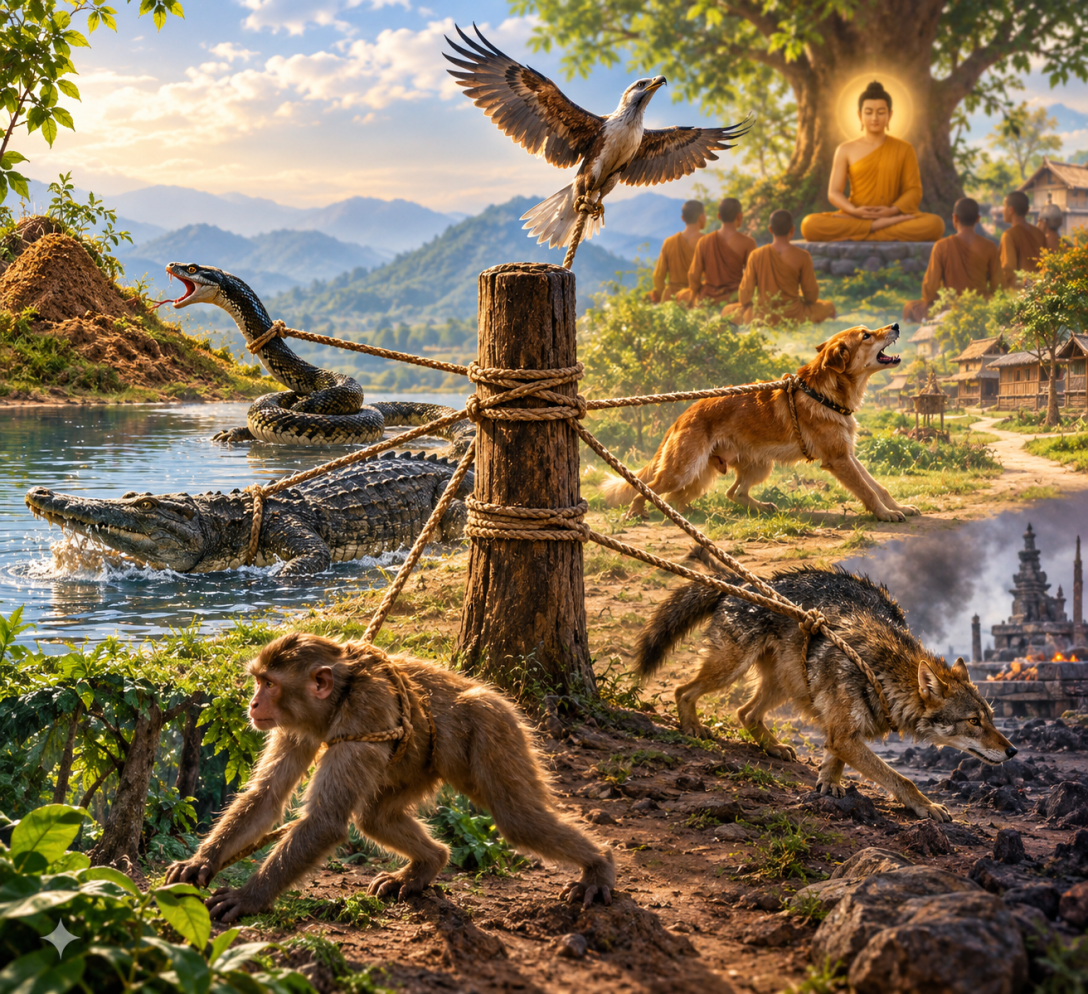
“The first is a snake.

The second is a crocodile.

The third is a bird.

The fourth is a dog.

The fifth is a jackal.

And the sixth is a monkey.”

The Buddha continued:

“Each animal belongs to a different place and seeks a different kind of life.

The snake longs for the earth and the safety of an anthill.

The crocodile longs for the water.

The bird longs for the open sky.

The dog longs for the village.

The jackal longs for the charnel ground.

And the monkey longs for the forest.”

The monks could imagine the scene.

The man took a strong rope and tied one end to each animal.

Then he tied the six ropes together in the middle.

And he let them go.

Immediately, the animals struggled.

The snake pulled toward the anthill.

The crocodile dragged toward the water.

The bird fought to rise into the sky.

The dog pulled toward the village.

The jackal strained toward the charnel ground.

The monkey pulled desperately toward the forest.

Six animals.

Six directions.

Six desires.

Each wanted only one thing:

“To go where I want to go.”

But none of them could go very far.

The ropes held them together.

So they pulled harder.

They struggled.

They fought.

They became exhausted.

Then something happened.

The strongest animal began to pull the others along.

The weaker animals could no longer resist.

They followed wherever the strongest one went.

The Buddha paused.

Then he said:

“So it is with the mind.”

The monks became still.

“When mindfulness of the body is not practiced and developed, the senses pull the mind in many directions.

The eye is drawn toward what is beautiful and attractive.

It recoils from what is unpleasant.

The ear reaches toward pleasing sounds and resists harsh ones.

The mind reaches toward pleasant thoughts and tries to escape unpleasant ones.

And just like the six animals, we are pulled wherever the strongest desire happens to lead us.”

The Buddha looked gently at the monks.

“How many people live this way without knowing it?”

A person sees something beautiful and wants it.

Someone speaks harshly, and anger rises.

Someone offers praise, and pride appears.

Someone gives criticism, and resentment follows.

A pleasant memory appears, and the mind clings to it.

A painful memory appears, and the mind tries desperately to escape.

The body is sitting in one place.

But the mind is everywhere.

It runs toward the past.

It rushes toward the future.

It chases pleasure.

It avoids pain.

It follows one thought after another.

And before we know it, we have spent the entire day being pulled by invisible ropes.

The Buddha then offered another image.

“Now imagine the same six animals,” he said.

“But instead of tying their ropes together and letting them pull against one another, the man fastens all six ropes to a strong post.”

The animals struggled.

The snake pulled toward the anthill.

The crocodile pulled toward the water.

The bird tried to fly.

The dog tried to run toward the village.

The jackal tried to reach the charnel ground.

The monkey tried to escape toward the forest.

But the post did not move.

The animals pulled.

The post remained firm.

They pulled again.

Still, the post did not move.

Eventually, one by one, the animals became tired.

They stopped struggling.

They rested near the post.

The Buddha said:

“Monks, the strong post is mindfulness of the body.”

This was the heart of the teaching.

Mindfulness does not mean that the world suddenly becomes quiet.

It does not mean that beautiful things stop being beautiful.

It does not mean unpleasant things stop being unpleasant.

It means that we no longer have to be dragged around by everything we see, hear, feel, or think.

We can see beauty without immediately needing to possess it.

We can experience pain without immediately becoming consumed by it.

We can hear criticism without allowing anger to take control.

We can receive praise without becoming intoxicated by it.

We can notice a thought without believing that we must follow it.

The world may continue pulling.

But we do not have to go with it.

The Buddha’s teaching was not asking his disciples to become cold or indifferent.

He was teaching them how to become free.

Mindfulness of the body becomes a place of return.

When the mind wanders, we return to the breath.

When anger arises, we notice the body.

When desire appears, we recognize it.

When fear comes, we feel it without becoming lost inside it.

When the mind races into tomorrow, we return to this moment.

When it becomes trapped in yesterday, we return to this moment.

Again and again.

Patiently.

Gently.

Without judgment.

This is why the Buddha told his monks:

“Practice mindfulness of the body.

Develop it.

Make it your vehicle.

Make it your dwelling place.

Make it your refuge.

Make it your resort.

Build it up and undertake it thoroughly.”

The six animals are still within us.

The snake still wants its anthill.

The crocodile still wants its water.

The bird still wants the open sky.

The dog still wants the village.

The jackal still wants the charnel ground.

The monkey still wants the forest.

And our senses and thoughts still pull us toward the things they find attractive.

But we do not have to fight them.

We do not have to hate them.

We simply need a place that does not move.

A place where we can return.

A place where the mind can rest.

That place is mindfulness.

And perhaps this is one of the most beautiful lessons the Buddha left us:

Peace does not come because the world stops pulling at us.

Peace comes when we stop allowing every pull to carry us away.

When mindfulness becomes strong, the heart becomes like the great post.

The sights may come.

The sounds may come.

Pleasure may come.

Pain may come.

Praise may come.

Blame may come.

Thoughts may come and go like birds across the sky.

But the heart does not have to chase them.

It can remain.

It can breathe.

It can see clearly.

And eventually, the things that once controlled us begin to lose their power.

The ropes loosen.

The struggle becomes quiet.

And the mind discovers something it had been searching for all along:

freedom.

Link: https://wisdombread.wordpress.com/2026/09/24/the-six-animals-and-the-unshakable-mind/
The Protection No One Can See

The Protection No One Can See

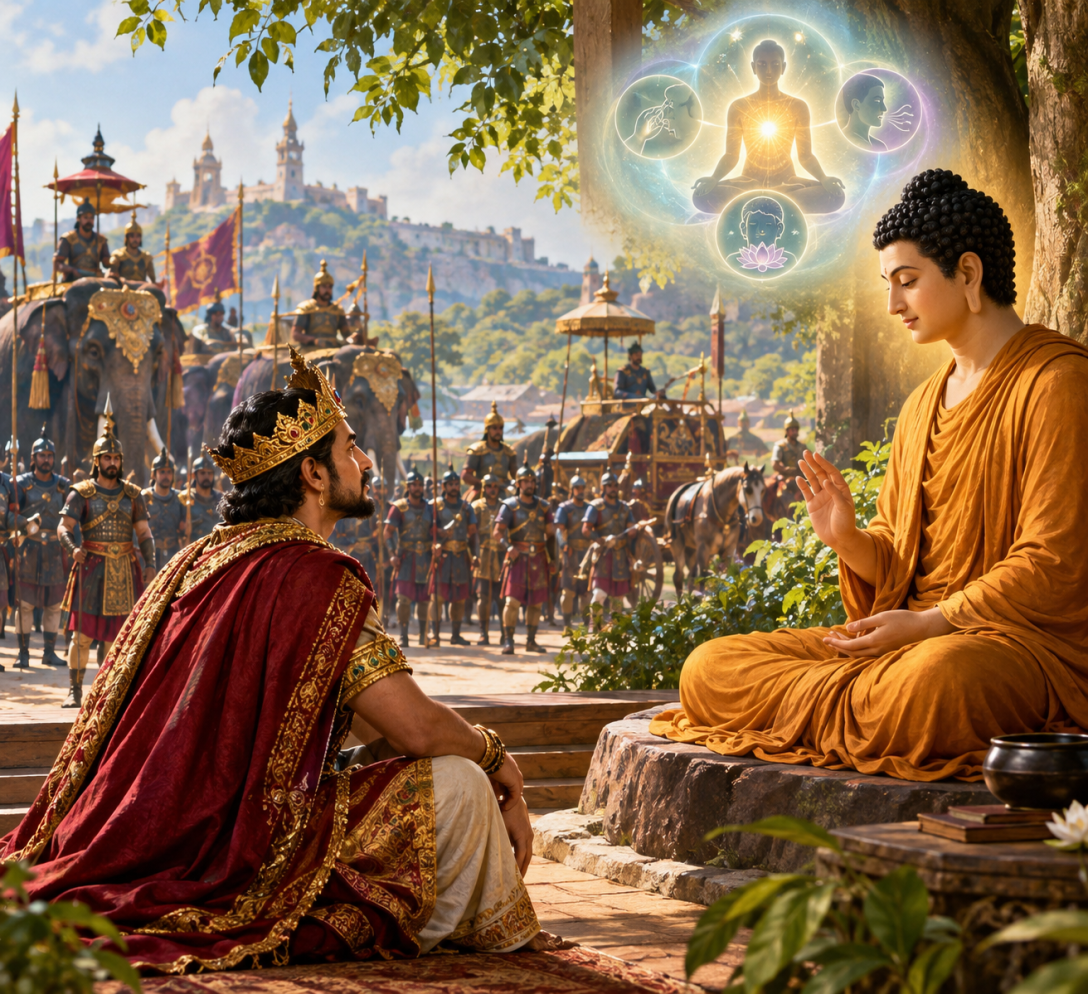
In the ancient city of Sāvatthī, there lived a king who was surrounded by protection.

King Pasenadi Kosala had armies at his command.

If he traveled beyond the palace walls, soldiers marched beside him. Elephants stood ready for battle. Horsemen waited with their weapons. Chariots could be summoned at a moment’s notice, and infantry soldiers guarded the gates and roads.

No ordinary person in the kingdom could easily approach him.

From the outside, the king seemed almost impossible to harm.

Yet one day, while sitting quietly with the Buddha, the king began to think about a different kind of protection.

He bowed respectfully and sat to one side.

“Lord,” he said, “while I was alone in seclusion, a thought arose in my mind.

‘Who truly protects themselves, and who leaves themselves unprotected?’”

The Buddha listened.

The king continued.

“I thought about those who behave badly through their bodies, through their speech, and through their minds.

Suppose such a person were surrounded by soldiers.

Suppose a whole squadron of elephants stood around them.

Suppose cavalry guarded every road, chariots protected every gate, and infantry stood watch day and night.

Would that person truly be protected?”

The king paused.

“No, lord,” he said. “They would still be unprotected.

Because all of that is only external protection.

It cannot protect the mind from the consequences of harmful actions.”

The Buddha remained silent, listening carefully.

King Pasenadi continued.

“But a person who acts well with the body, speaks well, and keeps the mind wholesome may have no army around them at all.

No elephants may guard them.

No cavalry may surround them.

No chariots may stand at their gates.

No soldiers may watch over them.

And yet that person is protected.

Why?

Because their protection is within.”

The king looked toward the Buddha.

“That was the thought that arose in me, lord.”

The Buddha smiled gently.

“That is exactly so, great king. That is exactly so.”

Then the Buddha explained that a person can build walls around a house, place guards at every entrance, and surround themselves with power and wealth—and still carry danger within their own heart.

A person may lock every door but leave anger unlocked.

They may protect their possessions but fail to protect their speech.

They may hire guards to watch the outside world while allowing greed, hatred, jealousy, and dishonesty to enter freely into their own mind.

And no army can stand guard over a person’s thoughts every moment.

No soldier can prevent a cruel word from leaving the mouth.

No fortress can stop a harmful action once the heart has decided to do it.

The Buddha then spoke of another kind of protection.

A person who restrains the body from harming others builds a kind of shelter within.

A person who restrains their speech from lying, cruelty, and needless harm builds another.

And a person who watches over the mind—guarding it from greed, hatred, and delusion—builds the deepest protection of all.

This protection cannot be seen.

It cannot be purchased.

It cannot be carried like a weapon.

It cannot be taken away by an enemy.

It travels with us wherever we go.

Then the Buddha offered these words:

“Restraint with the body is good.
Good is restraint with speech.
Restraint with the heart is good.
Good is restraint everywhere.
Restrained everywhere, conscientious,
one is said to be protected.”

The king listened quietly.

Perhaps, for the first time, he saw the walls of his palace differently.

He had spent his life thinking about protecting a kingdom.

The Buddha had shown him how to protect something even more important:

the person who lived inside the kingdom.

A person can have guards at every door and still be a prisoner of anger.

A person can possess great wealth and still be poor in peace.

A person can have powerful friends and still be alone with a troubled heart.

A person can live behind high walls and still be unable to escape their own actions.

But someone who learns to guard their body, their speech, and their mind carries a protection that no enemy can easily destroy.

The story of King Pasenadi leaves us with a question that is just as meaningful today as it was in the Buddha’s time:

What are you doing to protect yourself?

We often think protection means having enough money, a secure home, insurance, technology, locks, cameras, or people we can depend on.

These things have their place.

But the Buddha points to a protection that begins somewhere else.

It begins with the next action we take.

The next word we speak.

The next thought we allow to grow.

Every time we choose kindness instead of cruelty, we strengthen our protection.

Every time we choose truth instead of deception, we strengthen it again.

Every time we stop anger before it becomes an action, we build another wall.

And every time we choose compassion over hatred, we create a refuge within ourselves.

The strongest protection may be the one no one else can see.

Because when we guard our body, our speech, and our heart, we are not merely protecting ourselves from the world.

We are protecting ourselves from the suffering our own actions can create.

And that kind of protection can follow us anywhere.

Even when there are no walls.

Even when there are no guards.

Even when we are completely alone.

Link: https://wisdombread.wordpress.com/2026/09/18/the-protection-no-one-can-see/

The Stone in Her Heart

The Stone in Her Heart

There was once an old woman named Suda who lived in a small village near Sāvatthī.

She was known as a gentle woman.

She fed stray animals.

She gave rice to hungry children.

She helped her neighbors when they were sick.

And whenever someone came to her door asking for help, she rarely turned them away.

But there was one thing Suda could not give.

Forgiveness.

Many years earlier, when she was still a young woman, her only son had left the village after a terrible argument.

He had spoken harsh words to her.

She had answered with harsher ones.

Before he left, he turned toward her and said,

“Perhaps I would be better off without you.”

Suda never forgot those words.

Her son never returned.

At first, she waited.

Then she became angry.

Then she became bitter.

Eventually, she told herself that she no longer cared.

But every year, on the day he had left, she would sit alone outside her house and remember.

She remembered his voice.

She remembered his face.

She remembered the last words they had spoken.

And beneath all the anger was something she did not want to admit.

She missed him.

Years passed.

Suda grew old.

Her hair became white, and her hands became thin and trembling.

One afternoon, she heard that the Buddha was staying near Sāvatthī.

She decided to go and listen to him.

Perhaps, she thought, there was something he could teach her about the heaviness in her heart.

When she arrived, the Buddha was sitting beneath a tree surrounded by monks and laypeople.

Suda bowed and sat quietly.

The Buddha looked at her for a moment.

“You have come carrying something heavy,” he said.

Suda was startled.

She looked down at her empty hands.

“I carry nothing, Venerable Sir.”

The Buddha smiled gently.

“Not in your hands.”

Suda lowered her eyes.

For a long time, she said nothing.

Then the tears came.

She told the Buddha about her son.

She told him about the argument.

She told him about the words they had spoken.

And finally she said,

“I have tried to forgive him, but I cannot.”

The Buddha listened.

Then he asked,

“Where is your son now?”

“I don’t know.”

“Do you know whether he is alive?”

“No.”

“Do you know whether he remembers those words?”

Suda shook her head.

“No.”

The Buddha was silent.

Then he asked,

“And how many years have you carried his words in your heart?”

Suda thought for a moment.

“Almost forty.”

The Buddha looked at her with compassion.

“Then tell me, Suda. Who has suffered from those words for forty years?”

She opened her mouth, but no answer came.

The Buddha continued softly.

“Your son spoke those words once.”

Suda’s eyes filled with tears.

“But you have spoken them to yourself every day.”

The words struck her deeply.

She had never thought of it that way.

She had believed that she was keeping the memory because she could not forgive her son.

But perhaps she had been keeping the wound alive herself.

The Buddha picked up a small stone from the ground.

“Suda, imagine that you have been holding this stone in your hand for forty years.”

He placed the stone in her palm.

“At first, it may seem small.”

He closed her fingers around it.

“But after one year, your hand would ache.”

Suda nodded.

“After ten years, your arm would become tired.”

She nodded again.

“And after forty years?”

Suda looked at the stone.

“My hand would be exhausted.”

The Buddha gently opened her fingers.

“Would the stone have become heavier?”

“No.”

“Then why would you be suffering more?”

Suda stared at him.

“Because I never put it down.”

The Buddha nodded.

“Exactly.”

A long silence followed.

The leaves above them moved softly in the afternoon breeze.

Suda began to cry.

“But if I forgive him,” she said, “does that mean what he did was acceptable?”

“No.”

“Does it mean I was not hurt?”

“No.”

“Does it mean I must forget?”

“No.”

Suda looked at him.

“Then what does forgiveness mean?”

The Buddha’s voice was quiet.

“It means you no longer choose to carry the suffering.”

Suda closed her eyes.

For forty years, she had believed that holding onto her anger kept her connected to her son.

But perhaps it had only kept her connected to the moment when they had both been wounded.

The Buddha continued:

“Forgiveness does not change the past.

It does not erase the words that were spoken.

It does not make wrong into right.

It simply means that the past no longer has permission to destroy your present.”

Suda wept openly now.

“I wanted him to know how much he hurt me.”

“I understand.”

“I wanted him to come back and apologize.”

“I understand.”

“But what if he never does?”

The Buddha looked at her kindly.

“Then you must decide whether your peace will depend upon an apology that may never come.”

Suda became very still.

The question entered her heart like a bell.

She suddenly realized that she had been waiting forty years for someone who might never return to give her permission to be at peace.

She had placed the key to her happiness in another person’s hands.

The Buddha placed the stone back into her palm.

“Now,” he said, “you may choose.”

Suda looked at the stone.

For a moment, she remembered her son’s face as a young man.

Not the angry face from their final argument.

The face from years before.

The little boy who had once fallen asleep against her shoulder.

The child who had held her hand while crossing the river.

The young man who had once brought her flowers because he thought she looked sad.

She remembered that he had not always been the person who hurt her.

He had also been the person she loved.

And perhaps both things could be true.

He had hurt her.

And she had loved him.

She did not have to erase one truth to accept the other.

Slowly, Suda opened her hand.

She placed the stone on the earth.

For a moment, nothing happened.

The sky did not change.

The trees did not move.

There was no great miracle.

But something inside her became lighter.

She took a long breath.

Then another.

And for the first time in forty years, she whispered:

“My son, wherever you are, I hope you are safe.”

The Buddha said nothing.

He did not need to.

Suda remained beneath the tree until sunset.

When she finally stood to leave, she felt different.

Her son had not returned.

Her past had not changed.

The words had not been erased.

But the stone was no longer in her hand.

Years later, people in the village would remember Suda as a remarkably peaceful old woman.

Whenever someone came to her carrying anger toward another person, she would tell them:

“I once carried a stone for forty years because I believed putting it down meant I had forgiven someone who had hurt me.”

Then she would smile.

“But I eventually learned that forgiveness was not a gift I gave to him.”

“It was a gift I gave to myself.”

And whenever someone asked whether she ever stopped missing her son, she would shake her head.

“No.”

Then she would look toward the evening sky.

“I still miss him.”

A tear would sometimes appear in her eye.

“But now I can miss him without being angry.”

She would pause.

“And that is the difference.”

The Buddha teaches us that everything we cling to can become a source of suffering.

Sometimes we cling to possessions.

Sometimes to memories.

Sometimes to anger.

Sometimes to the words someone said to us years ago.

And sometimes we cling to a wound because we believe that letting go means saying that the wound did not matter.

But letting go does not mean that it did not matter.

It means that you matter, too.

You deserve to live beyond the moment that hurt you.

You deserve to laugh again.

You deserve to love again.

You deserve to sleep peacefully.

You deserve to wake up without carrying yesterday into today.

And sometimes the person who hurt you may never apologize.

They may never understand what they did.

They may never come back.

But your healing does not have to wait for them.

The past cannot be changed.

But the heart can change its relationship with the past.

So if there is someone whose name still makes your heart heavy, remember Suda.

You do not have to forget.

You do not have to pretend it did not hurt.

You do not even have to invite that person back into your life.

But perhaps, when you are ready, you can place the stone down.

Not for them.

For you.

Because sometimes forgiveness is not about saying,

“What you did was okay.”

Sometimes forgiveness is simply saying,

“What you did hurt me, but I will not let that pain decide the rest of my life.”

And then, with tears in your eyes and compassion in your heart,

you finally let the stone fall.

Link: https://wisdomtea.org/2026/09/10/the-stone-in-her-heart/

The Lantern Beneath the Earth

The Lantern Beneath the Earth

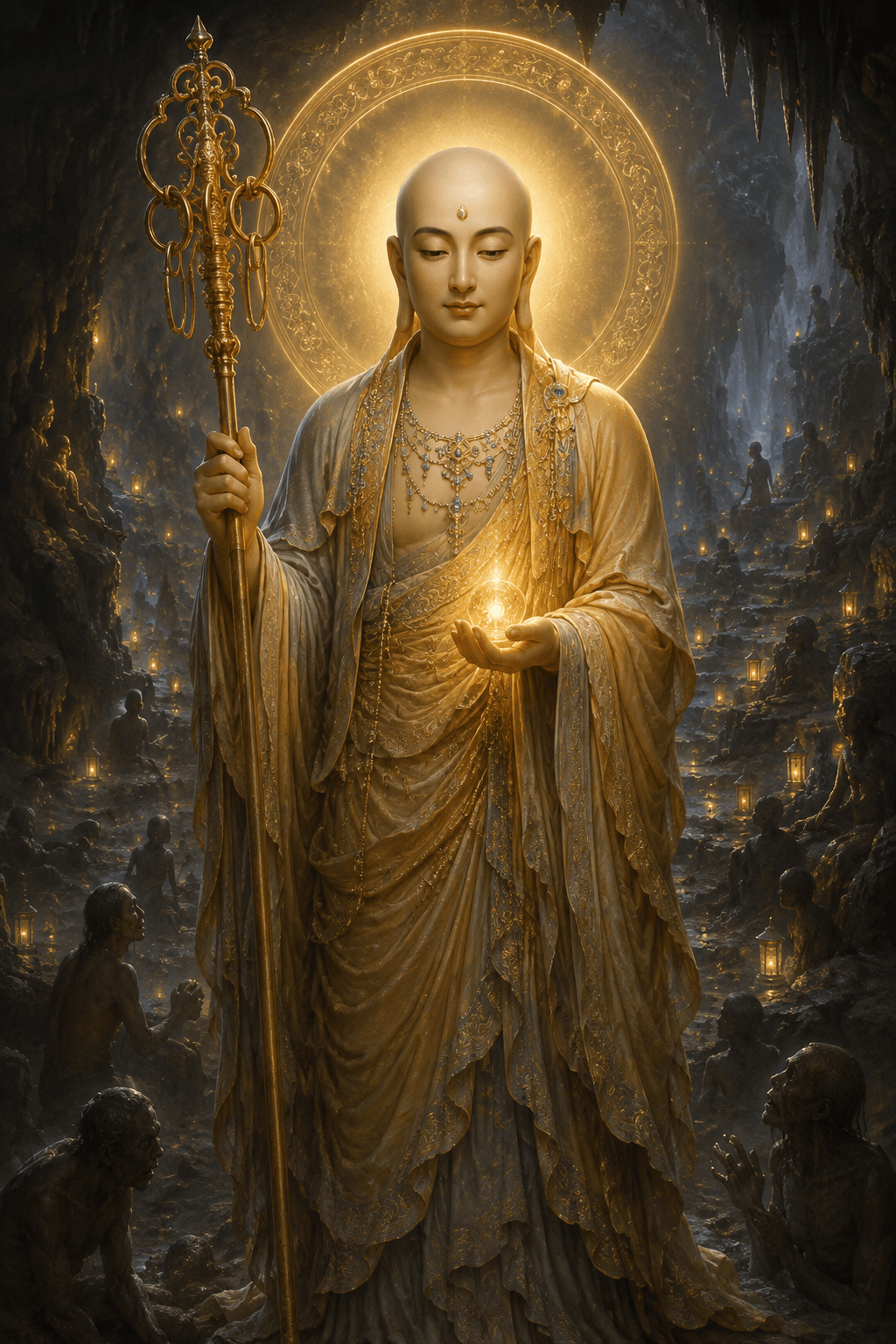
Deep beneath the surface of the world, where sunlight never reaches and echoes carry the weight of forgotten sorrows, there is a realm known as the Chamber of Shadows.

It is a place where beings wander lost, burdened by grief, regret, and karmic confusion. No ordinary light can penetrate its darkness.

Yet one lantern burns there.

Its flame is gentle, golden, and unwavering—a single point of warmth in an ocean of darkness. The lantern belongs to Kṣitigarbha Bodhisattva, the guardian of beings in the hell realms, the Bodhisattva who made the great vow:

“Until the hells are empty, I will not become a Buddha.”

One evening, a young spirit named Lian stumbled into the Chamber of Shadows.

She had carried fear for so long that she believed it had become part of her body. Her steps were heavy, her breath was thin, and her heart felt like a locked door.

She wandered through the darkness until she saw the lantern.

Kṣitigarbha Bodhisattva sat beside it, calm as a mountain and warm as spring soil. His robe shimmered like moonlight upon still water. When he looked at Lian, she felt seen—not judged, not measured, but simply seen.

“Why is it so dark here?” Lian asked.

“Because beings forget their own light,” Kṣitigarbha replied. “But darkness is never a punishment. It is simply a place waiting to be illuminated.”

Lian sank to her knees.

“I don’t know how to find my light.”

Kṣitigarbha gently placed the lantern between them.

“Then let us find it together.”

The flame flickered, and the chamber began to change.

The shadows peeled away like mist, revealing memories Lian had buried deep within herself—moments of kindness she had offered, forgiveness she had given, and courage she had shown when she thought she had none.

She saw herself as a child, offering her last steamed bun to a stray dog shivering in the rain.

She saw herself comforting a friend who had lost a parent.

She saw herself forgiving someone who had hurt her deeply, even though her own heart was still aching.

Each memory glowed faintly, like stars emerging at dusk.

“These are yours,” Kṣitigarbha said.

Lian stared at the memories in wonder.

“Your light was never gone,” he continued. “It was only hidden.”

Lian lowered her head.

“But I’m afraid,” she whispered.

“Fear is a visitor,” Kṣitigarbha said. “It knocks, but it does not own the house.”

For a long moment, Lian remained still.

Then, slowly, she reached toward the lantern.

The flame stretched gently toward her hand. It was warm, but it did not burn.

As her fingers touched the light, something extraordinary happened.

The flame flowed into her like warm water, filling her chest, her throat, and her eyes.

A soft radiance began to shine from within her.

The chamber brightened.

The shadows retreated.

Other wandering beings paused in the darkness. One by one, they turned toward Lian, drawn not only to Kṣitigarbha’s lantern but also to the new light shining from within her.

Some approached cautiously.

Others simply stood and watched.

For the first time in countless years, their faces became visible.

Kṣitigarbha smiled.

“Now you understand.”

Lian looked at him.

“When one being finds their light,” he said, “the whole realm becomes brighter.”

Lian looked around the chamber. The darkness was still there, but it no longer seemed endless.

She turned toward Kṣitigarbha.

“Will you stay here forever?”

The Bodhisattva looked upon the countless beings wandering beyond the lantern’s glow.

“As long as there is even one being who feels lost,” he said, “I will remain.”

Lian was silent for a moment.

Then she bowed deeply.

“Namo Kṣitigarbha Bodhisattva.”

The Bodhisattva returned her bow.

“And may your light guide others,” he said, “just as mine guided you.”

The lantern flame rose higher.

Its golden light spread through the chamber, touching walls that had known only darkness. One by one, the wandering spirits began to discover small sparks within themselves.

A forgotten kindness.

A moment of courage.

A sincere apology.

An act of forgiveness.

A memory of love.

Each spark became a flame.

And each flame became another lantern.

Soon, the Chamber of Shadows was no longer completely dark.

It had become a place where lost lights were rediscovered.

Lian looked upon the growing radiance and finally understood the Bodhisattva’s teaching.

Light does not become smaller when it is shared.

It becomes greater.

And somewhere deep beneath the world, Kṣitigarbha Bodhisattva continued to sit beside his lantern, watching over those who had lost their way.

He did not ask who deserved the light.

He did not ask who had wandered the farthest into darkness.

He simply kept the lantern burning.

For as long as even one being remained lost, compassion would remain.

And as long as compassion remained, there would always be a light waiting in the darkness.

Link: https://wisdomtea.org/2026/09/03/the-lantern-beneath-the-earth/