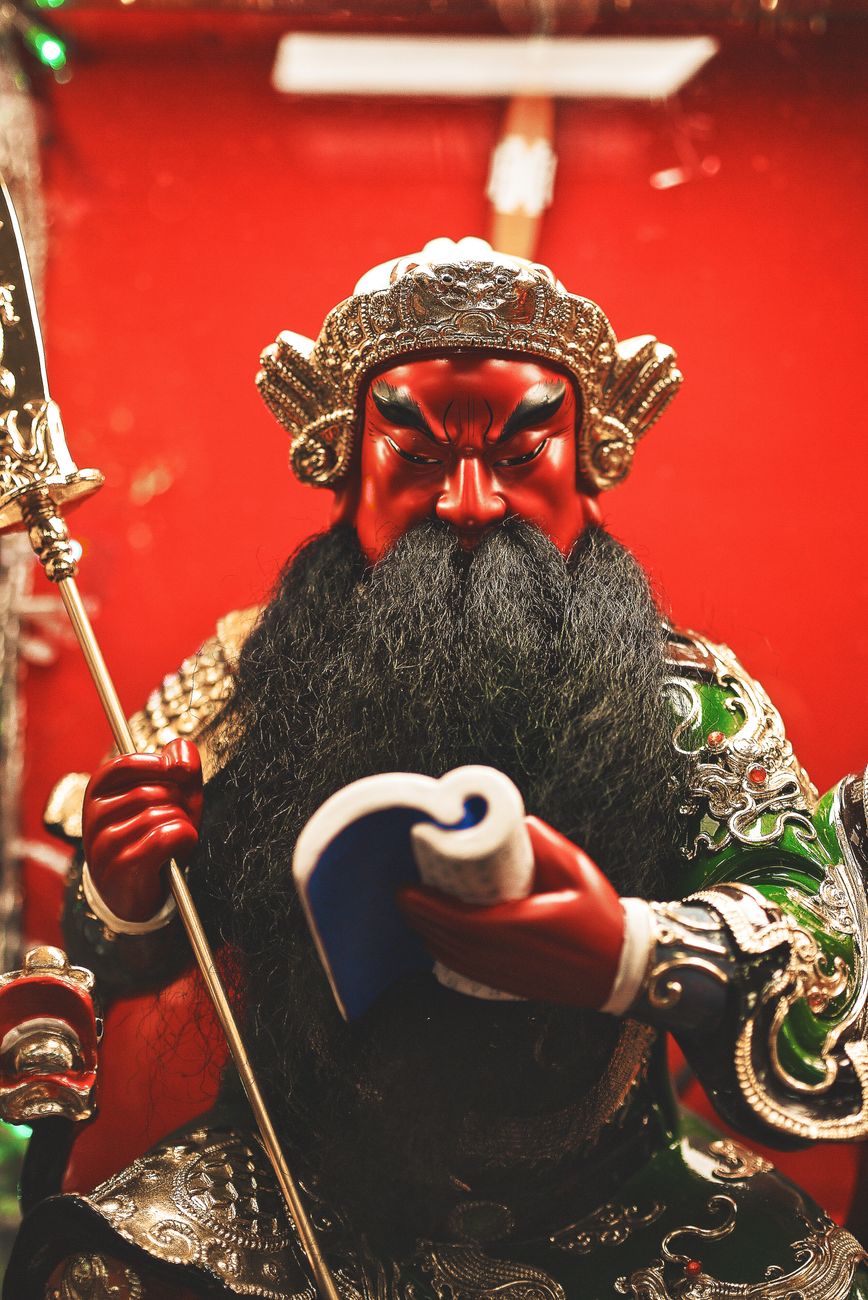
The Awakening of Guan Yu, Dharma Protector of the Three Realms

The Awakening of Guan Yu, Dharma Protector of the Three Realms

In an age when the world was troubled by war and suffering, when kingdoms rose and fell like waves upon the ocean, there lived a warrior named Guan Yu.

He was a man of great strength, with a face as red as the morning sun and a heart as steady as a mountain. He carried the Green Dragon Crescent Blade, a weapon feared by armies, yet his greatest power was not his blade—it was his unwavering devotion to righteousness.

Guan Yu made a sacred vow with his sworn brothers:

“Though the heavens change and the earth tremble, I shall never abandon those who walk the path of honor.”

Many warriors could conquer cities, but few could conquer their own desires. Guan Yu rejected greed, pride, and betrayal. Even when enemies offered him riches and glory, he chose loyalty over comfort and truth over survival.

Years passed, and Guan Yu’s deeds spread across the land. People whispered:

“Perhaps this warrior is protected by the heavens.”

But Guan Yu knew that all things are impermanent. The body is like a passing cloud, and even the mightiest warrior must one day return to dust.

When his earthly life ended, his spirit traveled beyond the gates of the mortal realm. He arrived before the celestial court, where spirits and enlightened beings observed the hearts of all who had lived.

There, the guardians of the Dharma saw something extraordinary.

Guan Yu’s spirit carried no hatred.
His heart held no desire for revenge.
His courage had been born not from anger, but from compassion.

The heavenly beings said:

“This is the strength of a true protector. He did not fight for power. He fought to defend what was right.”

A great Buddhist teacher then approached Guan Yu and said:

“Your blade has protected people from enemies of the world. But the greater battle is against the enemies within—the greed, anger, and ignorance that bring suffering to all beings.”

Guan Yu bowed and accepted the teaching.

From that moment, the warrior transformed into a guardian of the Dharma.

His Green Dragon Blade became a symbol of wisdom, cutting through delusion.
His fearless heart became a shield protecting those who sought the path of awakening.
His loyalty became a light guiding people through times of darkness.

The Buddha’s teachings were said to have found a powerful protector in Guan Yu, and temples began honoring him as a Dharma Guardian.

When evil spirits approached sacred places, Guan Yu’s presence was said to appear like thunder beneath the heavens. His armor shone like golden fire, and his voice echoed like a mountain bell:

“Those who follow the path of compassion shall not walk alone.”

From then on, Guan Yu watched over temples, monks, and all beings who practiced righteousness.

Yet he did not guard the Dharma with anger.

He guarded it with wisdom.

For the greatest warrior is not the one who defeats the most enemies—

but the one who conquers hatred within the heart.

And so Guan Yu became known throughout the realms as the Dharma Protector, the Guardian of Loyalty, Courage, and Righteousness.

Link: https://wisdomtea.org/2026/06/25/the-awakening-of-guan-yu-dharma-protector-of-the-three-realms/


The Quiet Path of My Father

The Quiet Path of My Father

The children always remembered the way their father moved through the house in the early morning — not rushing, not dragging, but walking with a quiet steadiness, as if each step were placed with intention. The soft shuffle of his feet, the gentle clearing of his throat, the way he paused at the doorway to look at the sky before beginning the day — all of it felt like a small ceremony, a reminder that life was something to be met with presence.

He never taught them compassion through words. He taught it through the way he lived.

When a neighbor’s roof began to leak during the winter rains, he didn’t sigh or complain about the inconvenience. He simply gathered his tools, wiped the mist from his glasses, and said, “Come with me. Let’s see how we can help.” The children watched him climb the ladder slowly, carefully, as if he were ascending a sacred path. The cold wind tugged at his jacket, the shingles were slick beneath his hands, but he worked with a calm focus that made the moment feel almost holy. When he patched the leak and the dripping finally stopped, he smiled — not because he wanted praise, but because someone’s burden had become lighter.

Another time, when an elderly man’s car refused to start in the heat of summer, their father knelt beside the engine with the same tenderness he used when holding a newborn. The children stood nearby, watching the sweat bead on his forehead as he listened to the engine’s uneven breaths. “Machines speak too,” he told them softly. “You just have to listen with patience.” When the engine finally roared back to life, the old man’s eyes filled with relief. Their father simply nodded, wiped his hands on a rag, and whispered, “May your road be smooth.”

The children didn’t understand it then, but he was teaching them the Dharma in the language of everyday life. He was showing them how to see suffering without turning away, how to offer help without expecting anything in return, how to move through the world with a heart that stayed open even when life was heavy.

As they grew older, they began to feel the weight of those lessons in their own bones.

One became a teacher who stayed after school to help students who felt invisible. She remembered the way her father listened — fully, without judgment — and she tried to offer her students that same refuge. Another became a nurse who held trembling hands in the quiet hours of the night. He remembered how his father breathed slowly, steadily, even when the work was hard, and he learned to be a calm presence for others. The youngest created a community program that helped families rebuild their lives. She remembered the way her father patched roofs and revived engines, and she understood that healing often begins with the smallest acts of care.

They didn’t choose these paths because their father told them to. They chose them because they had lived their whole lives watching him turn compassion into action, moment by moment, breath by breath.

Years passed. The children grew into adults who carried their father’s teachings in the way they spoke, the way they listened, the way they offered themselves to the world. And their father, now older, watched them with a quiet pride that softened his eyes.

On Father’s Day, they gathered around him. His hair had turned silver, his hands were rough from decades of work, but his presence was still steady — like a lantern that had guided them through every dark season.

“Dad,” the eldest said, her voice trembling, “everything we do… everything we’ve become… it’s because of you.”

He shook his head gently, the way he always did when he felt gratitude but didn’t want praise.

“I only showed you the path,” he whispered. “You walked it yourselves.”

But the children knew the truth.

He had given them more than shelter. More than guidance. More than love.

He had given them a way of seeing the world — a way rooted in compassion, patience, and the belief that every act of kindness sends ripples far beyond what the eye can see.

And as they sat with him that Father’s Day, surrounded by the warmth of everything he had nurtured, they realized something too:

The seeds he planted had grown into a forest — a living testament to the quiet, powerful love of a father who taught not through words, but through the gentle, unwavering example of a life lived with an open heart.

Link: https://wisdomtea.org/2026/06/18/the-quiet-path-of-my-father/

The Bridge My Father Built

The Bridge My Father Built

Every Father’s Day, before the sun fully rises, I sit quietly with a cup of coffee and think about my father.

I lost him when I was sixteen years old.

At that age, I believed fathers were supposed to stay forever. I thought there would still be many years ahead — years for conversations, advice, laughter, arguments, and reunions. I thought there would be time for him to grow old while I slowly became a man.

But life does not always move according to our wishes.

One day he was there, and then suddenly he was gone, leaving behind a silence so large that even now, after many years, I can still hear it.

When I was young, my father was a simple man. His hands were rough from work, and his face was darkened by years beneath the hot sun. He did not speak in grand speeches. He rarely talked about dreams or success. Yet every morning before dawn, he rose from bed without complaint and carried the weight of the family on his shoulders.

At sixteen, I did not fully understand sacrifice.

I only understood absence.

I saw empty chairs.

Unfinished sentences.

A family trying to smile while quietly learning how to live with grief.

For many years after his passing, I wished for impossible things.

I wished he could return for just one evening.

Just one meal.

Just one conversation.

I wanted to tell him how difficult life became after he left. I wanted to tell him how much I missed hearing his footsteps at home. I wanted to say the words sons often wait too long to say:

“Thank you.”

Years passed like seasons crossing a field.

Slowly, our family continued forward.

My brothers studied hard. My sister studied hard. We carried our father’s teachings even when we did not realize it. We learned perseverance from watching him endure hardship. We learned responsibility from watching him put family before himself. We learned dignity from the quiet way he faced life.

Today, two sons and a daughter have become civil engineers.

And the blessings of his sacrifice did not stop there.

His grandchildren continued building upon the foundation he laid long ago.

Some became doctors, healing the sick with compassion and knowledge.

Some became pharmacists, helping people through medicine and care.

Some followed the path of engineering, continuing the work of building and creating.

Some became businessmen and businesswomen, supporting families and communities through hard work and determination.

And some are still in college, carrying dreams in their hearts while preparing for the future.

Whenever I see them gathered together during family celebrations, I often become silent for a moment.

I imagine my father standing among them.

I imagine his tired hands folded behind his back, his humble smile slowly appearing as he listens to their conversations and watches their lives unfold.

Perhaps he would not say very much.

Perhaps he would simply look at them quietly with grateful eyes.

Because fathers often love this way — silently, deeply, without asking for recognition.

Sometimes I close my eyes and imagine introducing him to the family that grew from the seeds he planted long ago.

“Father, this is your family now.”

“These are your grandchildren.”

“These are the dreams you watered with your sacrifice.”

But the deepest ache is this: he never had the chance to see it with his own eyes.

On Father’s Day, many people celebrate with gifts, photographs, and dinners. I do not envy them. Instead, I quietly bow in gratitude for the years I was given, even though they were too few.

The Buddha taught that all conditioned things are impermanent. Whatever is born must change. Whatever is gathered must one day separate. No love in this world escapes the law of parting.

When I was younger, this truth felt cruel to me.

Now, as I grow older, I understand it differently.

Impermanence is the reason love matters so deeply.

If our parents lived forever, perhaps we would never learn gratitude. We would postpone kindness. We would assume there would always be another tomorrow.

But life moves like mist across morning fields — beautiful precisely because it does not remain.

And so every Father’s Day, I no longer ask only why my father had to leave so early.

Instead, I reflect on the bridge he built with his life.

A bridge made from hard work, sacrifice, patience, and love.

Though he is gone, we continue walking across that bridge even now.

His kindness still feeds the family.

His labor still shelters us.

His teachings still guide us.

His love still echoes through generations he never lived to see.

Sometimes I imagine speaking to him one last time.

I would say:

“Father, you left too soon, and I still miss you.”

“But your family survived.”

“We carried your strength forward.”

“Your children grew.”

“Your grandchildren flourished.”

“And everything good we became was built upon the foundation you gave us.”

Then perhaps I would finally understand something that grief slowly teaches over a lifetime:

A father does not disappear completely when he dies.

Part of him continues living quietly in the character of his children, in the compassion they offer others, in the sacrifices they make for their own families, and in the goodness they pass forward into the world.

Like a bridge that remains long after the builder is gone.

And every Father’s Day, when memory returns like soft rain upon the heart, I stand upon that bridge with gratitude, love, and longing — still missing my father, still wishing he were here, and still thanking him for everything.

Link: https://wisdomtea.org/2026/06/11/the-bridge-my-father-built/

The Flicker of Screens

The Flicker of Screens

In a quiet neighborhood on the edge of a busy city, there lived a young man named Daniel. Every morning before the sun rose, the glow of his phone lit his face before daylight ever touched his room. Before his feet touched the floor, his eyes had already wandered through headlines, messages, advertisements, photographs, arguments, and endless streams of other people’s lives.

His mind was never still.

At work, he listened to music through one earbud while answering emails. During lunch, he watched short videos while half-hearing his coworkers speak. At night, he lay in bed scrolling through images until sleep overcame him like a thief. Even dreams felt crowded.

One evening, after a long and exhausting day, Daniel visited his grandfather at a small retirement home outside the city. His grandfather had once been a schoolteacher, but age had bent his back and slowed his steps. Yet his eyes remained calm and bright.

When Daniel arrived, he apologized immediately.

“Sorry I’m late. Traffic was terrible. My phone kept buzzing. Work has been stressful.”

His grandfather smiled gently.

“Sit down first,” he said. “The tea is getting cold.”

Daniel sat across from him near a window overlooking a small garden. The old man poured tea slowly, as if there were nowhere else in the world to be.

For a few moments, neither spoke.

Then the grandfather asked, “Daniel, when you look at your phone, do the images stay?”

“What do you mean?”

“The pictures, the news, the messages. Do they remain?”

Daniel laughed softly. “Of course not. Everything changes every minute.”

“And the sounds you hear? The praise from your boss? The criticism from strangers online? The songs you listen to?”

“They disappear too.”

The old man nodded.

“And your thoughts? The worries that keep you awake at night? The excitement you feel when someone admires you? The anger when someone insults you?”

Daniel looked down at his tea.

“They change too,” he admitted.

His grandfather leaned back gently.

“When I was young,” he said, “people believed stability could be found in possessions. Today people believe it can be found in attention. But both vanish just the same.”

Outside the window, wind stirred the leaves.

“The eye changes,” the old man continued. “What it sees changes. The ear changes, and so do sounds. Smells fade. Tastes disappear. The body grows older. Thoughts rise and fall like birds crossing the sky. Yet people cling to these changing things and cry when they cannot hold them still.”

Daniel listened quietly.

For the first time in many months, he noticed the sound of the teacup touching the saucer. He noticed the fading sunlight on the garden stones. He noticed how quickly each moment vanished.

The old man spoke again.

“There are some who hear this truth and simply trust it. They do not fully understand yet, but something inside them bows toward wisdom. They begin walking carefully. Their hearts soften. They avoid harmful deeds because they sense there is a deeper path beyond endless craving.”

Daniel remembered a coworker named Maria who had quietly changed her life after attending meditation classes. She was calmer now, kinder, less eager to compete. Others mocked her simplicity, but she seemed lighter than everyone else.

His grandfather continued:

“There are others who investigate further. They reflect carefully. They observe their own minds. They begin to see how suffering arises from clinging to what cannot remain. Their understanding grows little by little, like dawn slowly brightening the horizon.”

Daniel thought about himself. Lately he had begun questioning why every achievement lost its satisfaction so quickly. Every new purchase excited him briefly before becoming ordinary. Every praise faded. Every entertainment required another after it. His pleasures felt like drinking salt water.

Then the old man became very still.

“And there are those,” he said softly, “who no longer merely believe or reason about impermanence. They see it directly. They see every sight flicker and disappear. Every sound vanish. Every feeling dissolve. They no longer build their identity upon shifting sands.”

The room fell silent.

In that silence, Daniel suddenly became aware of his own breathing. Inhale. Exhale. Appearing. Disappearing.

A notification buzzed loudly from his phone.

Without thinking, he reached for it.

But halfway there, he stopped.

For the first time, he noticed the movement of craving itself — sudden, automatic, restless. The urge rose in his chest like a fish lunging toward bait.

He slowly placed the phone face down on the table.

His grandfather smiled, though he said nothing.

Night settled over the garden. Crickets began their evening song. Somewhere in the distance, a siren wailed and faded away.

Daniel sat quietly beside the old man for a long time.

Nothing remained.

Not sounds.
Not feelings.
Not worries.
Not youth.
Not praise.
Not even the moments they were sharing together.

Yet strangely, instead of despair, Daniel felt relief.

If all things changed, then sorrow too could change.
If the mind was conditioned, it could also be trained.
If suffering arose, it could also cease.

The city outside still rushed endlessly, full of glowing screens and restless hearts chasing things already dissolving.

But that night, for the first time, Daniel did not feel entirely lost within it.

A small opening had appeared.

Like the first crack of dawn before sunrise.

Link: https://wisdomtea.org/2026/06/04/the-flicker-of-screens/