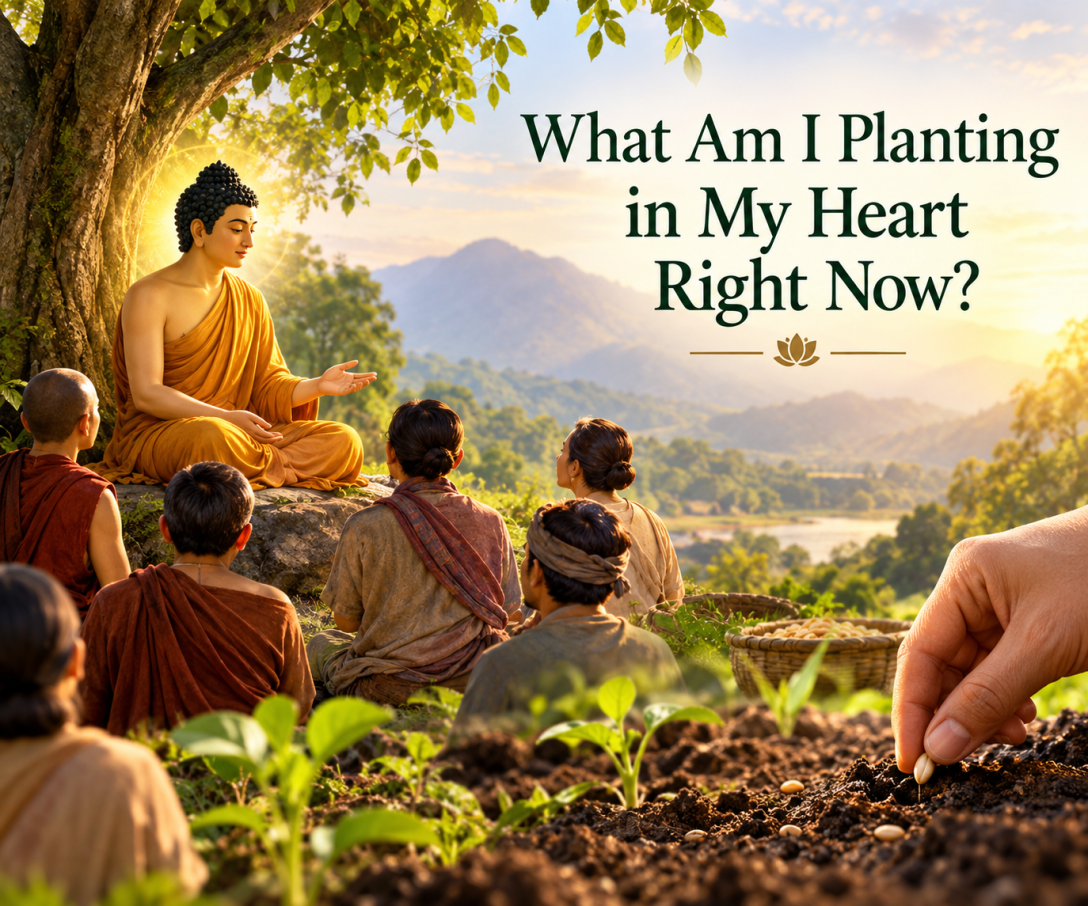
What am I planting in my heart right now?
There was once a man who wondered why his life seemed to grow more bitter with every passing year.
No matter how hard he worked, he found something to complain about. When others succeeded, he felt jealous. When someone criticized him, he became angry. When he made a mistake, he blamed someone else.
He believed the world was unfair, that people could not be trusted, and that kindness was a weakness that others would eventually exploit.
“If only people would change,” he often said, “my life would finally be peaceful.”
Yet the more he blamed the world, the more bitterness he carried inside his own heart.
One afternoon, while walking along a country road, he passed an old farmer kneeling beside a patch of moist earth. The farmer was carefully placing seeds into the soil.
The man stopped and watched him.
“What are you planting?” he asked.
“Some bitter melon seeds,” the farmer replied.
The man laughed. “Why would you plant something bitter? Surely you would rather grow something sweet.”
The old farmer smiled gently.
“Of course. But these are the seeds I have. And when they grow, they will give me bitter melons.”
The man shook his head. “Then you should not expect anything sweet from them.”
“Exactly,” said the farmer. “A seed cannot give what is not in its nature.”
The man continued down the road, giving little thought to the conversation. But those words would return to him in a way he never expected.
Several days later, he heard that the Buddha was teaching in a nearby grove. Curious, he went to listen.
He found the Buddha seated beneath the trees, surrounded by monks and villagers. The atmosphere was peaceful, and people listened with quiet attention.
After the teaching, the man approached the Buddha.
“Master,” he said, “I have tried to live a good life, yet I feel surrounded by suffering. People disappoint me. My efforts often fail. Even when I get what I want, I cannot enjoy it for long. Why does my life seem so bitter?”
The Buddha looked at him with compassion.
“Tell me,” the Buddha asked, “when you see someone succeed, what happens in your heart?”
“I feel jealous,” the man admitted.
“And when someone speaks harshly to you?”
“I become angry and want to hurt them with my words.”
“And when you make a mistake?”
“I try to hide it. Sometimes I blame others so that I will not be ashamed.”
The Buddha listened without judgment.
“Then tell me, my friend. If you plant bitter seeds in the earth, can you expect sweet fruit?”
“No,” the man replied. “That would be impossible.”
“And if you water those seeds every day, will they become sweet simply because you wish them to?”
“No, Master.”
The Buddha paused before speaking again.
“In the same way, the thoughts you nurture, the words you speak, and the actions you take are like seeds planted in the soil of your life. When you act from hatred, dishonesty, or harmful understanding, you encourage suffering to grow. When you act from wisdom, kindness, and truth, you cultivate the conditions for peace.”
The man lowered his eyes.
“But Master, I cannot control what other people do to me. How can I make my life better when the world itself is so difficult?”
The Buddha answered gently, “You may not be able to choose every circumstance that comes to you. But you can learn to choose how you understand it, how you respond, and what you cultivate in your heart.”
He continued, “A person who sees wrongly may believe that revenge will bring peace, that dishonesty will bring lasting happiness, or that harming another will make the heart stronger. But such choices carry their own bitterness. A person who sees rightly begins to understand the value of compassion, honesty, harmlessness, and wisdom. From that understanding, better intentions arise, better words are spoken, and better actions become possible.”
The Buddha then offered an example.
“Imagine two farmers. One plants bitter seeds, while the other plants rice, sugar cane, and grapes. Both farmers must work. Both must water their fields. Both must wait patiently for their crops to grow.
“But although they share the same earth and the same rain, their harvests will be different. The earth does not turn bitter seeds into sweet fruit, nor does it turn sweet seeds into bitterness. Each seed grows according to its nature.
“So it is with the path a person follows. Wrong understanding leads toward harmful choices and suffering. Right understanding supports wholesome intentions and actions that lead toward well-being. This is why the path of wisdom matters so deeply.”
The man sat quietly, allowing the words to settle into his heart.
For the first time, he began to wonder whether the bitterness he saw everywhere had also been growing inside himself.
He remembered his younger brother, whom he had not spoken to for years. They had quarreled over their father’s inheritance. The man had believed that winning the argument mattered more than preserving their relationship. He had spoken cruelly, refused to apologize, and spent years telling himself that his brother was entirely to blame.
Yet even after winning his share of the inheritance, he had never found the peace he expected.
He remembered the workers he had humiliated when they made mistakes, the lies he had told to protect his reputation, and the kindness he had refused because he feared being taken advantage of.
He had spent years trying to harvest happiness from seeds of resentment.
His eyes filled with tears.
“Master,” he whispered, “I have spent so much of my life blaming the world. I never thought to ask what I was planting within myself.”
The Buddha did not condemn him.
“To recognize an unwholesome seed is the beginning of wisdom,” he said. “You cannot change the seeds you planted yesterday, but you can begin to cultivate something different today.”
The man bowed deeply and returned home.
His life did not transform in a single afternoon. Old habits did not disappear simply because he had heard a beautiful teaching. Sometimes anger still rose in him. Sometimes pride persuaded him that he was right. Sometimes he caught himself preparing a sharp reply before remembering the Buddha’s words.
But now he had begun to notice the seeds before watering them.
When jealousy arose, he practiced wishing others well.
When anger appeared, he paused before speaking.
When he made a mistake, he tried to acknowledge it instead of hiding behind excuses.
And when he remembered his brother, he finally found the courage to send him a letter.
He did not write to prove that he had been right. He did not demand an apology. He simply admitted the hurtful things he had said and asked whether they might begin again.
For a long time, no reply came.
The man was disappointed, but he reminded himself that an apology was not a purchase with forgiveness as its reward. He had chosen to do what was right because it was right, not because he could control what happened next.
Several weeks later, a letter arrived.
His brother had accepted his apology. He, too, had carried years of sadness and regret. They agreed to meet.
When they finally stood face to face, neither knew what to say. Then the older brother reached out and embraced him.
Both men wept.
The past could not be erased, and the years they had lost could not be returned. But something new had begun to grow where bitterness had once taken root.
As the months passed, the man discovered that the world had not suddenly become fair. People still disappointed him. Difficulties still arose. He still experienced loss, criticism, and pain.
Yet something within him had changed.
He no longer believed that every insult required an answer, that every disagreement had to end in victory, or that another person’s happiness diminished his own.
He discovered that telling the truth brought a different kind of strength. That kindness did not require him to abandon wisdom or healthy boundaries. That admitting a mistake could restore a dignity that pride had never given him.
Most importantly, he learned that peace was not something he could demand from the world while continuing to feed the anger within his own heart.
Peace had to be cultivated.
One spring morning, the man returned to the old farmer’s field. The farmer was there again, placing seeds into the moist earth.
This time, the man carried a small bag of rice seeds.
“I would like to plant something wholesome,” he said. “Will you show me how?”
The farmer smiled and made room beside him.
Together, they knelt in the soil.
As the man pressed the tiny seeds into the earth, he thought of the Buddha’s teaching. He understood that a seed was small, but its future could be enormous. A single thought could become a word. A word could become an action. An action, repeated over time, could shape a character, a relationship, and even the course of a life.
He also understood that planting a wholesome seed did not mean he would never experience hardship. A farmer could care for a field and still face storms. But he could choose what to plant, tend the soil with care, and refuse to nourish what he knew would bring harm.
From that day forward, whenever anger or resentment threatened to take root, he remembered the field.
He would ask himself:
“What am I planting in my heart right now?”
And that simple question often changed what he did next.
The Buddha’s teaching had not promised him a life without pain. It had shown him a path toward living with greater wisdom, compassion, and freedom from the habits that deepened his suffering.
Years later, when people asked the man how he had become so peaceful, he would tell them about the farmer, the bitter seeds, and the Buddha who taught him to look within.
Then he would offer them the question that had changed his life:
“Every day, through our thoughts, words, intentions, and actions, we plant seeds. Some grow into bitterness, and some grow into kindness. We may not see their fruit today, but what we nurture matters.
“So before you speak in anger, before you act out of hatred, before you choose a lie because the truth feels difficult, pause for a moment.
“Ask yourself what kind of fruit you hope to harvest.
“And then plant accordingly.”
For in the end, the garden of the heart is cultivated one choice at a time.
The seeds we plant today become part of the world we live in tomorrow.
Link: https://wisdombread.wordpress.com/2026/10/09/what-am-i-planting-in-my-heart-right-now/

