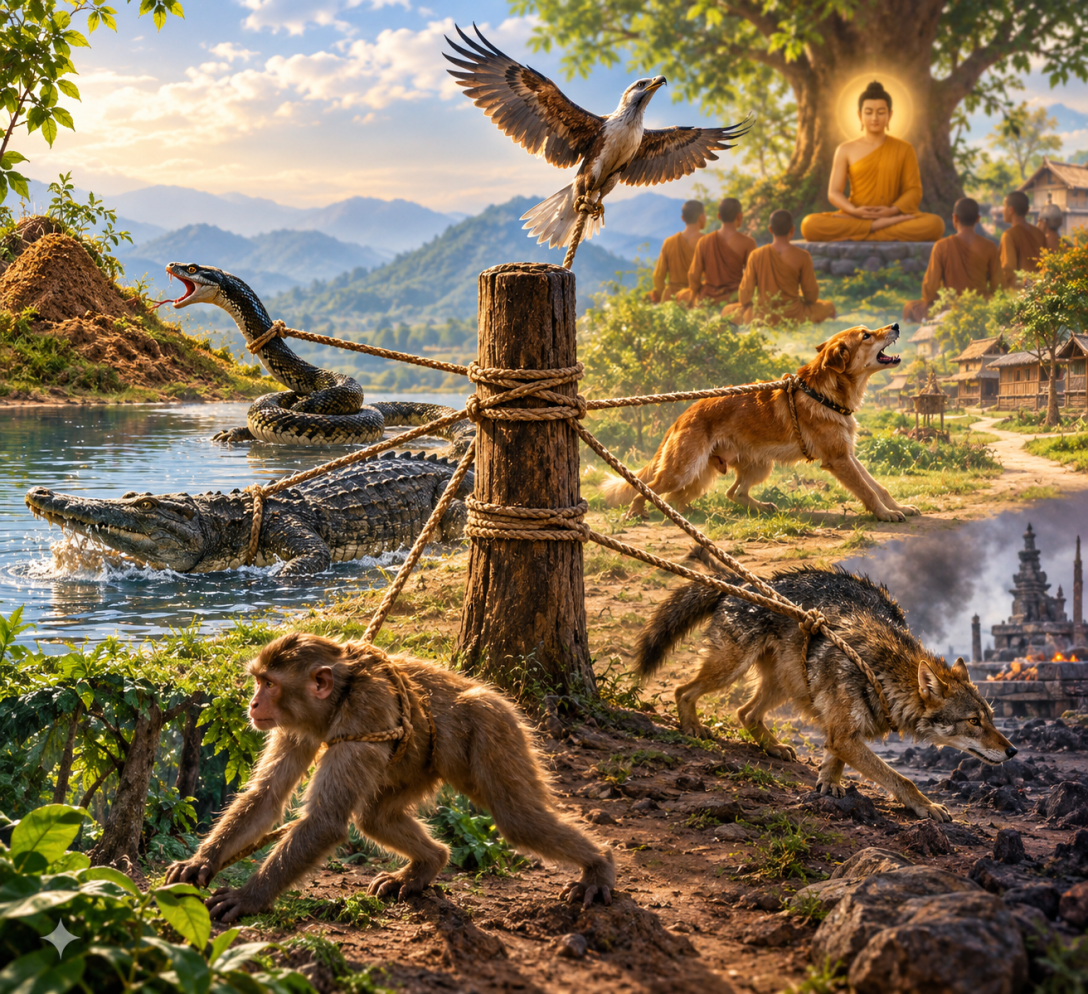
The Six Animals and the Unshakable Mind
One morning, the Buddha sat quietly with his monks and looked upon them with great compassion.
He knew that the greatest battles people fought were often invisible.
They were not battles with armies or enemies.
They were battles within the heart.
A beautiful sight could pull the mind toward desire.
A painful sight could push it toward anger.
A pleasant sound could make the heart cling.
A harsh word could make it restless.
A memory could bring joy.
Another memory could bring sorrow.
And sometimes, without even realizing it, a person could spend an entire day being pulled in six different directions.
The Buddha began to speak.
“Monks, imagine a man who catches six animals.”
The monks listened.
“The first is a snake.
The second is a crocodile.
The third is a bird.
The fourth is a dog.
The fifth is a jackal.
And the sixth is a monkey.”
The Buddha continued:
“Each animal belongs to a different place and seeks a different kind of life.
The snake longs for the earth and the safety of an anthill.
The crocodile longs for the water.
The bird longs for the open sky.
The dog longs for the village.
The jackal longs for the charnel ground.
And the monkey longs for the forest.”
The monks could imagine the scene.
The man took a strong rope and tied one end to each animal.
Then he tied the six ropes together in the middle.
And he let them go.
Immediately, the animals struggled.
The snake pulled toward the anthill.
The crocodile dragged toward the water.
The bird fought to rise into the sky.
The dog pulled toward the village.
The jackal strained toward the charnel ground.
The monkey pulled desperately toward the forest.
Six animals.
Six directions.
Six desires.
Each wanted only one thing:
“To go where I want to go.”
But none of them could go very far.
The ropes held them together.
So they pulled harder.
They struggled.
They fought.
They became exhausted.
Then something happened.
The strongest animal began to pull the others along.
The weaker animals could no longer resist.
They followed wherever the strongest one went.
The Buddha paused.
Then he said:
“So it is with the mind.”
The monks became still.
“When mindfulness of the body is not practiced and developed, the senses pull the mind in many directions.
The eye is drawn toward what is beautiful and attractive.
It recoils from what is unpleasant.
The ear reaches toward pleasing sounds and resists harsh ones.
The mind reaches toward pleasant thoughts and tries to escape unpleasant ones.
And just like the six animals, we are pulled wherever the strongest desire happens to lead us.”
The Buddha looked gently at the monks.
“How many people live this way without knowing it?”
A person sees something beautiful and wants it.
Someone speaks harshly, and anger rises.
Someone offers praise, and pride appears.
Someone gives criticism, and resentment follows.
A pleasant memory appears, and the mind clings to it.
A painful memory appears, and the mind tries desperately to escape.
The body is sitting in one place.
But the mind is everywhere.
It runs toward the past.
It rushes toward the future.
It chases pleasure.
It avoids pain.
It follows one thought after another.
And before we know it, we have spent the entire day being pulled by invisible ropes.
The Buddha then offered another image.
“Now imagine the same six animals,” he said.
“But instead of tying their ropes together and letting them pull against one another, the man fastens all six ropes to a strong post.”
The animals struggled.
The snake pulled toward the anthill.
The crocodile pulled toward the water.
The bird tried to fly.
The dog tried to run toward the village.
The jackal tried to reach the charnel ground.
The monkey tried to escape toward the forest.
But the post did not move.
The animals pulled.
The post remained firm.
They pulled again.
Still, the post did not move.
Eventually, one by one, the animals became tired.
They stopped struggling.
They rested near the post.
The Buddha said:
“Monks, the strong post is mindfulness of the body.”
This was the heart of the teaching.
Mindfulness does not mean that the world suddenly becomes quiet.
It does not mean that beautiful things stop being beautiful.
It does not mean unpleasant things stop being unpleasant.
It means that we no longer have to be dragged around by everything we see, hear, feel, or think.
We can see beauty without immediately needing to possess it.
We can experience pain without immediately becoming consumed by it.
We can hear criticism without allowing anger to take control.
We can receive praise without becoming intoxicated by it.
We can notice a thought without believing that we must follow it.
The world may continue pulling.
But we do not have to go with it.
The Buddha’s teaching was not asking his disciples to become cold or indifferent.
He was teaching them how to become free.
Mindfulness of the body becomes a place of return.
When the mind wanders, we return to the breath.
When anger arises, we notice the body.
When desire appears, we recognize it.
When fear comes, we feel it without becoming lost inside it.
When the mind races into tomorrow, we return to this moment.
When it becomes trapped in yesterday, we return to this moment.
Again and again.
Patiently.
Gently.
Without judgment.
This is why the Buddha told his monks:
“Practice mindfulness of the body.
Develop it.
Make it your vehicle.
Make it your dwelling place.
Make it your refuge.
Make it your resort.
Build it up and undertake it thoroughly.”
The six animals are still within us.
The snake still wants its anthill.
The crocodile still wants its water.
The bird still wants the open sky.
The dog still wants the village.
The jackal still wants the charnel ground.
The monkey still wants the forest.
And our senses and thoughts still pull us toward the things they find attractive.
But we do not have to fight them.
We do not have to hate them.
We simply need a place that does not move.
A place where we can return.
A place where the mind can rest.
That place is mindfulness.
And perhaps this is one of the most beautiful lessons the Buddha left us:
Peace does not come because the world stops pulling at us.
Peace comes when we stop allowing every pull to carry us away.
When mindfulness becomes strong, the heart becomes like the great post.
The sights may come.
The sounds may come.
Pleasure may come.
Pain may come.
Praise may come.
Blame may come.
Thoughts may come and go like birds across the sky.
But the heart does not have to chase them.
It can remain.
It can breathe.
It can see clearly.
And eventually, the things that once controlled us begin to lose their power.
The ropes loosen.
The struggle becomes quiet.
And the mind discovers something it had been searching for all along:
freedom.
Link: https://wisdombread.wordpress.com/2026/09/24/the-six-animals-and-the-unshakable-mind/

