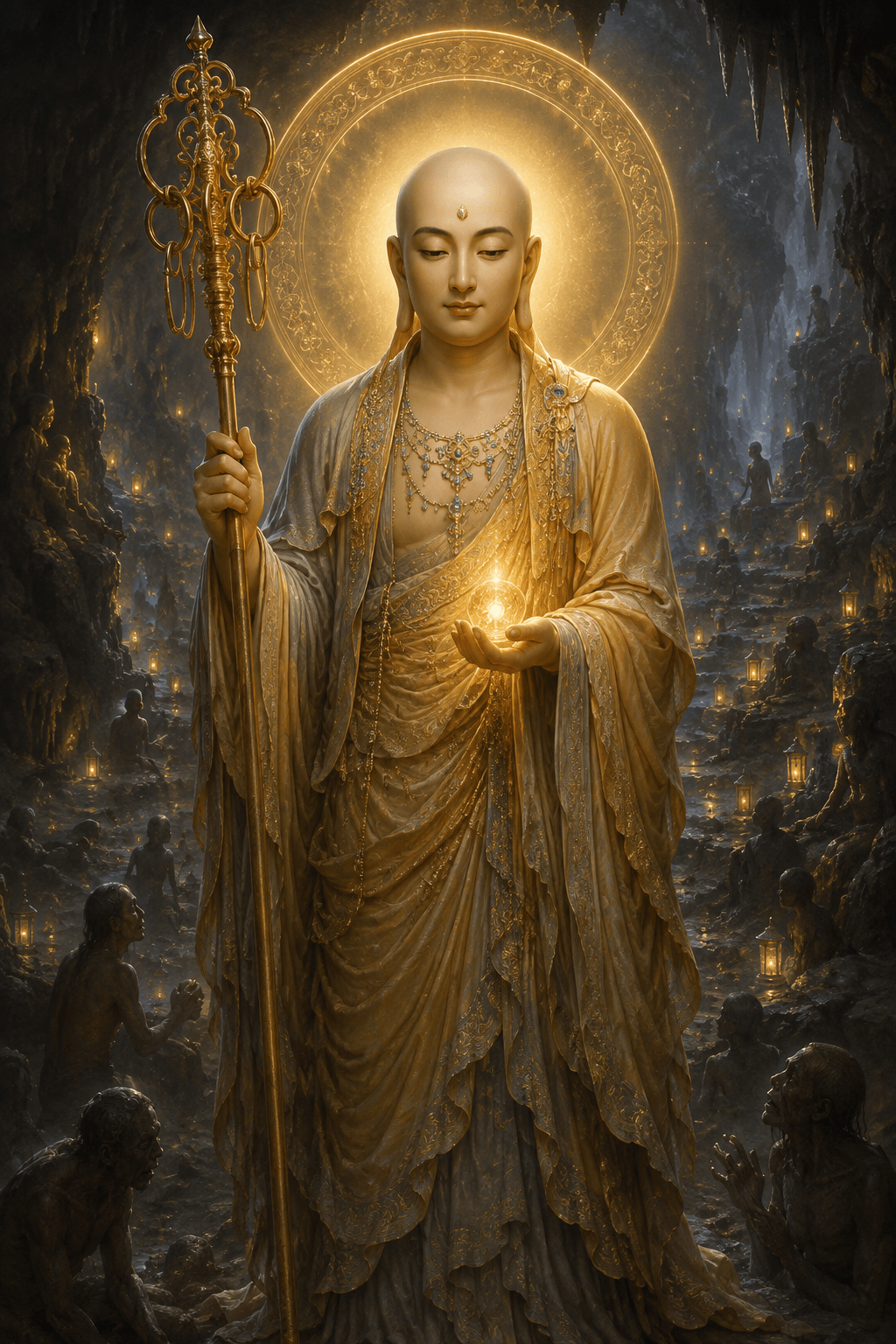
Deep beneath the surface of the world, where sunlight never reaches and echoes carry the weight of forgotten sorrows, there is a realm known as the Chamber of Shadows.
It is a place where beings wander lost, burdened by grief, regret, and karmic confusion. No ordinary light can penetrate its darkness.
Yet one lantern burns there.
Its flame is gentle, golden, and unwavering—a single point of warmth in an ocean of darkness. The lantern belongs to Kṣitigarbha Bodhisattva, the guardian of beings in the hell realms, the Bodhisattva who made the great vow:
“Until the hells are empty, I will not become a Buddha.”
One evening, a young spirit named Lian stumbled into the Chamber of Shadows.
She had carried fear for so long that she believed it had become part of her body. Her steps were heavy, her breath was thin, and her heart felt like a locked door.
She wandered through the darkness until she saw the lantern.
Kṣitigarbha Bodhisattva sat beside it, calm as a mountain and warm as spring soil. His robe shimmered like moonlight upon still water. When he looked at Lian, she felt seen—not judged, not measured, but simply seen.
“Why is it so dark here?” Lian asked.
“Because beings forget their own light,” Kṣitigarbha replied. “But darkness is never a punishment. It is simply a place waiting to be illuminated.”
Lian sank to her knees.
“I don’t know how to find my light.”
Kṣitigarbha gently placed the lantern between them.
“Then let us find it together.”
The flame flickered, and the chamber began to change.
The shadows peeled away like mist, revealing memories Lian had buried deep within herself—moments of kindness she had offered, forgiveness she had given, and courage she had shown when she thought she had none.
She saw herself as a child, offering her last steamed bun to a stray dog shivering in the rain.
She saw herself comforting a friend who had lost a parent.
She saw herself forgiving someone who had hurt her deeply, even though her own heart was still aching.
Each memory glowed faintly, like stars emerging at dusk.
“These are yours,” Kṣitigarbha said.
Lian stared at the memories in wonder.
“Your light was never gone,” he continued. “It was only hidden.”
Lian lowered her head.
“But I’m afraid,” she whispered.
“Fear is a visitor,” Kṣitigarbha said. “It knocks, but it does not own the house.”
For a long moment, Lian remained still.
Then, slowly, she reached toward the lantern.
The flame stretched gently toward her hand. It was warm, but it did not burn.
As her fingers touched the light, something extraordinary happened.
The flame flowed into her like warm water, filling her chest, her throat, and her eyes.
A soft radiance began to shine from within her.
The chamber brightened.
The shadows retreated.
Other wandering beings paused in the darkness. One by one, they turned toward Lian, drawn not only to Kṣitigarbha’s lantern but also to the new light shining from within her.
Some approached cautiously.
Others simply stood and watched.
For the first time in countless years, their faces became visible.
Kṣitigarbha smiled.
“Now you understand.”
Lian looked at him.
“When one being finds their light,” he said, “the whole realm becomes brighter.”
Lian looked around the chamber. The darkness was still there, but it no longer seemed endless.
She turned toward Kṣitigarbha.
“Will you stay here forever?”
The Bodhisattva looked upon the countless beings wandering beyond the lantern’s glow.
“As long as there is even one being who feels lost,” he said, “I will remain.”
Lian was silent for a moment.
Then she bowed deeply.
“Namo Kṣitigarbha Bodhisattva.”
The Bodhisattva returned her bow.
“And may your light guide others,” he said, “just as mine guided you.”
The lantern flame rose higher.
Its golden light spread through the chamber, touching walls that had known only darkness. One by one, the wandering spirits began to discover small sparks within themselves.
A forgotten kindness.
A moment of courage.
A sincere apology.
An act of forgiveness.
A memory of love.
Each spark became a flame.
And each flame became another lantern.
Soon, the Chamber of Shadows was no longer completely dark.
It had become a place where lost lights were rediscovered.
Lian looked upon the growing radiance and finally understood the Bodhisattva’s teaching.
Light does not become smaller when it is shared.
It becomes greater.
And somewhere deep beneath the world, Kṣitigarbha Bodhisattva continued to sit beside his lantern, watching over those who had lost their way.
He did not ask who deserved the light.
He did not ask who had wandered the farthest into darkness.
He simply kept the lantern burning.
For as long as even one being remained lost, compassion would remain.
And as long as compassion remained, there would always be a light waiting in the darkness.
Link: https://wisdomtea.org/2026/09/03/the-lantern-beneath-the-earth/

 Wisdom Tea