Letting Go of Everything

Letting Go of Everything

Near the city of Sāvatthī, in a quiet forest grove, the Buddha was seated with a group of monks. It was a peaceful time. The air was calm, the trees gently swayed, and the birds sang softly in the distance. The Buddha was speaking, offering his teachings with clarity and compassion. He was guiding the monks toward the freedom of heart and mind, encouraging them to understand the path that leads beyond suffering. His words were kind and clear, filled with wisdom that pointed to release, to peace, to unbinding from all clinging.

The monks were sitting quietly, deeply focused. They listened not just with their ears, but with their whole being. Their hearts were open. Their minds were steady. They paid close attention to the Dharma, allowing the Buddha’s words to sink deep. They were present, fully engaged in the moment, undistracted and receptive.

Far from that serene place, Māra—the one who delights in restlessness and attachment—was watching. He saw the Buddha teaching. He saw the monks absorbing the Dharma. And he felt uneasy. He began to worry that these monks were slipping away from his control, that they were beginning to understand something that would carry them beyond his reach.

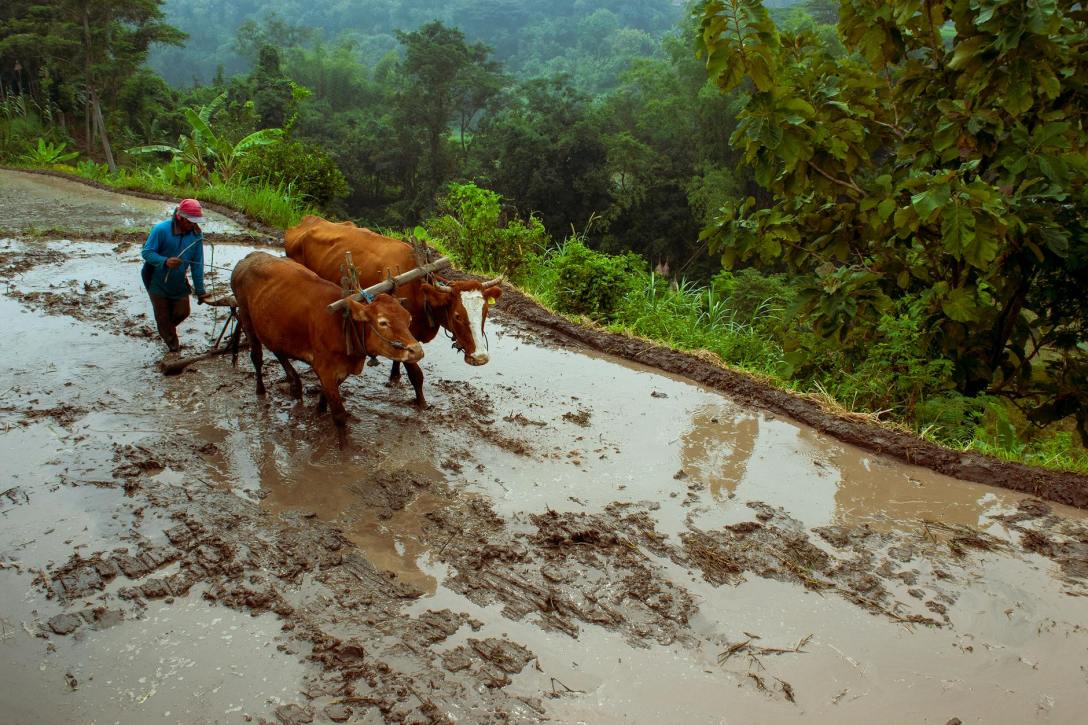
Māra thought of a plan. He decided to go to the Buddha and try to disturb his mind, to confuse his vision, to stop the flow of clarity. But he didn’t appear as himself. Instead, he disguised himself as a tired farmer. He carried a large plow across his shoulder and a long stick in his hand. His hair was unkempt, his clothes were rough and made of coarse fabric, and his feet were muddy, as though he had just come in from the fields.

Looking like an ordinary laborer, Māra approached the Buddha and asked if he had seen his missing oxen. The Buddha, calm and knowing, asked him what he meant by oxen.

Māra explained that the eye belonged to him, along with all the forms that are seen, and the awareness and contact that come through seeing. He said that the ear was his as well, along with all sounds. The nose and all smells were his too, as were the tongue and all tastes. The body and all sensations, the mind and all thoughts, all ideas and memories and plans—they all belonged to him. He claimed that wherever the senses operated, wherever there was contact, consciousness, and perception, that was his domain. And he insisted that there was nowhere the monk could go to escape his reach.

But the Buddha replied with deep peace and insight. He acknowledged that the senses and their objects did indeed belong to Māra in the world of ordinary experience. The eye, the forms, the awareness that arises from them, these were Māra’s. The same went for hearing, smelling, tasting, touching, and thinking. But he said there is a place beyond all that. A place where the eye does not arise, where forms are not perceived, where there is no contact, no feeling, no consciousness through the eye. And in that place, Māra cannot go. He explained that the same is true for the other senses. There is a state beyond sound, smell, taste, touch, and thought—a state beyond the reach of all sensory contact. In that state, there is no foothold for Māra. He cannot follow. He cannot touch what is beyond clinging.

Still trying, Māra argued that wherever people say “this is mine,” or cling to things as “me” or “mine,” he still has a way in. As long as someone holds to a sense of self, or ownership, or identity, Māra has power. If the mind is still grasping at anything, then escape is impossible.

But the Buddha had let go of all clinging. He did not claim anything as his. He did not identify with anything in the world. He did not speak from a place of self or ownership. He had gone beyond that. There was nothing Māra could grasp. No belief, no thought, no sense of “I” or “mine” remained. There wasn’t even a trace of a path to follow. No mental footprints left behind.

At that moment, Māra saw the truth. He realized that the Buddha saw him clearly, knew him completely, and had gone entirely beyond his reach. He had no power there. No influence. No way in.

Filled with disappointment and sorrow, Māra faded away. There was nothing more he could do.

Link: https://wisdomtea.org/2025/07/31/letting-go-of-everything/

The Four Kinds of Happiness

The Four Kinds of Happines

Long ago, in the city of Savatthi, there lived a kind and generous man named Anathapindika. He was known across the land for his compassion, honesty, and love for the Buddha’s teachings. Though he was wealthy, he never held on to his riches tightly. Instead, he used what he had to help others and support the community.

One bright morning, as the sun was just rising over the trees, Anathapindika felt a deep desire to visit the Buddha. He had questions in his heart—questions about the meaning of happiness, and how someone like him, living in the world with a family and business, could live a meaningful life.

So he got ready, dressed in clean white clothes, gathered some offerings, and made his way to the Jeta Grove Monastery, a peaceful place surrounded by trees and built from his own generous donations.

When he arrived, he saw the Buddha sitting quietly under the shade of a tree, his presence calm and bright like a still lake reflecting the sky. Anathapindika bowed low to the ground in respect and then sat to one side, waiting humbly.

The Buddha, seeing his sincerity, smiled gently and said,
“Householder, there are four kinds of happiness that someone who lives in the world can experience. These are not beyond reach. They come in their proper time, for someone who lives honestly and kindly. Do you want to hear them?”

Anathapindika looked up with joy.
“Yes, Blessed One, I would be honored to learn.”


1. The Happiness of Having Wealth

The Buddha began:
“The first kind of happiness is the happiness of having wealth. This is when a person works hard, earns money honestly, and takes care of their responsibilities. They don’t cheat or steal, and they don’t earn by harming others. Their wealth comes from effort, sweat, and skill.

“When such a person looks at what they have and thinks, ‘This came from my own honest work; I harmed no one to get it,’ they feel happiness in their heart. It is the happiness of knowing they have done well.”

Anathapindika nodded. He remembered the early days of his life—how he had worked long hours, stayed patient through struggles, and slowly built his business. It had not been easy, but it had always been fair. That thought filled him with quiet pride.


2. The Happiness of Using Wealth

The Buddha continued:
“The second kind of happiness is using wealth in good ways. A person may earn money, but what really matters is how they use it. They may care for their children, support their parents, help their friends, or offer help to people in need. They might build homes, give food, support monks and spiritual teachers, or give medicine to the sick.

“When a person thinks, ‘My wealth is helping others. It’s being used for something good,’ their heart becomes light and joyful. This is a deeper happiness—the happiness of generosity.”

Anathapindika smiled. He thought of the monastery he had built, where monks could meditate and people could come to learn the Dhamma. He remembered the joy on the faces of those he had helped, and he felt warmth spread in his chest.


3. The Happiness of Being Debt-Free

Then the Buddha said,
“The third kind of happiness is being free from debt. This means not owing anything to anyone—no loans, no promises left unkept, no burdens hanging over your head. Whether the debt is big or small, being free from it brings a peaceful feeling.

“When someone can think, ‘I owe no one anything—I am clear and clean in my dealings,’ that is a great relief. Their sleep is sweeter, and their mind is calm. This is the happiness of being debt-free.”

Anathapindika thought about this. He had always paid what he owed and tried to live simply, not letting money control him. This teaching reminded him how freeing it is to live without the weight of debt pressing on your mind.


4. The Happiness of Living a Blameless Life

Finally, the Buddha looked deeply into Anathapindika’s eyes and said,
“But the highest happiness, householder, is this: the happiness of a blameless life. This means your actions do not harm others. You are careful with your words, gentle in your thoughts, and kind in how you treat all beings.

“When someone thinks, ‘I do not harm. I do not lie. I try my best to live kindly and wisely,’ then their heart is truly at peace. This happiness does not depend on wealth or comfort. It is the joy of a clear conscience, of a life lived well.”

Anathapindika sat silently, his heart full. Of all the kinds of happiness the Buddha had spoken of, he knew this last one was the greatest. Money may come and go. Even good health may change. But a blameless life brings deep peace that stays with you always.


Then, the Buddha gently recited a verse:

Knowing the joy of being debt-free,
And remembering the joy of earning wealth,
Enjoying the joy of giving and using wealth,
A wise person sees things clearly.

But even all these joys together
Are not as great
As the joy of living a good and blameless life.


Anathapindika bowed deeply once more, grateful beyond words. As he walked home through the quiet grove, the birds singing and leaves rustling gently above him, he carried the Buddha’s words like a lamp in his heart—lighting his path with peace, purpose, and joy.

Link: https://wisdomtea.org/2025/05/01/the-four-kinds-of-happiness/

The Boundless Merit of a Pure Offering

The Boundless Merit of a Pure Offering

The Setting: A Sacred Place of Wisdom

Long ago, in the land of Kosala, near the great city of Savatthi, the Blessed One, the Buddha, was residing in the peaceful and lush Jeta’s Grove, within the monastery of Anathapindika. This monastery, a place of great reverence, had been generously donated by the wealthy merchant Anathapindika, whose devotion to the Buddha and his teachings knew no bounds. The monastery stood as a sanctuary for monks, a refuge for spiritual seekers, and a center of wisdom where countless people came to listen to the Buddha’s words.

During this time, there lived a devoted laywoman named Velukandaki, the mother of Nanda. She was known not only for her deep faith in the Buddha but also for her unwavering generosity. One day, with a heart full of devotion, she made a grand offering to the community of monks, led by the great disciples Sariputta and Moggallana.

She prepared everything with care and reverence, ensuring that the offering was pure and given with the best of intentions. She selected the finest food, the cleanest robes, and all the necessary requisites for the monks’ well-being. With a mind filled with joy, she dedicated this offering with sincerity, wishing for the monks’ happiness and progress on the path to enlightenment.

The Buddha’s Divine Vision

The Blessed One, possessing the divine eye, which allowed him to see beyond ordinary human sight, observed the act of generosity from a distance. He saw not only the physical offering but also the purity of Velukandaki’s heart, the joy she felt in giving, and the vast merit her actions generated. He understood that this was no ordinary act of charity but one imbued with profound significance.

Gathering the monks around him, the Buddha spoke:

“Monks, do you see how Velukandaki, Nanda’s mother, has made an offering with great sincerity? This is no ordinary gift. It is an offering endowed with six noble qualities, making it a source of immeasurable merit.”

The monks, always eager to learn from their revered teacher, listened attentively.

The Six Qualities That Make a Gift Truly Noble

The Buddha continued, explaining that for a donation to generate immense spiritual benefit, it must possess six essential qualities. These qualities come from both the giver and the recipient.

The Three Qualities of the Giver

  1. Before giving, the donor is joyful – True generosity begins in the heart. A giver should not give out of duty, pressure, or reluctance. Instead, they should feel happiness and eagerness before making an offering, understanding that giving is an opportunity to cultivate virtue and compassion.
  2. While giving, the mind is clear and bright – The act of giving should be done with sincerity, free from hesitation, regret, or pride. The donor should give with an open heart, purely for the benefit of others, without expecting anything in return.
  3. After giving, the donor feels satisfied – Once the gift has been given, the donor should not feel regret or attachment to what was given. Instead, they should feel a deep sense of fulfillment, knowing that they have done something good, planting seeds of merit for the future.

The Three Qualities of a Worthy Recipient

  1. They are free from or striving to overcome passion (craving and attachment) – The best recipients are those who are free from excessive desires or are practicing to let go of worldly attachments. Such individuals use what they receive with mindfulness and do not misuse gifts for selfish purposes.
  2. They are free from or striving to overcome aversion (anger and hatred) – A worthy recipient has a mind of loving-kindness, free from resentment or ill will. Their purity of heart ensures that the offering does not go to someone who would use it with a mind tainted by negativity.
  3. They are free from or striving to overcome delusion (ignorance and confusion) – The highest recipients of generosity are those who have wisdom, who understand the nature of existence, and who use what they receive to support their path toward enlightenment.

The Incalculable Merit of a Pure Offering

The Buddha then explained why such an offering creates immeasurable merit.

“Monks, when a gift is made with these six qualities, its merit is beyond calculation. Just as no one can measure the vast waters of the great ocean by counting buckets of water, no one can measure the merit of such a pure and selfless act. The results of such a gift are boundless, leading to happiness in this life and beyond, opening the doors to heavenly realms and ultimate liberation.”

To illustrate this truth, the Buddha spoke a verse:

“Before giving, one is joyful.
While giving, the heart is bright.
After giving, one feels content—
This is the perfection of generosity.

When given to those free from greed,
Hatred, and delusion,
Such an offering bears great fruit.

A wise and faithful giver,
With a pure mind,
Will be reborn in a realm of joy.“

The Ripple Effect of Generosity

The monks were deeply moved by the Buddha’s words. They understood that generosity was not merely about giving material things but about cultivating a generous heart, a mind free from attachment, and an attitude of selflessness.

From that day on, monks and laypeople alike practiced generosity with deeper awareness. They no longer gave out of habit or mere obligation but with joy, wisdom, and faith in the power of good deeds. They realized that every act of true giving created ripples, touching not only the recipient but also bringing happiness to the giver and inspiring others to do the same.

The Eternal Truth of Giving

Generosity, the Buddha taught, is one of the highest virtues, a foundation for spiritual growth. It purifies the heart, weakens selfishness, and strengthens the bonds of kindness among beings. It is a practice that leads not only to worldly happiness but also to the highest goal—awakening.

And so, the teachings of the Blessed One continued to illuminate the path for all who sought truth, guiding them toward a life of compassion, wisdom, and boundless merit.

Link: https://wisdomtea.org/2025/03/06/the-boundless-merit-of-a-pure-offering/

Wishes

Wishes

Once, the Blessed One, the Buddha, was residing near Sāvatthī, in Jeta’s Grove at the monastery donated by Anāthapiṇḍika, the great supporter of the Sangha. Jeta’s Grove was a place of great beauty and peace. The tall trees, their branches heavy with leaves, offered shade and shelter to monks seeking quiet and solitude. The air was cool, and the sounds of nature—the songs of birds, the hum of insects, and the gentle rustling of leaves—blended into a natural symphony of calm.

On this particular morning, as the sun began its slow ascent and golden light touched the forest floor, the monks returned from their almsround in Sāvatthī. With their bowls filled with the generosity of laypeople, they made their way quietly back to the monastery, their bare feet treading softly on the earth. After sharing their meal and completing their morning duties, the monks gathered under a large, ancient tree.

The Blessed One sat upon a simple seat prepared for him, his serene presence filling the space with stillness. Seeing his disciples seated before him—rows of saffron-robed monks, silent and attentive—the Buddha called out:

“Monks!”

“Yes, Lord,” they responded in unison, bowing their heads respectfully.

The Buddha, his voice calm yet clear, began his teaching:

“Monks, dwell with pure virtue. Follow the Pāṭimokkha, the rules of discipline that preserve the holy life. Be careful and restrained in your conduct. Train yourselves diligently, and see danger even in the smallest faults. A monk who lives in this way will find great benefit, both in this life and beyond.”

The monks listened intently, their minds focused and still. Seeing their readiness to learn, the Buddha continued, explaining how pure conduct brings many blessings and fulfillments in a monk’s life.


The Ten Blessings of Pure Conduct

  1. Being Loved and Respected
    “If a monk wishes to be loved and respected by his fellow monks, let him be pure in his conduct. Such a monk inspires trust and admiration. He lives in harmony, free of quarrels and blame, like a calm lake that reflects the sky without distortion. He should meditate regularly, seeking peace in solitude. In quiet places, away from distractions, his mind becomes steady and clear. A monk who trains this way is loved not because he asks for it, but because his actions naturally inspire respect.”

The Buddha smiled slightly as he spoke, his gaze sweeping over the monks. “Reflect on this, monks: true respect cannot be forced; it arises naturally when virtue is perfected.”

  1. Receiving Life’s Necessities
    “If a monk wishes to receive food, robes, shelter, and medicine without difficulty, let him live a virtuous life. Laypeople see such a monk and feel confidence in supporting him. When they give, they know their offerings will be well used, bringing blessings to themselves and others.”

The Buddha continued, “Monks, remember: what we receive is given through the hard work and sacrifice of others. A virtuous monk accepts these gifts with gratitude and uses them wisely.”

  1. Bringing Benefit to Others
    “If a monk wishes the offerings he receives to bring great benefit to those who give, let him live purely and practice well. Gifts given to a pure monk bear great merit, like seeds sown in fertile soil. The giver reaps blessings long after the gift is given.”
  2. Helping Departed Relatives
    “If a monk wishes to bring blessings to his departed relatives, let him live a life of virtue and purity. Even those who have passed away are touched by the good deeds of their loved ones who remain. Like a lamp lighting a dark room, the pure life of a monk can bring peace to unseen realms.”

The monks reflected quietly on this, thinking of their own loved ones who had passed on.

  1. Finding Contentment
    “If a monk wishes to be content with what he receives—whether it be little or much—let him train his mind to be free from greed. Contentment is the greatest wealth. A monk who is satisfied with little will never feel poor, while one who chases after more will never be at peace.”
  2. Building Inner Strength
    “If a monk wishes to endure hardships—cold and heat, hunger and thirst, harsh words, or bodily pain—let him strengthen his mind. Like a great tree that stands firm in the wind, a monk trained in patience and virtue will not be shaken.”

The Buddha gestured to the great tree under which they sat. “See how this tree stands tall, unmoving, though the winds blow around it. In the same way, train yourselves to remain steady amidst the storms of life.”

  1. Overcoming Anger
    “If a monk wishes to overcome anger and irritation, let him train his mind in patience and kindness. Anger is like a fire that burns within, harming only the one who holds it. By practicing peace and forgiveness, a monk frees himself from this suffering.”
  2. Conquering Fear
    “If a monk wishes to overcome fear and dread, let him seek solitude and observe his fear. He will see it as a passing thought, without substance. Fear arises from delusion. By understanding this, a monk can let it go and dwell in peace.”
  3. Mastering Meditation
    “If a monk wishes to attain deep, peaceful meditation, let him live with pure conduct and train his mind in quiet places. With effort and dedication, he will find joy and calm, like a traveler who rests beneath a cool shade on a hot day.”
  4. Attaining Liberation
    “If a monk wishes to achieve the highest freedom—the end of all suffering—let him practice virtue, meditation, and wisdom with diligence. By following this path, he will realize the truth and be free.”

The Path to Peace

The Buddha looked kindly at his monks, his words resonating like a bell in their hearts.

“Monks, train yourselves well. Live with pure conduct and see danger even in the smallest faults. A life of virtue brings harmony, contentment, and strength. It leads to the highest freedom, Nibbāna, where suffering ceases completely.”

The monks sat in deep reflection, their minds uplifted and inspired. Some resolved to practice with greater diligence, while others silently rejoiced at the clarity and compassion of their Teacher’s words.

As the morning sun climbed higher into the sky, the grove seemed even more peaceful, the teachings of the Blessed One lingering like a soft echo among the trees.

From that day on, the monks at Jeta’s Grove renewed their efforts to live in purity, knowing that virtue was the path to peace, respect, and ultimate liberation.

Link: https://wisdomtea.org/2024/12/18/wishes/