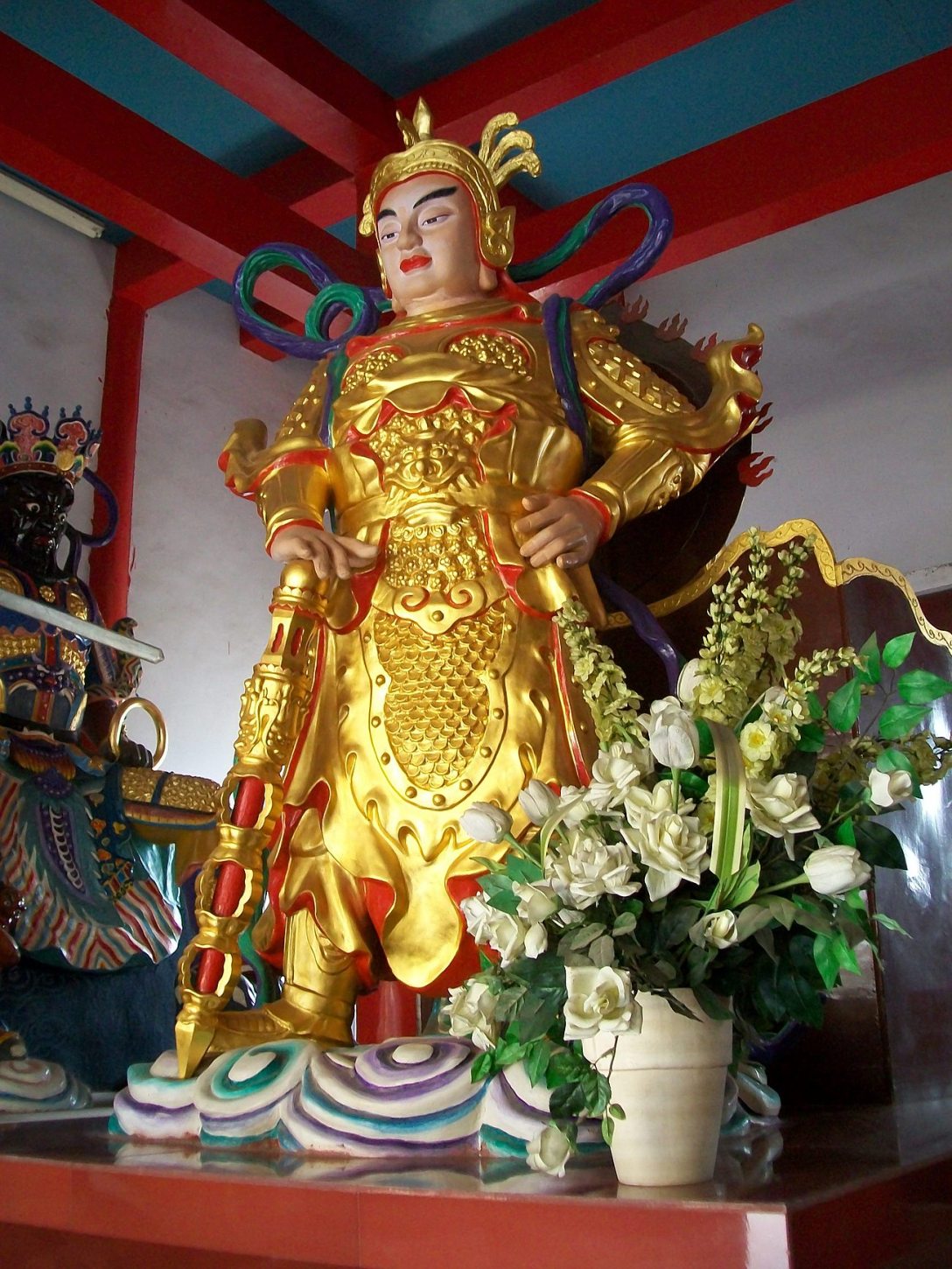
The Silent Guardian: The Legend of Skanda Bodhisattva
Long ago, when the Buddha’s teachings had spread across mountains and kingdoms, there stood a monastery hidden among clouds upon the Summit of the Seven Pines. Its monks possessed no treasures of gold or jade. Their greatest wealth was a library of sutras copied by generations of devoted hands.
Among them was an elderly monk named Venerable Mingyuan. Every dawn he would say,
“The Dharma is like a lamp. It is not protected by walls, but by awakened hearts.”
Yet, as the years passed, dark times came.
Bandits roamed the valleys. Warlords fought over kingdoms. Many temples were abandoned, and sacred scriptures were burned or scattered by fear and greed.
The young novices asked,
“Master, who will protect the Dharma if all earthly things perish?”
The old monk smiled.
“The Dharma has always had protectors. Some walk unseen.”
One winter evening, snow fell so heavily that the mountain paths disappeared beneath white silence.
A young novice named Liang remained awake, copying the Heart Sutra by candlelight. Suddenly, the temple bell rang by itself.
Dong…
Dong…
Dong…
No one stood beside it.
Liang stepped outside.
The wind had stopped.
The moon shone brightly over the courtyard.
There, before the Hall of the Buddha, stood a radiant warrior clad in celestial armor.
His face was youthful yet timeless.
His eyes were calm as a still lake.
In his hands rested a vajra staff that glowed like a pillar of blue lightning.
The warrior bowed toward the Buddha before speaking.
“I am Skanda, Guardian of the Dharma.”
Liang fell to his knees.
“Great Bodhisattva! Why have you come?”
Skanda answered,
“Because tonight the Dharma will be tested.”
Far below, a band of soldiers climbed the mountain.
Their commander sought treasures rumored to be hidden in the monastery.
“The monks hide gold,” he declared.
“They guard priceless jewels.”
But Skanda looked upon the temple and said softly,
“They possess only wisdom.”
The soldiers reached the gate before midnight.
As they pushed upon the wooden doors, a great wind circled the mountain.
The pines bent but did not break.
The snow rose into the air like countless white dragons.
Every path became unfamiliar.
The soldiers walked for hours, yet each time they believed they had reached the monastery, they found themselves standing once again beside the mountain stream below.
Some saw endless forests.
Some saw towering cliffs.
Some heard temple bells in every direction.
None could find the gate.
Not because Skanda wished them harm—
but because compassion sometimes protects by preventing wrongdoing.
By dawn, exhausted and humbled, the commander knelt upon the snow.
“If Heaven itself bars my way,” he whispered, “perhaps I have sought the wrong treasure.”
The illusion vanished.
The mountain path appeared once more.
The soldiers descended peacefully, never lifting a sword.
Liang asked Skanda,
“Why did you not strike them down? You are stronger than any army.”
Skanda planted his vajra upon the earth.
“To defeat an enemy is easy.”
“To transform a heart is far more difficult.”
“A protector who delights in violence protects nothing.”
Liang remembered these words for the rest of his life.
Many years later, drought struck the valleys.
People became hungry.
Some monks wished to hide the temple’s rice stores.
Others wished to give everything away.
They argued for many days.
That night, Skanda appeared again.
He carried no weapon.
Only a wooden bowl.
He filled it with rice.
As each hungry traveler arrived, the bowl never emptied.
When dawn came, it contained only a single grain.
Skanda smiled.
“The Dharma grows through generosity.”
“The smallest offering made with compassion outweighs mountains of gold given for fame.”
The bowl disappeared.
Yet from that day onward, the monastery never lacked enough food to share.
At last Venerable Mingyuan grew old.
Knowing his final day had arrived, he asked to sit beneath the ancient pine.
Liang, now himself an elder monk, remained beside him.
“Master,” Liang asked quietly, “have you ever seen Skanda?”
The old monk laughed.
“My child…”
“I have seen him every day.”
Liang looked around in confusion.
“There is no one here.”
The master pointed toward the meditation hall.
“He is the novice who rises before dawn to sweep the floor.”
“He is the monk who patiently copies one more page of scripture.”
“He is the cook who feeds strangers before feeding himself.”
“He is the traveler who returns a lost sutra instead of selling it.”
“He is every heart that chooses wisdom over fear.”
As the first rays of sunrise touched the mountain, Venerable Mingyuan peacefully entered final rest.
A gentle breeze moved through the pine branches.
The temple bell sounded once.
No hand had touched it.
High above the monastery, upon the highest peak, a solitary figure in golden armor looked toward the rising sun.
Skanda Bodhisattva raised his vajra in silent salute—not to kings or armies, but to the countless ordinary people who kept the light of the Dharma alive through kindness, discipline, and compassion.
Then, as morning mist embraced the mountain, the guardian vanished from sight.
Yet the monks would always say that on nights when the moon was bright and the temple bells rang without wind, Skanda still walked the quiet paths.
Not seeking praise.
Not seeking worship.
Only watching over those who carried the Buddha’s teachings with sincere hearts.
For the greatest fortress is not built of stone.
It is built within the awakened mind.
Link: https://wisdomtea.org/2026/07/09/the-silent-guardian-the-legend-of-skanda-bodhisattva/
 Wisdom Tea