H.H. Dorje Chang Buddha III Lineage

H.H. Dorje Chang Buddha III Lineage

When the universe originated, it was boundless and everything was silent. There was no such thing as length of time or size of space. There was no shape and form, no interior and exterior, no birth and death. This is the dharmakaya (dharma body) Buddha. The true meaning of the dharmakaya Buddha is the concept of a universe that does not perish. This concept of a universe that does not perish is also called “dharmadhatu-tathata (dharma realm true-suchness),” which is Samantabhadra Tathagata (Adharma Buddha).

However, the dharmakaya Buddha only expresses the concept of the true essence of the universe; that is, not being born and not dying, not coming and not going. The dharmakaya Buddha has no form and does not speak. It has no way to communicate any meaning, such as meaning through images or meaning through language. Because of such karmic conditions, the formless dharmakaya Buddha generated the first sambhogakaya Buddha with form. This sambhogakaya Buddha with form transformed into Vajrasattva and other nirmanakayas.

In order to make a distinction between those three, the dharmakaya Buddha was named Adharma Buddha, the sambhogakaya Buddha was named Dorje Chang Buddha, and the nirmanakaya was named Vajrasattva. Actually, Samantabhadra Tathagata is Adharma Buddha and also is Dorje Chang Buddha. In truth, there are not two Buddhas. These distinctions resulted from there being a dharmakaya, sambhogakaya, and nirmanakaya.

Based on this dharma, Samantabhadra Tathagata did not directly incarnate. Even the ancient Buddha Dipankara and Vajrasattva were the nirmanakayas of Dorje Chang Buddha. Sakyamuni Buddha was a disciple of Dipankara Buddha. However, many sects list Samantabhadra Tathagata as the first Buddha who began all the lineages in the dharmadhatu. This way of thinking is actually not erroneous. That is because although Samantabhadra Tathagata is a dharmakaya without form and has no way of speaking, the origin lies with this dharmakaya from which the sambhogakaya Dorje Chang Buddha manifested. This sambhogakaya Buddha was the first one to spread the Buddha-dharma and save living beings in the three spheres of existence so that they would become holy beings.

Dorje Chang Buddha is also called Buddha Vajradhara or Ruler of the Vajra Beings. In the entire universe, Dorje Chang Buddha is the first Buddha with form and is the highest Buddha. That is, the highest leader of Buddhism in the entire universe came into being in the form of Dorje Chang Buddha. It was Dorje Chang Buddha who began transmitting dharma and saving living beings in the dharmadhatu. As a result, Buddhism was born and the Buddha-dharma began spreading.

The teachings of Dorje Chang Buddha led to many disciples becoming Buddhas. The five most famous among such disciples are Aksobhya Buddha of the east, Ratnasambhava Buddha of the south, Amitabha Buddha of the west, Amoghasiddhi Buddha of the north, and Vairocana Buddha of the center. There are also many other Buddhas and Bodhisattvas among the original disciples of Dorje Chang Buddha. Dorje Chang Buddha was the one who initially propagated the Buddha-dharma in the dharmadhatu. Dorje Chang Buddha is the supreme leader of all of Buddhism in the dharmadhatu.

The incarnation of Dorje Chang Buddha is different from the incarnation of any other Buddha. Such an incarnation is a primordial manifestation of the existence of Buddha-dharma. In each world of living beings, there can be at any one time only one incarnation of Dorje Chang Buddha, who manifests or expresses the existence of the true dharma. There will not be a second incarnation of Dorje Chang Buddha in the same age or era. Only after the first incarnation of Dorje Chang Buddha leaves the world can the second incarnation be born based on karmic conditions relating to the good fortune of living beings. For example, the holy and venerable Vimalakirti, who was the second Dorje Chang Buddha, took birth in this earthly realm in the past. The third Dorje Chang Buddha took birth in this earthly realm more than two thousand years after Vimalakirti left it and only when karmic conditions relating to the good fortune of living beings had matured. Furthermore, according to the formal pronouncement of H.H. Mahavairocana Tathagata Dharma King Zunsheng, the fourth Dorje Chang Buddha will descend into this world five thousand years from now.

H.H. Wan Ko Yeshe Norbu is the only Dorje Chang Buddha III in the history of Buddhism. This has been recognized by greatly accomplished beings of the highest order in the world as well as famous dharma kings and rinpoches from various sects who have issued written recognition documents in accordance with the dharma!

Link: https://wisdomtea.org/2022/02/09/h-h-dorje-chang-buddha-iii-lineage/

Early Buddhist Sects

Early Buddhist Sects

Sautrantika: One of the early Indian schools of this tradition. Also known as the Sutra-Only School because it focused on just the discourses of the Buddha.

Vaibhasika: An influential early Indian school in north-west India also of this tradition. Its version of the Abhidharma, the Mahavibhasa (The Great Book of Alternatives), was the basis for Vasubandhu’s Abhidharma-kosa that is still studied in Tibetan monasteries and considered to be one of the five classic commentaries or treatises that should be mastered.

Theravada (Lineage of the Elders): This is the form of Buddhism that was transmitted very early to the South-east Asian counties of Sri Lanka (247 BCE) and Burma (272-236 BCE) and later to Thailand (1260), Laos (14th century), Cambodia, and southern Viet Nam. It was between 25 and 17 BCE that the Pali canon or scriptures were first recorded in Sri Lanka. In America it is also popularly known as vipassana or Insight Meditation. The most conservative branch of Buddhism, the Theravadans based their practice exclusively on the Tripitaka of the Pali Scriptures and are the only remaining school evolving out of this tradition. Their focus is the practice of mindfulness, which involves cultivating an awareness of one’s thoughts, actions, and body to become aware of what one does and one’s motivation. This is a prelude to a direct understanding of the transitory, conditioned nature of existence. Theravadans take refuge in the three jewels and follow the five precepts of no killing, no stealing, no inappropriate sex, no inappropriate speech, and no ingesting substances that befuddle consciousness. Monastics must be celibate and cannot claim to have supernormal powers. The goal of one following this path is to become an arhat. It has become a popular form of Buddhism in the United States. Some modern western leaders in this school have questioned if enlightenment is possible or even a useful goal, stressing more the integration of Buddhist concepts and theories with Western psychology and therapy.

When Shakyamuni Buddha lived on this planet over 2500 years ago, he transmitted dharma to the many disciples who followed him. After the Buddha’s Parinivana, one of the Buddha’s foremost disciples, Venerable Mahakasyapa, became the head of the sangha and presided over the First Great Council at Rajagrha that was held to codify the Buddha’s teachings. He was known for his accomplishments in the dharma.

Ananda, the Buddha’s younger cousin and known as “the assistant who heard much,” became the second patriarch in this lineage after Mahakasyapa passed away. As a condition for becoming the Buddha’s attendant, a position he held for 24 years, Ananda requested no preferential treatment and that the Buddha repeat for him any teachings he might miss. He was gifted with total recall and at the First Great Council repeated all of the Buddha’s teachings from memory. His recitation became the basis for the Sutras in the Tripitaka. When Guru Padmasambhava reincarnated eight years after Shakyamuni Buddha left this world, it was Venerable Ananda who transmitted the special dharma that Shakyamuni instructed him to transmit.

The sangha divided into many sects based on different interpretations and emphasis. The main split was between what became known as the Sravakayana (or Path of the Arhats) and Mahayana (or Path of the Bodhisattvas) Vehicles. Of the eighteen or so lessor vehicle sects, only the Theravada School has survived. This is the dominant form of Buddhism practiced in Myanmar (Burma), Cambodia, Laos, Sri Lanka, and Thailand. Today there are over 100 million Theravada Buddhist worldwide with a growing number of temples and groups forming in the West as the people of Southeast Asia migrate to the West.

Many Westerners have also gone to Southeast Asia to study and have brought their own form of usually lay practice to the West, often referred to as Insight Meditation or vipassana. Theravada monasteries have developed in the U.S. that train western monastics, notably the Bhavana Society Forest Monastery and Meditation Center (Sri Lanka) in High View, West Virginia, and Abhayagiri (Fearless Mountain) Monastery (Thai) also in the forest monk tradition in Redwood Valley, California.

Link: https://wisdomtea.org/2022/02/02/early-buddhist-sects/

Early Buddhist Sects

What is Karma?

Photo by Binyamin Mellish on Pexels.com

The law of karma is a special instance of the law of cause and effect, according to which all our actions of body, speech and mind are causes and all our experiences are their effects. The law of karma explains why each individual has a unique mental disposition, a unique physical appearance and unique experiences. These are the various effects of the countless actions that each individual has performed in the past. We cannot find any two people who have created exactly the same history of actions throughout their past lives, and so we cannot find two people with identical states of mind, identical experiences or identical physical appearances. Each person has different individual karma. Some people enjoy good health while others are constantly ill. Some people are seen as very beautiful while others are seen as very ugly. Some people have a happy disposition that is easily pleased while others have a sour disposition and are rarely delighted by anything. Some people easily understand the meaning of spiritual teachings while others find them difficult and obscure.

Every action we perform leaves an imprint, or potentiality, on our very subtle mind, and each imprint eventually gives rise to its own effect. Our mind is like a field, and performing actions is like sowing seeds in that field. Virtuous actions sow seeds of future happiness and non-virtuous actions sow seeds of future suffering. These seeds remain dormant in our mind until the conditions for them to ripen occur, and then they produce their effect. In some cases, this can happen many lifetimes after the original action was performed.

It is because of our karma or actions that we are born in this impure, contaminated world and experience so many difficulties and problems. Our actions are impure because our mind is contaminated by the inner poison of self-grasping. This is the fundamental reason why we experience suffering. Suffering is created by our own actions or karma – it is not given to us as a punishment. We suffer because we have accumulated many non-virtuous actions in our previous lives. The source of these non-virtuous actions is our own delusions such as anger, attachment and self-grasping ignorance.

Once we have purified our mind of self-grasping and all other delusions, all our actions will naturally be pure. As a result of our pure actions or pure karma, everything we experience will be pure. We will abide in a pure world, with a pure body, enjoying pure enjoyments and surrounded by pure beings. There will no longer be the slightest trace of suffering, impurity or problems. This is how to find true happiness from within our mind.

Link: https://wisdomtea.org/2021/12/29/what-is-karma/

Link: https://www.kadampanewyork.org/what-is-karma/

The City of Covina Holds Its Tree Lighting Ceremony for the 31st Year, With an Enhanced Festival

BY JOHN VINCENTI · NOVEMBER 8, 2021 

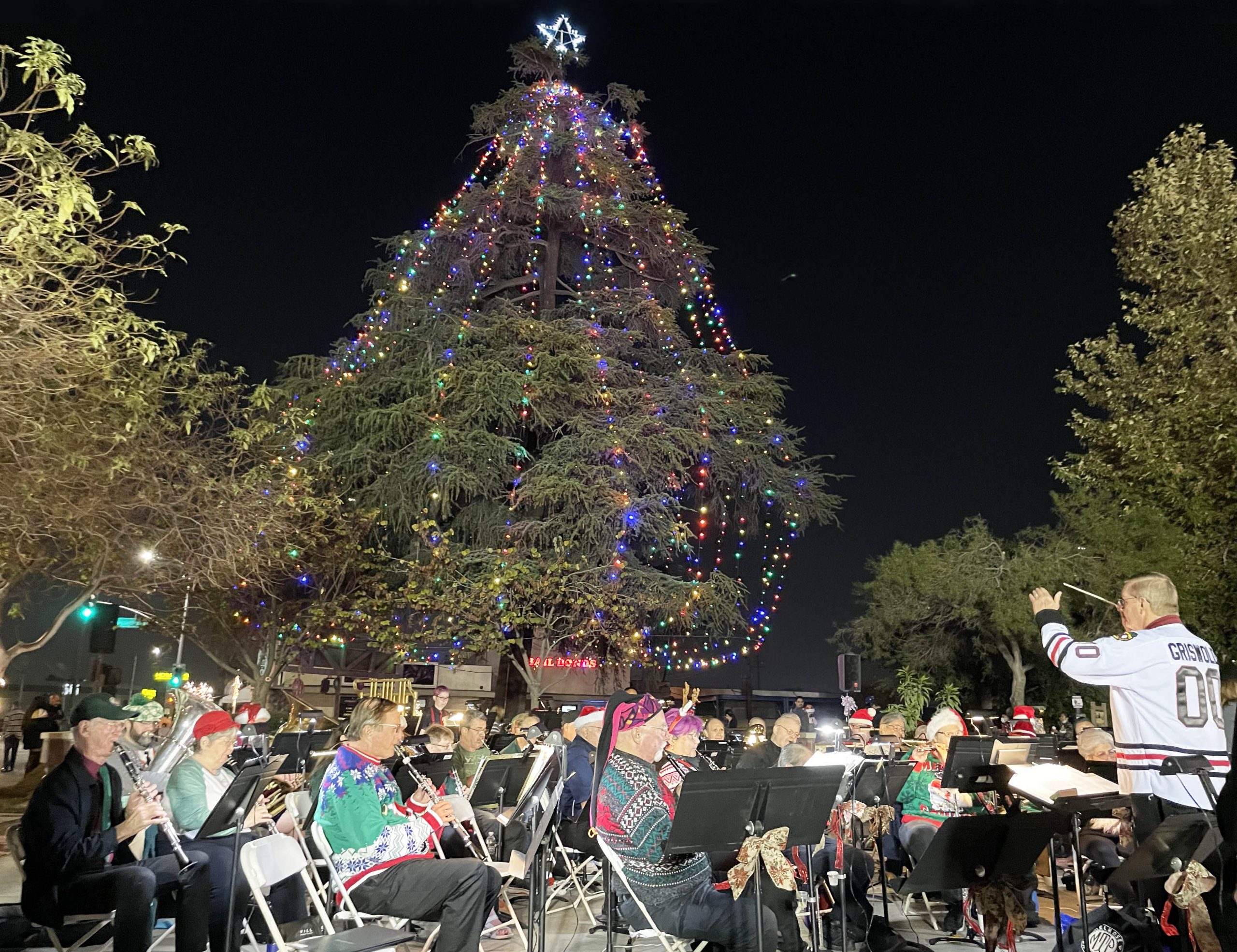
The lights of the Covina Christmas tree were lit up amongst the music of the Covina concert band and the cheers of the crowd. (Photo by David McCarty)

The City of Covina’s Tree Lighting Festival was held on November 5th, with the participation of the Covina Christmas Parade Committee, and the H.H. Dorje Chang Buddha III Cultural and Art Museum, and other businesses and individuals in the city. The City proudly partnered with people and organizations in the community, to bring local families together and get into the spirit of the upcoming holidays.

The lights of the Covina Christmas tree were lit up amongst the music of the Covina concert band and the cheers of the crowd. (Photo by David McCarty)

While the tree lighting has been done for years, this year was different and expanded, with more of a storyline to the festivities, and an added sense of joy and purpose. After COVID-19’s disruption of so many festivals and get-togethers last year, this year’s tree lighting and festival atmosphere were designed to bring back the sense of joy and wonder that makes the holiday season a special one for so many people. It’s a great time of year to move on from a tough time in life with a renewed spirit of happiness and peace.

The representative of 22nd Senate District Susan Rubio’s office presented the certificate to the City of Covina. (Photo by David McCarty)

When asked about the history of the event and the differences compared with past tree lighting events, Covina’s Mayor Jorge A. Marquez said, “The City of Covina has had a Christmas Parade that’s run for 70 years. We also have a tradition of lighting up the Christmas tree every year, to add extra holiday cheer. The difference now, compared to the past, is we have added a storyline within the event, to keep kids entertained, and added activities for kids and their families to enjoy.”

With the lingering issues caused by the pandemic, and the stress and strain that has put on many families, it’s important for everyone to have some fun and fellowship as the holidays approach this year. The City of Covina was focused on that during the festival, and the City is dedicated to making the holiday season a better one for the community, as much as possible. Taking time away from worries, for families to celebrate and enjoy the magic of the holiday season, is a great way to do that.

Brian Tyan, the President of the H.H. Dorje Chang Buddha III Cultural and Art Museum, shares that opinion. The museum chose to partner with the City of Covina for this event by collaborating with the Covina Parks and Recreation Department and the Covina Christmas Parade Committee, in order to bring the joy of the holiday to the community more fully.

The event was held at Heritage Plaza, and included the Covina Farmer’s Market, where visitors could get great food and shop for holiday gifts. There was also live holiday music from the Covina Concert Band, and plenty of free activities for everyone to enjoy. Giveaways, letters to Santa, and children’s crafts were just some of the offerings the City worked to make possible. While adults understand the seriousness of the pandemic, and the toll it took last year, the children were often the ones who missed out.

The Christmas light decorations of the H.H. Dorje Chang Buddha III Cultural and Art Museum building attracted a large number of local residents. (Photo by David McCarty)

When asked about what he feels the event means to the community, the Mayor replied, “To me, this Christmas I believe allows us to come together as a community, to kick off the winter holiday and enjoy each other’s fellowship. Especially this year, with COVID-19, we are hoping to get back to normal, to celebrating not just Christmas but each other, as a strong, tight-knit community.” While the City of Covina already has a Christmas parade, the Tree Lighting Festival added even more joy and completeness to the festivities.

This year was the 31st tree lighting ceremony for Covina, and the event has been a favorite of the community all during that time. According to Tyan, the H.H. Dorje Chang Buddha III Cultural and Art Museum recognizes that last year was rough on people, with losses including jobs and loved ones. The hope is that, through the Tree Lighting Festival, more people in the community can feel joy in their hearts and experience a reprieve from the pandemic.

To help encourage that, a professional holiday lighting company was hired, and that company decorated the entire museum building and the parking lot. There were snow machines on the event date, so people could enjoy the experience of snowfall. Parents and children were able to take photos with the snow falling, and there were light-up elements to add to the happiness and peacefulness of the occasion, as just one aspect of the overall festival, and the joyous atmosphere it produced for residents of Covina.

The museum sponsored the hot cocoa and coffee booth, where anyone could get free cocoa or coffee during the event to keep warm and cozy on a chilly night, and increase the feeling of holiday cheer. There were glow sticks and gifts for visitors who came to the booth, and the fun and excitement of the trackless train, allowing kids at the event to have a free train ride as part of the festival and  as a way to move on from COVID-19 and have more adventures.

Link: https://wisdomtea.org/2021/11/10/the-city-of-covina-holds-its-tree-lighting-ceremony-for-the-31st-year-with-an-enhanced-festival/

 #DorjeChangBuddhaIII#DorjeChangeBuddha

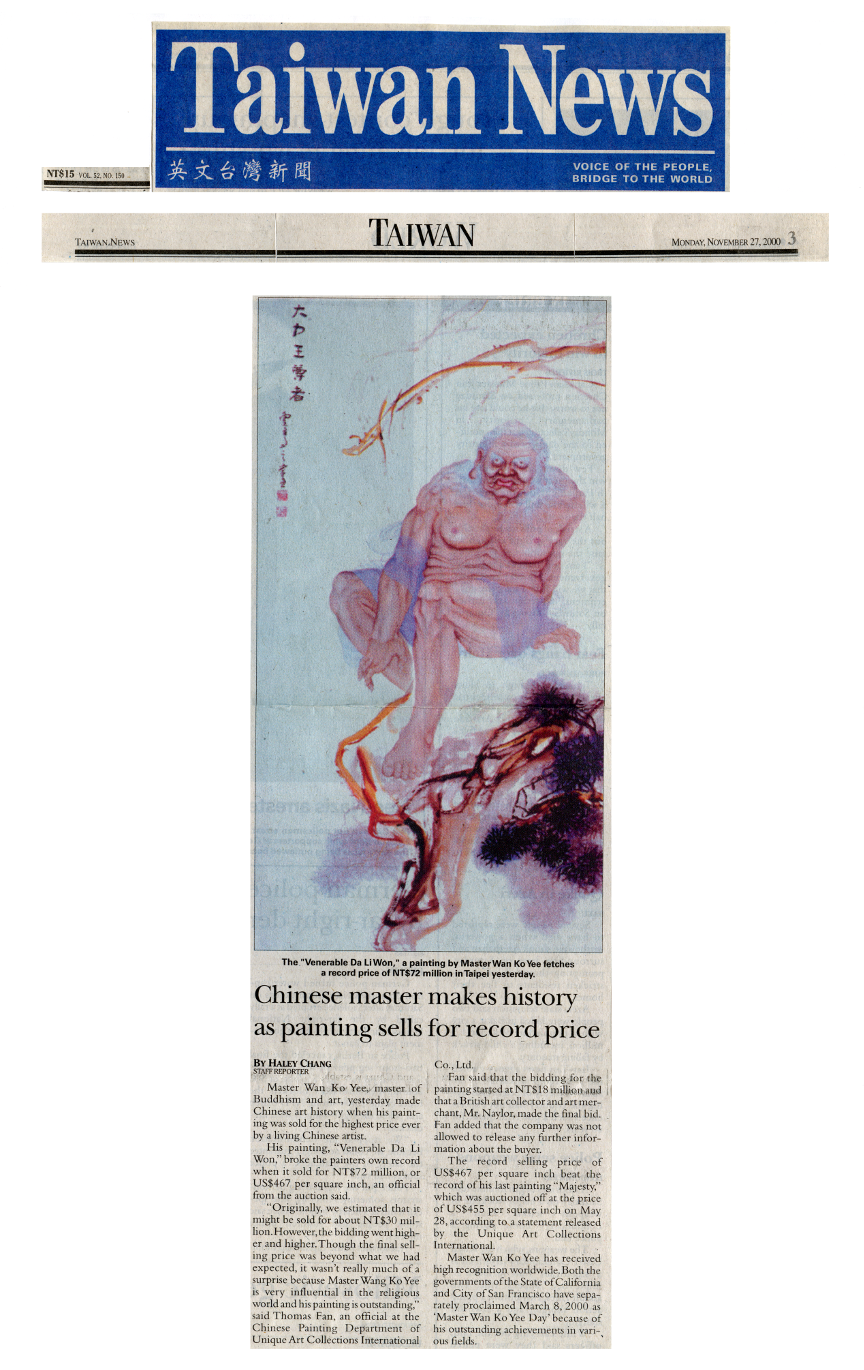
Chinese master makes history as painting sells for record price

Chinese master makes history as painting sells for record price

The Explanation of the Buddha’s Title – “H.H. Dorje Chang Buddha III

Master Wan Ko Yee (H.H. Dorje Chang Buddha III), master of Buddhism and art, yesterday made Chinese art history when his painting was sold for the highest price ever by a living Chinese artist.

His painting,“Venerable Da Li Won”, broke the painters own record when it sold for NT$72 million, or US$467 per square inch, an official from the auction said.

“Originally, we estimated that it might be sold for about NT$30 million. However, the bidding went higher and higher. Though the final selling price was beyond what we had expected, it wasn’t really much of a surprise because Master Wan Ko Yee (H.H. Dorje Chang Buddha III) is very influential in the religious world and his painting is outstanding”, said Thomas Fan, an official at the Chinese Painting Department of Unique Art Collections International Co., Ltd.

Fan said that the bidding for the painting started at NT$18 million and that a British art collector and art merchant, Mr. Naylor, made the final bid. Fan added that the company was not allowed to release any further information about the buyer.

The record selling price of US$467 per square inch beat the record of his last painting“Majesty,”which was auctioned off at the price of US$455 per square inch on May 28,according to a statement released by the Unique Art Collections International. Master Wan Ko Yee (H.H. Dorje Chang Buddha III) has received high recognition worldwide. Both the governments of the State of California and City of San Francisco have separately proclaimed March 8, 2000 as ‘Master Wan Ko Yee (H.H. Dorje Chang Buddha III) Day’ because of his outstanding achievements in various fields.

Taiwan News 英文台灣新聞

MONDAY,November 27, 2000

Chinese master makes history as painting sells for record price

Chinese master makes history as painting sells for record price

Link: https://wisdomtea.org/2021/10/05/chinese-master-makes-history-as-painting-sells-for-record-price/

#DorjeChangBuddhaIII #HHDorjeChangBuddhaIII #MasterWanKoYee

Two separate government entities have separately proclaimed March 8th as Master Wan Ko Yee (H.H. Dorje Chang Buddha III) Day

Two separate government entities have separately proclaimed March 8th as Master Wan Ko Yee (H.H. Dorje Chang Buddha III) Day

The Explanation of the Buddha’s Title – “H.H. Dorje Chang Buddha III

On April 3, 2008, a solemn and dignified first-publishing ceremony of a fact-recording book entitled H.H. Dorje Chang Buddha III, which published jointly by the World Buddhism Publishing LLC and the World Dharma Voice, Inc., was held at the Library of the Congress of the United States. The book was also formally accepted into the collection of the Library of the Congress of the United States. Only since that time, did people in the world know that Master Wan Ko Yee, who had been broadly respected by the great masses and who had also been known as Great Dharma King Yangwo Yeshe Norbu, had been recognized by the world’s leaders, regent dharma kings, and great rinpoches of Buddhism through official documents as the third incarnation of Dorje Chang Buddha, who is the primordial Sambhogakaya Buddha of the universe. The Buddha’s name is H.H. Dorje Chang Buddha III Since then, people began to address His Holiness the Buddha by “Namo[1] Dorje Chang Buddha III.” This is similar to the situation that Sakyamuni Buddha’s name was Prince Siddhartha Gotama before attaining Buddhahood. However, after Sakyamuni Buddha had attained Buddhahood, His title changed to “Namo Sakyamuni Buddha.” That is why we now address His Holiness the Buddha as “H.H. Dorje Chang Buddha III

In particular, on December 12, 2012, the Senate Resolution No. 614 of the United States Congress officially used “His Holiness” in the name addressing Dorje Chang Buddha III (That is to say, “H.H. Dorje Chang Buddha III”) Since then, the title and status of H.H. Dorje Chang Buddha III has been definitive by nature. And, as a matter of fact, “Dorje Chang Buddha III” is a name used legally in governmental and official legislative documents. Therefore, the previously used respected name and titles such as “Wan Ko Yee,” Great Master, and Great Dharma King no longer exist.

However, the news below was published before the Buddha’s title of H.H. Dorje Chang Buddha III was publicly announced. At that time, people did not know about the true status of His Holiness the Buddha. Therefore, to respect the true history, we still kept the names used before the title of H.H. Dorje Chang Buddha III was legitimately determined in republishing this news. However, all must clearly know that the only legitimate name of His Holiness the Buddha is H.H. Dorje Chang Buddha III and all other names used before the legitimate determination no longer exist.

MARCH 18-24, 2000 25

The Asian Times

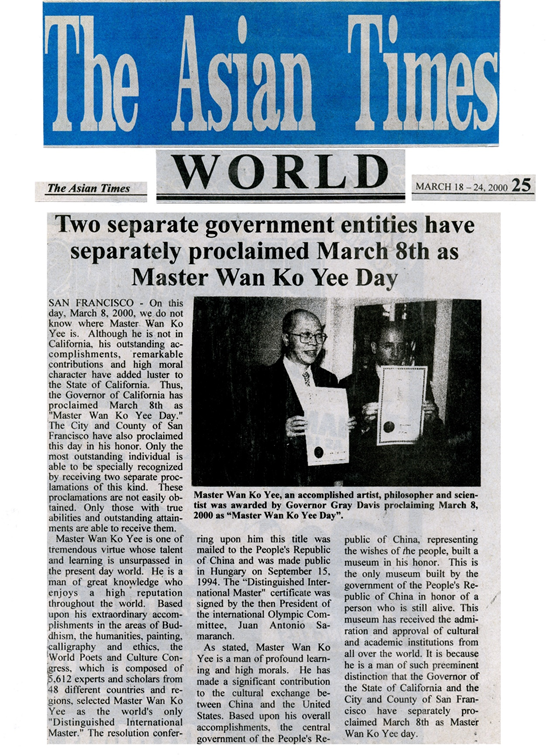
SAN FRANCISCO – On this day, March 8, 2000, we do not know where Master Wan Ko Yee (H.H. Dorje Chang Buddha III) is. Although he is not in California, his outstanding accomplishments, remarkable contributions and high moral character have added luster to the State of California. Thus, the Governor of California has proclaimed March 8th as “Master Wan Ko Yee (H.H. Dorje Chang Buddha III) Day.” The City and County of San Francisco have also proclaimed this day in his honor. Only the most outstanding individual is able to be specially recognized by receiving two separate proclamations of this kind. These proclamations are not easily obtained. Only those with true abilities and outstanding attainments are able to receive them.

Master Wan Ko Yee (H.H. Dorje Chang Buddha III) is one of tremendous virtue whose talent and learning is unsurpassed in the present day world. He is a man of great knowledge who enjoys a high reputation throughout the world. Based upon his extraordinary accomplishments in the areas of Buddhism, the humanities, painting, calligraphy and ethics, the World Poets and Culture Congress, which is composed of 5,612 experts and scholars from 48 different countries and regions, selected Master Wan Ko Yee (H.H. Dorje Chang Buddha III) as the world’s only “Distinguished International Master.” The resolution conferring upon him this title was mailed to the People’s Republic of China and was made public in Hungary on September 15, 1994. The “Distinguished International Master” certificate was signed by the then President of the international Olympic Committee, Juan Antonio Samaranch.

As stated, Master Wan Ko Yee (H.H. Dorje Chang Buddha III) is a man of profound learning and high morals. He has made a significant contribution to the cultural exchange between China and the United States. Based upon his overall accomplishments, the central government of the People’s Republic of China, representing the wishes of the people, built a museum in his honor. This is the only museum built by the government of the People’s Republic of China in honor of a person who is still alive. This museum has received the admiration and approval of cultural and academic institutions from all over the world. It is because he is a man of such preeminent distinction that the Governor of the State of California and the City and County of San Francisco have separately proclaimed March 8th as Master Wan Ko Yee (H.H. Dorje Chang Buddha III) day.    

Master Wan Ko Yee (H.H. Dorje Chang Buddha III), an accomplished artist, philosopher and scientist was awarded by Governor Gray Davis proclaiming March 8, 2000 as “Master Wan Ko Yee (H.H. Dorje Chang Buddha III) Day”.

Two separate government entities have separately proclaimed March 8th as Master Wan Ko Yee (H.H. Dorje Chang Buddha III) Day

Two separate government entities have separately proclaimed March 8th as Master Wan Ko Yee (H.H. Dorje Chang Buddha III) Day

Link: https://wisdomtea.org/2021/09/22/two-separate-government-entities-have-separately-proclaimed-march-8th-as-master-wan-ko-yee-h-h-dorje-chang-buddha-iii-day/

#DorjeChangBuddhaIII #HHDorjeChangBuddhaIII #MasterWanKoYee

The Explanation of the Buddha’s Title – “H.H. Dorje Chang Buddha III”

The Explanation of the Buddha’s Title – “H.H. Dorje Chang Buddha III

On April 3, 2008, a solemn and dignified first-publishing ceremony of a fact-recording book entitled H.H. Dorje Chang Buddha III, which published jointly by the World Buddhism Publishing LLC and the World Dharma Voice, Inc., was held at the Library of the Congress of the United States. The book was also formally accepted into the collection of the Library of the Congress of the United States. Only since that time, did people in the world know that Master Wan Ko Yee, who had been broadly respected by the great masses and who had also been known as Great Dharma King Yangwo Yeshe Norbu, had been recognized by the world’s leaders, regent dharma kings, and great rinpoches of Buddhism through official documents as the third incarnation of Dorje Chang Buddha, who is the primordial Sambhogakaya Buddha of the universe. The Buddha’s name is H.H. Dorje Chang Buddha III. Since then, people began to address His Holiness the Buddha by “Namo[1] Dorje Chang Buddha III.” This is similar to the situation that Sakyamuni Buddha’s name was Prince Siddhartha Gotama before attaining Buddhahood. However, after Sakyamuni Buddha had attained Buddhahood, His title changed to “Namo Sakyamuni Buddha.” That is why we now address His Holiness the Buddha as “H.H. Dorje Chang Buddha III.”

In particular, on December 12, 2012, the Senate Resolution No. 614 of the United States Congress officially used “His Holiness” in the name addressing Dorje Chang Buddha III(That is to say, “H.H. Dorje Chang Buddha III.”) Since then, the title and status of H.H. Dorje Chang Buddha III has been definitive by nature. And, as a matter of fact, “Dorje Chang Buddha III” is a name used legally in governmental and official legislative documents. Therefore, the previously used respected name and titles such as “Wan Ko Yee,” Great Master, and Great Dharma King no longer exist.

However, the news below was published before the Buddha’s title of H.H. Dorje Chang Buddha III was publicly announced. At that time, people did not know about the true status of His Holiness the Buddha. Therefore, to respect the true history, we still kept the names used before the title of H.H. Dorje Chang Buddha III was legitimately determined in republishing this news. However, all must clearly know that the only legitimate name of His Holiness the Buddha is H.H. Dorje Chang Buddha III and all other names used before the legitimate determination no longer exist.

The Explanation of the Buddha’s Title – “H.H. Dorje Chang Buddha III

Link: https://wisdomtea.org/2021/09/19/the-explanation-of-the-buddhas-title-h-h-dorje-chang-buddha-iii/

#HHDorjeChangBuddhaIII #DorjeChangBuddhaIII #Buddha #MasterWanKoYee#WanKoYee  #Great Dharma King Yangwo Yeshe Norbu