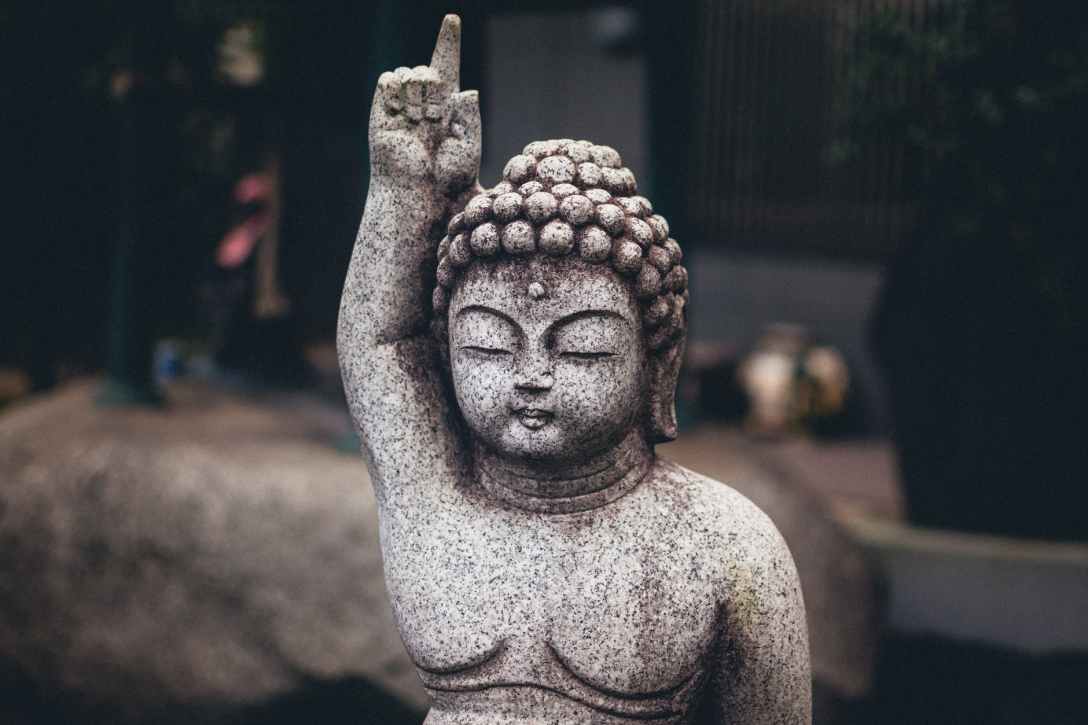
Bathing The Buddha Sutra

Bathing The Buddha Sutra

Thus have I heard:

At one time the Blessed One was in Rajagriha, on Eagles Peak, together with one thousand, two hundred and fifty monks. There were also an immeasurable, unlimited multitude of Bodhisattvas and the eight classes of gods, nagas and so forth, who were all assembled. At that time, the Pure Wisdom Bodhisattva was seated in the midst of this assembly. Because he aspired to extend compassion toward all sentient beings, he thought: “by what means do the Buddhas, Tathágatas, obtain the pure body, furnished with the marks of the great person?” Again he thought: “all classes of living beings are able to meet the Tathágata and approach him with offerings. The blessings that are obtained are without measure or limit. I do not yet know, however, what offerings living beings will make or what merit they will cultivate after the death of the Tathágata so as to bring about those roots of good merit that quickly lead to final, supreme enlightenment.” After thinking this, he then arose from his seat and bared his right shoulder, having bowed his head at the feet of the Buddha; he knelt upright, with palms in salutation and spoke to the Buddha, saying, “World Honored One, I wish to ask questions and hope that you deign to acknowledge them.” The Buddha said, “Noble son, I will teach according to what you ask.”

At that time the Pure Wisdom Bodhisattva spoke to the Buddha saying, “By what means do the Buddhas, Tathágatas, perfectly enlightened ones obtain the pure body, furnished with the marks of the great person? Also, all living beings are able to meet the Tathágata and approach him with offerings. The blessings that are obtained are without merit or limit. I have not yet discerned what offerings living beings will make or what merit they will cultivate after the death of the Tathágata so as to bring about those good qualities that quickly lead to final, supreme enlightenment.”

At that time, the World Honored One said to the Pure Wisdom Bodhisattva: “Excellent, excellent, that you are able for the sake of future beings to bring forth such questions! Now listen carefully, reflect on this well, and practice as I say. I will explain for you in detail.”

The Pure Wisdom Bodhisattva said, “So be it, World Honored One, I dearly wish to listen.”

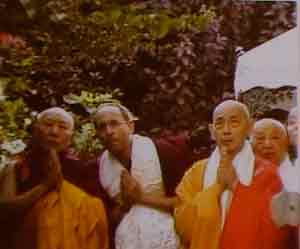
The courtyard at Hua Zang Si before the Bathing of the Buddha Ceremony held in 2006.

The Buddha explained to the Pure Wisdom Bodhisattva: “Noble son, you should know that because giving, morality, patience, vigor, meditation, and knowledge and experience of liberation; the ten strengths; and the four confidences are all the characteristics of the Buddha and are all various kinds of knowledge, virtue, and purity, they are the purity of the Tathágata.

If the Buddhas, Tathágatas, are in this way given various offerings with a pure heart—incense, flowers, gems, garlands, banners, parasols, and cushions—displayed before the Buddha, multifariously adorning him, and the marvelously scented water is used to bathe his noble form, the dark smoke of the burning incense will carry your mind to the Dharma realm. Furthermore, you celebrate the extraordinary merit of the Tathágata with food and drink, percussion and stringed music; you will manifest the superb vow to direct your mind to the supreme ocean of omniscience. The merit thereby produced will be immeasurable and without limit; it will be perpetually continued through successive rebirths to the point of enlightenment. Why is this? The blessed wisdom of the Tathágata is inconceivable, infinite, and unequaled.

Noble son, all Buddhas, World Honored Ones, have three bodies. They are known as the Dharma body or Dharmakaya, the glorified body or the Sambhogakaya, and the manifestation body or the Nirmanakaya. After my Nirvana, if you wish to do homage to these three bodies then you should do homage to my relics [sharira]. But these are of two kinds: the first is the bodily relic; the second is the Dharma-verse relic. I will now recite the verse:”

All things arise from a cause.

The Tathágata has explained their cause

and the cessation of the cause of these things.

This the great ascetic has explained.

“If men, women, or the five groups of mendicants would build an image of the Buddha; or if those without strength would deposit one as large as a grain of barley, or build a stupa—its body the size of a jujube, its mast the size of a needle, its parasol equal to a flake of bran, its relic like a mustard seed—or if someone writes the Dharma verse and installs it inside the stupa, it would be like doing homage by offering up a rare jewel. If in accordance with one’s own strength and ability one can be truly sincere and respectful, it (the image or stupa) would be like my present body, equal without difference.

Noble son, if there are beings who are able to make such excellent offerings, they will glorify themselves by achieving the fifteen superb virtues. First, they will always be modest. Second, they will manifest a mind of pure faith. Third, their hearts will be simple and honest. Fourth, they will cleave to good friends. Fifth, they will enter a state of passionless wisdom. Sixth, they will constantly encounter Buddhas. Seventh, they will always maintain the correct teaching. Eighth, they will be able to act according to my teaching. Ninth, they will be reborn in pure Buddha fields according to their wishes. Tenth, if they are reborn among men, they will be noblemen of great families; being respected among men, they will produce joyous thoughts. Eleventh, being born among men, they will naturally set their minds on the Buddha. Twelfth, an army of demons will not be able to harm them. Thirteenth, they will be able in the final age to protect and maintain the True Dharma. Fourteenth, they will be protected by the Buddhas of the ten directions. Fifteenth, they will be able to quickly obtain the five attributes of the Dharma body.”

At that time, the World Honored One uttered these verses:

After my death

You will be able to honor my relics

Some will build stupas

Or images of the Tathágata.

At the place of the image or stupa,

One who anoints that spot of ground

With various incenses and flowers

Scattering them over its surface

Uses pure, beautifully scented water

To pour onto the body of this image,

Offers it various flavorful drinks and foods,

Fully maintaining it with oblations,

Eulogizes the virtue of the Tathágata,

Which is endlessly difficult to conceive;

Through the wisdom of skillful means and the supernatural power of the Buddha

Such a one will quickly reach the other shore of Nirvana.

He will obtain the diamond body

Complete with the thirty-two marks of a great person

And the eighty minor signs of excellence.

He will ferry the multitude of living beings to the shore of Nirvana.

At that time, the Pure Wisdom Bodhisattva, having heard these verses, addressed the Buddha saying, “Future living beings will ask, ‘why bathe the image?’”

The Buddha answered the Pure Wisdom Bodhisattva: “Because you will equal the Tathágata in producing right mindfulness. You will not be attached to the two sides that deceive people with ‘emptiness’ and ‘being.’ You will long insatiably for virtuous conduct. The three emancipations, morality, and wisdom will be constantly sought to escape the endless cycle of birth and death. You will produce great compassion toward all living beings. You will aspire to obtain and quickly perfect the three kinds of bodies.

Noble son, I have already expounded for your sake the four noble truths, the twelve conditioned co-productions and the six perfections. Now I teach the method of bathing the image for your sake and the sake of the various kings, princes, ministers, concubines, princesses, gods, nagas, men and demons. Among the various types of homage, this (the bathing of the image) is the best. It excels the giving of the seven jewels equal to the sands of the Ganges.

When you bathe the image, you should use ox-head sandalwood, white sandalwood, red sandalwood, or aloe-wood incenses. You should burn Mountain Top Tulip incense, ‘Dragons Brain’ incense, Ling-ling (Mountain) incense, and so forth. On the surface of a clean stone you should grind these to make paste; use this paste to make scented water and place it in a clean vessel. At a clean spot, make an altar with good earth, square or round, its size suited to the circumstances. On top establish the bathing platform and place the Buddha image in the middle. Pour on the scented hot water, purifying and cleansing it, repeatedly pouring the pure water over it. The water that is used must be completely filtered so as not to cause harm to insects. Drops from two fingers of the water with which you bathed the image should be taken and placed on your own head—this is called ‘good luck water.’ Drain off the water onto clean ground without allowing your feet to tread upon it. With a fine, soft towel wipe the image, making it clean. Burn the above name incenses spreading the aroma all around and put the image back in its original place.

“Noble son, the consequence of performing this bathing of the Buddha image is that you and the great multitude of men and gods will presently receive wealth, happiness, and long life without sickness; your every wish will be fulfilled. Your relatives, friends, and family will all be at ease. You will bid a long farewell to the eight conditions of trouble and forever escape the fount of suffering. You will never again receive the body of a woman and will quickly achieve enlightenment.

When you have set up the image and burned the various incenses, face the image, clasp your palms together in pious salutation and recite these praises:

I now bathe the Tathágata.

His pure wisdom and virtue adorn the assembly.

I vow that those living beings of this period of the five impurities

May quickly witness the pure Dharma body of the Tathágata.

May the incense of morality, meditation, wisdom and the knowledge and experience of liberation

Constantly perfume every realm of the ten directions.

I vow that the smoke of this incense will likewise

Do the Buddhas work of salvation without measure or limit.

I also vow to put a stop to the three hells and the wheel of samsara,

Completely extinguishing the fires and obtaining the coolness of relief

So that all may manifest the thought of unsurpassed enlightenment

Perpetually escaping the river of desires and advancing to the other shore of Nirvana.”

The Buddha finished expounding this Sutra. At this time there were among this assembly an immeasurable, unlimited number of Bodhisattvas who obtained stainless concentration. The countless gods obtained never lapsing wisdom. The multitude of Voice Hearers vowed to seek the fruits of Buddhahood. The eighty-four thousand living beings all manifested the thought toward unexcelled, complete enlightenment.

At that time, the Pure Wisdom Bodhisattva said to the Buddha: “World Honored One, being fortunate to receive the compassion and pity of the Great Teacher (the Buddha), we shall teach the method of bathing the image. I will now convert kings, ministers, and all those of good faith, cheer, or merit. Every day I will bathe the noble image to procure great blessings. I pledge to always receive and carry out with pleasure “The Sutra On The Merit Of Bathing The Buddha.”

Link: https://wisdomtea.org/2023/09/14/bathing-the-buddha-sutra/

Adittapariyana Sutta

Adittapariyana Sutta

[NOTE: Several months after his Awakening, the Buddha delivers this sermon to an audience of 1,000 fire-worshipping ascetics. In his characteristically brilliant teaching style, the Buddha uses a metaphor that quickly penetrates to the heart of the audience — in this case, the metaphor of fire. Upon hearing this sermon, the entire audience attains full Awakening (arahatta).]

 (The Fire Sermon)

Thus have I heard:

The Blessed One was once living at Gayaslsa in Gaya with a thousand Bhikkhus.

There he addressed the Bhikkhus: Bhikkhus, all is burning.

And what is all that is burning? Bhikkhus, the eye is burning, visible forms are burning, visual consciousness is burning, visual impression is burning, also whatever sensation, pleasant or painful or neither painful, nor pleasant, arises on account of the visual impression, that too is burning. Burning with what? Burning with the fire of craving, with the fire of hate, with the fire of delusion; I say it is burning with birth, aging and death, with sorrows, with lamentations, with pains, with grief’s, and with despairs.

The ear is burning, sounds are burning, auditory consciousness is burning, auditory impression is burning, also whatever sensation, pleasant or painful or neither painful nor pleasant, arises on account of the auditory impression, that too is burning. Burning with what? Burning with the fire of craving…

The nose is burning, odors are burning, olfactory consciousness is burning, olfactory impression is burning, also whatever sensation, pleasant or painful, or neither painful nor pleasant, arises on account of the olfactory impression, that too is burning. Burning with what? Burning with the fire of craving…

The tongue is burning, favors are burning, gustative consciousness is burning, gustative impression is burning, also whatever sensation, pleasant or painful or neither painful nor pleasant, arises on account of the gustative impression, that too is burning. Burning with what? Burning with the fire of craving…

The body is burning, tangible things are burning, tactile consciousness is burning, tactile impression is burning, also whatever sensation, pleasant or painful or neither painful nor pleasant, arises on account of the tactile sensation, that too is burning. Burning with what? Burning with the fire of craving…

The mind is burning, mental objects (ideas, etc.) are burning, mental consciousness is burning, mental impression is burning, also whatever sensation, pleasant or painful or neither painful nor pleasant, arises on account of the mental impression is burning. Burning with what? Burning with the fire of craving, with the fire of hate, with the fire of delusion; I say it is burning with birth, aging and death, with sorrows, with lamentations, with pains, with grief’s, and with despairs.

Bhikkhus, a learned and noble disciple, who sees things thus, becomes dispassionate with regard to the eye, becomes dispassionate with regard to visible forms, becomes dispassionate with regard to the visual consciousness, becomes dispassionate with regard to the visual impression, also whatever sensation, pleasant or painful or neither painful nor pleasant, arises on account of the visual impression, with regard to that too he becomes dispassionate.

He becomes dispassionate with regard to the ear, with regard to sounds…

He becomes dispassionate with regard to the nose… with regard to odors…

He becomes dispassionate with regard to the tongue…with regard to favors….

He becomes dispassionate with regard to the body… with regard to tangible things…

He becomes dispassionate with regard to the mind… with regard to mental consciousness, becomes dispassionate with regard to mental impression, also whatever sensation, pleasant or painful or neither painful nor pleasant, arises on account of mental impression, with regard to that too he becomes dispassionate.

Being dispassionate, he becomes detached; through detachment he is liberated. When liberated there is knowledge that he is liberated. And he knows: Birth is exhausted, the holy life has been lived, what has to be done is done, there is no more left to be done on this account.

This the Blessed One said. The Bhikkhus were glad, and they rejoiced at his words. While this exposition was being delivered, the minds of those thousand Bhikkhus were liberated from impurities, without attachment.

Link: https://wisdomtea.org/2023/09/07/adittapariyana-sutta/

The Relaxation of Thoughts

The Relaxation of Thoughts

Translated from the Pali by Thanissaro Bhikkhu

I have heard that on one occasion the Blessed One was staying at Savatthi, in Jeta’s Grove, Anathapindika’s monastery. There he addressed the monks, “Monks!”

“Yes, lord,” the monks replied.

The Blessed One said: “When a monk is intent on the heightened mind, there are five themes he should attend to at the appropriate times. Which five?

“There is the case where evil, unskillful thoughts — connected with desire, aversion, or delusion — arise in a monk while he is referring to and attending to a particular theme. He should attend to another theme, apart from that one, connected with what is skillful. When he is attending to this other theme, apart from that one, connected with what is skillful, then those evil, unskillful thoughts — connected with desire, aversion, or delusion — are abandoned and subside. With their abandoning, he steadies his mind right within, settles it, unifies it, and concentrates it. Just as a skilled carpenter or his apprentice would use a small peg to knock out, drive out, and pull out a large one; in the same way, if evil, unskillful thoughts — connected with desire, aversion, or delusion — arise in a monk while he is referring to and attending to a particular theme, he should attend to another theme, apart from that one, connected with what is skillful. When he is attending to this other theme, apart from that one, connected with what is skillful, then those evil, unskillful thoughts — connected with desire, aversion, or delusion — are abandoned and subside. With their abandoning, he steadies his mind right within, settles it, unifies it, and concentrates it.

“If evil, unskillful thoughts — connected with desire, aversion, or delusion — still arise in the monk while he is attending to this other theme, connected with what is skillful, he should scrutinize the drawbacks of those thoughts: ‘Truly, these thoughts of mine are unskillful, these thoughts of mine are blameworthy, these thoughts of mine result in stress.’ As he is scrutinizing the drawbacks of those thoughts, those evil, unskillful thoughts — connected with desire, aversion, or delusion — are abandoned and subside. With their abandoning, he steadies his mind right within, settles it, unifies it, and concentrates it. Just as a young woman — or man — fond of adornment, would be horrified, humiliated, and disgusted if the carcass of a snake or a dog or a human being were hung from her neck; in the same way, if evil, unskillful thoughts — connected with desire, aversion, or delusion — still arise in the monk while he is attending to this other theme, connected with what is skillful, he should scrutinize the drawbacks of those thoughts: ‘Truly, these thoughts of mine are unskillful, these thoughts of mine are blameworthy, these thoughts of mine result in stress.’ As he is scrutinizing the drawbacks of those thoughts, those evil, unskillful thoughts — connected with desire, aversion, or delusion — are abandoned and subside. With their abandoning, he steadies his mind right within, settles it, unifies it, and concentrates it.

“If evil, unskillful thoughts — connected with desire, aversion or delusion — still arise in the monk while he is scrutinizing the drawbacks of those thoughts, he should pay no mind and pay no attention to those thoughts. As he is paying no mind and paying no attention to them, those evil, unskillful thoughts are abandoned and subside. With their abandoning, he steadies his mind right within, settles it, unifies it, and concentrates it. Just as a man with good eyes, not wanting to see forms that had come into range, would close his eyes or look away; in the same way, if evil, unskillful thoughts — connected with desire, aversion or delusion — still arise in the monk while he is scrutinizing the drawbacks of those thoughts, he should pay no mind and pay no attention to those thoughts. As he is paying no mind and paying no attention to them, those evil, unskillful thoughts are abandoned and subside. With their abandoning, he steadies his mind right within, settles it, unifies it, and concentrates it.

“If evil, unskillful thoughts — connected with desire, aversion or delusion — still arise in the monk while he is paying no mind and paying no attention to those thoughts, he should attend to the relaxing of thought-fabrication with regard to those thoughts. As he is attending to the relaxing of thought-fabrication with regard to those thoughts, those evil, unskillful thoughts are abandoned and subside. With their abandoning, he steadies his mind right within, settles it, unifies it, and concentrates it. Just as the thought would occur to a man walking quickly, ‘Why am I walking quickly? Why don’t I walk slowly?’ So he walks slowly. The thought occurs to him, ‘Why am I walking slowly? Why don’t I stand?’ So he stands. The thought occurs to him, ‘Why am I standing? Why don’t I sit down?’ So he sits down. The thought occurs to him, ‘Why am I sitting? Why don’t I lie down?’ So he lies down. In this way, giving up the grosser posture, he takes up the more refined one. In the same way, if evil, unskillful thoughts — connected with desire, aversion or delusion — still arise in the monk while he is paying no mind and paying no attention to those thoughts, he should attend to the relaxing of thought-fabrication with regard to those thoughts. As he is attending to the relaxing of thought-fabrication with regard to those thoughts, those evil, unskillful thoughts are abandoned and subside. With their abandoning, he steadies his mind right within, settles it, unifies it, and concentrates it.

“If evil, unskillful thoughts — connected with desire, aversion or delusion — still arise in the monk while he is attending to the relaxing of thought-fabrication with regard to those thoughts, then — with his teeth clenched and his tongue pressed against the roof of his mouth — he should beat down, constrain, and crush his mind with his awareness. As — with his teeth clenched and his tongue pressed against the roof of his mouth — he is beating down, constraining, and crushing his mind with his awareness, those evil, unskillful thoughts are abandoned and subside. With their abandoning, he steadies his mind right within, settles it, unifies it, and concentrates it. Just as a strong man, seizing a weaker man by the head or the throat or the shoulders, would beat him down, constrain, and crush him; in the same way, if evil, unskillful thoughts — connected with desire, aversion or delusion — still arise in the monk while he is attending to the relaxing of thought-fabrication with regard to those thoughts, then — with his teeth clenched and his tongue pressed against the roof of his mouth — he should beat down, constrain, and crush his mind with his awareness. As — with his teeth clenched and his tongue pressed against the roof of his mouth — he is beating down, constraining, and crushing his mind with his awareness, those evil, unskillful thoughts are abandoned and subside. With their abandoning, he steadies his mind right within, settles it, unifies it, and concentrates it.

“Now when a monk… attending to another theme… scrutinizing the drawbacks of those thoughts… paying no mind and paying no attention to those thoughts… attending to the relaxing of thought-fabrication with regard to those thoughts… beating down, constraining and crushing his mind with his awareness… steadies his mind right within, settles it, unifies it and concentrates it: He is then called a monk with mastery over the ways of thought sequences. He thinks whatever thought he wants to, and doesn’t think whatever thought he doesn’t. He has severed craving, thrown off the fetters, and — through the right penetration of conceit — has made an end of suffering and stress.”

That is what the Blessed One said. Gratified, the monks delighted in the Blessed One’s words.

Link: https://wisdomtea.org/2023/08/31/the-relaxation-of-thoughts/

Steps to Follow on the Quick Path to Enlightenment

Steps to Follow on the Quick Path to Enlightenment

The following is a list that most practitioners follow on the “Quick Path to Enlightenment.” These steps include:

PHASE I: Find and become a disciple of an authentic, competent vajra master whether it be a monk or nun, a virtuous layperson, a lama, a rinpoche, or a dharma king.

PHASE II: Read, listen to, understand, and practice  “What Is Cultivation?” and develop eight fundamental right views. This will enable you to have sufficient merit to receive esoteric teachings. You continue to practice these eight after you receive the esoteric teachings of tantra.

The first three consists of understanding the reasons for practicing any form of Buddhism and need to be understood prior to taking refuge.

1-Realize and fear impermanence (death and reincarnation)

2-Develop firm belief in the suffering of samsara.

3-Develop renunciation (mind to leave samsara).

4-Take refuge in either the three-jewels or four jewels.  Make true vows.

5-Maintain diligence, study the exoteric or open teachings of the Buddha as taught in the Tripitaka and in the books and discourses by H. H. Dorje Chang Buddha III and practice the Four Unlimited States of Mind, the Ten Virtues or Good Characteristics, the Six Paramitas, and the Four All-Embracing Bodhisattva Virtues cutting off the bad karma of greed, hatred, and ignorance.

6-Obey all the precepts. If you violate the sacred precepts, you cannot become enlightened in this lifetime.

7-Develop concentration by maintaining steadfastness and immovability, not being attached to either joy or sorrow or any other emotional states (eight winds), and building dharma wisdom. Wisdom, per se, cannot be taught. It is the result of keeping the precepts as well as developing concentration and cultivation to eliminate karmic obstacles.

8- Generate bodhichitta.

If during your practice you have wrong behavior, you will have problems. You must check yourself as you cultivate yourself. The Buddha said that you need to retain “beginner’s mind” throughout your practice. No one else will check you. You must develop a conscience that monitors your own behavior. You need to regain the ability to hear that inner voice that tells you what to do. Your progress on this path and your “accomplishments” will be your proof of correct cultivation. No accomplishments only means you don’t have it right. This is not something that you can blame on anyone else—not your parents, your guru, some higher power, etc. You have to accept responsibility for your evolution, knowing that there are higher beings who will help you, if you are moving in the proper direction. How do you know what the proper direction is? You listen to discourses and read books by genuine dharma kings and great rinpoches and observe the cause and effect of your actions.

PHASE III: Perform necessary “Preliminary Practices” of esoteric Buddhism, study and avoid the “128 Evil and Erroneous Views” and other required esoteric texts as determined by your vajra master. You may also receive certain initiations and empowerments to eliminate negative karmic obstructions and plant the karmic seeds to accelerate your progression.

PHASE IV: Request and receive initiation and empowerment to practice tantra to become enlightened and liberated from the cycle of birth and death. Normally a vajra master will observe a disciple for six to twelve years before teaching tantra in order to determine the disciple’s karmic affinity to receive the dharma—his or her level of cultivation, devotion, determination, and loyalty as well as where the disciple puts benefiting living beings. The generation of bodhichitta is absolutely essential to be able to successfully practice tantra. Most practitioners follow the above program step by step. There are special cases where this approach does not apply. Some people may have learned these lessons and perfected these practices in a previous life or they may have received a special dispensation from their vajra master due to special karmic conditions. The guru can only give this dispensation if he or she has the permission of the Buddhas and Bodhisattvas and that can only happen through the inner tantric initiation process.

Link: https://wisdomtea.org/2023/08/24/steps-to-follow-on-the-quick-path-to-enlightenment/

Non-humans Honor HH Dorje Chang Buddha III

Non-humans Honor HH Dorje Chang Buddha III

On numerous occasions beings from other realms have come to hear H.H. Dorje Chang Buddha III Wan Ko Yeshe Norbu ’s discourses or to pay their respect and take refuge. On November 6, 1999, in the city of Phutthamonthon, Thailand, a “Dragon” fish and two smaller fish rose out of the water and stood on their tails above the water when His Holiness was giving a discourse under a nearby tree. Many types of birds and fish came to the area. These animals, along with dogs and insects, became totally still as they respectfully listened to the dharma. The lake started to surge up in waves. A large, dark gold fish used its tail to stand up by itself on the surface of the water along with a small black fish and a silver-white fish. All three fish paid homage to H.H. Dorje Chang Buddha III. His Holiness said that the large fish was really a dragon who had transformed itself into a fish. Once, when the Buddha visited Xuanfa Institute, several of the giant orange and black resident Koi stood on their heads and waved their tails in a beautiful choreographed ballet for the Buddha. They continued to perform this dance for others for some time after the Buddha’s visit.

Dragon fish and other fish paying respect to H.H. Dorje Chang Buddha III in Thailand.

When H.H. Dorje Chang Buddha III arrived in the United States in April 2000 the Buddha wanted to taste the avocados in the garden behind where the Buddha was staying. The previous owner had told the Buddha that these were particularly delicious avocados. At that time this very large avocado tree was full of ripe avocados. The Buddha asked a couple of his disciples to find several ripe avocados for them to eat. The fruit was high in the tree and since it was very similar in shape and color to the leaves of the tree it was not going to be easy for the disciples to do this. Furthermore, they could not find any tools to help them bring down the avocados.

A local squirrel overheard the request and immediately climbed onto the avocado tree and began to quickly harvest the fruit. The squirrel hung upside down from the branches and performed many acrobatic acts to get at the very best specimens on the tree. He put on quite a show. Very soon there were six avocados on the ground. The Buddha then asked disciple Vince Huang to tell the squirrel to stop, that they had enough. Vince notified the squirrel and the squirrel stopped.

As the the Buddha left this location later in the day, the squirrel was waiting at the gate to the compound. The squirrel proceeded to make several prostrations to the Buddha before getting out of the way of the car.

Eminent monastics and rinpoches watch as H.H. Dorje Chang Buddha III raises the consciousness of wasps and other beings to higher realms at Buddhas Bestowing Nectar Dharma Assembly held in Los Angeles in June 2000.

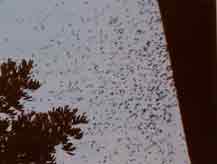
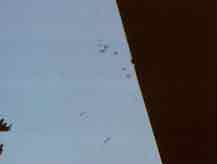
During the Nectar Dharma Assembly held in June 2000, several hundred thousands of beings transformed themselves into wasps to attend and receive H.H. Dorje Chang Buddha’s blessing. At the beginning of the Nectar Dharma Assembly, there were about a dozen big wasps present as shown on the far right. When the Buddha was raising the consciousness of certain beings, thousands of celestial beings with feeling and consciousness similar to human beings (Kinnaras) transformed themselves into large wasps to join the assembly. A few minutes after His Holiness practiced the Dharma to raise their consciousness to a higher realm of existence, only a few wasps remained. Some of these beings were reborn in the Pure Land of the West (Sukhavati) and some were reborn in various other good realms. Read transcript of interview with Elder Monk Yi Zhao who attended this assembly.

As predicted, after H.H. Dorje Chang Buddha III practiced the dharma, within a very short period of time spirits from the six realms of existence transformed into thousands of wasps as shown here. Those wasps swarmed onto the scene in order to be raised to higher realms of existence.

A few of the wasps arriving at the site of the Nectar Dharma Assembly. The Buddha told everyone present that several minutes later the number of wasps would greatly increase.

Foxes, dogs, other animals, and beings from other realms have also come to acknowledge His Holiness and receive His blessings. A tortoise once joined a human family who had come to take refuge, joining the line of those presenting themselves to the Buddha Master and bowing at the appropriate time. A giant golden eagle came to Hua Zang Si while His Holiness was there and remained a long time as a most solemn sentry. A female ghost followed, greatly annoyed, and threatened a disciple of His Holiness for many years. This continued until she was able to receive the dharma from the Buddha Master

At Xuanfa Institute a rather large goose, erroneously named Dharma Duck, came when preliminary translations of dharma discourses given by H.H. Dorje Chang Buddha III were being read and insisted he be let in to listen. He flew against the window where Zhaxi Zhuoma was reading the discourses. Finally, someone opened the door to the Institute enough so that Dharma Duck could hear the discourse and he was satisfied. He guarded the Institute for a long time, scaring away any strangers–actually chasing them off the property.

Link: https://wisdomtea.org/2023/08/17/non-humans-honor-hh-dorje-chang-buddha-iii/

Buddha-dharma, Buddhist Studies And Popular Buddhism

Buddha-dharma, Buddhist Studies And Popular Buddhism

 In Taichung there is an elderly layman. All nine members of his family are devout Buddhists. They have followed and learned from a famous old monk for many years. However, what they hear from this old monk is completely theory. Each of them can talk about the sutras in a clear and logical fashion. However, none of them have real skills associated with the Buddha-dharma.

            In the autumn of 1995 the Elder Dharma King happened to be in Taiwan propagating the dharma.  The elderly layman requested instruction from the Elder Dharma King by saying, “This year I am already eighty-one years old.  I do things in furtherance of Buddhism everyday.  I have donated over one-half of my vast wealth.  Nevertheless, I have never seen a real Buddha or Bodhisattva.  The only knowledge I have of supernormal dharma powers comes from what I read in books.  Why do the Buddhas and Bodhisattvas not come down to our house?  May I ask the Elder Dharma King, what is the Buddha-dharma?”

When the Dharma King heard these words, he chanted “Wobamei!”  He then said, “Layman, you all have not learned the Buddha-dharma.  How could you have any true skills?” When all of the members of the layman’s family heard this, they felt quite surprised.  With his brows tightly knit, the old layman said, “My entire family devoutly learns Buddhism and recites sutras. How is it that we are not learning the Buddha-dharma? Could it be said that these sutras are all false?”

The Elder Dharma King said, “It is true that all of you are reading sutras and learning Buddhism.  Those sutras are genuine sutras and are dharma treasures.  The knowledge concerning Buddhism which those old monks impart to all of you is also genuine knowledge.  However, this is Buddhist studies.  It is not the Buddha-dharma!  In Esoteric Buddhism, Buddhist studies is called the exoteric teachings portion.  This is what we are required to learn when we first enter Esoteric Buddhism.  After we have learned the exoteric teachings portion and we have this foundation of theory, we must then enter into real, practical cultivation of our conduct, speech and thoughts.  The process of putting this into practice is called cultivation of the Buddha-dharma.

“Take, for example, the practice whereby one invites the Buddhas and Bodhisattvas to bestow nectar. In theory, people think that this is simply reciting mantras, reciting passages from sutras and visualizing.  In theory, people think that nectar is simply water which has been empowered by mantras. However, in the real practice of the Buddha-dharma, there is a special dharma method to invite the Buddhas to directly bestow true nectar from the sky. The shape of this nectar is unlike any other thing on this earth. It has unlimited power. It can cure all illnesses and can easily increase one’s life span! This is because this is the Buddha-dharma, not Buddhist studies.”

The old layman said, “I received the Kalachakra Vajra Initiation from the Dalai Lama!”  Elder Dharma King Losang said, “Last year a Great Rinpoche wanted to introduce the Dalai Lama to me.  I did not have any spare time.  I wanted to do other things in furtherance of the Buddha-dharma.  I did not meet him.  I do not know much about him and will not comment on him.  I do not have any right to inquire into that initiation.  I hope that you are able to receive benefits from it.”

When the old layman and his family heard this, it was as if they had awakened from a big dream.  Their eyes became teary, they knelt down on the ground and respectfully requested the Elder Dharma King to teach them the dharma.  After a moment, the Elder Dharma King slowly said, “Today I will teach the dharma to your entire family.  I will also teach the dharma to all living beings.”  Following his words, a beam of red light emanated from in between his eyebrows which circled the room.  The Elder Dharma King then said, “Do no evil.  Do that which is good.  Deeply study the sutras. This is Buddhist studies.  Do no evil.  Do that which is good.  Recite the Buddha’s name with all your mind.  This is the way to ascend to the Pure Land.  Do no evil. Do that which is good.  Deeply study the sutras.  Esoteric initiations in which supernormal powers are manifested and which comply with Know the True Doctrine is the Buddha-dharma.”

After the old layman heard these words, he put his palms together and respectfully asked, “Other than Know the True Doctrine, what books should I read?”  Dharma King Losang said, “With respect to Know the True Doctrine, it is enough if you understand its contents.  The most important thing is that you read the books of Ah Wang Nuo Bu Pa Muand Great Dharma King Yangwo Yisinubu [H.H. Dorje Chang Buddha III].  The more you read such books the better.  You must also live in accordance with the principles contained therein.  This is the best method!”

The old layman said, “I will remember your words. I would like to ask another question.  Does every Rinpoche have a mind which regards all things as equal?” The Elder Dharma King instructed, “The most difficult thing to attain in one’s cultivation and in one’s practice of the Buddha-dharma is a mind which regards all things as equal.  Without such a mind, one will pursue fame, gain, riches, high government positions and occupation of other people’s land.  One with a mind which regards all things as equal does not pursue such things.

“For example, some people want to cut apart my native place, Tibet.  Actually, this way of thinking is a deviation from cultivation.  Is this cultivation or is this fighting for something based upon personal desire?  Tibetan people, Chinese people and people of every other race and ethnicity should all be considered our close family members who are on an equal footing!  We should cause all of these people to unite so that they can live together in friendship and love and develop their common happiness.  The Buddha taught us that all living beings have the Buddha nature and that we should treat them equally and with love.  We should not desire government positions.  Only by cutting off the concept of self, cutting off erroneous thinking and cutting off attachment to things of the world can one reach high spiritual states!  This is the certain truth of the Buddha-dharma.  We must love others equally in order that we may give rise to the four limitless states of mind.   With the four limitless states of mind as our foundation, we will be able to enter into the state of the sacred bodhi mind.  If one cannot even renounce selfish desires and cannot even look after all living beings on an equal basis, then how can one enlighten oneself and enlighten others?”

Link: https://wisdomtea.org/2023/08/11/buddha-dharma-buddhist-studies-and-popular-buddhism/

Views of H.H. Dorje Chang Buddha III on Being Recognized as an Ancient Buddha

Views of H.H. Dorje Chang Buddha III on Being Recognized as an Ancient Buddha

by H.H. Dorje Chang Buddha  from the book H.H. Dorje Chang Buddha III:

Before my identity was recognized by others, it is only natural that I did not make my position known. However, I have now been recognized as the third Dorje Chang in accordance with the dharma rules. I will now discuss my views on whether or not I am the third Dorje Chang .
If I said that I am Dorje Chang III , I would undoubtedly be expressing an unbridled form of “attachment to self” or egocentrism and would thereby be acting like an ordinary person. How could that be even slightly in accordance with the enlightened conduct of a Buddha? On the other hand, it would be even more serious if I said that I am not the incarnation of Dorje Chang. That would be the conduct of a demon rather than the conduct of an ordinary person. That would be slandering the Buddhas, the dharma, and the sangha. It would mean denying the existence of the Buddhas and Bodhisattvas and the Buddha-dharma. It would undoubtedly be saying that those holy dharma kings, rinpoches, and eminent monks who issued recognition certificates and written congratulations are in fact not holy and therefore issued documents that contain false words and deceive living beings. If one denies the recognition certificates and written congratulations of those dharma kings and rinpoches, who are incarnations of Buddhas and Bodhisattvas, wouldn’t that be slandering the Buddhas and Bodhisattvas by claiming that they speak falsely? Wouldn’t that be slandering those eminent monks by claiming that they speak recklessly and act irresponsibly toward living beings? That would be completely tantamount to labeling those dharma kings, rinpoches, and eminent monks as ordinary people or deceivers, which would mean that eminent monks and people of holy virtue do not exist. As such, how could there still be Buddhism and Buddha-dharma in this world?
However, living beings should understand that for the past few thousand years Buddhism and Buddha-dharma have been true, the Buddhas and Bodhisattvas have benefited living beings, and the Buddhas and Bodhisattvas have bestowed upon living beings good fortune and wisdom. Countless beings have attained liberation from the cycle of birth and death and even have attained the rainbow body. Those eminent monks who recognized my identity and offered written congratulations to me are present-day dharma kings of great holiness and rinpoches of the highest order who have been universally recognized as such. They are also leaders within dharma lineages of great accomplishment. buddhas and Bodhisattvas never reach false conclusions. This is undeniable. Thus, the documents they wrote are in accord with the rules of the Buddha-dharma. They are Buddhas and Bodhisattvas. They are models for living beings to emulate in their self-cultivation.
I would like to state clearly the following. This matter involves the true words of those Buddhas and Bodhisattvas and the karmic conditions of good fortune that living beings have. Actually, before they recognized my identity, I thought of myself as an ordinary person. Nonetheless, I am Dorje Chang III . After they recognized my identity, I am still Dorje Chang III and still think of myself as an ordinary person. Nothing has increased and nothing has diminished. I am still I. When practitioners realize the truth of and practice the contents of my discourse “What Is Cultivation?” they will be able to truly receive the liberating empowerment of Dorje Chang III. They will also be able to receive the liberating empowerment of Dorje Chang I. Throughout history, Sakyamuni Buddha, Amitabha Buddha, and other Buddhas have incarnated into this world. They have provided living beings with a model of self-cultivation by being humble, patient, and greatly compassionate. Since even the Buddhas are like this, I, an ordinary person, should of course be even more like this.

Link: https://wisdomtea.org/2023/08/03/views-of-h-h-dorje-chang-buddha-iii-on-being-recognized-as-an-ancient-buddha/

The Manifestation of the Body of a Saint or Holy Being


The Manifestation of the Body of a Saint or Holy Being

By Zhaxi Zhuoma Rinpoche:

Over the past ten years I have been indeed fortunate to receive so many empowerments and initiations from H.H. Dorje Chang Buddha III. I have practiced the dharma of self-cultivation taught me by my Buddha Master so that I do have a modest degree of realization. My life has been dedicated to helping others learn and practice as well. I have seen many miraculous states including seeing my Buddha Master and other Buddhas and Bodhisattvas in the heavens and watching a vajra pill fly out of my hand in a dazzling red light. I was also able to awaken another vajra pill and hear and see others sing and dance. But were these signs that I was a holy being? His Holiness had said that I was, but would ordinary people be able to see the transformation? My real concern was, would I be able to help liberate other living beings? Would they believe me and follow the teachings that I had learned from my Buddha Master?

I learned of another magnificent Buddha-dharma from The Supreme and Unsurpassable Mahamudra of Liberation that can enable one to actually demonstrate that they have the body of a saint or holy being. It is known as the Tien Jie Mandala Ni-Wan Dao-guo Fa or Heavenly Realm Mandala Mud Pill Lamdre Dharma. “Ni-wan” translates literally as “mud pill.” Lamdre is a Tibetan term for “the path and its fruit.” Through this dharma, the “gate to heaven” on the crown of the head can truly be opened. The “mud pill” is also found in the meditative techniques of inner alchemy in Daoism. The Mud Pill crown opening was what was sought to become an immortal. Ancient emperors of China would have given their kingdoms and fortunes to be able to receive this dharma. Ni-wan is also a Daoist term for the place where the consciousness or spirit enters and leaves the body of an immortal. It literally means a point on the top of the head that when open feels like soft mud. A newborn’s brain is like this, which is the reason one has to protect the head of a baby until these openings or fontanelles can grow shut. This point is also known in acupuncture as the Bai Hui or the hundredth meeting point and is connected to the hypothalamus, pineal and pituitary glands—all parts of our anatomy that modern science does not fully understand or appreciate. This is also the Hindu Yogic equivalent of the Crown Chakra. The “ni-wan” also refers to the upper Cinnabar Field in Daoism or the center for intellect and spirituality. In Daoism, one refines one’s essence (jing) into vital energy (qi), refines one’s vital energy into spirit (shen), and refines one’s spirit into emptiness. One unites one’s primordial spirit to become form (an immortal) and dissipates that spirit to become formless vital energy. One is then neither empty nor substantial. That is what is called “non-doing.”  In Daoism you are said to also be able to receive cosmic energy through this point as well.

Lest there be confusion, I want to make something perfectly clear. The Mud Pill of Daoism is the place on the crown of the head through which one leaves the body to ascend to heaven. Buddhism also recognizes that the Mud Pill is the place through which one leaves the body to become a celestial being or immortal, which is one type of living being among all of the living beings in the six realms. However, what I am writing about is the Buddha-dharma and not Daoism or any other form of religion. When Buddhism came to China, the Daoists adopted many aspects of Buddhism. Still, Buddhism leads one to become a Buddha or Bodhisattva, and Daoism leads one to become an immortal.  People who misunderstand what I am saying might question why I talk of a Daoist practice. This is a result of simply not understanding the teachings of Shakyamuni Buddha. Shakyamuni Buddha clearly stated in the sutras that there are six realms into which living beings can reincarnate and that the highest realm is the realm of the immortals. The ten types of immortals are described in general terms in the Surangama Sutra and elsewhere, but they can generally be grouped into three classes: earth bound immortals who continue to live amongst us, heavenly immortals who will go to the heavenly realms only after they leave this earth, and the divine immortals who can go to the heavenly realms now with their earthly bodies as well as after they leave this world. What the Surangama Sutra does not say, but the Buddha explains in other texts, is the fact that those who cultivate themselves according to the teachings of the Buddha can continue their practice in these heavenly realms and go on to become Bodhisattvas. The translation that I have of the Surangama Sutra is not clear on this point and appears to be discussing primarily the earth-bound immortals and not their higher forms.

Although this Buddha-dharma can be transmitted to non-Buddhists as well as Buddhists and help sincere practitioners of other religions to achieve their goals of heavenly rebirth, its purpose for a Buddhist is quite different. Buddhists are also able to take rebirth in the Heavenly Realm and enjoy this paradise, but they do so in order to continue their cultivation and practice of the dharma and be able to eventually become Buddhas and Bodhisattvas.  In the Sutra on Loving-Kindness (Metta Sutta), Shakyamuni Buddha tells us that although a non-Buddhist may enjoy a life-span in these heavens, when that life-span ends he must return to the lower realms to repay his karmic debts due to the law of cause and effect. However, one who follows the way of the Buddha can enjoy the pleasures of these realms and also gain liberation through the practice of Buddha-dharma while in these realms, eventually attaining the…  “complete extinction of lust, hate and delusion in that same kind of heavenly existence.” But there is another aspect of this dharma that also makes it important. When one becomes accomplished in or achieves the fruit of this dharma, one’s structural body actually changes. One’s bones become different than those of an ordinary being to enable one’s consciousness to ascend to the heavenly realms. In this way one becomes a true holy being or saint.

Why is this important? Only holy beings or saints can liberate other living beings, and our work here as Buddhists is to help others seek liberation from the unhappiness, pain, and suffering of samsara or worldly existence. So, how do we know that someone is a holy being? There are many who claim such status and their disciples support them by calling their master a holy being, but are those who make such a claim really able to demonstrate their holiness?

There are two aspects of holy beings that distinguish them from ordinary beings. The first is that they manifest the Great Compassionate Bodhisattva State. This is a type of mind or level of accomplishment whereby everything they do is done for living beings. No matter what they do, say, or think, it is to help living beings become accomplished in the dharma or liberated. This is the aspect of virtuous conduct.  However, this alone is not enough to be designated a holy being, because, generally speaking, it cannot be seen or understood by ordinary people.

The second aspect of a holy being is that their physical body type is different from that of ordinary people and there are ways that this can be demonstrated. This is seen through miraculous events that actually change the structure of the body. The Mud Pill Holy Dharma is a Highest Form of Inner-Tantric State-Practice Initiation contained in The Supreme and Unsurpassable Mahamudra of Liberation. The Mud Pill Holy Dharma can accomplish this change in the structure of the body, as can accomplishment in the practice of Tummo Dharma that goes beyond the second stage. It is one way to prove that someone actually has the true Buddha-dharma and can help liberate other living beings. The process for becoming a saint in Catholicism is quite similar. A person has to have exhibited a pure, moral, and kind life and demonstrate some sort of miracle. The opening of the crown in the skull without any visible means on the surface of the skull is such a miracle! But scientific tests show that there indeed is such an opening!

As I mentioned earlier, the Mud Pill dharma from The Supreme and Unsurpassable Mahamudra of Liberation is unique in that such dharma can be practiced by the practitioner of any religion. Although one needs to be a good person with deep roots of kindness, one does not need become a Buddhist to practice it. However, one must be careful in applying this dharma.  It can be used to have the consciousness leave and return to the body, and it can be useful at the time of leaving this earth. But if your crown has been so opened, you must strictly abide by the Mud Pill Path Fruit Precepts. If you violate any of those precepts, you must repent that same day. If you repent a day later, your crown will close and you will not attain liberation. But if you abide by the precepts, you will be able to go immediately to the heaven or paradise of your choice after death. You do not need to pass through the bardo. A Christian’s soul would go the Christian Heaven to be with Jesus, while a Hindu would have his consciousness merge with Universal Consciousness (Supreme Cosmic Spirit) in the formless realms or go to the Brahman Heavens of the Form Realm, and so on. In an oral discourse on the dharma, the Buddha Master expounded that our crowns must be opened for us to go to any of the higher realms. What we call consciousness and others refer to as the soul or “spirit” exits the body at the time of death. The means by which it exits determines the next life. The Buddhist sutras also state that if the exit is through the souls of the feet or Yong-Quan gate, one goes to the hell realms; the lower orifices, one becomes an animal; or the navel, one becomes a hungry ghost. The part of the body that determines where the consciousness/soul/spirit of the person goes will remain warm after the rest of the body becomes cold. If one’s heart is warm and the rest of the body is cold, one is reborn to the human realm to be a human. If the throat or the throat gate is hot and the rest of the body is cold, one becomes an Asura. If one’s body is cold and the Mud Pill gate, or fontanelle, is hot, one becomes a deva or a heavenly being. When one is liberated and/or is reborn into a Buddha land, the exit place will be at the Da-Le gate, i.e. the top gate right in the middle of the skull.  I remember Dr. Mitchell Levy at Zion, Illinois reporting that after the Sixteenth Karmapa departed this world, to his and the rest of the hospital staff’s amazement, the area around his heart remained warm for a very long time, which would imply that he would be reborn as a human.

The “Mud Pill” dharma does not enable one to become a Bodhisattva. It only enables one to become an immortal and go to the heavenly realms. It can demonstrate that one’s physical body has the qualities of a holy being. However, there are many kinds of holy beings. It does not mean that as long as you have your crown opened it can be said that you are a great holy being. This is true no matter what type of crown opening you receive—either from the Ni-wan Dharma or the Vajra Substitute Body Meditation Dharma. These crown openings belong to the initial stage of a holy being. They are not great holy beings who truly attain the level of perfect liberation. His Holiness has made it very clear that even for the dharma of Vajra Substitute Body Meditation, the opening of the crown should reveal a hole as big as an egg. Moreover, there should be a deep hole in the brain. It does not count if one just has an opening of the scalp or scull bone. His Holiness taught us that using scientific exams alone is not enough to determine the success of a crown opening. In front of the watchful eyes of many people, testing and verification of the crown opening must take place based on Buddha-dharma rules. There is 100% proof that the crown opening was successful when three peacock feathers hanging over the crown of the person tested move about as a result of his consciousness leaving his body or his energy leaving his crown.

MRI scans of those who have received the Mud Pill empowerment show a small opening at the crown. However, the concentration powers of a small portion of those practitioners are not strong. For the sake of their safety, it is best that their openings are closed. At the time of their death, their crowns will naturally open again. There is no need to close the openings of those whose concentration powers are strong. Still, such people must strictly abide by the Mud Pill Path Fruit Precepts. I know of a devout Tibetan whose skull had many such openings from empowerments he had received from various rinpoches. His skull was retrieved from the sky burial field and kept for veneration at a local temple because the lamas knew that he was a true holy being.

So, although I was encouraged to continue my dharma practice and seek higher states of realization, my Master wanted me to have this empowerment. At the time of my Mud Pill Path Fruit Crown Opening, I wrote a vow of truth that stated the following: “FACING WHAT IS TRUE—Becoming accomplished through the Mud Pill Path-Fruit of The Supreme and Unsurpassable Mahamudra of Liberation does not require the Master to touch the crown of the head or pour water onto the crown from a precious vase. The Master was on one side of the garden, and I was on the other side. The Buddha Master never came close to the crown of my head. His Holiness used His mind to accomplish this transmission. Right then and there His Holiness caused the Emperor of Heaven to descend and open the crown of my head. I clearly saw a wondrous state appear before me. It was extremely clear. Nobody would believe me. How could this be? I was worried it might have been an illusion, so I had it evaluated by a scientific instrument. That evaluation proved that what had happened was real. This fact proves that I have the qualifications of an immortal. If what I have just stated is false, I will surely descend into hell. Sincerely spoken by Zhaxi Zhuoma.”

I hope that virtuous non-Buddhists with deep roots of kindness will also receive this empowerment.

My own experience in receiving and practicing the Mud Pill Dharma of The Supreme and Unsurpassable Mahamudra of Liberation was incredible. I find it difficult to describe in any way that can explain what happened in a believable way. Fortunately, I have the MRI photos that can show the success or fruit of my efforts. I truly believe that these pictures are “worth a thousand words” as far as demonstrating the results, but let me try and tell as much as I can about how they came about. As I have mentioned elsewhere, one does not usually talk about the empowerments and holy inner-tantric initiations one has received. In fact, we are prohibited from doing so according to the dharma. This is an inviolable rule especially with respect to State Practice Initiations. However, I will describe what I am permitted to describe in order to provide non-Chinese speaking people with more specific information about the magnificence of the true Buddha-dharma.

First, it was a beautiful, balmy day. The sun was shining brightly with a slight breeze, providing ideal weather. I sat under a large orange tree next to a calm pool. My assistant sat behind me and was some distance away from me. She faced the opposite direction since she could not witness the ceremony. Of course, I cannot give the particulars of the ceremony itself, but what I can tell you is that my magnificent Master was not in any way near me. His Holiness never touched me or my head before, during or after the ceremony. In fact, my Master was on one side of the yard and I on the other during the ceremony. His Holiness used His mind to accomplish this transmission of the Buddha-dharma to me. His Holiness continued to pray for me while I practiced the dharma. His Holiness prayed that I be a most kindhearted person, that I always benefit all living beings, that I always wish my country and its people be at peace, that I always wish all living beings be free from disasters and hardships, and that I always wish all sentient beings be eternally happy. After I received this dharma, I sat and chanted a certain mantra silently. When I experienced a bright, distinct holy state, I began chanting the same mantra loudly to thank the Emperor of Heaven—also known as the Jade Emperor— for receiving me. My place in the celestial realms as an immortal had been insured. Right then and there my practice of the dharma caused the Emperor of Heaven to descend and open the crown of my head. The wondrous state that appeared before me was extremely clear. There was no doubt that something supernatural had happened!

After the ceremony my Master still did not touch my crown, including the entire time from when I received the dharma until year of 2010 at a medical center where I went to have a MRI image made of my head. Even if the Buddha Master had opened the “Gate of Heaven” on my crown by touching my head, such a power would have exceeded that of all of the Buddhist patriarchs throughout the generations. Even without touching my head, the Buddha Master enabled me to experience the supernatural state through mind transmission alone. I still wondered, “Could this just be an illusion?” It was, after all, an incredible accomplishment. I knew that in ancient times many great sages had devoted their entire lives and resources to achieving this to no avail. Why was I able to realize it?

As soon as I returned from the MRI center, I put the CD of the procedure on a computer. I knew from personally witnessing the beautiful holy state that the ceremony had been a success, but what would the MRI scans show? Would modern medical science be able to see this crown opening? Would the photos record that which is not visible to the naked eye? We were not disappointed. The results were phenomenal! The MRI image showed exactly what should appear according to a discourse given by my Master on this subject—that the Emperor of Heaven connected with me and opened my crown with a hole that was at least an inch wide. The bone around the opening even curved downward to allow for the opening. It was as if the bone had been transformed to a soft wax that could easily be shaped into a different form. Some of the images showed the opening from different angles. It was amazing! Who could believe it? Yet when I looked in the mirror, there was no sign of any change on my crown. No scars, no marks, nothing was visible to the ordinary eye. However, the sophisticated scientific instruments at the MRI center clearly showed a large opening in my crown. It went all the way through the bone into the soft tissue of my brain. It was so amazing. To the average person, this was a miracle! To a holy being, this was supernormal! I now had the body of a holy being and could prove it!

After the image was recorded, I deeply understood that my powers were not yet mature enough. Therefore, I decided to temporarily close my crown to prevent my consciousness from leaving my body and not returning or riding the clouds to heaven before my time has come. That way, I can remain in this world for a while longer. If I abide by the Mud Pill Dharma precepts, I will be received by the Emperor of Heaven and the other celestial beings and be able to continue my study and practice of the Buddha-dharma in paradise. If I become accomplished in the Buddha-dharma in this lifetime, my Da-Le gate will automatically open and I will be able to go to the Buddha-lands. Should I be able to go to the Buddha-lands, the celestial beings will come to escort me there. My Buddha Master is magnificent. I sincerely pray that all living beings have the opportunity to receive this blessed dharma. My gratitude to my Buddha Master is without limits.

Link: https://wisdomtea.org/2023/07/27/the-manifestation-of-the-body-of-a-saint-or-holy-being/

How Nectar Bestowed by Buddha Was Obtained

How Nectar Bestowed by Buddha Was Obtained

by Long Hui Fa Shih

Only through cultivation can we achieve liberation from the sufferings of impermanence; from the sufferings of the cycle of reincarnation, which entails repeated birth, aging, illness and death; and from the sufferings of the three lower realms. To obtain liberation from all of these sufferings, I incisively saw the emptiness of the four great elements of this world and became a nun. The goal of my becoming a nun is to live in full accordance with the Buddha’s teachings, strictly keep the precepts, and cultivate myself after the Buddha. I dare not slack off or break the precepts in the slightest, for I am deeply aware that if I broke the precepts, I would have become a nun for nothing and wasted my time! Realizing impermanence and the relentless pace of change, I was able to establish firmly my determination to end the cycle of birth and death. At the temple, I constantly cultivated myself according to the dharma.

Long Hui Fa Shih washes bowl that will be used to gather nectar at Dharma Assembly held in Los Angeles.

However, the beneficial effects of my practice were very few. Only after extraordinary conditions of merit accumulated from many previous lives reached fruition was I able to go to China; formally acknowledge H.H. Dorje Chang Buddha III Wan Ko Yeshe Norbu Holiest Tathagata as my Master; and learn esoteric Buddhist teachings by following His Holiness. Little did I know that the Buddha Master would demand that I first comprehend thoroughly exoteric Buddhism and pass a test on the exoteric teachings before His Holiness would transmit the preliminary practices, main practices, and completion practices of esoteric Buddhism. With utmost devoutness and respect, I cultivated myself under the teachings of H.H. Dorje Chang Buddha III. Living with a group of nuns all year round, I diligently carried on my practice.

Five years passed. I gained some direct understanding of my original nature and made clear progress in deepening my insight. However, I seldom manifested true dharma powers. When I saw that many high-level fellow- disciples who were around me were able to manifest true dharma powers, I was both upset and nervous and felt tremendous pressure. I asked myself, “Can I liberate myself from the cycle of reincarnation just through empty theories? Why is it that my fellow-disciples of the Buddha Master can manifest the Buddha-dharma and I cannot?”

Many times I beseeched Buddha Master H.H. Dorje Chang Buddha III Wan Ko Yeshe Norbu to practice the nectar dharma. Each time my Buddha Master compassionately responded with the following teaching: “I have learned how to practice the nectar dharma, but I truly am not sure that I can cause nectar to descend. I have practiced that dharma a few times with no success. This certainly is not a dharma that can be successfully practiced without exception. That is because whoever requests Buddha to bestow nectar must first be granted a dharma certificate with a nectar-merit. That is created when more than ten thousand great rinpoches from Tibet together practice the Fire Offering Dharma and transfer the merit of that practice onto a piece of paper on which seed syllables are written. Although more than ten thousand rinpoches and lamas practice the Fire Offering Dharma, the most important thing is that certain true Bodhisattvas must be among them. If among them there is not a Bodhisattva who represents charity, a Bodhisattva who represents wisdom, a Bodhisattva who represents great compassion, a Bodhisattva who represents patience under adverse circumstances, and a Bodhisattva who represents supernatural powers, then the nectar dharma certificate will be of no effect. All five holy aspects must be represented. Otherwise, I cannot successfully practice the nectar dharma.”
There was one time when a Tibetan dharma king arrived and brought with him a nectar dharma certificate. I took that opportunity to beseech my Buddha Master to practice the nectar dharma. As before, my Buddha Master said, “All I can do is try. Do not be disappointed if I do not succeed. I truly cannot be sure of success. You should go and give the practice of that dharma a try. If you succeed, then you succeed. If you do not succeed, then you do not succeed.”

I was very familiar with the rituals of this practice. I began the practice in accordance with the dharma and prayed to Buddha to bestow nectar. However, I was left with an empty bowl at the end of the ceremony. Buddha did not bestow nectar in response to my prayer. This time I was not disappointed because I knew this was a tremendous dharma. My Buddha Master sincerely explained to me that even He does not have absolute confidence that His practice of that dharma will succeed. It was only natural that I could not successfully practice such dharma. My Buddha Master gave me a special discourse on that subject.

Another year passed and I practiced this dharma once again, only to receive the same result—nothing. This time I felt very sad and ashamed. In the past, elder monk Wu Ming, the chairman of the World Buddhist Sangha Council, washed the dharma bowl under the watch of the Buddha Master. The Buddha Master then successfully invoked the bestowal of nectar for that group of eminent monks. But why was I not up to the task? I begged my Buddha Master for a discourse to explain why it was that I could not bring real benefit to living beings.

The Buddha Master benevolently expounded: “Successful practice of the dharma to invoke Buddha to bestow nectar requires the aggregation of many causes and conditions. The dharma-conditions are not complete if even one of the conditions is missing. That time when I successfully invoked the bestowal of nectar was a fortunate happenstance among my other unfortunate attempts that did not succeed. Moreover, with respect to the necessary conditions, elder monk Wu Ming and elder monk Yi Zhao have great merit and high realization. They have the karmic affinity to receive the benefits of a true Five Holy Aspects Dharma Certificate.” The Buddha Master also added, “When practicing the nectar dharma, one must at least have a true Five Holy Aspects Dharma Certificate. Even with the foundation and external karmic condition of having such a dharma certificate, the person’s practice must still be in accord with the dharma.”

I reported to the Buddha Master that there were no mistakes in all of the rituals that I practiced. However, the Buddha Master said, “You did not understand what I meant by practicing in accord with the dharma. I was referring not to the rituals of the nectar dharma but to “What Is Cultivation?” You must gain a deep understanding of the cultivation that I taught you all. Your practices must be in accord with those of the Buddhas and Bodhisattvas.” At that moment, I felt very ashamed of myself and repented from my heart. (The precious dharma of cultivation transmitted by the Buddha Master is contained in this book, A Treasury of True Buddha-Dharma.)

From that time on, I told myself every moment to take firm hold of my three karmic forces—behavior, speech, and mind. As a result, I deeply understood how truly difficult it is to cultivate oneself and that cultivation is a most subtle matter! If one cultivates oneself with a mixture of hidden doubts and misunderstanding, if one does not thoroughly cultivate oneself, or if one’s bodhicitta is inadequate, then it is not real cultivation. In this way, I practiced earnestly. One day I came to a sudden realization. I decided to drop the word “I” and correct all my errors as soon as they occurred.

After practicing for another three months, the karmic conditions came together. A Fire Offering Dharma Certificate from more than ten thousand eminent monastics, dharma kings, and rinpoches was obtained. The Buddha Master began to select the one person who would wash the dharma bowl that would receive the nectar. More than twenty experienced practitioners from Taiwan and the United States were there to choose from, including rinpoches and great dharma teachers. Geshe Xing, Xima Rinpoche, and I were from the United States. In the end, unexpectedly, a humble nun such as myself was chosen to carry out the practice of the dharma.

After cleansing and consecrating the mandala, we first respectfully invited the Buddha Master to ascend to the throne. At that time, I suddenly experienced a great sensation and powerful blessing. I knew that the Buddha Master would invoke Buddha to bestow nectar that day. Still, I was somewhat worried since the Buddha Master told me before He began practicing the dharma that He truly could not be sure that He would successfully invoke Buddha to bestow nectar. His Holiness said that if He could not successfully invoke nectar it would be because the karmic conditions were inadequate. His Holiness hoped that I would understand. Still, the Buddha Master stated that no matter what happened, I must earnestly learn Buddhism and benefit living beings. After I heard those words from the Buddha Master, I felt quite humbled.

At that dharma assembly, I washed the bowl in accordance with the dharma rituals. The sound of everyone chanting mantras filled the entire mandala, resulting in an extremely auspicious atmosphere. After the dharma certificate that embodied the fire-offering merit of more than ten thousand monastics was burned, an exceedingly wondrous air filled the sky and the mandala. Dharma teachers saw Buddha and Kuan Yin Bodhisattva moving in the sky. This time, Buddha bestowed nectar, and it quaked and moved in the purple-gold bronze dharma bowl. All of the monastics and laypersons saw this scene and became very excited. They vowed to work hard at their cultivation and benefit multitudinous living beings. News reporters from both the Chinese and English media reported on that magnificent and holy Buddha-dharma event.
Looking back on this today, I think that the vows of those people who were at that dharma assembly were moving, but did they really understand what cultivation is? Actually, many people do not understand what cultivation is. The answer is that they did not understand what cultivation is! Just like myself in the beginning, although I became an abbess, my cultivation was flawed. I, too, was unable to fully cultivate myself. We should all earnestly study this book about the Buddha Master, A Treasury of True Buddha-Dharma. We should also earnestly correspond our three karmas with the teachings of the Buddhas and Bodhisattvas and carry out in our daily lives the dharma of cultivation that the Buddha Master has transmitted to us. Only then can we attain accomplishment!

I will now make the following vow of truth about the nectar bestowed by Buddha. At the time, I washed the purple-gold bronze dharma bowl in front of all of the monastics and laypersons. I did not pull any tricks or put anything in the dharma bowl. Everyone saw the nectar descend into it. When Buddha bestowed thread after thread of nectar through the lid of the dharma bowl into the dharma bowl, some people saw golden light, while others saw red light. Seeing different things was the result of each person’s particular karmic conditions. If I am lying, pulled any trick, or put anything in the dharma bowl to delude living beings, may I experience evil karmic retribution, descend to one of the three lower realms, and undergo endless suffering for such wrongdoing.

To people of the world, it may seem vulgar for a nun to be making vows, but may this vulgar statement turn into my true and pure heart. The successful bestowal of nectar by Buddha has compelled me to ponder deeply and thoroughly and to realize the importance of cultivation! Had I not engaged in such cultivation, I would have contaminated the dharma bowl with my evil karma when I washed it. Had superlative karmic conditions not existed, how could nectar have descended to bless everyone? The great dharma “What Is Cultivation?” that my Buddha Master transmits in this book, A Treasury of True Buddha-Dharma, is the real priceless treasure! This is the blessing for living beings for millions of eons to come!

Buddhist nun with a heart of humility,
Long Hui Fa Shih

Link: https://wisdomtea.org/2023/07/21/how-nectar-bestowed-by-buddha-was-obtained/

The Path to Learning Buddhism and Cultivation

The Path to Learning Buddhism and Cultivation

By Practitioner Yundun Duojibai V, Gadu with a heart of humility

Recently, when I was giving speeches to the friends at the Rotary Club, I was often asked a same question by a number of kind people, which is “What is a correct path of learning Buddhism and cultivation, and how can we correctly follow that path?”

In the following, I am going to use an analogy which is not exactly very appropriate but quite understandable by general public to explain the above question.

First, we must know that there are two very important acts or conducts on the path of learning Buddhism and cultivation, namely, “cultivation” and “dharma practice.”

  1. The so-called “cultivation” means that we should, in our daily life and in our interaction with other people, correct our deeds that are not good so as to conform to the precepts and doctrine transmitted from the Buddha’s teaching. The goal is to make us become a humble practitioner who has the bodhicitta of great compassion, always considers the interests and benefits of others, possesses the correct knowledge and views, follows the guidance of the 128 views expounded by H. H. Dorje Chang Buddha III, and is liked and praised by the general public. (Please respectfully read the Dharma of Cultivation discoursed in the treasure book of H. H. Dorje Chang Buddha III)
  2. The so-called “dharma practice” means relying on the method that the Buddha left to us and was transmitted to you by the great kind and knowledgeable advisor to deeply enter into the practice of the dharma so as to increase your reward of fortune, acquire great wisdom, end the cycle of birth and death, be able to casually control your journey in the human world, and enjoy your presence in the three dharma spheres.
  3. Comparing “cultivation” and “dharma practice” in term of the relative allocation of effort, the former, “cultivation,” should have a percentage of about 85-90%. The latter, “dharma practice,” although it takes only a percentage of only about 10-15%, is also indispensible. One must proceed on both these two aspects concurrently and should not emphasize only either one based on your own preference. The important person who connects your “cultivation” and “dharma practice” together is the great kind and knowledgeable advisor, your master. Therefore, on the path of learning Buddhism and cultivation, everyone must have a master who provides reliance and guidance.
  4. In Buddhism, the concept of master represents the general form of the Three Jewels (Buddha, Dharma, and Sangha). That is to say, the Three Jewels of Buddha, Dharma, and Sangha collectively form one entity through the master. Therefore, your master represents the Buddha Jewel, Dharma Jewel, and Sangha Jewel to transmit the dharma to you and guide you in cultivation. Thus, you need to rely upon and follow a great good knowledgeable one who possesses the bodhicitta of great compassion, always thinks about benefiting living beings, and has the correct knowledge and views as well as realization of virtue, state, and power as your own master to teach you the dharma and guide you in your cultivation.

Next, I will make an analogy in term of “television.”

  1. “Cultivation” is like the process of assembling a television set by yourself. If your cultivation is always conducted according to the precepts and doctrine taught by the Buddha that include Belief-Vow-Practice, Commandment-Concentration-Wisdom, the Five Precepts, the Ten Virtues, the Four Limitless States of Mind, the Six Paramitas, the Three Comprehensive Precepts, and so on and your conduct is based on the bodhicitta of great compassion, your television set is guaranteed to be of good quality. Otherwise, its quality will not be good or the television set may have defects in it.
  2. “Dharma practice” is similar to the method of operating the television set and using the channels of TV stations. Once your master taught you the method of operating the television set and provided you with the information about the channels of TV stations, you should remember well and practice diligently.
  3. The Buddha lands of Buddhas and Bodhisattvas are analogous to various different TV stations that are always in operation, 365 days a year and 24 hours a day, without any time off. They all broadcast to all living beings with great benevolence and equanimity.
  4. Even with the TV stations, your television set as well as the knowledge about TV channels and the method of operating the television set, you are still not able to view the programs from the TV stations. You still need the empowerment by your master using his or her realization of virtue, state and power and the siddhi power from the authentic lineage of Buddhism as the electric power. Only with the connection of electricity, can your TV set be utilized to display video images.
  5. If your TV set is of good quality (your cultivation is perfect) and you can also operate it correctly and correctly select the TV channels as taught by your master (analogy of cultivating according to the teaching and practicing the dharma with the three karmas of body, speech, and mind in correspondence to the master’s teaching), once the set is turned on, the image of Buddha land displayed on the TV screen is certain to be perfect and free of defects. If not, there may be various kinds of problems from the TV screen such as having sound but no image, or having image only but no sound, or having fuzzy and unclear images with snow-like spots on the screen. These phenomena can be due to any of the faults of a defective TV set, inappropriate ways of operating, or incorrect channel selection (indicating that you did not act according to the teaching in your cultivation or dharma practice or that you made mistakes in the correspondence of the three karmas). At this time, you should not blame your master or the TV station. Instead, you should thoroughly repent yourself before your master and Buddhas and Bodhisattvas. You should modestly examine yourself and uncover your faults and shortcomings in views, in cultivation, or in dharma practice. Are you acting according to the teaching? Do you still have your three karmas in correspondence with your master? Did you commit various sins violating the law of cause and effect due to your ignorance and karmic impedance? Under such circumstance, you should immediately reflect upon yourself and correct it right away. If you have delusions or misunderstanding in your views, cultivation and dharma practice that you cannot resolve by yourself, you should immediately ask for help from your master to expel the delusion and eliminate the impedance to prevent the consequence of stepping onto the wrong path.

Actually, the path of learning Buddhism and cultivation is quite simple and straightforward. By practicing honestly according to what I described above, anyone will receive blessing and empowerment from Buddhas and Bodhisattvas as well as dharma protectors and the benefits of good health, family harmony, success in all one does, and ending the cycle of birth and death are absolutely guaranteed.

Finally, I like to mention that my above discourse was made based on the attitude of honesty and being responsible for the law of cause and effect. At the same time, here is an advice from me to all kind and virtuous ones here:

“Do no deed that is evil; do all that is good.”

Once I was invited to give a speech at another Rotary Club. The president of that club was a Catholic follower and has quite a bit of prejudice toward Buddhism. At the beginning of my speech, I mentioned, “Although Catholicism is regarded as another external religion by Buddhists, its doctrine of guiding people to do kind deeds is very good. Among Catholics, there are many good cultivators whom we admire very much. Their benevolence and acts of great love are what we should learn from. Within the Catholic religion, there are also Bodhisattvas who manifested as Catholics for the affinities of saving and transforming different kinds of people. Therefore, we should have mutual respect and not attack each other.” Upon listening to this, he laughed heartedly and kept nodding. In the end, he listened attentively to my entire discourse of 45 minutes.

After my discourse, a friend of mine at the Rotary Club raised a question, “I have been cultivating and learning Buddhism for many years in the exoteric sect. My master once taught us in our meditation practice that the esoteric sect does not belong to orthodox Buddhism. Only those people who like to eat meat will become believers of esoteric Buddhism. I did not quite agree with him at that time. I knew from your conduct when you were at the Rotary Club that rinpoche you are a devoted Buddhist. Your personality and character are also respectable. That is why I dare to raise this question now. I like to hear your opinion and get guidance from you. What is the difference between the exoteric sect and the esoteric sect? Do both belong to Buddhism?”

Upon hearing this question from this friend of mine in the old days, I was very thankful for his benevolence. He is truly a good Buddhist disciple. Because he knew me and because he wanted to defend me and all of Buddhism, he raised this question that many Buddhist disciples are confused about.

First I gave a discourse on the issue of eating meat. In esoteric Buddhism, a monastic bhiksus or bhiksunis is called a lama. Once being ordained to become monastic practitioners and received the Great Precepts of the Three Altars, they must abide by the precepts that were handed down from Sakyamuni Buddha. Therefore, monastic lamas must be vegetarian and are not allowed to eat meat. Only those of them who break the precepts will ever eat meat. Among rinpoches, there are two kinds, monastic rinpoches and layperson rinpoches. For example, dharma kings in the Sakya Sect of esoteric Buddhism and the well-known H.H. Dharma King Mindrolling Trichen are layperson rinpoches. Layperson rinpoches are permitted to eat meat. However, they must conduct the dharma to elevate the souls of the deceased bodies to higher realms. On the other hand, monastic rinpoches are not allowed to eat meat. If they do, the act is a violation of the precepts.

Next, the question of “What is exoteric Buddhism, what is esoteric Buddhism, and what is the difference between exoteric Buddhism and esoteric Buddhism?” was asked by many kind virtuous people when I was giving speeches at many Rotary Clubs. I will give a brief explanation below.

Based on my own comprehension and realization, a perfect and complete Buddha-yana (vehicle of Buddhism) consists of exoteric Buddhism and the practice of tantric rituals (rituals are the predefined formal procedures of dharma practice). We can regard exoteric Buddhism as half of the system of Buddha-dharma. Only esoteric Buddhism is a complete system of Buddha-dharma. Why can we say so? The so-called esoteric Buddhism that we know has six major divisions, combining the exoteric Buddhism and the practice of tantric rituals. Tantric rituals include five major categories of mantra, mudra, visualization, common and non-common mandala, and outer and inner tantric initiations. Therefore, a true practitioner of esoteric Buddhism must first start from learning the sutras and classics of exoteric Buddhism that includes Hinayana and Mahayana. Then he will  study the classic works of Tantrayana, precepts, and quite a number of commentaries, such as the Hetu-Vidya Treatise, the Mulamadhyamakakarika Treatise, the Treatise of Prajna, the Abhidharmakosa Treatise, the Treatise on Precepts and Discipline, the Treatise on Wisdom and Truth, the Treatise on Supreme Practice, the Treatise on Liberation by Mahayana Practice, and so on. Meanwhile, he should also complete the Four Preliminary Practices. After fulfilling all these requirements, he must pass a rigorous exam at an open debate contest for being admitted into the academy of tantrayana to have the opportunity of receiving initiation of profound Buddha-dharma and learning and practicing the rituals. The cultivation of the dharma starts from the generation stage and, after the completion stage, eventually achieves the  stage of unattached application.

Therefore, the supreme and profound tantrayana should not exclude the exoteric school. On the other hand, cultivating only the practices from the exoteric school will not lead to the realization of the two bodies of sambhogakaya and nirmanakaya. That requires truly and deeply entering into the cultivation and practice of the supreme and secret teaching of tantrayana. One must combine the cultivation and practice from exoteric teaching and tantric rituals to realize the three bodies of dharmakaya, sambhogakaya and nirmanakaya and attain great accomplishment in the current lifetime.

Exoteric sect and esoteric sect are both Buddhism. Unfortunately, within the two sects, some people who do not understand the theory and essence of the teaching were attacking each other. That is sinful. Buddhist disciples who received their precepts especially should not do that. Such acts must be repented!

Link: https://wisdomtea.org/2023/07/13/the-path-to-learning-buddhism-and-cultivation/