The Tradition of Buddha’s Robe

The Tradition of Buddha’s Robe

A Dharma talk given by Sr. Candana Karuna
At IBMC 9-24-06

During the past year, I’ve noticed a lot of people wondering about Buddhist robes: why are there so many different colors and styles, why are they worn, what do they mean, what’s the big deal?  It can be confusing. Doubly so here at IBMC, where there are not only many Buddhist traditions represented, but there are also differences in robes among those ordained within the American Vietnamese Zen tradition of our founder, Dr. Thich Thien-An. 

Answering questions about Buddhist robes is easy on the surface, but each answer seems to lead to more questions.  For some Buddhists, these answers are important; for others, even the question of robes is extraneous.  Sometimes one explanation contradicts another or even seems to go against the spirit of Buddhism.

I like questions. I don’t have all or even most of the answers, and I still have questions, because in researching this subject I’ve discovered that for almost every statement I’m about to make, you can find a completely different answer.  Sometimes, it’s simply that the different schools of Buddhism have different explanations or ways of doing things; at other times, language issues arise and translations are not reliable.

At any rate, this morning let me present you with what I have learned, my best guess, in trying to demystify the Tradition of Buddha’s Robe.

Siddhartha Gautama, the man who would become Buddha, was born a son of the Shakya clan and grew to manhood in an entitled and sheltered life during the 6th century BCE in India.  Encounters with sickness, old age and death shattered his complacency and made him question the privileged experiences and assumptions of his life.  He renounced home and family in order to devote himself to answering the questions of suffering and, as was the custom, traded his fine clothing away for that of a mendicant seeker. 

So, what did beggar’s clothing look like?  In most representations of the Buddha, such as the figure on our altar, his clothing looks pretty good: classic simplicity – clean lines and not a hole or stain in sight.   Presumably, that’s because he’s usually shown after his enlightenment, when his robes were cared for by attendants and replenished by donations.
 
But even if you find a statue of the ascetic Siddhartha – hollowed cheeks, sunken eye sockets and ribs like desiccated bones – although he looks terrible, the loincloth looks neat and tidy.  Take it with a grain of salt, because there are no contemporary portraits extant.  In fact, it was hundreds of years after he passed into parinirvana before anyone thought to make an image of the Buddha.  And art, by its nature, idealizes.  So, don’t look to statues or artwork as a primary source – they simply tell you about the culture in which they were created. 

But here’s what we are told in the sutras about mendicant robes during that time.  They were made from discarded scraps of cloth, or what is called in Sanskrit pāmsūda or pāmsūla.  There are various lists identifying what constitutes pāmsūda. For example, cloth that has been 1) burned by fire, 2) munched by oxen, 3) gnawed by mice, or 4) worn by the dead.  The Japanese equivalent of pāmsūda is funzoe, a polite translation of which is “excrement sweeping cloth” and indicates another potential source.

These scraps were scavenged from the trash, out in the fields, by roadsides or even from the cremation grounds.  Any truly unsalvageable parts were trimmed off and the resulting bits were washed and sewn, piecemeal and without pattern, into a rectangle large enough to wrap around and cover the mendicant. Then the rectangle was dyed, using gleaned roots and tubers, plants, bark, leaves, flowers or fruits, especially heartwood and leaves of the jackfruit tree, which resulted in a variable and generic color known in Sanskrit as kashaya, denoting mixed/variegated, neutral or earth tones.  It’s also defined as “color that is not pure” or “bad color.” I have also been told that it refers to colors considered ugly, colors chosen to renounce that culture’s values.  This also ties in with another connotation of the word kashaya, which is impurity or uncleanliness, reflecting back to the source of the cloth used.
 
We’ll return to color and style later, but this is the clothing Siddhartha Gautama wore as he studied with and surpassed several prominent teachers of that time, and undertook to master the most severe ascetic practices.  Even then, he found them as ultimately empty of answers as was his early life.  Finally, he turned away from those paths, sat down under the Bodhi tree with his questions and found the solution to suffering.
 
After his enlightenment, he began to teach and many of those who heard his teachings – mendicants, former teachers, householders, even his own family and royalty – left their pursuits and followed him forming the Sangha of monks and, later, nuns.  Their clothing was not codified, and various sutras refer to a variety in dress, some of it fairly fantastic.  Tradition has it that those who ordained with the Buddha, as well as the Buddha himself, primarily wore the mendicant clothing of that time, essentially the same worn in India today; they all wore some version of a simple, serviceable, Kashaya robe.

This caused a problem for a Buddhist king named Bimbasara, who wanted to pay homage to Buddhist monks but was having trouble picking them out of the crowd.  One day, he complained and asked the Buddha to make a distinctive robe for his monks.  They were walking by a rice field in Magadha at the time, and Buddha asked Ananda, his personal attendant, to design a robe based on the orderly, staggered pattern of rows of the rice padi fields.

This original Buddhist robe comprised three parts, layered depending on activity and weather, and was therefore known as the “triple robe” (tricivara in Sanskrit):

1. Uttarasanga is the normal clerical robe.  It is a large rectangle, about 6 feet by 9 feet, worn wrapped around the torso and covering one or both shoulders. Although all three parts were made of kashaya fabric, this piece was the robe that came to represent Buddhism as it traveled to other countries, and it came to be called the Kashaya Robe.  With its five-fold or five-column rice field pattern surrounded by a border, it is regarded as symbolic of a Buddhist’s relationship with the Buddha and his teachings

2. Antarasavaka is a lower robe, wrapped around the waist to knee like a sarong and tied at the waist with a flat cotton belt.  According to the monastic rules or Vinaya, a monk could wear it by itself if he was on his own, sick, crossing a river or looking for a new Uttarasanga.
 
3. Sanghati is an extra robe, often made of two layers, which is used for extra warmth or may be used, spread out as a seat or bedding.  It is sometimes folded and placed on one shoulder.

This “triple robe” traveled from India throughout the world as Buddhism spread and was adapted, as Buddhism has adapted, by each country and culture it encountered. 

I’d like to go on a brief tangent and mention robe relics, those purported to be of an actual, worn-by-the-Buddha variety.  A tradition of hand-me-down robes was extant during the Buddha’s lifetime; the sutras tell us when Ananda agreed to become the Buddha’s attendant, he stipulated that he would not take any of the Buddha’s robes because he didn’t want to create the appearance of favoritism. Since the Buddha taught for 45 years after his enlightenment, he undoubtedly went through quite a few robes, and there are quite a few stories of such robes or pieces thereof.
  
One of these relics was entrusted to the Buddhists of Sri Lanka by the Emperor Asoka in the 4th Century BCE but, unfortunately, the Buddha’s Robe relic disappeared or was destroyed during one of the many Chola invasions between the 9th and 13th Centuries CE.
 
Another story of such a robe comes from Zen Buddhism, which holds that the Buddha gave his robe to Mahakasyapa in testament to his deep understanding, evidenced when the Buddha held up a flower in silence and Mahakasyapa smiled, the only one to see the Buddha’s teaching.  Some believe the 28th Indian Patriarch/1st Chinese Patriarch, Bodhidharma, brought this very robe to China and go so far as to say that it was passed to succeeding patriarchs until the Fifth Chinese Patriarch passed it to Hui-neng, with the instruction that there would be no more passing of the robe.  Not every Zen Buddhist believes this in a literal sense; I personally suspect the Buddha’s Robe, at least in this case, was more symbolic of Mind-seal transmission than involving any actual original garment.
   
Back to the “triple robe,” which arrived in China with Buddhism well ahead of Bodhidharma, although it wasn’t Chan (which became Zen), and once it left India, the form of the “triple robe” as well as the terminology began to change. The Sanskrit word kashaya was transliterated into Chinese as jiasha in Mandarin, kasa in Cantonese, and came to be applied specifically to the Uttarasanga, or normal clerical robe.
 
While India’s climate is temperate, and the three rectangular robes provided sufficient warmth and protection from the elements, even a double-layered Sanghati didn’t cut it in China.  So the Chinese layered additional, Taoist-style robes and jackets, or what we would recognize as kimono (although that’s a Japanese term), under the kasa. These garments had sleeves of various types, from relatively close-fitting to what we Americans think of as the archetypical Asian sleeve, the pendulous dogleg that may or may not be closed at the wrist.
 
China did not have a mendicant tradition, wherein monastics would be supported by the populace (nor was it likely official support would be forthcoming from a government steeped in Confucianism and Taoism).  In order to be as self-sufficient as possible, Chinese monastics farmed and performed manual labor in addition to religious practice.  Because the wrapped “triple robe” is not designed or conducive to this type of heavy work (especially when it’s freezing), the monks developed wrapped leggings, split skirts (like culottes) or pants as alternate forms of the lower robe or Antarasavaka.

The kasa, itself, also went through some changes.  The original Uttarasanga had five columns in the rice field pattern and was large enough to simply wrap around the body and shoulders.  Once Buddhism had left India, four small squares inside the outside corners and two larger reinforcing squares near the top border on either side of the center column were added to the kasa, modifying the original design.  Ties and straps, or fasteners were attached, often in the form of a ring and spoke.
 
At some point, perhaps in China, Korea or Japan, a smaller version was developed, like the one I’m wearing which we call the rakusu. It has the five columns and is worn around the neck like a bib. The origin of the rakusu is one of the confusing questions for me.  Some say that it developed during the transition to manual labor in China, because a full kasa was cumbersome.  Some say it was originated during a time of persecution, so that Buddhists could wear the kasa, hidden and safe, under their outer clothing. It’s also been suggested that started as simply the “cloth bag that wandering monks wore to carry alms bowl and other small items,” which was later “formalized as a monastic ‘accoutrement’.”  There are even Japanese scholars who believe that it was developed in Japan during the Edo or Tokugawa Era, as the result of sumptuary regulations which limited the size and fabric type of clerical wear (I suspect a bit of nationalism, here).
 
The other big change to the full-sized kasa was the addition of columns as the monastic advanced in ordination and power, whether spiritual or temporal.  The basic five-fold robe expanded to accommodate a system of rank modeled after the traditional nine-grade hierarchical Chinese law, so that five grew to seven, to nine, to 11, 13, 15, 17, 19, 21, 23 and 25 strips of cloth, often of rich or rare fabrics, providing a physical proof of one’s status.

Buddhism spread from China to Korea, and the Koreans adopted the term Kasa.  They also maintain the rakusu or small kasa tradition, but did add a shortened kimono-type robe to be worn under the kasa. 

Korean Buddhists introduced Buddhism to Japan, although eventually it was Chinese influence that overwhelmed and was wholeheartedly embraced by Japanese Buddhists: Taoist-style robes with wide arms, purple kasa, multiple columns, work clothes and all.  The Japanese transliterated the Korean/Chinese kasa to kesa, or okesa, which is simply a polite Japanese format.   The Japanese adopted the distinctive and practical work clothes, which they called samue, as the everyday working uniform of the monastic.  They also created a new form of kesa, by developing a black wide-sleeved kimono-style monk’s robe which conforms to the spirit, if not the form, of the Kashaya Robe in that it is made from the pieces of cheapest fabric, which are sewn and dyed by the monk.

Japanese Buddhist monastics created many different robes, sacred as well as ordinary clothing, and it seems like they have 20 words for each one.  As an example, I will simply mention the rakusu.  In addition to the one we’re familiar with at at this temple, there is the Okau, a larger rakusu worn on the left shoulder (I believe that’s the style that looks a little like you’re wearing a barrel by one suspender), the Hangesa or “half kesa” given to lay people and the Wagesa or “small kesa” also worn by lay people who have taken precepts.

Japanese rakusu have sewn designs on the straps, or on the collar covering, where they fall across the back of the neck to indicate denominational sects: Soto is a pine, Rinzai is a mountain-shaped triangle, and Obaku is a six-pointed star. In addition, Rinzai and Soto traditions sew a large flat ring on the left strap.  This ring is not functional, but recalls the shoulder fasteners of the full-length kesa.  As a result of a reform movement known as the fukudenkai in the mid-20th century, some Soto Zen groups have eliminated the rakusu ring.
 
Buddhism entered Vietnam from India and later from China, although the Chinese forms became dominant.  The Vietnamese prefer a close-fitting sleeve on the kimono, again illustrating that robe style often begins with an adaptation of a culture’s normal clothing and becomes institutionalized. A similar situation applies to the Vietnamese pajama-like work clothes: a monastic uniform, but not sacred clothing.
 
Within the Tibetan or Vajrayana tradition, the culture once again adapted the “triple robe.”  Ordained male and female clerics wear a sleeveless tunic and lower robe or skirt.  The Tibetan Kashaya Robe is variously called shamtab (five strips), chogu, or namba (25 strip, for high ordination).

American robes, such as they are to date, are largely determined by a teacher’s tradition.  Variations occur due to personal preference, convictions, understanding, or simply opportunity.  And sometimes, speaking for myself, it’s all about comfort.

Although the essential Buddhist robe was the Kashaya Robe, there have been variations in quality of material ever since the Buddha’s time. In the Pali tradition, six kinds of cloth are allowed for making the upper and outer robes of the “triple robe”: plant fibers, cotton, silk, animal hair (not human), hemp, and a mixture of some or all of them.  There are other lists of materials, but it’s clear that a variety of fabrics were used throughout. Some were sumptuous.  Some were simple or easy-care.  Certainly, most of Asia seems to be using man-made fabrics right now. In the ultimate sense, of course, any material could be used, provided there is no attachment.

With reference to attachment, one interesting thing that is prohibited in the Vinaya is “sewing cowries shells or owls’ wings” onto robes.   Evidently, some of the Buddha’s monks were adorning their robes and had to be restricted in their artistic or preening tendencies.   When the Chinese embroidered scenes in gold thread in their ceremonial kesa, or the Japanese took a single elaborate weaving and simulated the pieced, rice field pattern by appliqueing brocade dividing strips, perhaps sewn to one edge only so that the loosely attached strips swayed like tatters — do you suppose that they were truly not attached?   Not that I’m not appreciative of the craft and beauty of these kesa.  I’m just wondering.
 
This finally brings me to color, back to the concept of kashaya – broken or variegated color – which probably was in a spectrum from yellow to a reddish brown from being washed and dyed with plant materials, sometimes saffron or tumeric.  Because the materials and dyestuffs vary, colors are not consistent.  They also fade and become soiled.  According to Seung Sahn Sunim, the Korean Zen master, during the Buddha’s time, the monks wore yellow robes, because that was the color of the dirt and didn’t show soil when the wind was blowing.

In modern times, monastics of the Theravadan tradition in Sri Lanka, Cambodia, Thailand or Laos usually continue this tradition of saffron or ochre robes.  One source I encountered claimed that forest monks wear ochre while city monks wear saffron, but concluded that this is not always the case. 

Monastics in the Mahayana tradition wear many different colors, according to region, country, sect and ordination level.  When Buddhism came to China, color changed and changed again; different temples in various regions wore different colors: yellow, light golden brown, brown, grey or blue, shades of black: pitch black, grey black.  During the Tang Dynasty, the emperor awarded purple robes and honorary titles to high-level monks.
    
Japanese monastics usually wear grey or black.  They adopted the purple kesa tradition, which was revoked in the 17th Century under the Tokugawa Shogunate.  The emperor abdicated in protest and monks who resisted, no matter how high, were exiled.

Koreans wear grey, brown or blue robes.
 
In the Vietnamese Zen tradition the kimono robes are brown or yellow, or somewhere in between, and the kesa are yellow to orange.  At IBMC, after 10 years at high ordination, the cleric may wear a red kesa.

The colorful robes of the Vajrayana tradition of Tibet range from the simple to some of the most elaborate in the world, from bright yellow to orange to maroon to a purplish-red according to School and Dharma level.  Their versions of the Kashaya Robe are usually yellow.  If their sleeveless tunic is trimmed with yellow brocade or they are wearing yellow silk and satin as normal attire, they are probably eminent monks or considered living Buddhas.

Americans tend to follow the color coding associated with their teacher’s tradition, although we do have a tendency toward individualism and downright contrariness when it comes to formalization.  Our Rev. Kusala once suggested that American Buddhist robes might be blue denim. 

As an example of how schools assign colors according to Dharma level, here’s what I think I know about IBMC’s Americanized Vietnamese Zen.  Monks and priests wear some shade of brown robes with yellow/orange kesas.  Fully ordained priests may additionally wear yellow collars or yellow piping around the collar.  Laypeople, whether taking Refuge or atangasilas (eight-precept ordainees such as myself, Nam, Doug and Gary) wear the rakusu and, while not entitled to wear the larger kesa, we do get to wear these spiffy grey non-sacred robes.
 
One Soto Zen website mentions that Bodhisattvas wear black or dark brown kesas, so I guess IBMC and a large part of Japan are pretty far advanced.
    
With respect to bib-like rakusu, colors may reflect those of the kesa.  At IBMC, ours are gold.  In Korea, the half-kasa is brown.  Or they may be a different, contrasting color to the kasa.  In China, Chan-style rakusu are white.   The Japanese wear blue, brown or black, with their rakusu first given during Refuge. No matter what color faces out, the Japanese back them with white cloth, on one side of which  teacher writes the “Verse of the Kesa” while on the other, he writes his name, the student’s dharma name and the date of the Refuge ceremony.  In Soto Zen, blue is for laypeople, black is for priests, and brown is the highest, for people who have received Dharma transmission from a lineage teacher.

However, not all Soto temples, even in Japan, follow the Dharma level color coding.  One might receive a brown rakusu at lay ordination at one temple, but be chided at another temple for wearing a color reserved for someone at a much higher level. This actually happened to someone at two American Zendos.

Confusing?  Yes, and that’s simply mundane style and color.  Here’s a quick rundown of the symbolism of the Buddha’s Robe.

Kesa or Kashaya Robes, whether small and large, today are almost entirely “Symbol.” They are the Buddhist’s connection with the Tathagata.  In Buddhist numerology, five is the number of the Buddha, which is echoed by the five-folds and five points of the rectangle: east, west, north, south, and middle.  The Kashaya Robe is the robe of the renunciant, wherein the discards of the world are made pure and precious, yet the rice field pattern also represents and encompasses the world, in all the fecundity of agriculture.  It can also be regarded as a mandala, geometric patterns of squares and lines which represent the universe and serve as a meditation object on many levels.  The little squares on each corner represent the four directions or, perhaps, each of the Buddhist Dharma protectors.  The center column is sometimes said to represent the Buddha, and the two flanking squares his attendants.
 
“The kesa is the heart of Zen, the marrow of its bones,” said Eihei Dogen, (1200-53 CE) who established the Soto branch of the Zen in Japan.  It is the physical doctrinal symbol, the essence of Transmission, and essential to a sense of legitimacy. Dogen studied in China and received the kesa of a Chinese Zen patriarch who had lived a century earlier.

Dogen was somewhat fanatical on the subject of kesa, proselytizing its profound virtues, lamenting the decadent period wherein it provided the only lifeline and yet was so neglected.  I recommend his Kesa Kudoku (The Merit of the Buddha Robe), Chapter 3 of his great work the Shobogenzo, which waxes poetic on the subject, while providing practical information concerning  the making, care and use of the garment. I can provide copies by email if you are interested.

He wrote, “… one verse of the ‘Robe Gatha,’ [also known as the Verse of the Kesa]… will become the seed of eternal light, which will finally lead us to the supreme Bodhi-wisdom.” The Robe Gatha is a Zen chant which is said before one puts on the Kesa or Rakusu.

Here is one translation:

How great the robe of liberation       
A formless field of merit.
Wrapping ourselves in Buddha’s teaching,
We save all beings.

Pretty marvelous, isn’t it?  However, a cautionary story about the robes, appearances and reality comes to us from the founder of Rinzai Zen, Master Lin-chi I-hsuan, who lived in the 9th century CE, who said, 

“… I put on various different robes…The student concentrates on the robe I’m wearing, noting whether it is blue, yellow, red, or white. Don’t get so taken up with the robe! The robe can’t move of itself; the person is the one who can put on the robe. There is a clean pure robe, there is a no birth robe, a bodhi robe, a nirvana robe, a patriarch robe, a Buddha robe. Fellow believers, these sounds, names, words, phrases are all nothing but changes of robe … Because of mental processes thoughts are formed, but all of these are just robes. If you take the robe that a person is wearing to be the person’s true identity, then though endless kalpas may pass, you will become proficient in robes only and will remain forever circling round in the threefold world, transmigrating in the realm of birth and death.”

Perhaps it is not a good thing to become too impressed or too attached, even to the kesa, although Master Dogen might disagree.  Some American Buddhists chafe against robes as representative of the hierarchy of Asian Buddhism; they wonder if robes have any value.  Some wonder if different robes encourage comparisons such as, “who is most enlightened?” or “who is the senior here?” Some believe robes intimidate newcomers or encourage pride as one advances. And some just don’t like the inherent formalism or the implied elitism.  Many Americans, simply wear their robes or just a rakusu over ordinary clothes. Rev. S’unya often replaces his pajamas with Heartland Zen brown overalls.  Perhaps we *are* developing American Buddhist robes.  But then again, perhaps not: the Sangha at Spirit Rock in Northern California has decided not to wear robes or differentiating insignia at all.

As a final point and to thank you all for listening to me, I would like to address one additional aspect of the Tradition of Buddha’s Robe.  Although I’ve run through the quick guide as to who wears what, when and why, I’d also like to leave you with a proactively positive way of approaching life with the help of the Buddha’s Robe. 

In the Lotus Sutra, the great, some say the greatest, Mahayana Sutra, we encounter a specific concept of “putting on the Buddha’s Robe.”  This appears in Chapter 10, “Teacher of the Law,” which addresses how to communicate with others, specifically when discussing Dharma.  But I believe it is applicable to our everyday lives, whether chatting about the weather or politics or sitting, alone, with ourselves. 
 
In this chapter, Shakyamuni Buddha explains “the three rules of teaching,” one of which is that a teacher must, “put on the Thus Come One’s robe,” before trying to teach the Lotus Sutra. 

In the Sutra, Buddha is speaking metaphorically; he explains that his Robe is “a mind that is gentle and forebearing.”   What does this mean? Gentle seems easy enough. Forebearing, or perseverance, seems to me to be the echo of Zen’s Great Effort, this time applied to communication.  If we, as a people, were able to combine kindness with willingness to stay engaged in dialogue, even when disagreement, criticism or misunderstanding arise, a great many problems might simply be talked away.  Unkindness breeds; if someone does not understand or rejects our position, we are tempted to return the favor.  Rejection leads to anger or disengagement, our cliché of fingers-in-ears “La,la,la, I can’t hear you,” often resulting in frustration and sorrow.  We lose the opportunity to communicate.

I believe that “gentle forebearance” comes from a resolve to develop one’s center –  it nurtures seeds of equanimity.  This requires inner strength, but also an open mind.  Such a tremendous amount of effort is involved in simply acting, rather than reacting, in not becoming too attached to what you believe, to being right – because if you personalize dogma, it becomes a fixed barrier to dialogue, any attempt at discussion swirls around it and crashes.
 
This is not to say that one should be passively meek and it’s not a quid pro quo kind of situation.  “I’ll be nice if you’ll be nice,” is not the goal here, although it is a nice side effect of being respectful. In fact, I think we should approach communication without expectation of reaching agreement or even understanding.
 
I may believe that, but I rarely achieve it.  However, I offer this Dharma talk to you all in that spirit!  May you all be warmly wrapped in Buddha’s Robe, open to dialogue but firm in your resolve and effort, and not perturbed by the questions of Buddhist couture.

Link: https://wisdomtea.org/2023/05/18/the-tradition-of-buddhas-robe/
Reincarnation now

Reincarnation now

Edited byNigel Warburton

When people outside of Asia think of Buddhism, they tend to think about just philosophy and meditation. Buddhists are often said not to have gods, wars or empires. Their religion isn’t about ritual or belief, but a dedicated exploration into what causes suffering and how to end it through meditation and compassion. Although there’s some basis for this image, Buddhists and scholars of Buddhism have been at pains for decades to show that it’s largely untrue, or at least very partial. The Buddhism that non-Buddhists know today is less an accurate vision of its history than a creation of the late 19th and early 20th centuries. In that time period, Buddhists and their sympathisers created this modernised Buddhism. They discarded from it the elements of Buddhist history that didn’t fit the rational, scientific worldview that accompanied colonisation and modernisation. In a remarkable feat of historical reinvention, Buddhism went from degraded other to uplifted saviour in a matter of decades.

While there’s much wrong with colonisation forcing such changes, there’s nothing inherently wrong with Indigenous thinkers recreating their religions. Religions reinvent themselves all the time in response to changes both internal and external. What Buddhists such as D T Suzuki did wasn’t particularly different from what Martin Buber did for Judaism, Paul Tillich for Christianity, Muhammad Iqbal for Islam, or Swami Vivekananda for Hinduism. All of these thinkers returned to elements of their traditions to create a version of their religion that spoke better to the modern world. They also effectively rebutted claims from outsiders about their inferiority. Buddhists, here, were extremely successful, especially in the eyes of non-Buddhists, for whom Buddhism became the modern, rational religion par excellence. Indeed, they were so successful that Buddhism is often said to be just a philosophy that one can embody, regardless of one’s religious affiliation.

This success, however, has come with costs. At the very least, it has turned outsiders’ understandings of Buddhism into a set of rather unfortunate stereotypes, such as when the Tibetan studies scholar Robert Thurman spoke of Tibetans as ‘the baby seals of the human rights movement’. At worst, it has provided cover for atrocities committed by Buddhists in countries such as Myanmar and Sri Lanka. It has also had potentially negative effects on those who engage with modern Buddhism. Critics today write of ‘McMindfulness’, a pop version of mindfulness that, rather than overcoming suffering and delusion, in fact makes them worse by letting people believe that they can do whatever harm they want, so long as they meditate once a day. According to the philosopher Slavoj Žižek, this means that Buddhism’s advice to ‘let things go’ and focus on your breathing equates to letting go of fighting against all the cruelty and injustice in the world. By focusing on the presentness of your own breath or body posture, you might very well come to feel at ease in a world that’s full of disease and devastation.

People who want to really understand Buddhism in all of its complexity should spend time in Buddhist countries (not just at monasteries), learn ancient and modern languages, and study the works of scholars around the world who offer a more detailed history of Buddhism and Buddhists. But for those who are interested only in the modern, cleaned-up version of Buddhism, yet want to avoid the problems of modern Buddhism – both in terms of its ignorance of history and its politics of the present – I would offer this advice: take reincarnation seriously.

hat probably doesn’t sound right. Reincarnation (also called transmigration or rebirth) is the idea that some part of consciousness lives on after death, and keeps returning to this or other realms of existence until liberated by Buddhist practice. And it seems like exactly the kind of thing that modern, secular Buddhists would reject, often with good reason. After all, reincarnation has often been used to justify why some people deserve good or bad things, based on the actions that they supposedly made in their past lives. But when I say that people should take reincarnation seriously, I don’t mean that they should embrace every detail of the classical doctrine. Whether or not one does is a question for practising Buddhists and others – a question about which I have neither the right nor the capacity to speak. What I mean, rather, is that we should seriously consider what a contemporary version of the idea of reincarnation would look like.

Thinking about reincarnation today is, first of all, a reminder of the complexity of Buddhism, and the fact that individual practices can’t be neatly separated from broader institutional histories. Any change in our personal lives is inseparable from change in the world around us. Second, reincarnation offers a way of thinking about the present as connected to the deep past and to any potential futures as well. We needn’t think of the specifics of the reincarnation doctrine to realise that we’re all the inheritors of a past that we didn’t create and the bequeathers of a future we won’t live to see. Third, this temporal relation is also an ethical one, because it suggests that we’re the products of other lives and the creators of other futures, and thus share a global and temporal interdependence. And fourth, it follows that part of our task as humans is to be aware of what we might accidentally replicate from our past and thus unknowingly recreate in the future.

The Buddhist ideal of ending the cycle of reincarnation has a secular corollary in the ideal of removing all traces of our past mistakes – truly living in a society without patriarchy or poverty or violence. If we take reincarnation seriously, then we can move past injunctions to just ‘be more in the present moment’ and understand how real presence means being connected to much more than our breathing. It forces us to come to terms with the possibility that we’re connected to many more lives and beings – across both time and space – than we can ever realise.

In Tibet, the doctrine of rebirth was used to identify the consciousness of a deceased monk in a newborn child

Rethinking reincarnation isn’t unprecedented. As with other elements of Buddhism, the concept has changed over time. And it’s worth recalling that part of the origin of Buddhism was to challenge prevailing theories of reincarnation in the place where Siddhartha Gautama was born – in what is now the India-Nepal border, around the 5th century BCE. In these belief systems, some part of the person (which part is interpreted differently both across and within religious movements) would live on in a cycle of rebirth called samsara. There’s also diversity of thought about the meaning of this cycle, but Gautama and his followers criticised a variety of their contemporaries’ ideas. One was the notion that only a few were able to leave this cycle and become part of the divine. Another was that the aim was, indeed, to become part of something. According to Gautama, everyone, regardless of their place of birth, is capable of exiting the cycle of reincarnation. And to do so doesn’t mean joining with something; it means disjoining entirely, or ‘extinguishing’ the fire of life. In one image, consciousness is like a flame being passed from candle to candle. After enlightenment, no more candles will be lit.

Buddhism, then, began in part as a new set of views about reincarnation. And throughout its history, Buddhists have debated and expanded the potential for what reincarnation entails. For example, in Tibet, probably beginning in the 13th century, the doctrine of rebirth took a significant twist: it was used to identify the consciousness of a deceased monk in a newborn child, and thus grant to that child the religious and political title of the previous monk. This is the background for what became the tradition of the Dalai Lamas. Although this was based on the existing doctrine that someone who had achieved nirvana could ‘emanate’ their consciousness on Earth in order to guide humans to liberation, it took on a whole new meaning and history in Tibet.

More recently, Buddhists, as well as outsiders seeking to modernise Buddhism, have continued to reinterpret the doctrine of reincarnation for their own times. From the mid-19th century, as the theory of evolution developed, thinkers such as Ralph Waldo Emerson began to suggest that the doctrine of transmigration was an intimation of the understanding of the transmutation of species. As he put it: ‘The transmigration of souls is no fable. I would it were; but men and women are only half human.’ This kind of assimilation was also advocated by Buddhists such as the Chinese reformer Taixu, who spoke of evolution as describing ‘an infinite number of souls who have evolved through endless reincarnations’. And contemporary, ecologically minded Buddhists such as Thich Nhat Hanh have extended this to the whole of the planet: ‘I know that in the past I have been a cloud, a river, and the air. And I was a rock. I was the minerals in the water … gas, sunshine, water, fungi, and plants.’ This fits within the contemporary understanding that the components of a human body pre-existed that body in the natural world. It also expresses a genuine sense of interdependence between humans and their environment.

Reincarnation has also been used to think about politics. In his essay ‘The 18th Brumaire of Louis Bonaparte’ (1852), Karl Marx wrote:

Men make their own history, but they do not make it as they please; they do not make it under self-selected circumstances, but under circumstances existing already, given and transmitted from the past. The tradition of all dead generations weighs like a nightmare on the brains of the living.

I’m not sure what Marx might have known of Indian doctrines of reincarnation. He more likely had in mind the ideas of transmigration that one can find in Pythagoras and Plato. But he was closer to the Buddhist critique of Brahmanism than anything else, because the Platonic system – like the Brahmanic one – had no particular end: people could reincarnate forever. Marx’s point wasn’t that reincarnation went on forever, but that we needed to take concrete steps to end it: we should awaken to something new, beyond the nightmare of histories of oppression.

But taking reincarnation seriously doesn’t just mean thinking about the ecological or political potential of its doctrines. It also means thinking seriously about the failure of any doctrine to realise its mission. This is another reason why we shouldn’t excise reincarnation from the modern understanding of Buddhism. Consider, as an example, the work of the writer and scholar Robert Wright and his popular book Why Buddhism Is True (2017). According to Wright, Buddhism is true because it understands something very specific about the effect of natural selection on the human condition. Namely, that evolution is driven by fleeting pleasure. Humans seek satisfaction through eating and copulating, only to find that the pleasure from these activities is remarkably evanescent. And yet, nevertheless, we get up and try to find satisfaction through them every day. Wright says that this is a neat trick of natural selection, which is driven simply by the blind will of the species to continue. If we were completely sated by our meals or sexual encounters, we wouldn’t have the same urge to keep doing them. So evolution tricks us into thinking that we’ll achieve satisfaction, when we never will. The trouble is that this cycle of pleasure, satisfaction and dissatisfaction is, well, rather unsatisfying. And this is what Buddhism understands and what mindfulness meditation can help cure. To perpetually pursue satisfaction is suffering. To become aware of this process and gain distance from it through mindfulness provides relief.

Early in his book, Wright makes a qualification about what he thinks is true in Buddhism. He writes: ‘I’m not talking about the “supernatural” or more exotically metaphysical parts of Buddhism – reincarnation, for example.’ But if we look at the story that he’s told us about the truth of Buddhism, we will actually see reincarnation at work. First, in the sense that every human bears traces of historical processes that happened long before any of us were alive. Second, in that humans are driven by a fundamental process of the endless reincarnation of pleasure. Third, that when we think we’re moving past a problem, we’re often just creating a new version of it. Thus evolution, for example, solved the problem of how to keep the species going by creating other problems of survival for that very species – whether through epidemics of obesity or the greed for pleasure that leads people to pillage and destroy others. This tendency to recreate failures was Marx’s point in his essay about the failure of revolutionaries in France. And it would later become the devastating problem of many who followed Marx himself.

To take reincarnation seriously isn’t only to develop a more sophisticated understanding of where we come from and what we owe to what comes after us, but also to face up to our tendency to bring screaming into the future the mistakes that we’ve made in the past. The hope of this reckoning is that we might better understand these conditions and awake from these nightmares. This is the point at which Gautama and Marx and many others agree: for there to be progress in ending suffering, some elements of the world – poverty, racism, hatred – simply must cease to be reincarnated.

The politics of reincarnation refuses to see the world as broken up into friends and enemies, victors and losers

The political demands to end negative reincarnations are, in part, made possible by the ethical view of human interdependence that reincarnation affords us. One of the ideas that we learn in the classical doctrine is that reincarnation links many of us across the histories of our being. In the words of Steven Collins, one of the most important Anglophone interpreters of the doctrine, stories of reincarnation are ‘narrative ways of connecting identities one to another’. Someone whom we don’t know, and might never know, could very well be part of our chain of existence. Indeed, one of the most intriguing elements of the classical view is that not everything or everyone is actually connected. Some other humans and elements are connected to us as individuals, in that we’re linked across time through our past or future selves. But some people and things always remain separate. Collins points out that, except for the enlightened few, most of us never know whether or how we’re related to others. The ethics here is thus not one in which I act kindly to others because I know that I am related to them, but rather precisely because I don’t know.

Reincarnation, then, isn’t about providing certainty, but a means of developing ethics within conditions of uncertainty. We might think of it as a kind of Pascalian wager. That is, just as the 17th-century philosopher Blaise Pascal wagered that it would be better, after this life has ended, to have believed in God, just in case God is real, the ethics of reincarnation suggests that we’re better off believing in our interconnectedness to any given person or animal or plant – whether we ever meet them or not – just in case we are. The immediate payoff of the wager is this: because I don’t know how I’m connected to the Universe, and the people, plants, animals and bacteria that I share it with, it’s best that I act kindly and calmly toward everything and everyone.

There are analogies in other traditions. In the Gospel of Matthew, for example, Jesus said that all who fed or clothed or cared for him, when he was downtrodden, would go to heaven. When someone asked how they could do this for him, he replied: ‘[J]ust as you did it to one of the least of these my brothers and sisters of mine, you did it to me.’ There’s also a Jewish tradition that speaks of 36 hidden, just people who maintain the stability of the world. The scholar of Jewish mysticism Gershom Scholem argued in 1971 that this myth led to ‘a somewhat anarchic morality: your neighbour may be one of the hidden just men.’ The version of reincarnation that I’m advocating for here adds to these traditions by urging us to extend this ethics beyond how we treat our neighbours or those we meet. Our lack of knowledge about our specific connections to the world should make us behave ethically toward the whole world. The politics of reincarnation that one can develop from this ethics refuses to see the world as broken up into friends and enemies, victors and losers. It suggests that we’re all patchworks of each other, bound together on a wheel of time. Our task in such a world can’t be to defeat each other, for there’s no one who is an other.

Of course, there are ways to arrive at all of these thoughts without engaging reincarnation. The basic ideas can be formulated through any number of traditions. And, as I mentioned at the beginning of this essay, the doctrine of reincarnation has its own potential downsides, especially when it’s used to justify people’s positions within a social order. But the value of taking reincarnation seriously is that it might lead us to grasp more readily where and how we’re recreating such troubled social formations. Perhaps we see this in today’s supposed meritocracies, which create new, caste-like justifications for hierarchy and inequality, as several recent critics have suggested. Or perhaps we see it in some modern Buddhist monasteries in the West, where histories of sexual harassment keep recurring. To take reincarnation seriously is to think about how we can end these histories of suffering. This means working not just on a personal or even national scale, but through a global ethics based on our interdependence to all creatures and the natural world. It’s hard to think of anything less ‘McMindful’ than that.

Link: https://wisdomtea.org/2023/05/04/reincarnation-now/

https://aeon.co/essays/why-modern-buddhists-should-take-reincarnation-seriously?utm_source=Aeon+Newsletter&utm_campaign=e65820b672-EMAIL_CAMPAIGN_2021_05_06_09_25&utm_medium=email&utm_term=0_411a82e59d-e65820b672-71528832

Dharma Protectors

Dharma Protectors

By Zhaxi Zhuoma

The Sanskrit term dharmapala literally means the guardian of the dharma.  For the protection of its teachings and institutions, the vajrayana called upon this group of beings who can also be invoked by the individual practitioner. Dharma protectors are sometimes emanations of Buddhas or Bodhisattvas, and sometimes spirits, celestial beings,animals, or even demons who have been subjugated by a Great Master and bound under oath. Dakinis are also considered dharma protectors. When you have the desire to benefit and make happy all sentient beings and keep your precepts, the dharma protectors will come to protect and uphold your practice, wipe out your demonic obstructions and assist you in becoming accomplished. The dharma protectors will safeguard your road to liberation. The dharma protectors will not allow nectar to be bestowed or other initiations to take place unless the recipients are qualified according to the dharma. It is the dharma protectors who will open your chakras to enable you to receive supernormal powers. If the holy dharmapalas are properly evoked by one who practices the correct dharma, they can also bestow blessings and empowerment that will enable that person to quickly become an enlightened holy being.

Guan Yu

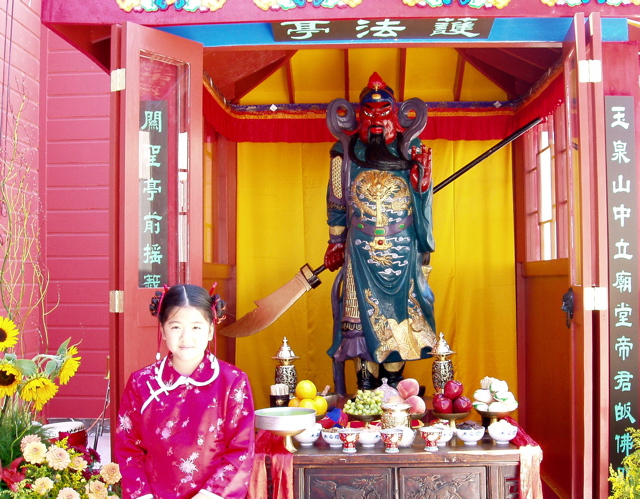
Statue of Dharma Protector Guan Yu at Hua Zang Si.

Statue of Dharma Protector Guan Yu at Hua Zang Si.

Every year Hua Zang Si and other temples celebrate the holy birthday of the Dharma Protecting Deity, Guan Yu to pray that disasters will be minimized, evil eradicated, and good promoted so as to bring harmony to families and happiness to our life and to safeguard the country.

The couplets on the pavilion of the Dharma Protecting Deity express the profound dharma expounded by H. H. Dorje Chang Buddha III Wan Ko Yeshe Norbu. The first line of the couplets is “Yu quan shan zhong li miao tang di jun gui fo men.” This explains that Guan Yu took refuge in Master Zhiyi at Yuquan Hill. He then manifested great supernatural power and constructed the Yuquan Temple overnight on a barren lot, where he resolved to become a protector of Buddhism. The other line of the couplet is “Guan sheng ting quian yao qian yun ling gan shi guo yin.” Even before the statue of Guan Yu was installed at Hua Zang Si, it has manifested great efficacious power. It is for these reasons that it is most auspicious to have this pavilion and statue in the temple garden.

Skanda Bodhisattva

Skanda Bodhisattva

Skanda Bodhisattva

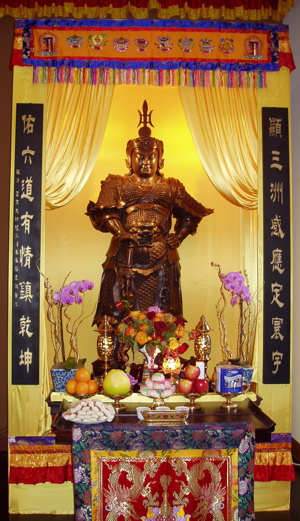
While Guan Yu Bodhisattva watches over and protects our worldly affairs, Skanda Bodhisattva protects our spiritual affairs, watching over dharma matters.

The Holy Shrine of Skanda Bodhisattva at Hua Zang Si has two couplets about Skanda Bodhisattva written by H.H. Dorje Chang Buddha III:

xian san zhou gan ying ding huan yu

you liu dao you qing zhen qian kun

The first line of the couplet by H.H. Dorje Chang Buddha III Wan Ko Yeshe Norbu is “xian san zhou gan ying ding huan yu.” Its basic meaning is as follows. Skanda Bodhisattva is a great dharma protector who is constantly with us. He protects all sentient beings in the entire universe. Through meditation, he looks over the entire universe.

The second line of the couplet is “you liu dao you qing zhen qian kun.” Skanda Bodhisattva has great compassion. He compassionately blesses and protects all living beings whose lives are in correspondence with the dharma. He comes and goes day and night as he supernaturally observes what happens on earth. He often uses his samadhi powers to stabilize all things in the universe.

Skanda Bodhisattva’s birthday is celebrated on or near the third day of the sixth lunar month each year.

Guan Yu Bodhisattva watches over worldly matters while Skanda Bodhisattva watches over dharma

Link: https://wisdomtea.org/2023/04/20/dharma-protectors/

Buddha-Bestowed Nectars Unexpectedly Appeared

Buddha-Bestowed Nectars Unexpectedly Appeared

By Zhaxi Zhuoma

(Reported from Los Angeles) Expounding the Absolute Truth Through the Heart Sutra is truly a supreme holy scripture. On March 7, 2014 CE, a dharma assembly of empowerment with this treasure book was held for the first time at the Holy Manifestation Temple in the United States of America. The treasure book Expounding the Absolute Truth Through the Heart Sutra, the six great dharmas, holy mantras, and letters of petition to be chanted and practiced by the seven types of cultivators, and dharma water and willow branches were presented to the dharma rostrum for worshipping. Forty six (46) pieces of first-publishing stamping seals to be empowered by the dharma water were placed at the front.

Dharma King Gar Tongstan Ciren Gyatso escorted the purple-colored brass dharma bowl that he had beseeched in person from H.H. Dorje Chang Buddha III to the Holy Manifestation Temple. The dharma bowl was then placed onto the elegantly carved granite fortune-beseeching platform. Elder Dharma King Gar Tongstan, Kaichu Rinpoche who is over the age of 80, and Gongga Rinpoche who is 20 years old performed the leading roles of dharma practice at the dharma assembly. Dharma King Gar Tongstan handed the dharma bowl to Kaichu Rinpoche in person. After the rituals of praying and bathing the mandala, Gongga Rinpoche fetched clear water and washed the dharma bowl as watched by everyone. Then the dharma bowl was presented onto the fortune-beseeching platform. All attendees of this dharma assembly were rinpoches, dharma masters, and acaryas. They all started to chant the Six Character Great Bright Mantra and the Heart Sutra with great devotion.

Dharma King Gar Tongstan is using the Seven-Component (with nectars being the leading one) Holy water to empower the stamping seals and ink paste to be used for the first-publishing memorial edition of Expounding the Absolute Truth Through the Heart Sutra

About a little over ten minutes after the dharma assembly had begun, gusty winds suddenly started to roll in the sky. The sounds of whoosh signaled the arrival of many holy dharma protectors. However, the yellow-satin banners covering the walls of the dharma tent were not rolled up by the strong winds. At this time, disciples each saw different holy magnificent states that were beyond description by words! After the chanting of the sutra and the mantra had stopped, Gongga Rinpoche was going to pour six glasses of dharma water into the dharma bowl at the center. Suddenly, he saw through the transparent cover of the dharma bowl light being emitted within the bowl. Upon looking closely, many nectars were seen inside the bowl. With astonishment and joy, he immediately prostrated to the dharma bowl. The site of the dharma assembly was filled with a scene of happiness and delight. People all went forward to view the dharma bowl respectfully. Some people saw that the nectars were five-colored. Some saw the nectars as being purple-red colored. Some others saw the nectars as being white. The shapes and forms of the nectars were unlike any objects or matters in the human world. The nectars were truly wonderful and miraculous beyond description!

People present all praised the holy scene with surprise and joy. After this period of excitement, the six glasses of dharma water were merged with the nectars. Holy water of seven components, with nectars being the leading one, was created in the dharma bowl. Dharma King Gar Tongstan used willow branches to sprinkle the holy water onto the first-publishing stamping seals to empower the ink paste and the stamping seals. He also knocked the dharma bowl to have it ring loudly to manifest the voice of the dharma transmitting through the sky to everywhere in the dharma realm to benefit living beings with perfect good fortune and wisdom.

Attendees all witnessed Buddhas bestowed nectars at the dharma assembly, as a congratulation to the Supreme Treasure Scripture Expounding the Absolute Truth Through the Heart Sutra.

Attendees all witnessed Buddhas bestowed nectars at the dharma assembly, as a congratulation to the Supreme Treasure Scripture Expounding the Absolute Truth Through the Heart Sutra.

Although H.H. Dorje Chang Buddha III did not come to the site to practice the dharma, because of the presence of the scripture Expounding the Absolute Truth Through the Heart Sutra expounded by His Holiness the Buddha, the boundless merit and realization power of His Holiness the Buddha still invoked Buddha-bestowed nectars. All these supreme holy manifestations thoroughly proved that the dharma Expounding the Absolute Truth Through the Heart Sutra expounded by H.H. Dorje Chang Buddha III is the most supreme unsurpassable sutra of Buddhism leading to liberation and accomplishment!

Link: https://wisdomtea.org/2023/03/16/buddha-bestowed-nectars-unexpectedly-appeared/

“After attending that dharma assembly, I fell the warmth from my two feet and no longer need to use a hot-water bag to help me fall asleep. Even when I wake up at night, I would pleasantly find that my feet warm….”

“After attending that dharma assembly, I fell the warmth from my two feet and no longer need to use a hot-water bag to help me fall asleep. Even when I wake up at night, I would pleasantly find that my feet warm….”

By: Disciple Huiyu Qiu

In September 2016, I had the good fortune to attend the Dharma Assembly of Empowerment by Kuan Shi Yin Bodhisattva’s Great Compassion held at Hua Zang Si and received very magnificent benefits. I would like to take this opportunity to share my experience and feelings on that day with my fellow cultivators.

At the beginning of the dharma assembly, the presiding master told us to chant the mantra first. The rhythm of chanting was rather slow and the sound was very wonderful and beautiful. My feeling was completely different from my experience of the chanting I normally did.

After chanting for a short while, without knowing any reason, my father, my husband, and my two children suddenly appeared in my mind. The appearance of my father was especially clear. Sadness rose in me and tears streamed down through my face. I thought that they had not taken refuge in Buddhism and did not have the affinity to learn the true dharma of the Tathagata. That was the reason that I could not bear the sad feeling.

I stopped weeping and continue to chant. At that time, my grandparents from both my mother’s side, who have passed away and my father’s side as well as some other family members and relatives all appeared before my eyes. Though the view just flashed by me momentarily, I felt that I saw each of them clearly. I thought about the fact that some of them had not taken refuge while some others, though had taken refuge, were still not diligently making a good effort to learn and practice Buddha-dharma. Thinking that they would surely be in very miserable and lonely situations in the future, I could not suppress my sad mood and wept again.

Then I stopped weeping and continued to chant. Next, the faces of my father, husband, and children emerged before my eyes again. Every time I saw them, my heart was painfully pulled. I could not keep myself from weeping.

I once again stopped weeping and joined the chanting again. At this time, my ears clearly heard the voices of chanting the mantra from the crowd. However, my heart felt that I heard a voice of shouting for rescue. It sounded like a desperate yelling for help from someone who was completely surrounded by a situation of despair and horror. I had a very shocking feeling at the time. Clearly, this is the call for help from living beings, begging Buddhas and Bodhisattvas to rescue them! We are sincerely beseeching Buddhas and Bodhisattvas to save us and cross us over, to lead us to leave the abyss of pain and suffering in samsara forever! At this time, the sadness and bitterness in my heart were beyond description by words. Thus, I cried again with my face covered by tears.

After chanting the mantra, the dharma master announced that the dharma assembly would formally begin. I kept my body in a fixed posture and closed my eyes. I did my best to stay calm.

Very soon, the sound of patting came from behind. Also, people on my right side generated different kinds of sound. Someone before me was crying and fell to the ground. I sensed that she later moved to lie next to my feet (not sure whether she was actually lying down or not) and touched me a few times. I tried not to think about that. Shortly after that, she moved to behind me and started to pat the rear of my left foot and then my right foot. My right foot was hit with more power and more frequently. I dared not move myself at all and tried my best to keep my mind calm. However, I was still somewhat at a loss since I did not know what she might do to me next. When the patting stopped, I felt that she was still behind me. After a while, my right foot was again patted a few times. After that, she seemed to have left me. My eyes were always closed during this period. I dared not open my eyes.

My two arms felt more and more tired. I put my arms down twice and raised them again. After putting down my arms the last time, I felt that my neck began to rotate very slowly from right to left. After rotating two rounds, it went the opposite direction. At that time, I could not be sure whether this was an empowerment from Kuan Shi Yin Bodhisattva or a response made by myself due to being eager to receive empowerment.

Next, my both shoulders began to turn from the front to the back.

After that, I heard singing. I could not hear the words of singing clearly. At this time, my shoulders continued turning and the speed seemed to be faster.

Finally, I could hear clearly that the song was the Six Character Great Bright Mantra and “Namo Kuan Shi Yin Bodhisattva.” I first followed the singing with humming and then joined with my open voice. At this time, the movement of my two hands became bigger. My hands were swinging back and forth and left and right, as if doing a stretching exercise. However, all movements were spontaneous and beyond my own control.

At this time, I heard a fellow sister behind me speaking loudly in Cantonese. She seemed to be saying that we have committed lots of sins and evil deeds in the past and therefore we now must repent earnestly and so on.

My hands continued swinging. I followed the singing and joined from time to time. At this time, my hand movement changed and turned into a movement of dancing. That was the hand gesture in a Chinese classic dance. I was dancing to the singing. My heart was filled with the joy of the dharma. With a smile on my face and while singing lightly, I made all kinds of wonderful movement with my hands (At least I felt that my hand movement was very wonderful.). Totally without any control, I felt that all movements were so smooth, fluent, and natural. Though my eyes were always closed, my mind was very clear and very much open. I was clearly aware what gestures and movements were performed by my hands. However, the dancing and moving of my hands was not directed by my own mind.

My two hands kept waving and moving. However, when the master leading the dharma practice called out “Stop!”, my hands gradually moved to a position before my chest and stopped there.

After the perfect conclusion of the dharma assembly, the attending crowd went together to perform the ending practice of saving living beings from captivity. On the trip of driving back home, I unexpectedly noticed that my two feet were warm. This was something extraordinary to me. For quite a number of years, my two feet were rather cold. In particular, I must have a hot water bag prepared before going to bed. Otherwise I would not be able to fall asleep. Even if I went to sleep after having a hot bath or having my feet soaked in hot water, my feet would still be cold. Sometimes when I did not use a hot water bag, I would wake up at night with my feet being ice-cold. I could feel the chilly air from my bones and would even tremble. At that time, I had to have the hot-water bag ready immediately. After attending that dharma assembly, I fell the warmth from my two feet and no longer need to use a hot-water bag to help me fall asleep. Even when I wake up at night, I would pleasantly find that my feet warm.

I am grateful to the empowerment bestowed on me by the greatly loving and greatly compassionate Kuan Shi Yin Bodhisattva!

Additionally, I also had an unexpected discovery. The ankle joints in my two feet were no longer in pain. I could not remember since when my ankle joints started to ache, but it should have been for quite a while. I did not know what the cause was either. Normally, there was no pain if I do not touch them. However, it was very painful if the spot was pressed. Therefore, when I sat crossed legged to practice meditation, a towel or a blanket must be placed under my feet. Otherwise I would not be able to keep myself in a sitting position.

Yesterday evening, while chatting with my family members after dinner, I reached out to massage the ankle joints on my right foot as I used to do. I did not even feel any pain at all. I immediately pressed the ankle joints on my left foot and did not feel any pain either. I dared not believe that fact at the time and repeatedly pressed the spots many times. It was really true that I had no pain at all.

I once again express my gratitude to the greatly loving and greatly compassionate Kuan Shi Yin Bodhisattva!

This dharma assembly was very magnificent. The attending crowd were also empowered by Kuan Shi Yin Bodhisattva’s great compassion and were full of the joy from the dharma. Had I not experienced the occasion in person, I absolutely would not be able to imagine the inconceivable feeling and benefits I had when the empowerment from Buddhas and Bodhisattvas came to me!

I gratefully prostrate to H.H. Dorje Chang Buddha III!

I gratefully prostrate to the greatly loving and greatly compassionate Kuan Shi Yin Bodhisattva!

I gratefully prostrate to all Buddhas and Bodhisattvas in the ten directions!

Link: https://wisdomtea.org/2023/02/23/after-attending-that-dharma-assembly-i-fell-the-warmth-from-my-two-feet-and-no-longer-need-to-use-a-hot-water-bag-to-help-me-fall-asleep-even-when-i-wake-up-at-night-i-would-pleasantly-fin/

Good Fortune

Good Fortune

Good Fortune is symbolized by the Chinese characters “fu bao” which are usually translated as having abundant happiness and blessings or living a “good life” including having high status, good health, and longevity. It also includes being free of calamities or avoiding disasters as expressed by the Chinese “mian zai.” However, like many of these Buddha-dharma “jewels” it has a deeper meaning as well. It also represents the accumulation of merit, one of the two accumulations or resources necessary to become a Buddha. You accumulate merit to acquire the body of a Buddha. The other is the accumulation of wisdom. You accumulate wisdom to acqure the mind of a Buddha. You acquire good fortune by practicing the basic precepts of the Buddha: “Cease Evil, Do Good, and Help Others.”

There are many aspects of Good Fortune that we need to understand in taking the “Quick Path to Enlightenment.” This includes its “worldly” aspects as well as its holy qualities. Since your fortune is determined by the laws of karma, it is also important that you have an understanding of karma as well.

Link: https://wisdomtea.org/2023/01/19/good-fortune/

Three foods options to boost immune system

Three foods options to boost immune system

If you’re looking for ways to prevent colds, the flu, and other infections, then you can try these 3 food options. Feeding your body with these 3 food options may keep your immune system strong.

#1 Citrus fruits

Vitamin C, or ascorbic acid, is a water-soluble vitamin well known for its role in supporting a healthy immune system. Most people turn straight to vitamin C after they’ve caught a cold. That’s because it helps build up your immune system.

Vitamin C is thought to increase the production of white blood cells, which are key to fighting infections.

Citrus fruits are an excellent source of vitamin C that fights free radicals in the body which may help prevent or delay certain cancers and heart disease, and promote healthy aging.

Popular citrus fruits include grapefruit, oranges,  clementines, tangerines, lemons, and limes.

#2 Red Bell Peppers

A cup of chopped red bell pepper contains nearly three times more vitamin C than an orange—190 mg. Red peppers are also a great source of vitamin A, which promotes eye health.

#3 Broccoli

Broccoli is one of the healthiest vegetables you can put on your plate.

One cup of raw chopped broccoli has 81 mg vitamin C. That’s not quite as much as orange juice, but a big serving of raw broccoli provides most of the vitamin C you’ll need for one day.

Link: https://wisdomtea.org/2022/12/22/three-foods-options-to-boost-immune-system/

Finding a True Vajra Master

Finding a True Vajra Master

The practice of esoteric Buddhism depends on establishing the proper relationship with an authentic vajra master. This requires that a karmic affinity exists between the master and the disciple. A disciple must carefully choose his or her master and the master must select the disciple as well to determine whether or not the potential disciple is a suitable vessel to receive and understand the teachings of Buddhism. An unqualified disciple is not allowed to receive the great tantra. Once the relationship between a disciple and a vajra master is established, the disciple must respect his or her master as a Buddha throughout his or her lifetime. Once you have found an authentic master, you should begin to learn the teachings in a fully committed, whole-hearted way. If there are Bodhisattva masters present, you should learn from them. The rules of the dharma require that you must learn from your vajra master in order to attain accomplishment.

It is critical in practicing esoteric Buddhism that you envision the master as being capable of developing the fundamentals and that you rely on this master for your liberation by faithfully establishing your actions, speech, and thought to be the same as your master’s. Paying utmost and sincere respect to your master is essential to the way of becoming a Buddha. This is because when the master is treated with respect as a Buddha, you are learning from a Buddha and only a Buddha can liberate you. If you cannot see your master as a Buddha, how can he or she confer the special blessings of a Buddha that can enable you to become enlightened? If you view your master as an ordinary person you will definitely only receive the results of an ordinary person, no matter what level of realization the master may have.

You must know that your three karma gates (conduct, speech, and thought) must correspond to the three karmas of your vajra master. However, it is essential to clearly evaluate and verify the qualifications the master possesses. If the master does not have an understanding of the sutras, possess the realizations of Buddha-dharma, or is able to perform two or three of the five vidyas that are beyond the ordinary person’s abilities and powers, the master is not qualified. This so-called master is an ordinary person and is not qualified to be considered a master. Corresponding to the three karmas of a unqualified master can lead you to being guilty of the most heinous crimes.

The three steps of showing respect to a vajra master are:

1.  Do your best to serve and please your master.

2.  Have complete confidence in the teachings of your master.

3.  Treat your master and the Buddha as one and the same.

There are many different types and levels of masters:

  • The refuge master
  • The conditional or basic master (sometimes referred to as a doctrine master)
  • The vajra master

Your refuge master is the one from whom you receive the refuge vows and precepts and who teaches you how to practice the refuge state.

The conditional or basic masters, who may or may not also be your refuge master, are kind and dignified Buddhist teachers who are very knowledgeable and compassionate. This is the master that you listen to for his or her interpretation of the sutras or discourses. These discourses are according to the teachings of sutra-pitaka. When the conditions are right, you may study or learn from such a master. Even a great vajra master or dharma king may serve as your conditional master or even your refuge master.

On the other hand, the vajra master teaches the tantra and confers the tantric initiation. Your vajra master is the master who transmits the Buddha-dharma to you and initiates you in the Buddha-dharma. The disciple follows the doctrine of this master in the practice of the disciple’s yidam. The vajra master also teaches and transmits the doctrines of exoteric Buddhism. The high level vajra masters have acquired liberation from the cycle of birth and death and have already obtained the dharmakaya themselves.

The highest of all is the dharma king master who represents the highest accomplishments of all with an understanding of the Tripitaka and tantras that is equal to the Buddha, who is able to conduct all of the inner tantra initiations, and who has the highest level of achievement in all of the five vidyas. Such a being has direct contact with the Buddhas and Bodhisattvas and can exhibit supernatural powers both in the mandala and in other ways.

A disciple may take refuge with any vajra master who can meet the qualifications listed below and who can arrange that the disciple will receive the appropriate inner tantra initiations when the disciple is ready to receive them, either by conducting them or by having his or her vajra master conduct them. This means that a beginning vajra master must have as his or her master an authentic inner tantra master or a dharma king or Buddha who will serve as the disciple’s “Grand Master” and give the highest initiations. If you want to achieve liberation, you should not take as your master one who does not meet these standards.

As a minimum, any master must have very high moral achievement; must understand the meaning of the Buddha’s teachings and have command of sutra and tantra; is conversant in the five vidyas; can continue the dharma lineage by having sufficient merit to disseminate the Buddha-dharma to liberate all sentient beings; and have received the Vajra Acarya Initiation or other form of certification from someone who possesses the qualifications to bestow it. A vajra master must also have the other four virtues of always obeying his or her master’s orders; not violating any of the esoteric or exoteric precepts; expounding the Correct Dharma; and having equal compassion for all believers, never giving up on them, and loving everyone—even his or her enemies. In addition, a vajra master should diligently practice the principles explained in “What Is Cultivation?,” perfect the six paramitas, and be able to manifest at least two of the five vidyas. They must also have the approval of their vajra master to enter a mandala and perform empowerments and initiations for disciples. You can count on following such masters to reach liberation.

An inner tantra master, in addition to the above conditions, must possess the mandala power to confer at least one of the inner tantra initiations. The disciple must be able to see evidence that the dharma protecting deities have actually come to the mandala. (In this context, mandala refers to the sacred altar area where initiations are given.) An inner tantra master must be able to document that he or she has met the qualifications for giving inner tantric initiations. A dharma king must possess all four divisions of the inner tantra initiations and the supreme secret inner tantra initiations in addition to all the criteria stated above and greatly excel in all five vidyas. In short, a dharma king must be able to communicate directly with the saints or great holy ones (Buddhas and Bodhisattvas). A true holy dharma king also possesses a vajra dharma wheel (dharmachakra) that can make decisions concerning who should receive which inner tantra initiations as well as perform other miraculous functions.

There is also the Holy Form of Inner Tantra Initiations that is even more rare and will not be discussed here. Read H.H. Dorje Chang Buddha III for more information on this very high form of practice. There are very few people in the world today who can perform it.

You should never be confused by outer appearances. Do not misconceive the false as the true and mistake outer tantra initiation as inner tantra initiation. Most empowerments or initiations given today are only outer tantra initiations. The inner tantra initiation is for people with the utmost Mahayana’s faculty to enter Buddhahood in their current lifetime and not for regular practitioners. Moreover, the saint who can confer an inner tantra initiation is very rare; it is hard to find one in 10,000 great rinpoches. However, you should never look down upon outer tantra initiation and its practices that were also handed down by the Buddhas and also possess the tantra blessing power. If you correspond your three karmas with the teachings of your master and practice accordingly, then you can get out of reincarnation by means of outer tantra initiation.

Practitioner Mi-Kong in How to Recognize the Vajra Tantra states:

“Tantra provides a shortcut for achievement and for the highest level of attainment (that is, for one who practices unexcelled yoga, Supreme Tantra enables one to become a Buddha in the current life, make the whole body transparent, transform miraculously at one’s will and be the same entity as the universe). Hence, many practitioners have devoted their entire life to seeking the utmost tantra since Adharma Buddha (the Adi-Buddha) started teaching tantra. I have studied tantra for decades in Tibet and have seen an enormous amount of tantra—similar to a deep ocean—that is immense, concise and wise. Many great virtuous ones throughout Tibet have achieved Nirvana based on tantra. Consequently, a number of normal Buddhism teachers and false practitioners pretend to be rinpoches or khutukhus and claim themselves to be vajra masters. They teach false tantra. Innumerable innocent people have been deceived and learned nothing but rather wasted time and effort; even worse, some have entered the wrong paths and become the devil’s offspring. Especially during the current degenerate period, it is difficult to distinguish between a Buddha and a devil, and there are more false masters than can be counted. Sentient beings are easily bewildered by false dharma and deceiving masters.”

The United International World Buddhism Association Headquarters has developed a system for determining the qualifications and levels of accomplishment of various masters. You should refer to their public announcements on how to determine the level of any master so that you will not be misled. You should also know that until any master reaches a very high level of non-regression, he or she can devolve into an ordinary being even though he or she was once a true vajra master. Reading the 128 Evil and Erroneous Views and listening to recorded dharma discourses given by H.H. Dorje Chang Buddha III are also helpful in knowing what to look for in a vajra master.

Link: https://wisdomtea.org/2022/12/15/finding-a-true-vajra-master/

True innocence relieves the suffering of many

True innocence relieves the suffering of many

Once upon a time, the Enlightenment Being was born as a fish in a pond in northern India. There were many kinds of fish, big and small, living in the pond with the Bodhisatta.

There came to be a time of severe draught. The rainy season did not come as usual. The crops of men died, and many ponds, lakes and rivers dried up.
The fish and turtles dug down and buried themselves in the mud, frantically trying to keep wet and save themselves. The crows were pleased by all this. They stuck their beaks down into the mud, pulled up the frightened little fish, and feasted on them.

The suffering of pain and death by the other fish touched the Enlightenment Being with sadness, and filled him with pity and compassion. He realized that he was the only one who could save them. But it would take a miracle.

The truth was that he had remained innocent. by never taking the life of anyone. He was determined to use the power of this wholesome truth to make rain fall from the sky, and release his relatives from their misery and death.

He pulled himself up from under the black mud. He was a big fish, and as black from the mud as, polished ebony. He opened his eyes, which sparkled like rubies, looked up to the sky, and called on the rain god Pajjunna. He exclaimed, “Oh my friend Pajjunna, god of rain, I am suffering for the sake of my relatives. Why do you withhold rain from me, who am perfectly wholesome, and make me suffer in sympathy with all these fish?”

“I was born among fish, for whom it is customary to eat other fish – even our own kind, like cannibals! But since I was born, I myself have never eaten any fish, even one as tiny as a rice grain. In fact, I have never taken life from anyone. The truthfulness of this my innocence gives me the right to say to you: Make the rains fall! Relieve the suffering of my relatives!”

He said this the way one gives orders to a servant.

And he continued, commanding the mighty rain god Pajjunna: “Make rain fall from the thunderclouds! Do not allow the crows their hidden treasures! Let the crows feel the sorrow of their unwholesome actions. At the same time release me from my sorrow, who have lived in perfect wholesomeness.”

After only a short pause, the sky opened up with a heavy downpour of rain, relieving many from the fear of death – fish, turtles and even humans. And when the great fish who had worked this miracle eventually died, he was reborn as he deserved.

Link: https://wisdomtea.org/2022/12/08/true-innocence-relieves-the-suffering-of-many/

Giving thanks can make you happier

Giving thanks can make you happier

Each holiday season comes with high expectations for a cozy and festive time of year. However, for many this time of year is tinged with sadness, anxiety, or depression. Certainly, major depression or a severe anxiety disorder benefits most from professional help. But what about those who just feel lost or overwhelmed or down at this time of year? Research (and common sense) suggests that one aspect of the Thanksgiving season can actually lift the spirits, and it’s built right into the holiday — being grateful.

The word gratitude is derived from the Latin word gratia, which means grace, graciousness, or gratefulness (depending on the context). In some ways, gratitude encompasses all of these meanings. Gratitude is a thankful appreciation for what an individual receives, whether tangible or intangible. With gratitude, people acknowledge the goodness in their lives. In the process, people usually recognize that the source of that goodness lies at least partially outside themselves. As a result, being grateful also helps people connect to something larger than themselves as individuals — whether to other people, nature, or a higher power.

In positive psychology research, gratitude is strongly and consistently associated with greater happiness. Gratitude helps people feel more positive emotions, relish good experiences, improve their health, deal with adversity, and build strong relationships.

People feel and express gratitude in multiple ways. They can apply it to the past (retrieving positive memories and being thankful for elements of childhood or past blessings), the present (not taking good fortune for granted as it comes), and the future (maintaining a hopeful and optimistic attitude). Regardless of the inherent or current level of someone’s gratitude, it’s a quality that individuals can successfully cultivate further.

Link: https://wisdomtea.org/2022/11/17/giving-thanks-can-make-you-happier-2/

https://www.health.harvard.edu/healthbeat/giving-thanks-can-make-you-happier