BRIEF DESCRIPTION OF THE INCARNATION OF DORJE CHANG BUDDHA

BRIEF DESCRIPTION OF THE INCARNATION OF DORJE CHANG BUDDHA

Dorje Chang Buddha is Buddha Vajradhara (金剛總持, pronounced jin gang zong chi in Chinese, which literally means “Supreme Ruler of the Vajra Beings”) and is also called in Chinese 持金剛 (pronounced chi jin gang, which literally means “Ruler of the Vajra Beings”). Dorje Chang Buddha is not 金剛持 (pronounced jin gang chi in Chinese, which means “Practitioner of the Vajra” as explained below). In English, people often use the word vajradhara to refer to a 金剛持 (jin gang chi), or Practitioner of the Vajra. Actually a 金剛持 (vajradhara) is a master or guru. BuddhaVajradhara is a Buddha. Moreover, Buddha Vajradhara is the primordial sambhogakaya Buddha whose sambhogakaya manifested out of the dharmakaya of Adharma Buddha (Adi Buddha, or Samantabhadra Tathagata). All of the Buddha-dharma of Buddha Vajradhara originated from the tathata (true suchness) of Samantabhadra Tathagata. With respect to the dharmakaya of Samantabhadra Tathagata, there is no past and no future. Without form yet not empty, He neither comes nor goes. There are no Buddhas above Him to become. There are no living beings below Him to be saved. Such is His absolute truth. Thus, the dharma-body state of Samantabhadra Tathagata is without signs or characteristics, without speech, and without form. As such, there is no subject or being who could expound the dharma. Without such a subject or being, the multitudinous living beings could not be saved.

Because of such karmic conditions, the formless dharmakaya Buddha generated the first sambhogakaya Buddha with form. This sambhogakaya Buddha with form transformed into Vajrasattva and other nirmanakayas. In order to make a distinction between those three, the dharmakaya Buddha was named Adharma Buddha; the sambhogakaya Buddha was named Dorje Chang Buddha; the nirmanakaya was named Vajrasattva. Actually, all three are Samantabhadra Tathagata, all three are Adharma Buddha, and three are Dorje Chang Buddha. In truth, there are not two Buddhas. These distinctions are due to a dharmakaya, sambhogakaya, and nirmanakaya. Based on this dharma, Samantabhadra Tathagata did not directly incarnate. Even the ancient Buddha Dipankara and Vajrasattva were the nirmanakayas of Dorje Chang Buddha.

Dorje Chang Buddha is also called Buddha Vajradhara or Ruler of the Vajra Beings (持金剛 chi jin gang). In the entire universe, Dorje Chang Buddha is the first Buddha with form and is the highest Buddha. That is, the highest leader of Buddhism in the entire universe came into being in the form of Dorje Chang Buddha. It was Dorje Chang Buddha who began transmitting dharma and saving living beings in the dharmadhatu. As a result, Buddhism was born and the Buddha-dharma began spreading.

However, many sects and lineages list Samantabhadra Tathagata as the first Buddha who began all the lineages in the dharmadhatu. This way of thinking is actually correct as well. That is because although Samantabhadra Tathagata is a dharmakaya without form and has no way of speaking, the origin lies with this dharmakaya from which the sambhogakaya Dorje Chang Buddha manifested. This sambhogakaya Buddha was the first one to spread the Buddha-dharma in the dharmadhatu. That sambhogakaya Buddha also transformed into Vajrasattva and other nirmanakayas whospread the dharma in the triloka (three spheres). Because of the birth of Dorje Chang Buddha, living beings were thus able to become holy beings in accordance with His dharma teachings.

We often see in dharma books a blue image of Adharma Buddha. Actually, this image is a symbol. Such a symbolic form is necessary since the tathata emptiness of Adharma Buddha is invisible and cannot be depicted in a thangka. There is no way to draw the shape of emptiness. The dharmakaya has no features that can be pictorially depicted. In fact, the concept of dharmakaya is the absolute truth of the universe (dharmadhatu) that is not born and does not perish. The sambhogakaya Buddha (Buddha Vajradhara) manifested out of this concept of not being born and not perishing.

Dorje Chang Buddha is the ancient, primordial sambhogakaya Buddha. He has the unsurpassed virtuous appearance that all of the Buddhas in the ten directions have. He was the first in the dharmadhatu and triloka (three spheres) to express the dharma. Therefore, Buddha Vajradhara, or Dorje Chang Buddha, is actually the greatest leader of Buddhism in the entire dharmadhatu. He is the original ancestor of Buddhism.

However, many Buddhists misinterpret Dorje Chang Buddha, or Buddha Vajradhara, as being a 金剛持 (jin gang chi), or Practitioner of the Vajra (i.e. vajradhara). This is a mistake in a matter of principle that carries with it a karmic offence. Buddha Vajradhara has the meaning of one who is in charge of and has supervision over all of the vajra beings. Thus, He is the 持金剛 (chi jin gang) or Ruler of the Vajra Beings, the one who has dominion over the vajra beings. On the other hand, a 金剛持 (jin gang chi), or Practitioner of the Vajra (i.e. vajradhara), is one who learns the dharma and teaches others. Such a person enlightens himself and others. The term 金剛持 (jin gang chi), or Practitioner of the Vajra, connotes Vajra Master. There is a world of difference between a 金剛持 (jin gang chi) or Practitioner of the Vajra on the one hand and a 持金剛  (chi jin gang) or Ruler of the Vajra Beings on the other hand.

Buddha Vajradhara (also called Ruler of the Vajra Beings) has passed down dharma to all of the Buddhas and Bodhisattvas, who received such dharma. All of the Buddha-dharma of both exoteric and esoteric Buddhism was originally transmitted by this Ruler of the Vajra Beings. The 84,000 dharma methods that Sakyamuni Buddha taught were transmitted to Sakyamuni Buddha by the ancient Buddha Dipankara, who was a nirmanakaya of Dorje Chang Buddha. Tibetan esoteric Buddhism, which contains all of the dharma of the Nyingma, Sakya, Jonang, Kagyu, and Geluk sects, including the Kalachakra Vajra Dharma transmitted by Sakyamuni Buddha; Japanese esoteric Buddhism; and esoteric Buddhism taught by Sakyamuni Buddha contained in the Tripitaka all come from the lineage of which Dorje Chang Buddha is the original ancestor or from the lineage of His nirmanakaya, Vajrasattva. 金剛總持 Buddha Vajradhara or Ruler of the Vajra Beings is the supreme leader of Buddhism in the dharmadhatu. He is not a Vajra Master who is a 金剛持 (jin gang chi), or Practitioner of the Vajra (i.e. vajradhara).

When disciples find a qualified master, they should visualize their Vajra Master as being a Buddha. This is done out of respect for the dharma and respect for one’s lineage. However, no matter what type of master he may be, if his identity or status has not been recognized as a Buddha by rinpoches of great holiness in accordance with the dharma, then he is not a Buddha. Still, the disciple must visualize Him as a Buddha. Even the holy and venerable Vimalakirti, who as the second Buddha Vajradhara, was affirmed as a Tathagata (Buddha) through an announcement of Sakyamuni Buddha.

The incarnation of Dorje Chang Buddha is different from the nirmanakayas of any other Buddha. Such an incarnation is a primordial manifestation of the existence of Buddha-dharma. In each world of living beings, there can be at any one time only one incarnation of Dorje Chang Buddha, who manifests or expresses the existence of the true dharma. There will not be a second incarnation of Dorje Chang Buddha in the same age or era. Only after the first incarnation of Dorje Chang Buddha leaves the world can the second incarnation be born based on karmic conditions relating to the good fortune of living beings. For example, the holy and venerable Vimalakirti, who was the second Dorje Chang Buddha, took birth in this earthly realm in the past. The third Dorje Chang Buddha, H.H. Wan Ko Yeshe Norbu, took birth in this earthly realm more than two thousand years after Vimalakirti left it and only when karmic conditions relating to the good fortune of living beings had matured.

Nobody can get away with falsely claiming to be the incarnation of Dorje Chang Buddha. In order to protect the dignity of the Buddha-dharma in the dharmadhatu and prevent demons from falsely claiming to be Buddha Vajradhara or the Ruler of the Vajra Beings, Buddha Vajradhara must be born with His own dharma and realization so that He may manifest or express the dharma. No other Buddha is able to manifest realization equal to the realization of Dorje Chang Buddha. That is because in order to protect the true dharma, the Buddhas do not manifest realization powers at the sameholy level as the realization of Dorje Chang Buddha. Conversely, all demons lack the power to manifest such realization and therefore cannot manifest such realization.

When Sakyamuni Buddha lived in this world, Dorje Chang Buddha took birth as the holy and venerable Vimalakirti, who helped Sakyamuni Buddha teach the 500 monks and 8,000 Bodhisattvas. The holy and venerable Vimalakirti, who was the second incarnation of Dorje Chang Buddha, had the highest wisdom and the greatest ability to manifest supernatural powers as an expression of dharma. No other holy being could match Him.

H.H. Mahavairocana Tathagata formally pronounced that the third incarnation of Dorje Chang Buddha, H.H. Wan Ko Yeshe Norbu, must meet five conditions: He must successfully invoke the Buddhas to bestow nectar. He must be able to perform the Golden Vase Selection of Karmic Affinity and predict the results of that ceremony beforehand. He must be able to eliminate the karmic obstructions of disciples. He must be able to take mist, place it inside a hollowed out sculpted boulder, and have the mist stay there. He must be able to carve wondrous multicolored sculptures.

The formal pronouncement stated that no other holy being could repeat those five types of accomplishments. It also stated that if any other person of great holiness repeat those five types of accomplishments, then Mahavairocana Tathagata’s recognition that H.H. Wan Ko Yeshe Norbu is Dorje Chang Buddha is false, and the pronouncement has deceived the public in order to build up a false reputation.

The facts have proven that in this world there is no being of great holiness and virtue or even an expert who is able to match the accomplishments of H.H. Dorje Chang Buddha III Wan Ko Yeshe Norbu. Furthermore, great dharma kings on the level of a Buddha or Bodhisattvahave unanimously recognized the identity of H.H. Wan Ko Yeshe Norbu through recognition certificates. This thoroughly proves that no one can get away with falsely claiming the identity or status of Dorje Chang Buddha.

In order to prevent demons from wreaking havoc by falsely claiming to be the incarnation of Dorje Chang Buddha, the required number of many holy beings must recognize the incarnation of Dorje Chang Buddha. Furthermore, many additional holy beings must bear witness to the veracity of the recognition and respectfully offer congratulations. The many holy beings who recognize the incarnation of Dorje Chang Buddha must be Buddhas, Bodhisattvas, or great dharma kings. Those who bear witness to the veracity of the recognition and respectfully offer congratulations must beextremely holy and virtuous Bodhisattvas. All of those who recognize, bear witness, and respectfully offer congratulations must be famous leaders within Buddhism and great rinpoches. If the identity of the person was not recognized by those on such a holy level, if congratulations were not respectfully offered to him by those on such a holy level, and if he does not have legitimate recognition certificates, then his claims that he is a holy being are false.

People say, “So-and-so rinpoche is universally recognized as the incarnation of Buddha Vajradhara.” This way of speaking is based on heretical and erroneous understanding. It is not in accord with the rules of true Buddhism. Where is the realization of this rinpoche that an incarnation of Buddha Vajradhara would have? Does this rinpoche have complete proficiency in both exoteric and esoteric Buddhism? Does he have full mastery of the Five Vidyas? Which five dharma kings have recognized his identity as being Buddha Vajradhara and which ten dharma kings or rinpoches have certified that recognition? Can he show others a recognition certificate showing he is the third Buddha Vajradhara? Which several famous people of holy virtue respectfully offered congratulations to him for being recognized? No matter how high a certain monastic may be, if he does not have true realization and the required written recognitions andcongratulations stating he is the third incarnation of Buddha Vajradhara, then all claims by others that he is Buddha Vajradhara are flattery, exaggeration, and rumors.

Hence, one must understand that Buddha Vajradhara (金剛總持, jin gang zong chi) is 持金剛 (chi jin gang, which is a Buddha). On the other hand, a 金剛持 (jin gang chi) is a lama (master). Anyone who misinterprets a 金剛持(jin gang chi) as being a 持金剛  (chi jin gang) or Buddha Vajradhara is undoubtedly placing the status of a mere vajra master over that of Amitabha Buddha and other Buddhas. Such conduct is a terrible offense because according to the sutras and esoteric scriptures Buddha Vajradhara is Dorje Chang Buddha (持金剛   chi jin gang), the Master of the Five Buddhas and other Buddhas.

Link: https://wisdomtea.org/2022/08/18/brief-description-of-the-incarnation-of-dorje-chang-buddha/
Empowerment Of The Buddhas And Bodhisattvas

Empowerment Of The Buddhas And Bodhisattvas

A Personal Experience

by Qiu Hui Yu, a Buddhist disciple of H.H. Dorje Chang Buddha III

Writing articles has never being an easy task for me, the challenge only compounded when it comes to speaking from the heart and the impact the Buddha dharma has had on my life since I embarked on the journey of learning Buddhism.

I have the great fortune to have the opportunity to respectfully listen to the Dharma Discourses expounded by H.H. Dorje Chang Buddha III on a frequent basis. The Buddha repeatedly reminds me that a Buddhist cultivator must resolutely and clearly believe in the laws of cause and effect and be mindful of constantly improve our speech, thoughts and actions.   I planted these teaching deep in my heart. In daily life, I am constantly mindful of my speech, thoughts and action during social interactions and how I manage affairs. And often contemplate and rectify my short comings.   As a result, I become less agitated and my worries and troubling thoughts have reduced.   Things that used to mire me in worry and despair, I can now wave them away with a chuckle. Individuals, whom used to cause me unpleasantness, no longer impose such an unwelcome impression. Just when I commended myself about the improvement, something happened that almost obliterated my clam and peaceful state of mind.

About half a year ago, when a good friend of mine ran into difficulties, I did all I could to help him as a friend. However, things sometimes have minds of their own, not only the results were not as expected, but it roused dissatisfaction and misunderstanding from my friend.   He twisted my pure intention and accused me of purposeful deceit, and even threatened me with legal recourse. Other friends were well aware of my honest intention and supported me with their heart, but they could not tangibly help me in any way. I found myself between a rock and a hard place. I have never found myself in such a precarious situation.   I can honestly say I did nothing wrong, but things were careening down a narrow one way street with no room for maneuvering. I did not know how to face the situation calm and collected. In deep despair facing this seemingly helpless troubling situation, the only thing that I could do was to go to Hua Zang Si and confess to the Buddhas and Bodhisattvas everything and to beseech blessing.

Walking in Hua Zang Si that day, I felt depressed and helpless beyond words. I even felt that I could not breathe. After I paid my homage, I joined my palms and knelt down in front of Buddhas and Bodhisattvas and started to report the entire situation. Then what happened next was something that I shall remembered for the rest of my life. After only three to four sentences, my complex despondence suddenly lifted and my heart became unbelievable calm. It was as if an ominous grey sky suddenly transformed into vast limitless blue sky. This very situation regarded as even more serious as “the sky is falling” just a few seconds ago, suddenly no longer had any effect on me. I felt an indescribable calm and peace that I have never experienced before; it was as if I had been transported to Shari-la. I felt complete ease and tranquility.

I immediately registered this sudden change of my state of mind, tears rushed down my face before I even knew it. I finally felt the empowerment of the Buddhas and Bodhisattvas, something I have yearned for a very long time. From that day forward, nothing fazed me again, I could completely let go of anything. Awhile later the situation with my friend ran its course and resolved in a positive manner. Once again, I want to express sincere gratitude to the Buddhas and Bodhisattvas.

As consequence of this experience now whatever thrown my way, I may feel misunderstood or sad, but I never have even a slight hint of hatred. I could forbear and never put blame on anyone. Reflecting upon it, I am grateful for such an opportunity, because ever since this situation I am able to face anything in my life constructively with rectitude.

This self- transformation could only become possible when I began to learn Buddhism, I understand the laws of cause and effect never errs. Everything that we experience in this life is simply what we have done in the past coming to roost. Whatever happens, do not let it affects us, and definitely there is no need to complain about it. Instead, do our best to pay back the debt and dissolve all the negative karmic causes that we have planted since time immemorial.

From this moment forward, we should faithfully follow the teachings of Buddhas and Bodhisattvas; abide by precepts without deviation, and to correct any imperfection of our speech, thoughts and actions little by little but persistently. As long as we stay on this course persistently, it is unequivocal that Buddhas and Bodhisattvas will confer empowerment upon us, and such empowerment is without bound.

I just want to share this very experience with my fellow cultivators and let it serve as a mutual encouragement. The path of learning Buddhism is long and arduous. We will face challenges and calamities. But as long our goal is clear and correct and we are resolved to reach that goal, as long as we can persist and forebear insult, we will be able to pacify all difficulties and obstacles and be on our way to the brilliant path of enlightenment.

From the bottom of my heart I wish all the cultivators be persistent and plant good karmic causes and elevate ourselves to a higher level in our pursuit of learning Buddhism and may all of us realize Bodhi. Amitabha!

Link :https://wisdomtea.org/2022/07/28/empowerment-of-the-buddhas-and-bodhisattvas-2/

The Pope of Buddhism His Holiness Dorje Chang Buddha III

The Pope of Buddhism His Holiness Dorje Chang Buddha III

The conferment of the Pope of Buddhism to His Holiness Dorje Chang Buddha III originated in January 2018 when the World Peace Prize Awarding Council and World Peace Prize Religious Leaders Title Awarding Council passed the resolution to confer to H.H. Dorje Chang Buddha III the title of Pope of Buddhism, the highest leader of Buddhism in this world. However, His Holiness the Buddha refused to accept the conferment.

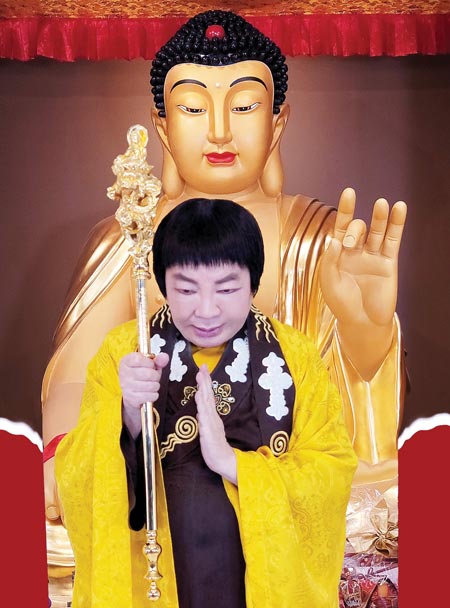
For the sake of propagating Buddha Dharma and benefitting living beings, the World Buddhism Association Headquarters took the liberty to accept the conferment decree and the Pope of Buddhism Scepter. When the World Buddhism Association Headquarters respectfully presented the Pope of Buddhism Scepter and conferment decree to H.H. Dorje Chang Buddha III, His Holiness the Buddha III said: “I see that on top of this Scepter is the seated Shakyamuni Buddha, we should be respectful to Namo Shakyamuni Buddha.” His Holiness the Buddha then raised the Scepter above His head and made a symbolic closed palm gesture with one hand to express His respects. However, H.H. Dorje Chang Buddha III also expressed that He is just a humble cultivator and resolutely would not accept such a conferment. Hence, His Holiness the Buddha immediately returned the conferment decree and the Pope of Buddhism Scepter to the two Councils.

On September 23, 2020, the World Peace Prize Awarding Council and World Peace Prize Religious Leaders Title Awarding Council passed an ultimate joint resolution, determining that the return of the Pope of Buddhism Scepter and conferment decree by H.H. Dorje Chang Buddha III was not effectible. On September 24, the joint Chair of the World Peace Prize Awarding Council and World Peace Prize Religious Leaders Title Awarding Council Suzi Leggett made the ultimate announcement at the Holy Miracles Temple of the World Buddhism Association Headquarters: “Over the past several decades, the World Peace Prize Awarding Council has presented the World Peace Prize to presidents, spiritual leaders, and prime ministers of many nations, including President Ronald Reagan, Hon. Mahatma Gandhi, and H.E. Yitzhak Rabin. There has never been a precedence of an award being retracted or returned. All determinations made and implemented by our Councils are very solemn, serious, and absolutely cannot be changed. The return of the Pope of Buddhism Scepter and conferment decree by H.H. Dorje Chang Buddha III is deemed not effectible. The title, status, and authority of the Pope of Buddhism belong only to H.H. Dorje Chang Buddha III, and cannot be exercised by anyone else.” Chair Leggett once again requested that the World Buddhism Association Headquarters accept and present to H.H. Dorje Chang Buddha III the Pope of Buddhism Scepter and conferment decree that His Holiness the Buddha previously returned.

Representing the World Buddhism Association Headquarters, Venerable Mozhi Rinpoche accepted the conferment decree and Pope of Buddhism Scepter. He said during his speech, “The World Buddhism Association Headquarters considers that the decision made by the two Councils is remarkably proper and sagacious.

“Ever since Namo Shakyamuni Buddha entered parinirvāṇa, there has not been a supreme leader who has the authority to guide all Buddhists the same way that the Buddha did. However, the authoritative position of the Pope of Buddhism certainly is not a role that a leader of a single Buddhist sect would have the attributes to fulfill; rather, the Pope must be a leader who has authority over the entirety of Buddhism, namely, a Buddha.

“Namo H.H. Dorje Chang Buddha III holds the perfect teachings of Buddhism and meets the criteria used by all Buddhist sects to recognize a Buddha. His inherent nature is in accord with that of a Buddha. His unsurpassed, complete, and perfect enlightenment is in accord with that of a Buddha. Just based on the accomplishment of H.H. Dorje Chang Buddha III in Lifting the Pestle onto the Platform, surpassing His own base weight standard by 59 levels, no one else can possibly reach such a record.

“The state of virtue of H.H. Dorje Chang Buddha III is that of a Buddha. His Holiness the Buddha has perfect mastery of Exoteric and Esoteric Buddhism, perfect accomplishments in the Five Vidyas, and so forth, all of which accord with the unsurpassed, complete, and perfect enlightenment of a Buddha.

“In more than 2,000 years, there has not been a Buddhist Holy Guru in this world who possesses the same Buddha level qualities. Just by the facts that H.H. Dorje Chang Buddha III vowed and carries out the vow to benefit living beings purely on a voluntary basis and does not accept any offerings throughout His entire life, and that He possesses perfect wisdom and unimpeded accomplishments, no other Holy Guru can be of comparison. Only Namo H.H. Dorje Chang Buddha III can take on this immensely noble, holy, and heavy responsibility of the Pope of Buddhism, to properly guide Buddhists onto the correct path of learning Buddhism.

“Therefore, on behalf of Buddhists, the World Buddhism Association Headquarters thanks the World Peace Prize Awarding Council and the World Peace Prize Religious Leaders Title Awarding Council for having made the ultimate decision.”

H.H. Dorje Chang Buddha III is selfless and noble, and the first person in Buddhism to possess substantive holy realization power of a Buddha and perfectly flawless accomplishments at the pinnacle of the Five Vidyas. These are the qualities that no other eminent Buddhist monastic or virtuous person in this world has so perfectly attained. It is naturally a matter of course that H.H. Dorje Chang Buddha III is the veritable Pope of Buddhism.

Link: https://wisdomtea.org/2022/04/06/the-pope-of-buddhism-his-holiness-dorje-chang-buddha-iii/

Holy Beings (Saints)

Holy Beings (Saints)


Green Tara (Jetsun Drolma) statue from the Gyantse Kumbum Pagoda, Pelkor Chode Monastery, Gyantse, Tibet

H.E. Tangtong Gyalpo Bodhisattva (1361-1485)

It is through the understanding and practice of the Buddha-dharma that one becomes a holy person–a living jewel. Sainthood in Buddhism has a somewhat different meaning than that held in Christianity although both refer to people who live an exceptionally holy life, are very compassionate, and can demonstrate certain “miracles.” In Buddhism it also means one who has become enlightened—been liberated from the cycle of reincarnation and all its related suffering. The Christian saint aspires to be born in the Christian heaven, but this is not the goal of a Buddhist. A Buddhist saint is one who has escaped samsara or existence all together and gone beyond what is possible in the heavenly realms. A Buddhist saint would live in the Dharma realms or wherever he choses to be to help living beings. A saint in Buddhism is one who, like the Buddha, has become enlightened and realized his or her original nature, possessing the skills and wisdom of a Buddha. They have gained control over life and death and are thus liberated from the cycle of reincarnation. This is true happiness!

“Painting of Monk Jigong” by Master Wan Ko Yee.

In Buddhism saints may not lead what is normally thought of as a “conventional” life. There are many examples of Buddhist saints who exhibited most unorthodox (“deliberate“) behavior. Examples of these kinds of happy, crazy saints are Han-shan and Shih-te, eccentric Ch’an (Zen) hermit-monks from Tang Dynasty, as well as Monk Ji-gong and Birdnest Roshi, but there are many others including the crazy yogis of Tibet like Padmasambhava, Virupa, Manjusrimitra, Tsang Nyon Heruka, and Tangtong Gyalpo. Saints can manifest in innumerable forms and may appear as humans or animals or live in other dimensions.

Japanese hanging scroll by Hashimoto Gaho of Han-shan and Shih-te (Kanzan and Fittoku), eccentric Ch’an (Zen) hermit-monks from Tang Dynasty, whose poetry is popular in the west.

It is important to know that one cannot fully understand what takes place on higher levels of the path. For example, those on the first Bodhisattva stage do not know about what takes place on the second Bodhisattva stage and so on up the path. Those on the second Bodhisattva stage see those on the first Bodhisattva stage as having impurities. Even those on the tenth Bodhisattva stage see those on the ninth Bodhisattva stage as having certain impurities. It is natural that the impurities and obscurations of those on the lower levels would be greater than those at the higher levels. Nevertheless, those who are kind and benefit others can guide and transform living beings no matter where they are on the path. However, ordinary beings and those at the lower levels of the path cannot possibly understand the behavior of true holy beings.

The key features of the various paths to becoming a holy being are summarized in the chart “The Way to Become a Holy Being or Saint.” It is useful to think of these paths as stages on the way to becoming a Buddha. It is interesting to note that the other world religions are also included as initial stages on the way to buddhahood in as much as they teach compassion, loving kindness, some aspects of morality, and discourage evil. Some also teach various forms of training the mind in meditation. Bodhisattvas do not only incarnate as Buddhists to help living being. The three pure precepts of Buddhism—cease evil, do good, and help others—can be practiced in many forms.

You must remember that ALL sentient beings are evolving toward the perfection of being a Buddha, whether they know it or not, and whether at the moment they may be very confused and behaving in foolish or even evil ways. This includes the minions of Mara and the demons of hell as well as the devas or gods in heaven.

Link: https://wisdomtea.org/2022/03/23/holy-beings-saints

H.H. Dorje Chang Buddha III Lineage

H.H. Dorje Chang Buddha III Lineage

When the universe originated, it was boundless and everything was silent. There was no such thing as length of time or size of space. There was no shape and form, no interior and exterior, no birth and death. This is the dharmakaya (dharma body) Buddha. The true meaning of the dharmakaya Buddha is the concept of a universe that does not perish. This concept of a universe that does not perish is also called “dharmadhatu-tathata (dharma realm true-suchness),” which is Samantabhadra Tathagata (Adharma Buddha).

However, the dharmakaya Buddha only expresses the concept of the true essence of the universe; that is, not being born and not dying, not coming and not going. The dharmakaya Buddha has no form and does not speak. It has no way to communicate any meaning, such as meaning through images or meaning through language. Because of such karmic conditions, the formless dharmakaya Buddha generated the first sambhogakaya Buddha with form. This sambhogakaya Buddha with form transformed into Vajrasattva and other nirmanakayas.

In order to make a distinction between those three, the dharmakaya Buddha was named Adharma Buddha, the sambhogakaya Buddha was named Dorje Chang Buddha, and the nirmanakaya was named Vajrasattva. Actually, Samantabhadra Tathagata is Adharma Buddha and also is Dorje Chang Buddha. In truth, there are not two Buddhas. These distinctions resulted from there being a dharmakaya, sambhogakaya, and nirmanakaya.

Based on this dharma, Samantabhadra Tathagata did not directly incarnate. Even the ancient Buddha Dipankara and Vajrasattva were the nirmanakayas of Dorje Chang Buddha. Sakyamuni Buddha was a disciple of Dipankara Buddha. However, many sects list Samantabhadra Tathagata as the first Buddha who began all the lineages in the dharmadhatu. This way of thinking is actually not erroneous. That is because although Samantabhadra Tathagata is a dharmakaya without form and has no way of speaking, the origin lies with this dharmakaya from which the sambhogakaya Dorje Chang Buddha manifested. This sambhogakaya Buddha was the first one to spread the Buddha-dharma and save living beings in the three spheres of existence so that they would become holy beings.

Dorje Chang Buddha is also called Buddha Vajradhara or Ruler of the Vajra Beings. In the entire universe, Dorje Chang Buddha is the first Buddha with form and is the highest Buddha. That is, the highest leader of Buddhism in the entire universe came into being in the form of Dorje Chang Buddha. It was Dorje Chang Buddha who began transmitting dharma and saving living beings in the dharmadhatu. As a result, Buddhism was born and the Buddha-dharma began spreading.

The teachings of Dorje Chang Buddha led to many disciples becoming Buddhas. The five most famous among such disciples are Aksobhya Buddha of the east, Ratnasambhava Buddha of the south, Amitabha Buddha of the west, Amoghasiddhi Buddha of the north, and Vairocana Buddha of the center. There are also many other Buddhas and Bodhisattvas among the original disciples of Dorje Chang Buddha. Dorje Chang Buddha was the one who initially propagated the Buddha-dharma in the dharmadhatu. Dorje Chang Buddha is the supreme leader of all of Buddhism in the dharmadhatu.

The incarnation of Dorje Chang Buddha is different from the incarnation of any other Buddha. Such an incarnation is a primordial manifestation of the existence of Buddha-dharma. In each world of living beings, there can be at any one time only one incarnation of Dorje Chang Buddha, who manifests or expresses the existence of the true dharma. There will not be a second incarnation of Dorje Chang Buddha in the same age or era. Only after the first incarnation of Dorje Chang Buddha leaves the world can the second incarnation be born based on karmic conditions relating to the good fortune of living beings. For example, the holy and venerable Vimalakirti, who was the second Dorje Chang Buddha, took birth in this earthly realm in the past. The third Dorje Chang Buddha took birth in this earthly realm more than two thousand years after Vimalakirti left it and only when karmic conditions relating to the good fortune of living beings had matured. Furthermore, according to the formal pronouncement of H.H. Mahavairocana Tathagata Dharma King Zunsheng, the fourth Dorje Chang Buddha will descend into this world five thousand years from now.

H.H. Wan Ko Yeshe Norbu is the only Dorje Chang Buddha III in the history of Buddhism. This has been recognized by greatly accomplished beings of the highest order in the world as well as famous dharma kings and rinpoches from various sects who have issued written recognition documents in accordance with the dharma!

Link: https://wisdomtea.org/2022/02/09/h-h-dorje-chang-buddha-iii-lineage/

Early Buddhist Sects

Early Buddhist Sects

Sautrantika: One of the early Indian schools of this tradition. Also known as the Sutra-Only School because it focused on just the discourses of the Buddha.

Vaibhasika: An influential early Indian school in north-west India also of this tradition. Its version of the Abhidharma, the Mahavibhasa (The Great Book of Alternatives), was the basis for Vasubandhu’s Abhidharma-kosa that is still studied in Tibetan monasteries and considered to be one of the five classic commentaries or treatises that should be mastered.

Theravada (Lineage of the Elders): This is the form of Buddhism that was transmitted very early to the South-east Asian counties of Sri Lanka (247 BCE) and Burma (272-236 BCE) and later to Thailand (1260), Laos (14th century), Cambodia, and southern Viet Nam. It was between 25 and 17 BCE that the Pali canon or scriptures were first recorded in Sri Lanka. In America it is also popularly known as vipassana or Insight Meditation. The most conservative branch of Buddhism, the Theravadans based their practice exclusively on the Tripitaka of the Pali Scriptures and are the only remaining school evolving out of this tradition. Their focus is the practice of mindfulness, which involves cultivating an awareness of one’s thoughts, actions, and body to become aware of what one does and one’s motivation. This is a prelude to a direct understanding of the transitory, conditioned nature of existence. Theravadans take refuge in the three jewels and follow the five precepts of no killing, no stealing, no inappropriate sex, no inappropriate speech, and no ingesting substances that befuddle consciousness. Monastics must be celibate and cannot claim to have supernormal powers. The goal of one following this path is to become an arhat. It has become a popular form of Buddhism in the United States. Some modern western leaders in this school have questioned if enlightenment is possible or even a useful goal, stressing more the integration of Buddhist concepts and theories with Western psychology and therapy.

When Shakyamuni Buddha lived on this planet over 2500 years ago, he transmitted dharma to the many disciples who followed him. After the Buddha’s Parinivana, one of the Buddha’s foremost disciples, Venerable Mahakasyapa, became the head of the sangha and presided over the First Great Council at Rajagrha that was held to codify the Buddha’s teachings. He was known for his accomplishments in the dharma.

Ananda, the Buddha’s younger cousin and known as “the assistant who heard much,” became the second patriarch in this lineage after Mahakasyapa passed away. As a condition for becoming the Buddha’s attendant, a position he held for 24 years, Ananda requested no preferential treatment and that the Buddha repeat for him any teachings he might miss. He was gifted with total recall and at the First Great Council repeated all of the Buddha’s teachings from memory. His recitation became the basis for the Sutras in the Tripitaka. When Guru Padmasambhava reincarnated eight years after Shakyamuni Buddha left this world, it was Venerable Ananda who transmitted the special dharma that Shakyamuni instructed him to transmit.

The sangha divided into many sects based on different interpretations and emphasis. The main split was between what became known as the Sravakayana (or Path of the Arhats) and Mahayana (or Path of the Bodhisattvas) Vehicles. Of the eighteen or so lessor vehicle sects, only the Theravada School has survived. This is the dominant form of Buddhism practiced in Myanmar (Burma), Cambodia, Laos, Sri Lanka, and Thailand. Today there are over 100 million Theravada Buddhist worldwide with a growing number of temples and groups forming in the West as the people of Southeast Asia migrate to the West.

Many Westerners have also gone to Southeast Asia to study and have brought their own form of usually lay practice to the West, often referred to as Insight Meditation or vipassana. Theravada monasteries have developed in the U.S. that train western monastics, notably the Bhavana Society Forest Monastery and Meditation Center (Sri Lanka) in High View, West Virginia, and Abhayagiri (Fearless Mountain) Monastery (Thai) also in the forest monk tradition in Redwood Valley, California.

Link: https://wisdomtea.org/2022/02/02/early-buddhist-sects/

Early Buddhist Sects

What is Karma?

Photo by Binyamin Mellish on Pexels.com

The law of karma is a special instance of the law of cause and effect, according to which all our actions of body, speech and mind are causes and all our experiences are their effects. The law of karma explains why each individual has a unique mental disposition, a unique physical appearance and unique experiences. These are the various effects of the countless actions that each individual has performed in the past. We cannot find any two people who have created exactly the same history of actions throughout their past lives, and so we cannot find two people with identical states of mind, identical experiences or identical physical appearances. Each person has different individual karma. Some people enjoy good health while others are constantly ill. Some people are seen as very beautiful while others are seen as very ugly. Some people have a happy disposition that is easily pleased while others have a sour disposition and are rarely delighted by anything. Some people easily understand the meaning of spiritual teachings while others find them difficult and obscure.

Every action we perform leaves an imprint, or potentiality, on our very subtle mind, and each imprint eventually gives rise to its own effect. Our mind is like a field, and performing actions is like sowing seeds in that field. Virtuous actions sow seeds of future happiness and non-virtuous actions sow seeds of future suffering. These seeds remain dormant in our mind until the conditions for them to ripen occur, and then they produce their effect. In some cases, this can happen many lifetimes after the original action was performed.

It is because of our karma or actions that we are born in this impure, contaminated world and experience so many difficulties and problems. Our actions are impure because our mind is contaminated by the inner poison of self-grasping. This is the fundamental reason why we experience suffering. Suffering is created by our own actions or karma – it is not given to us as a punishment. We suffer because we have accumulated many non-virtuous actions in our previous lives. The source of these non-virtuous actions is our own delusions such as anger, attachment and self-grasping ignorance.

Once we have purified our mind of self-grasping and all other delusions, all our actions will naturally be pure. As a result of our pure actions or pure karma, everything we experience will be pure. We will abide in a pure world, with a pure body, enjoying pure enjoyments and surrounded by pure beings. There will no longer be the slightest trace of suffering, impurity or problems. This is how to find true happiness from within our mind.

Link: https://wisdomtea.org/2021/12/29/what-is-karma/

Link: https://www.kadampanewyork.org/what-is-karma/

History of Buddhism

History of Buddhism

Over 2500 years ago  Shakyamuni Buddha taught for 45 years in the Ganges River basin of north-east India to many types of followers—from beggars to kings, to monastics and lay men and women. It is said that the Buddha taught 84,000 different Dharmas to help beings free themselves of the suffering of worldly existence caused by the 84,000 different afflictions. A council of 500 arhats was convened immediately after the parinivana of the Buddha by the Venerable Mahakasyapa. During this meeting Venerable Upali recited the monastic rules that became known as the Vinaya while Venerable Ananda recited the Sutras. For 400 years the teachings were only transmitted orally.

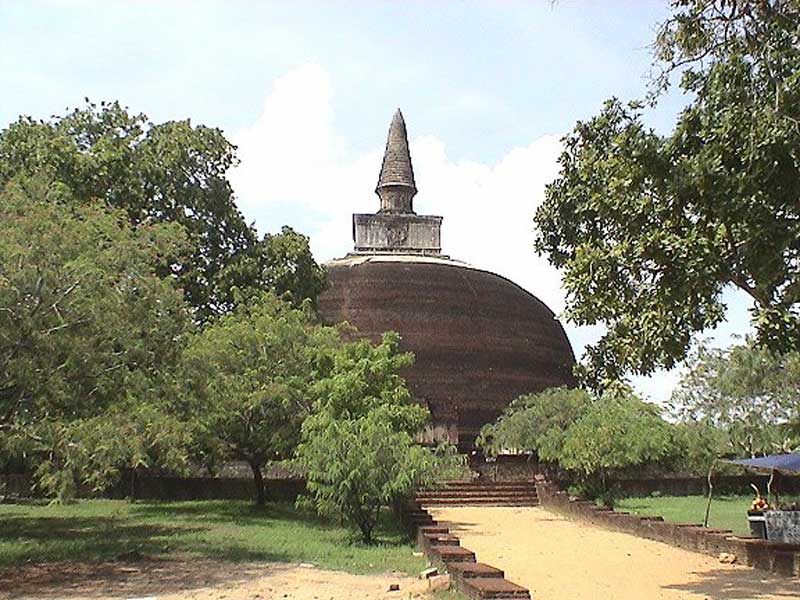
The Jetavanaramaya Stupa built in the third century as part of the Jetavana Monastery in Anuradhapura, Sri Lanka. At 400 feet, it was one of the tallest structures in the ancient world, with only two (the Great Pyramids of Giza) being higher.

In 326 BCE, several hundred years after the Buddha’s death, the Sangha divided into two schools: the Mahasanghika or majority who wanted changes and the Sthaviravada who were opposed to any changes. A hundred years later the Sthaviravada further divided into the Sarvastivada and the Vibhajyavada. The Sarvastivada migrated into northern India in the Kashmir region while the Vibhajyavada flourished in the Ganges River valley under the great Buddhist King Ashoka. In 247 BCE King Ashoka (272-231 BCE) sent his son, the monk Mahinda, and his daughter Sanghamitta, a nun, to Sri Lanka to establish Buddhism there.

By the first century CE there were 18-20 different schools, each with its own version of the Buddha’s teachings. Two written versions remain, at least in part: that produced in Sri Lanka in the ancient language of Pali by the Tamrashatiyas and known as the Southern Transmission and a Sanskrit version from the Sarvastivadas known as the Northern Transmission. These became known as the Tripitaka or three Baskets of the Vinaya or code of rules for monks and nuns, the Sutras or collections of instructional discourses of the Buddha and his closest disciples, and the commentaries that included the Abhidharma, which consists of the extracted and systematized philosophy implicit in the teachings. The Southern Transmission remains as the Pali canon and is followed by the Theravada in Sri Lanka, Burma, Thailand,and other south-east Asian countries. Although only fragments remain of the Northern Transmission in its original Sanskrit, it was translated into Tibetan and Chinese and many of these translations remain. The Tibetan transmission was also translated into Mongolian while the Chinese transmission became the basis for the Korean and Japanese scriptures.

The Buddha started the Mahayana teachings and predicted that great adepts would emerge to revitalize the tradition and explain the teachings that were not yet understandable to the majority of followers. Mahayana Buddhism arose during the 1st or 2nd century BCE from the Mahasanghika. It replaced the concept of the arhat with that of the bodhisattva as the highest ideal of Buddhism. The main difference being that the bodhisattva seeks enlightenment in order to help others, while the arhat is primarily concerned with his own salvation. The mahayana also grew out of the growing lay movements since most of the focus on early Buddhism had been on the monastic communities, although the great mahayana teachers were  also monks.

The Buddha himself was keenly aware of the limitations of words in respect to expressing spiritual reality. There is a famous story of how the Buddha held up a flower before the assembly of monks and smiled, saying nothing. The monks were confused by this. Only the Venerable Mahakasyapa responded, indicating that he understood that the truth is beyond words and doctrine.

The earliest and best-known mahayana scripture is the Prajnaparamita Sutra compiled by the master of the Madhyamaka or “Middle Way” school, the great Mahasiddha Nagarjuna, at the beginning of the Current Era from earlier works and various doctrines expressed by the Buddha while He taught in His nirmanakaya form. The well-known Heart Sutra and the Diamond Sutra represent the essence of these teachings.

Much of the Vajrayana or tantric Buddhism was transmitted by Vajrasattva and other Holy Beings in their sambhogakaya embodiments, although Shakyamuni Buddha started the teachings late in His life and predicted the later teachings. By the time of Nagarjuna there were adepts whose realization was high enough that they were able to communicate directly with these sambhogakaya beings. The basic esoteric teachings Shakyamuni Buddha transmitted directly to His son, Rahula. It is a very, very quick way to achieve realization. If, and only if, you have the opportunity to follow a true Vajra Master can you realize Buddhahood in a single lifetime using this method. It is a highly concentrated form of Buddhism. It gives you many supernormal powers. Only highly qualified people can receive this. Actually, for most beings, it is easier to realize Buddhahood in this life than in heaven. In the higher realms, you may not even have a body, but only consciousness. Life here is very difficult with much pain and suffering. This provides the motivation and the raw material for transmutation and realization. Many humans do have the good fortune to be able to pursue spiritual development, something that is not possible in the lower realms as hell beings, hungry ghosts, or animals–or in unfortunate human births.

Vajrayana Buddhism was well established by the seventh century of the Current Era (CE). Its methods evolved from the tradition of the spiritual sadhus, yogis who wandered around India who were adepts in tantric practices designed to provide realization, but, as previously noted, the teachings themselves originated with Shakyamuni Buddha. The source of all these teachings comes from Dorje Chang Buddha who manifested as Dipankara Buddha and taught them to Shakyamuni Buddha in another realm. It reached its peak in Tibet where it also assimilated the indigenous shamanic Bon religion, incorporating the local deities as protectors of the dharma. Vajrayana Buddhism is based on the secret teachings of Shakyamuni Buddha which were only transmitted to very high adepts and higher beings who, in turn, transmitted them to certain highly evolved humans when the conditions were right for them to be received. There were even certain humans like Tilopa, Sukasiddhi, and Niguma who reached a level of realization that they could learn the dharma directly from Dorje Chang Buddha. The aim of this form of Buddhism is to transform one’s body, speech and mind into those of a fully enlightened Buddha by special yogic means, including a variety of ritual and secret methods. In tantra, everything is vested with cosmic energy. For example, sounds or mantras can produce powerful spiritual effects and, as modern science is just beginning to discover, physical effects as well. Likewise, movements like prostrations have a ritual significance as well as a physical and spiritual impact.

Tantra requires the initiation or empowerment of a qualified teacher or master who provides specialized teachings, rituals, and practices to enable the disciple to root out or eliminate the dark side of his/her psyche and thus become like the Bodhisattvas and Buddhas. Supernormal powers that are viewed as the natural outcome of realization are used by qualified teachers. However, ordinary disciples are not allowed to discuss or display their supernormal powers. Only very highly evolved Bodhisattvas and Buddhas dare to display such powers and then only to help living beings. A person seeking initiation must demonstrate an understanding of emptiness, exhibit high moral conduct, and have developed an altruistic desire to help all beings. It is believed that any empowerment will have limited impact without a proper foundation of preliminary practices or Prayogas. These practices may have been performed in previous lives as well as the current one. It recognizes that supernormal powers cannot be given to one who has not eliminated the negative aspects of the self.

Even today, the Highest Tantric teachings and practices are only transmitted orally and are held in great secrecy between the teacher and the disciple. Because of the power of these teachings, it is recognized that the student must be thoroughly prepared to receive them. A true master will usually test a disciple for six to twelve years or longer before transmitting the higher teachings.

Link:https://wisdomtea.org/2021/12/02/history-of-buddhism/

#DorjeChangBuddhaIII#DorjeChangeBuddha

Buddha-Dharma

Buddha-Dharma

The truth and the original nature of all conditioned and unconditioned phenomena in the universe are contained in the word Buddha-dharma. The Buddha-dharma is all causes and effects in the universe. To understand all causes and effects, yet not be controlled by cause and effect, is to realize liberation and the Buddha-dharma. No matter how many schools or sects there are, the Buddha-dharma has only one truth. It is the truth of the universe: the dharma of ending the cycle of birth and death!  The Buddha-dharma is the life order of another world and dimension.

However, this rather abstract definition does not tell us how we realize or learn the Buddha-dharma. In a series of dharma discourses on learning Buddhism released in January 2016, H.H. Dorje Chang Buddha III gives such a practical definition. It is the dharma that we practice in the vajrayana form of Buddhism. It is the preliminary, main, and ending practice in their totality. The true Buddha-dharma emphasizes real practice and skills and is not merely theoretical Buddhist studies. The holy manifestations or miracles described on Xuanfa Institute’s website and in the book H.H. Dorje Chang Buddha III are evidence that the true Buddha-dharma, as practiced by Shakyamuni Buddha and the accomplished ones of the past, still exists in the world and that very high levels of spiritual accomplishment are possible for those who follow a true vajra master.

H.H. Dorje Chang Buddha III has said: “After you enter the door of Buddhism, you must cultivate yourself according to the dharma. Your three karmas of body, speech, and mind must correspond with the teachings of the Master. Only then will you be able to become accomplished. Conduct that is not in accord with the teachings of the Buddhas and Bodhisattvas must be corrected through concrete actions. You must make your conduct accord with the teachings contained in the Tripitaka and the states of morality, concentration, and wisdom. Yet, correcting your words and conduct must be carried out within everyday worldly life. That is because everyday worldly life (worldly or secular dharma) is the Buddha-dharma. There is no Buddha-dharma to accomplish apart from worldly or secular dharma. That is why you must use all mundane or worldly experiences to improve your self-cultivation. You must use worldly experiences to perfect your realization and conduct. If your basic worldly conduct is not proper, it is of no use to speak in a high-sounding way about emptiness or to speak boastfully and wish wildly.”

However, we must have patience in learning the Buddha-dharma. You cannot completely understand the principles of the dharma in a brief period of time. You must go though the sequence of first hearing the principles from your vajra master, gradually acting in accordance with these principles, walking the correct path and so on. You must advance step my step. You cannot expect that your negative karmic obstructions that have formed over many past lives can be purified in just one day. The tantric dharma that we receive when correctly practiced will enable us to overcome our obstructions, purify our three karmas, and enable us to progress on this path. Do not waste time on activities that do not lead to liberation and becoming a Buddha. DO NOT WASTE TIME!!!

Link:https://wisdomtea.org/2021/11/24/buddha-dharma/

#DorjeChangBuddhaIII#DorjeChangeBuddha

Dharma-Ending Age

Although most would agree that we are currently living in degenerate times, often referred to as the “Dharma-ending Age,” there are other considerations given in the sutras that offer great hope. First, it would appear that the most dire of predictions on the time that the dharma would remain applied to India, the land of its earthly origins. For example, The Sutra of the Golden Age states that the dharma will only exist in its pure form for 500 years after the passing of Shakyamuni Buddha. After that the dharma will exist as a shadow of its real self for another 1,500 years. Other sutras refer to a period of 1,000-2,000 years as well. It is true that the Buddhism lasted in India for less than 2,000 years. However, Buddhism was exported to other countries where it took root and flourished for much longer. In China it lasted for many centuries and in Tibet it flourished for over a thousand years. It is still the state religion in many countries in south-east Asia. However, there is good evidence that some of the original power and effectiveness of the teachings have been lost over time and in many cases, only a “shadow” of what Shakyamuni Buddha taught remains

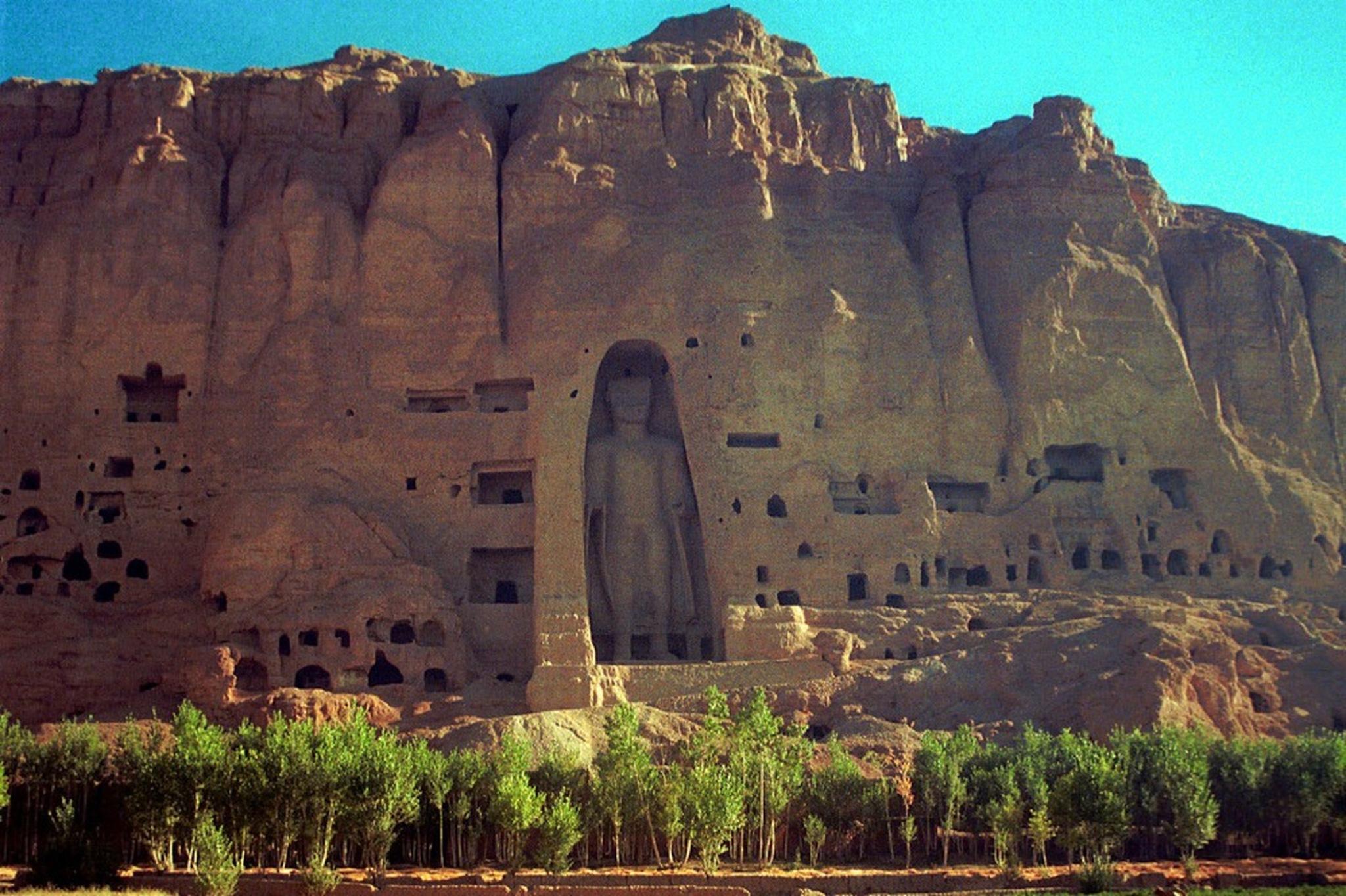
See the source image
World’s tallest statue of Buddha (175 feet tall) in Bamiyan, in Afghanistan. Destroyed by Taliban Islamic militia in 2001

Also, as Shakyamuni Buddha tells Subhuti in the Diamond-Cutter Sutra, when the dharma ending days come, great Bodhisattvas who possess morality, fine qualities, and wisdom will incarnate to revitalize the dharma. In India there were the Six Jewels (Great Dharma Kings–Nagarjuna, Aryadeva, Asanga, Vasubandhu, Dignaga, and Dharmakirti) who developed the texts that are considered the core classic commentaries today. In Tibet there were the great Dharma Kings: Padmasambhava, Marpa, Sakya Pandita, Dolpopa, Longchenpa, Tsongkhapa, Tangtong Gyalpo, Taranatha, Jigme Lingpa and others.

See the source image
Bamiyan Buddha, in Afghanistan

For over 500 years between the coming of Master Padmasambhava in the 8th century until Master Tsongkhapa came in the 14th century, the great or high dharmas were available in Tibet and many people easily achieved enlightenment in one lifetime. This was because the tantric teachings were freely taught—even to many who did not have the discipline or qualifications to receive them. By the 14th century, Master Tsongkhapa (1357-1419) had a different situation. Because the tantric teachings had been so liberally transmitted and the discipline required for proper transmission had been lax, there were many false rinpoches and lamas and much of what was being practiced as dharma was not correct. Master Tsongkhapa was sent to this world by the Adharma Buddha (Adi-Buddha), Samantabhadra. Master Tsongkapa’s mission was to restore the discipline and bring order out of the chaos that had developed from the other transmissions to the Nyingma, Jonang, Kagyu, and Sakya sects. It is not that the other transmissions were wrong. It is just that because of the lack of discipline and the transmission of dharma to those who were not qualified to receive it, the dharma became corrupted and many of the lineages were filled with false rinpoches and false dharma, as is true today. Master Tsongkapa, a great scholar and disciplinarian, dutifully set out to correct the dharma and restore order to monastic practice. To set an example for his monks, Master Tsongkhapa, himself a monk, did not practice the higher tantric dharmas. As a result he was not able to obtain the rainbow body or become a Buddha while alive. He only obtained Buddhahood in the bardo. Also he did not transmit these higher dharmas to his disciples. The Geluk sect itself does not have these higher tantric practices. The Gelukas cannot obtain enlightenment in one lifetime from the practice of their own teachings.

The systems that evolved for classifying these periods or ages of the dharma are generally as follows:

Golden Age or Age of True Dharma(500-1,000 years): Practitioners are of a high capacity and the teachings are transmitted intact, so that many achieve the goal of liberation. During this period the teaching is vigorous, people are capable of comprehending it AND putting it into practice and many attain enlightenment under their own power.

Age of Counterfeit or Semblance Dharma; zobo in Japanese (500-1,000 years): Practitioners have lower capacities, shorter life-spans, and the teachings are transmitted imperfectly so that only a semblance of the true dharma remains, with attainment of the goal being rare. Only a few people of great intelligence are able to grasp the doctrine correctly and obtain enlightenment.

Dharma-Ending Age or Age of the Final Dharma, mo-fa in Chinese or mappo in Japanese (500-1,000 years): Practitioners are of a low capacity, the dharma cannot be transmitted correctly, and the world is beset by so many problems that is not possible to practice. It was in response to the perception that we had entered this period that the new modes of practice arose such as the Pure Land Sect that relies on the power of an already-enlightened Buddha or the Nichiren Sect which relies on chanting the Lotus Sutra.

It is also stated that the method for accounting for these periods are different in the sutras and in the tantras. The Kalachakra tantra, for example, has the end of the vajryana coming in 4224 C.E. and the mahayana in 4120 C.E.

By any of the methods of accounting and by just observing the world around us, it can be seen that we have entered the “Dharma-Ending Age.” However, the Buddha, having foreseen this dark age, provided for teachings that were appropriate for the different ages and predicted that great Holy Ones would incarnate at appropriate times and places to revitalize and teach the dharma that was appropriate for that period of time and place. It is because of these conditions that His Holiness Dorje Chang Buddha III came to this world to demonstrate that the true Buddha-dharma does still exist and to offer us a “Quick Path” to liberation. When talking about H.H. Dorje Chang Buddha III, Penor Rinpoche, the third leader of the Nyingma Sect, told  Zhaxi Zhuoma Rinpoche that “because this is the Dharma-Ending Age, it is good that such a high being has incarnated.”

Link:https://wisdomtea.org/2021/11/17/dharma-ending-age/

#DorjeChangBuddhaIII#DorjeChangeBuddha