History of Buddhism

History of Buddhism

Over 2500 years ago  Shakyamuni Buddha taught for 45 years in the Ganges River basin of north-east India to many types of followers—from beggars to kings, to monastics and lay men and women. It is said that the Buddha taught 84,000 different Dharmas to help beings free themselves of the suffering of worldly existence caused by the 84,000 different afflictions. A council of 500 arhats was convened immediately after the parinivana of the Buddha by the Venerable Mahakasyapa. During this meeting Venerable Upali recited the monastic rules that became known as the Vinaya while Venerable Ananda recited the Sutras. For 400 years the teachings were only transmitted orally.

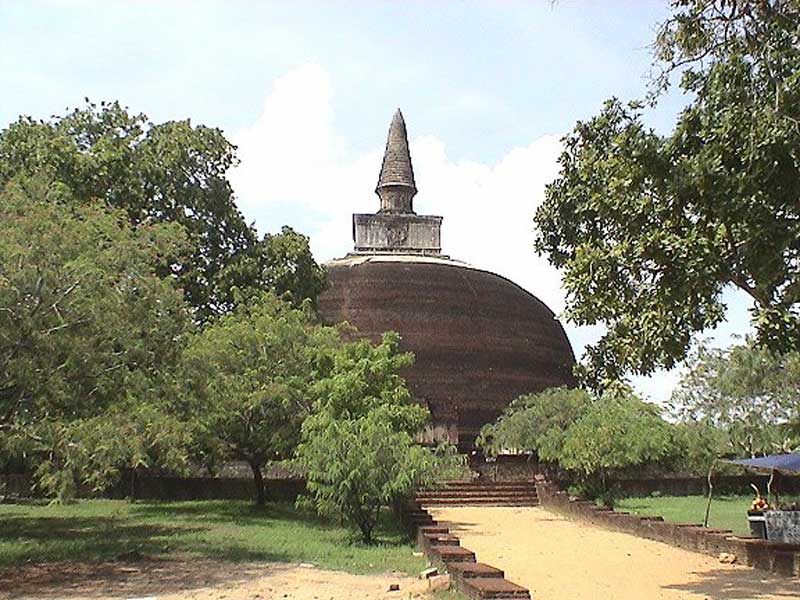
The Jetavanaramaya Stupa built in the third century as part of the Jetavana Monastery in Anuradhapura, Sri Lanka. At 400 feet, it was one of the tallest structures in the ancient world, with only two (the Great Pyramids of Giza) being higher.

In 326 BCE, several hundred years after the Buddha’s death, the Sangha divided into two schools: the Mahasanghika or majority who wanted changes and the Sthaviravada who were opposed to any changes. A hundred years later the Sthaviravada further divided into the Sarvastivada and the Vibhajyavada. The Sarvastivada migrated into northern India in the Kashmir region while the Vibhajyavada flourished in the Ganges River valley under the great Buddhist King Ashoka. In 247 BCE King Ashoka (272-231 BCE) sent his son, the monk Mahinda, and his daughter Sanghamitta, a nun, to Sri Lanka to establish Buddhism there.

By the first century CE there were 18-20 different schools, each with its own version of the Buddha’s teachings. Two written versions remain, at least in part: that produced in Sri Lanka in the ancient language of Pali by the Tamrashatiyas and known as the Southern Transmission and a Sanskrit version from the Sarvastivadas known as the Northern Transmission. These became known as the Tripitaka or three Baskets of the Vinaya or code of rules for monks and nuns, the Sutras or collections of instructional discourses of the Buddha and his closest disciples, and the commentaries that included the Abhidharma, which consists of the extracted and systematized philosophy implicit in the teachings. The Southern Transmission remains as the Pali canon and is followed by the Theravada in Sri Lanka, Burma, Thailand,and other south-east Asian countries. Although only fragments remain of the Northern Transmission in its original Sanskrit, it was translated into Tibetan and Chinese and many of these translations remain. The Tibetan transmission was also translated into Mongolian while the Chinese transmission became the basis for the Korean and Japanese scriptures.

The Buddha started the Mahayana teachings and predicted that great adepts would emerge to revitalize the tradition and explain the teachings that were not yet understandable to the majority of followers. Mahayana Buddhism arose during the 1st or 2nd century BCE from the Mahasanghika. It replaced the concept of the arhat with that of the bodhisattva as the highest ideal of Buddhism. The main difference being that the bodhisattva seeks enlightenment in order to help others, while the arhat is primarily concerned with his own salvation. The mahayana also grew out of the growing lay movements since most of the focus on early Buddhism had been on the monastic communities, although the great mahayana teachers were  also monks.

The Buddha himself was keenly aware of the limitations of words in respect to expressing spiritual reality. There is a famous story of how the Buddha held up a flower before the assembly of monks and smiled, saying nothing. The monks were confused by this. Only the Venerable Mahakasyapa responded, indicating that he understood that the truth is beyond words and doctrine.

The earliest and best-known mahayana scripture is the Prajnaparamita Sutra compiled by the master of the Madhyamaka or “Middle Way” school, the great Mahasiddha Nagarjuna, at the beginning of the Current Era from earlier works and various doctrines expressed by the Buddha while He taught in His nirmanakaya form. The well-known Heart Sutra and the Diamond Sutra represent the essence of these teachings.

Much of the Vajrayana or tantric Buddhism was transmitted by Vajrasattva and other Holy Beings in their sambhogakaya embodiments, although Shakyamuni Buddha started the teachings late in His life and predicted the later teachings. By the time of Nagarjuna there were adepts whose realization was high enough that they were able to communicate directly with these sambhogakaya beings. The basic esoteric teachings Shakyamuni Buddha transmitted directly to His son, Rahula. It is a very, very quick way to achieve realization. If, and only if, you have the opportunity to follow a true Vajra Master can you realize Buddhahood in a single lifetime using this method. It is a highly concentrated form of Buddhism. It gives you many supernormal powers. Only highly qualified people can receive this. Actually, for most beings, it is easier to realize Buddhahood in this life than in heaven. In the higher realms, you may not even have a body, but only consciousness. Life here is very difficult with much pain and suffering. This provides the motivation and the raw material for transmutation and realization. Many humans do have the good fortune to be able to pursue spiritual development, something that is not possible in the lower realms as hell beings, hungry ghosts, or animals–or in unfortunate human births.

Vajrayana Buddhism was well established by the seventh century of the Current Era (CE). Its methods evolved from the tradition of the spiritual sadhus, yogis who wandered around India who were adepts in tantric practices designed to provide realization, but, as previously noted, the teachings themselves originated with Shakyamuni Buddha. The source of all these teachings comes from Dorje Chang Buddha who manifested as Dipankara Buddha and taught them to Shakyamuni Buddha in another realm. It reached its peak in Tibet where it also assimilated the indigenous shamanic Bon religion, incorporating the local deities as protectors of the dharma. Vajrayana Buddhism is based on the secret teachings of Shakyamuni Buddha which were only transmitted to very high adepts and higher beings who, in turn, transmitted them to certain highly evolved humans when the conditions were right for them to be received. There were even certain humans like Tilopa, Sukasiddhi, and Niguma who reached a level of realization that they could learn the dharma directly from Dorje Chang Buddha. The aim of this form of Buddhism is to transform one’s body, speech and mind into those of a fully enlightened Buddha by special yogic means, including a variety of ritual and secret methods. In tantra, everything is vested with cosmic energy. For example, sounds or mantras can produce powerful spiritual effects and, as modern science is just beginning to discover, physical effects as well. Likewise, movements like prostrations have a ritual significance as well as a physical and spiritual impact.

Tantra requires the initiation or empowerment of a qualified teacher or master who provides specialized teachings, rituals, and practices to enable the disciple to root out or eliminate the dark side of his/her psyche and thus become like the Bodhisattvas and Buddhas. Supernormal powers that are viewed as the natural outcome of realization are used by qualified teachers. However, ordinary disciples are not allowed to discuss or display their supernormal powers. Only very highly evolved Bodhisattvas and Buddhas dare to display such powers and then only to help living beings. A person seeking initiation must demonstrate an understanding of emptiness, exhibit high moral conduct, and have developed an altruistic desire to help all beings. It is believed that any empowerment will have limited impact without a proper foundation of preliminary practices or Prayogas. These practices may have been performed in previous lives as well as the current one. It recognizes that supernormal powers cannot be given to one who has not eliminated the negative aspects of the self.

Even today, the Highest Tantric teachings and practices are only transmitted orally and are held in great secrecy between the teacher and the disciple. Because of the power of these teachings, it is recognized that the student must be thoroughly prepared to receive them. A true master will usually test a disciple for six to twelve years or longer before transmitting the higher teachings.

Link:https://wisdomtea.org/2021/12/02/history-of-buddhism/

#DorjeChangBuddhaIII#DorjeChangeBuddha

Buddha-Dharma

Buddha-Dharma

The truth and the original nature of all conditioned and unconditioned phenomena in the universe are contained in the word Buddha-dharma. The Buddha-dharma is all causes and effects in the universe. To understand all causes and effects, yet not be controlled by cause and effect, is to realize liberation and the Buddha-dharma. No matter how many schools or sects there are, the Buddha-dharma has only one truth. It is the truth of the universe: the dharma of ending the cycle of birth and death!  The Buddha-dharma is the life order of another world and dimension.

However, this rather abstract definition does not tell us how we realize or learn the Buddha-dharma. In a series of dharma discourses on learning Buddhism released in January 2016, H.H. Dorje Chang Buddha III gives such a practical definition. It is the dharma that we practice in the vajrayana form of Buddhism. It is the preliminary, main, and ending practice in their totality. The true Buddha-dharma emphasizes real practice and skills and is not merely theoretical Buddhist studies. The holy manifestations or miracles described on Xuanfa Institute’s website and in the book H.H. Dorje Chang Buddha III are evidence that the true Buddha-dharma, as practiced by Shakyamuni Buddha and the accomplished ones of the past, still exists in the world and that very high levels of spiritual accomplishment are possible for those who follow a true vajra master.

H.H. Dorje Chang Buddha III has said: “After you enter the door of Buddhism, you must cultivate yourself according to the dharma. Your three karmas of body, speech, and mind must correspond with the teachings of the Master. Only then will you be able to become accomplished. Conduct that is not in accord with the teachings of the Buddhas and Bodhisattvas must be corrected through concrete actions. You must make your conduct accord with the teachings contained in the Tripitaka and the states of morality, concentration, and wisdom. Yet, correcting your words and conduct must be carried out within everyday worldly life. That is because everyday worldly life (worldly or secular dharma) is the Buddha-dharma. There is no Buddha-dharma to accomplish apart from worldly or secular dharma. That is why you must use all mundane or worldly experiences to improve your self-cultivation. You must use worldly experiences to perfect your realization and conduct. If your basic worldly conduct is not proper, it is of no use to speak in a high-sounding way about emptiness or to speak boastfully and wish wildly.”

However, we must have patience in learning the Buddha-dharma. You cannot completely understand the principles of the dharma in a brief period of time. You must go though the sequence of first hearing the principles from your vajra master, gradually acting in accordance with these principles, walking the correct path and so on. You must advance step my step. You cannot expect that your negative karmic obstructions that have formed over many past lives can be purified in just one day. The tantric dharma that we receive when correctly practiced will enable us to overcome our obstructions, purify our three karmas, and enable us to progress on this path. Do not waste time on activities that do not lead to liberation and becoming a Buddha. DO NOT WASTE TIME!!!

Link:https://wisdomtea.org/2021/11/24/buddha-dharma/

#DorjeChangBuddhaIII#DorjeChangeBuddha

Dharma-Ending Age

Although most would agree that we are currently living in degenerate times, often referred to as the “Dharma-ending Age,” there are other considerations given in the sutras that offer great hope. First, it would appear that the most dire of predictions on the time that the dharma would remain applied to India, the land of its earthly origins. For example, The Sutra of the Golden Age states that the dharma will only exist in its pure form for 500 years after the passing of Shakyamuni Buddha. After that the dharma will exist as a shadow of its real self for another 1,500 years. Other sutras refer to a period of 1,000-2,000 years as well. It is true that the Buddhism lasted in India for less than 2,000 years. However, Buddhism was exported to other countries where it took root and flourished for much longer. In China it lasted for many centuries and in Tibet it flourished for over a thousand years. It is still the state religion in many countries in south-east Asia. However, there is good evidence that some of the original power and effectiveness of the teachings have been lost over time and in many cases, only a “shadow” of what Shakyamuni Buddha taught remains

See the source image
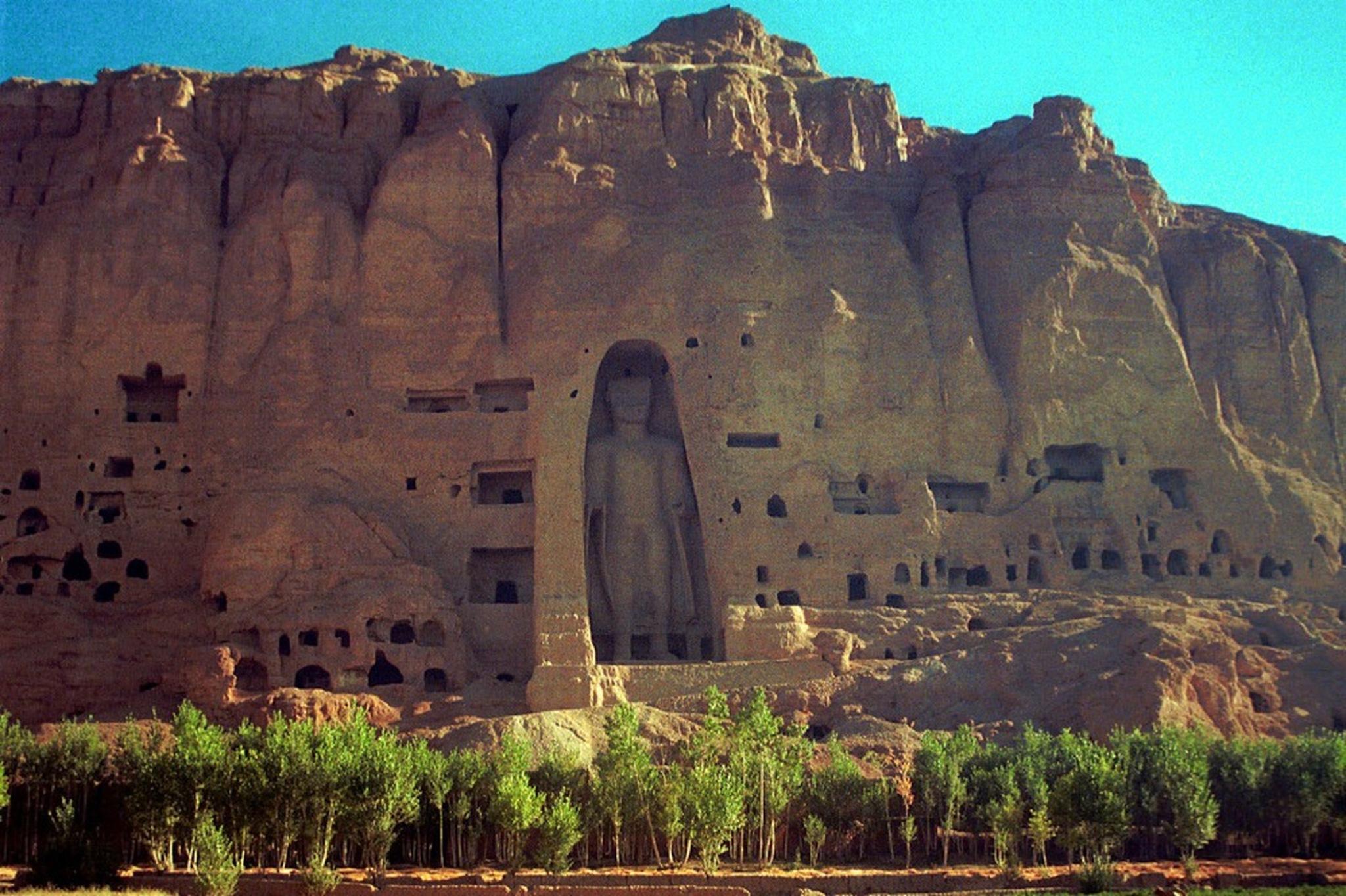
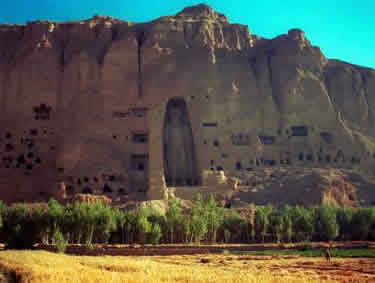
World’s tallest statue of Buddha (175 feet tall) in Bamiyan, in Afghanistan. Destroyed by Taliban Islamic militia in 2001

Also, as Shakyamuni Buddha tells Subhuti in the Diamond-Cutter Sutra, when the dharma ending days come, great Bodhisattvas who possess morality, fine qualities, and wisdom will incarnate to revitalize the dharma. In India there were the Six Jewels (Great Dharma Kings–Nagarjuna, Aryadeva, Asanga, Vasubandhu, Dignaga, and Dharmakirti) who developed the texts that are considered the core classic commentaries today. In Tibet there were the great Dharma Kings: Padmasambhava, Marpa, Sakya Pandita, Dolpopa, Longchenpa, Tsongkhapa, Tangtong Gyalpo, Taranatha, Jigme Lingpa and others.

See the source image
Bamiyan Buddha, in Afghanistan

For over 500 years between the coming of Master Padmasambhava in the 8th century until Master Tsongkhapa came in the 14th century, the great or high dharmas were available in Tibet and many people easily achieved enlightenment in one lifetime. This was because the tantric teachings were freely taught—even to many who did not have the discipline or qualifications to receive them. By the 14th century, Master Tsongkhapa (1357-1419) had a different situation. Because the tantric teachings had been so liberally transmitted and the discipline required for proper transmission had been lax, there were many false rinpoches and lamas and much of what was being practiced as dharma was not correct. Master Tsongkhapa was sent to this world by the Adharma Buddha (Adi-Buddha), Samantabhadra. Master Tsongkapa’s mission was to restore the discipline and bring order out of the chaos that had developed from the other transmissions to the Nyingma, Jonang, Kagyu, and Sakya sects. It is not that the other transmissions were wrong. It is just that because of the lack of discipline and the transmission of dharma to those who were not qualified to receive it, the dharma became corrupted and many of the lineages were filled with false rinpoches and false dharma, as is true today. Master Tsongkapa, a great scholar and disciplinarian, dutifully set out to correct the dharma and restore order to monastic practice. To set an example for his monks, Master Tsongkhapa, himself a monk, did not practice the higher tantric dharmas. As a result he was not able to obtain the rainbow body or become a Buddha while alive. He only obtained Buddhahood in the bardo. Also he did not transmit these higher dharmas to his disciples. The Geluk sect itself does not have these higher tantric practices. The Gelukas cannot obtain enlightenment in one lifetime from the practice of their own teachings.

The systems that evolved for classifying these periods or ages of the dharma are generally as follows:

Golden Age or Age of True Dharma(500-1,000 years): Practitioners are of a high capacity and the teachings are transmitted intact, so that many achieve the goal of liberation. During this period the teaching is vigorous, people are capable of comprehending it AND putting it into practice and many attain enlightenment under their own power.

Age of Counterfeit or Semblance Dharma; zobo in Japanese (500-1,000 years): Practitioners have lower capacities, shorter life-spans, and the teachings are transmitted imperfectly so that only a semblance of the true dharma remains, with attainment of the goal being rare. Only a few people of great intelligence are able to grasp the doctrine correctly and obtain enlightenment.

Dharma-Ending Age or Age of the Final Dharma, mo-fa in Chinese or mappo in Japanese (500-1,000 years): Practitioners are of a low capacity, the dharma cannot be transmitted correctly, and the world is beset by so many problems that is not possible to practice. It was in response to the perception that we had entered this period that the new modes of practice arose such as the Pure Land Sect that relies on the power of an already-enlightened Buddha or the Nichiren Sect which relies on chanting the Lotus Sutra.

It is also stated that the method for accounting for these periods are different in the sutras and in the tantras. The Kalachakra tantra, for example, has the end of the vajryana coming in 4224 C.E. and the mahayana in 4120 C.E.

By any of the methods of accounting and by just observing the world around us, it can be seen that we have entered the “Dharma-Ending Age.” However, the Buddha, having foreseen this dark age, provided for teachings that were appropriate for the different ages and predicted that great Holy Ones would incarnate at appropriate times and places to revitalize and teach the dharma that was appropriate for that period of time and place. It is because of these conditions that His Holiness Dorje Chang Buddha III came to this world to demonstrate that the true Buddha-dharma does still exist and to offer us a “Quick Path” to liberation. When talking about H.H. Dorje Chang Buddha III, Penor Rinpoche, the third leader of the Nyingma Sect, told  Zhaxi Zhuoma Rinpoche that “because this is the Dharma-Ending Age, it is good that such a high being has incarnated.”

Link:https://wisdomtea.org/2021/11/17/dharma-ending-age/

#DorjeChangBuddhaIII#DorjeChangeBuddha

The City of Covina Holds Its Tree Lighting Ceremony for the 31st Year, With an Enhanced Festival

BY JOHN VINCENTI · NOVEMBER 8, 2021 

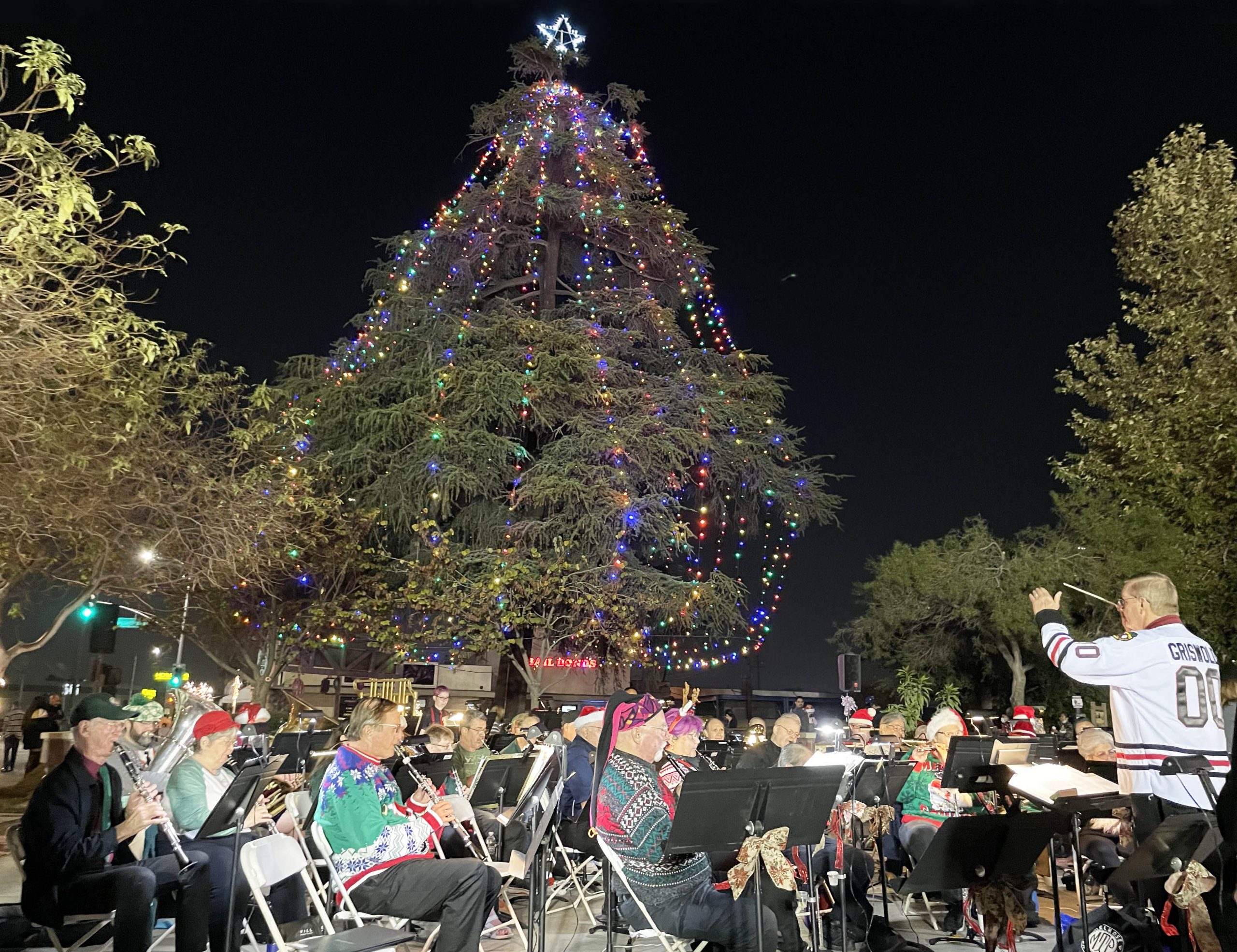
The lights of the Covina Christmas tree were lit up amongst the music of the Covina concert band and the cheers of the crowd. (Photo by David McCarty)

The City of Covina’s Tree Lighting Festival was held on November 5th, with the participation of the Covina Christmas Parade Committee, and the H.H. Dorje Chang Buddha III Cultural and Art Museum, and other businesses and individuals in the city. The City proudly partnered with people and organizations in the community, to bring local families together and get into the spirit of the upcoming holidays.

The lights of the Covina Christmas tree were lit up amongst the music of the Covina concert band and the cheers of the crowd. (Photo by David McCarty)

While the tree lighting has been done for years, this year was different and expanded, with more of a storyline to the festivities, and an added sense of joy and purpose. After COVID-19’s disruption of so many festivals and get-togethers last year, this year’s tree lighting and festival atmosphere were designed to bring back the sense of joy and wonder that makes the holiday season a special one for so many people. It’s a great time of year to move on from a tough time in life with a renewed spirit of happiness and peace.

The representative of 22nd Senate District Susan Rubio’s office presented the certificate to the City of Covina. (Photo by David McCarty)

When asked about the history of the event and the differences compared with past tree lighting events, Covina’s Mayor Jorge A. Marquez said, “The City of Covina has had a Christmas Parade that’s run for 70 years. We also have a tradition of lighting up the Christmas tree every year, to add extra holiday cheer. The difference now, compared to the past, is we have added a storyline within the event, to keep kids entertained, and added activities for kids and their families to enjoy.”

With the lingering issues caused by the pandemic, and the stress and strain that has put on many families, it’s important for everyone to have some fun and fellowship as the holidays approach this year. The City of Covina was focused on that during the festival, and the City is dedicated to making the holiday season a better one for the community, as much as possible. Taking time away from worries, for families to celebrate and enjoy the magic of the holiday season, is a great way to do that.

Brian Tyan, the President of the H.H. Dorje Chang Buddha III Cultural and Art Museum, shares that opinion. The museum chose to partner with the City of Covina for this event by collaborating with the Covina Parks and Recreation Department and the Covina Christmas Parade Committee, in order to bring the joy of the holiday to the community more fully.

The event was held at Heritage Plaza, and included the Covina Farmer’s Market, where visitors could get great food and shop for holiday gifts. There was also live holiday music from the Covina Concert Band, and plenty of free activities for everyone to enjoy. Giveaways, letters to Santa, and children’s crafts were just some of the offerings the City worked to make possible. While adults understand the seriousness of the pandemic, and the toll it took last year, the children were often the ones who missed out.

The Christmas light decorations of the H.H. Dorje Chang Buddha III Cultural and Art Museum building attracted a large number of local residents. (Photo by David McCarty)

When asked about what he feels the event means to the community, the Mayor replied, “To me, this Christmas I believe allows us to come together as a community, to kick off the winter holiday and enjoy each other’s fellowship. Especially this year, with COVID-19, we are hoping to get back to normal, to celebrating not just Christmas but each other, as a strong, tight-knit community.” While the City of Covina already has a Christmas parade, the Tree Lighting Festival added even more joy and completeness to the festivities.

This year was the 31st tree lighting ceremony for Covina, and the event has been a favorite of the community all during that time. According to Tyan, the H.H. Dorje Chang Buddha III Cultural and Art Museum recognizes that last year was rough on people, with losses including jobs and loved ones. The hope is that, through the Tree Lighting Festival, more people in the community can feel joy in their hearts and experience a reprieve from the pandemic.

To help encourage that, a professional holiday lighting company was hired, and that company decorated the entire museum building and the parking lot. There were snow machines on the event date, so people could enjoy the experience of snowfall. Parents and children were able to take photos with the snow falling, and there were light-up elements to add to the happiness and peacefulness of the occasion, as just one aspect of the overall festival, and the joyous atmosphere it produced for residents of Covina.

The museum sponsored the hot cocoa and coffee booth, where anyone could get free cocoa or coffee during the event to keep warm and cozy on a chilly night, and increase the feeling of holiday cheer. There were glow sticks and gifts for visitors who came to the booth, and the fun and excitement of the trackless train, allowing kids at the event to have a free train ride as part of the festival and  as a way to move on from COVID-19 and have more adventures.

Link: https://wisdomtea.org/2021/11/10/the-city-of-covina-holds-its-tree-lighting-ceremony-for-the-31st-year-with-an-enhanced-festival/

 #DorjeChangBuddhaIII#DorjeChangeBuddha

Chinese master makes history as painting sells for record price

Chinese master makes history as painting sells for record price

The Explanation of the Buddha’s Title – “H.H. Dorje Chang Buddha III

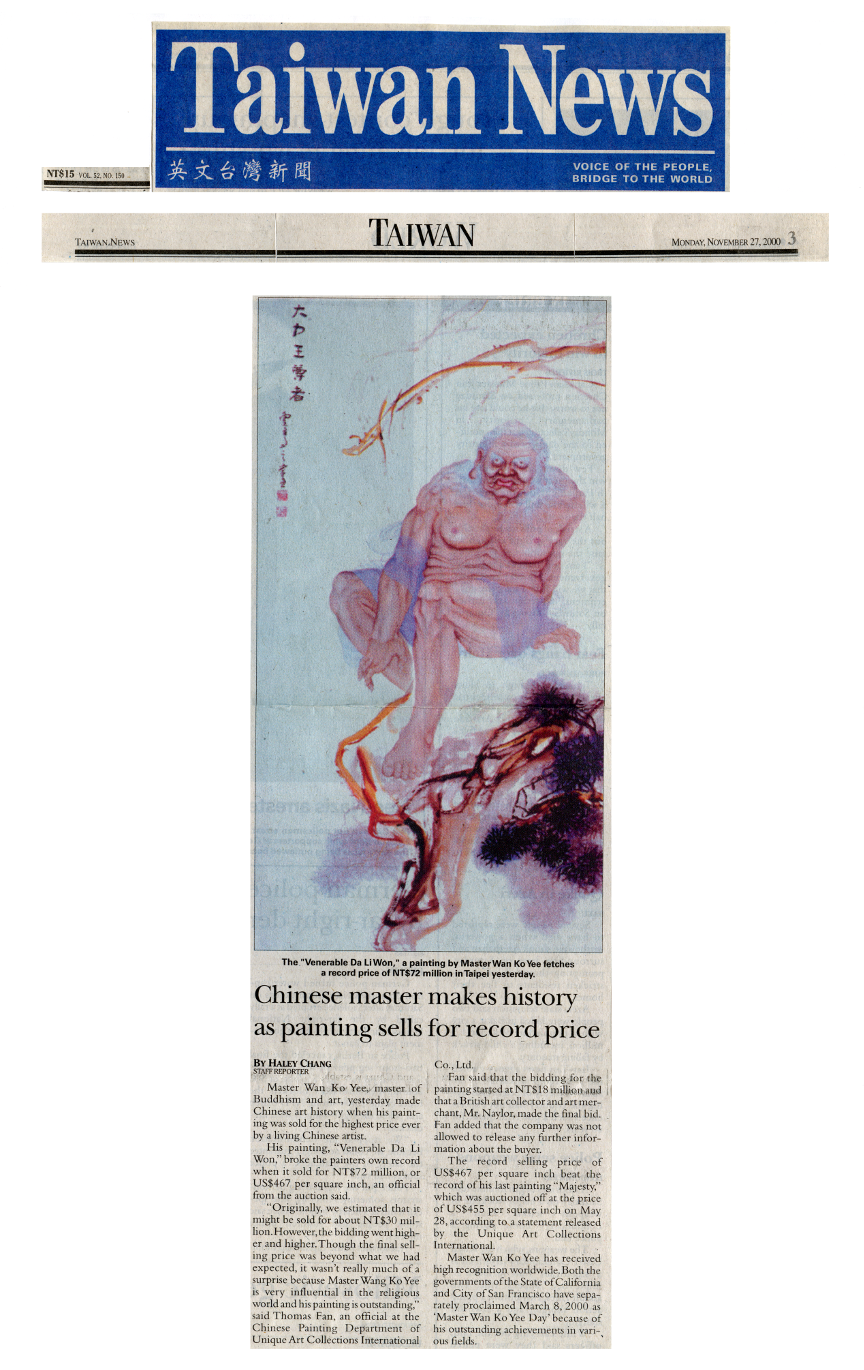
Master Wan Ko Yee (H.H. Dorje Chang Buddha III), master of Buddhism and art, yesterday made Chinese art history when his painting was sold for the highest price ever by a living Chinese artist.

His painting,“Venerable Da Li Won”, broke the painters own record when it sold for NT$72 million, or US$467 per square inch, an official from the auction said.

“Originally, we estimated that it might be sold for about NT$30 million. However, the bidding went higher and higher. Though the final selling price was beyond what we had expected, it wasn’t really much of a surprise because Master Wan Ko Yee (H.H. Dorje Chang Buddha III) is very influential in the religious world and his painting is outstanding”, said Thomas Fan, an official at the Chinese Painting Department of Unique Art Collections International Co., Ltd.

Fan said that the bidding for the painting started at NT$18 million and that a British art collector and art merchant, Mr. Naylor, made the final bid. Fan added that the company was not allowed to release any further information about the buyer.

The record selling price of US$467 per square inch beat the record of his last painting“Majesty,”which was auctioned off at the price of US$455 per square inch on May 28,according to a statement released by the Unique Art Collections International. Master Wan Ko Yee (H.H. Dorje Chang Buddha III) has received high recognition worldwide. Both the governments of the State of California and City of San Francisco have separately proclaimed March 8, 2000 as ‘Master Wan Ko Yee (H.H. Dorje Chang Buddha III) Day’ because of his outstanding achievements in various fields.

Taiwan News 英文台灣新聞

MONDAY,November 27, 2000

Chinese master makes history as painting sells for record price

Chinese master makes history as painting sells for record price

Link: https://wisdomtea.org/2021/10/05/chinese-master-makes-history-as-painting-sells-for-record-price/

#DorjeChangBuddhaIII #HHDorjeChangBuddhaIII #MasterWanKoYee

Two separate government entities have separately proclaimed March 8th as Master Wan Ko Yee (H.H. Dorje Chang Buddha III) Day

Two separate government entities have separately proclaimed March 8th as Master Wan Ko Yee (H.H. Dorje Chang Buddha III) Day

The Explanation of the Buddha’s Title – “H.H. Dorje Chang Buddha III

On April 3, 2008, a solemn and dignified first-publishing ceremony of a fact-recording book entitled H.H. Dorje Chang Buddha III, which published jointly by the World Buddhism Publishing LLC and the World Dharma Voice, Inc., was held at the Library of the Congress of the United States. The book was also formally accepted into the collection of the Library of the Congress of the United States. Only since that time, did people in the world know that Master Wan Ko Yee, who had been broadly respected by the great masses and who had also been known as Great Dharma King Yangwo Yeshe Norbu, had been recognized by the world’s leaders, regent dharma kings, and great rinpoches of Buddhism through official documents as the third incarnation of Dorje Chang Buddha, who is the primordial Sambhogakaya Buddha of the universe. The Buddha’s name is H.H. Dorje Chang Buddha III Since then, people began to address His Holiness the Buddha by “Namo[1] Dorje Chang Buddha III.” This is similar to the situation that Sakyamuni Buddha’s name was Prince Siddhartha Gotama before attaining Buddhahood. However, after Sakyamuni Buddha had attained Buddhahood, His title changed to “Namo Sakyamuni Buddha.” That is why we now address His Holiness the Buddha as “H.H. Dorje Chang Buddha III

In particular, on December 12, 2012, the Senate Resolution No. 614 of the United States Congress officially used “His Holiness” in the name addressing Dorje Chang Buddha III (That is to say, “H.H. Dorje Chang Buddha III”) Since then, the title and status of H.H. Dorje Chang Buddha III has been definitive by nature. And, as a matter of fact, “Dorje Chang Buddha III” is a name used legally in governmental and official legislative documents. Therefore, the previously used respected name and titles such as “Wan Ko Yee,” Great Master, and Great Dharma King no longer exist.

However, the news below was published before the Buddha’s title of H.H. Dorje Chang Buddha III was publicly announced. At that time, people did not know about the true status of His Holiness the Buddha. Therefore, to respect the true history, we still kept the names used before the title of H.H. Dorje Chang Buddha III was legitimately determined in republishing this news. However, all must clearly know that the only legitimate name of His Holiness the Buddha is H.H. Dorje Chang Buddha III and all other names used before the legitimate determination no longer exist.

MARCH 18-24, 2000 25

The Asian Times

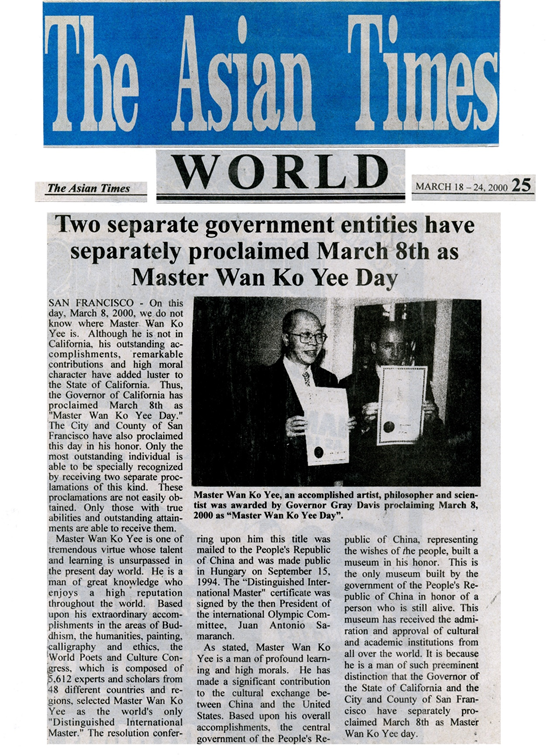
SAN FRANCISCO – On this day, March 8, 2000, we do not know where Master Wan Ko Yee (H.H. Dorje Chang Buddha III) is. Although he is not in California, his outstanding accomplishments, remarkable contributions and high moral character have added luster to the State of California. Thus, the Governor of California has proclaimed March 8th as “Master Wan Ko Yee (H.H. Dorje Chang Buddha III) Day.” The City and County of San Francisco have also proclaimed this day in his honor. Only the most outstanding individual is able to be specially recognized by receiving two separate proclamations of this kind. These proclamations are not easily obtained. Only those with true abilities and outstanding attainments are able to receive them.

Master Wan Ko Yee (H.H. Dorje Chang Buddha III) is one of tremendous virtue whose talent and learning is unsurpassed in the present day world. He is a man of great knowledge who enjoys a high reputation throughout the world. Based upon his extraordinary accomplishments in the areas of Buddhism, the humanities, painting, calligraphy and ethics, the World Poets and Culture Congress, which is composed of 5,612 experts and scholars from 48 different countries and regions, selected Master Wan Ko Yee (H.H. Dorje Chang Buddha III) as the world’s only “Distinguished International Master.” The resolution conferring upon him this title was mailed to the People’s Republic of China and was made public in Hungary on September 15, 1994. The “Distinguished International Master” certificate was signed by the then President of the international Olympic Committee, Juan Antonio Samaranch.

As stated, Master Wan Ko Yee (H.H. Dorje Chang Buddha III) is a man of profound learning and high morals. He has made a significant contribution to the cultural exchange between China and the United States. Based upon his overall accomplishments, the central government of the People’s Republic of China, representing the wishes of the people, built a museum in his honor. This is the only museum built by the government of the People’s Republic of China in honor of a person who is still alive. This museum has received the admiration and approval of cultural and academic institutions from all over the world. It is because he is a man of such preeminent distinction that the Governor of the State of California and the City and County of San Francisco have separately proclaimed March 8th as Master Wan Ko Yee (H.H. Dorje Chang Buddha III) day.    

Master Wan Ko Yee (H.H. Dorje Chang Buddha III), an accomplished artist, philosopher and scientist was awarded by Governor Gray Davis proclaiming March 8, 2000 as “Master Wan Ko Yee (H.H. Dorje Chang Buddha III) Day”.

Two separate government entities have separately proclaimed March 8th as Master Wan Ko Yee (H.H. Dorje Chang Buddha III) Day

Two separate government entities have separately proclaimed March 8th as Master Wan Ko Yee (H.H. Dorje Chang Buddha III) Day

Link: https://wisdomtea.org/2021/09/22/two-separate-government-entities-have-separately-proclaimed-march-8th-as-master-wan-ko-yee-h-h-dorje-chang-buddha-iii-day/

#DorjeChangBuddhaIII #HHDorjeChangBuddhaIII #MasterWanKoYee