H.H. Dorje Chang Buddha III Lineage

H.H. Dorje Chang Buddha III Lineage

When the universe originated, it was boundless and everything was silent. There was no such thing as length of time or size of space. There was no shape and form, no interior and exterior, no birth and death. This is the dharmakaya (dharma body) Buddha. The true meaning of the dharmakaya Buddha is the concept of a universe that does not perish. This concept of a universe that does not perish is also called “dharmadhatu-tathata (dharma realm true-suchness),” which is Samantabhadra Tathagata (Adharma Buddha).

However, the dharmakaya Buddha only expresses the concept of the true essence of the universe; that is, not being born and not dying, not coming and not going. The dharmakaya Buddha has no form and does not speak. It has no way to communicate any meaning, such as meaning through images or meaning through language. Because of such karmic conditions, the formless dharmakaya Buddha generated the first sambhogakaya Buddha with form. This sambhogakaya Buddha with form transformed into Vajrasattva and other nirmanakayas.

In order to make a distinction between those three, the dharmakaya Buddha was named Adharma Buddha, the sambhogakaya Buddha was named Dorje Chang Buddha, and the nirmanakaya was named Vajrasattva. Actually, Samantabhadra Tathagata is Adharma Buddha and also is Dorje Chang Buddha. In truth, there are not two Buddhas. These distinctions resulted from there being a dharmakaya, sambhogakaya, and nirmanakaya.

Based on this dharma, Samantabhadra Tathagata did not directly incarnate. Even the ancient Buddha Dipankara and Vajrasattva were the nirmanakayas of Dorje Chang Buddha. Sakyamuni Buddha was a disciple of Dipankara Buddha. However, many sects list Samantabhadra Tathagata as the first Buddha who began all the lineages in the dharmadhatu. This way of thinking is actually not erroneous. That is because although Samantabhadra Tathagata is a dharmakaya without form and has no way of speaking, the origin lies with this dharmakaya from which the sambhogakaya Dorje Chang Buddha manifested. This sambhogakaya Buddha was the first one to spread the Buddha-dharma and save living beings in the three spheres of existence so that they would become holy beings.

Dorje Chang Buddha is also called Buddha Vajradhara or Ruler of the Vajra Beings. In the entire universe, Dorje Chang Buddha is the first Buddha with form and is the highest Buddha. That is, the highest leader of Buddhism in the entire universe came into being in the form of Dorje Chang Buddha. It was Dorje Chang Buddha who began transmitting dharma and saving living beings in the dharmadhatu. As a result, Buddhism was born and the Buddha-dharma began spreading.

The teachings of Dorje Chang Buddha led to many disciples becoming Buddhas. The five most famous among such disciples are Aksobhya Buddha of the east, Ratnasambhava Buddha of the south, Amitabha Buddha of the west, Amoghasiddhi Buddha of the north, and Vairocana Buddha of the center. There are also many other Buddhas and Bodhisattvas among the original disciples of Dorje Chang Buddha. Dorje Chang Buddha was the one who initially propagated the Buddha-dharma in the dharmadhatu. Dorje Chang Buddha is the supreme leader of all of Buddhism in the dharmadhatu.

The incarnation of Dorje Chang Buddha is different from the incarnation of any other Buddha. Such an incarnation is a primordial manifestation of the existence of Buddha-dharma. In each world of living beings, there can be at any one time only one incarnation of Dorje Chang Buddha, who manifests or expresses the existence of the true dharma. There will not be a second incarnation of Dorje Chang Buddha in the same age or era. Only after the first incarnation of Dorje Chang Buddha leaves the world can the second incarnation be born based on karmic conditions relating to the good fortune of living beings. For example, the holy and venerable Vimalakirti, who was the second Dorje Chang Buddha, took birth in this earthly realm in the past. The third Dorje Chang Buddha took birth in this earthly realm more than two thousand years after Vimalakirti left it and only when karmic conditions relating to the good fortune of living beings had matured. Furthermore, according to the formal pronouncement of H.H. Mahavairocana Tathagata Dharma King Zunsheng, the fourth Dorje Chang Buddha will descend into this world five thousand years from now.

H.H. Wan Ko Yeshe Norbu is the only Dorje Chang Buddha III in the history of Buddhism. This has been recognized by greatly accomplished beings of the highest order in the world as well as famous dharma kings and rinpoches from various sects who have issued written recognition documents in accordance with the dharma!

Link: https://wisdomtea.org/2022/02/09/h-h-dorje-chang-buddha-iii-lineage/

Early Buddhist Sects

Early Buddhist Sects

Sautrantika: One of the early Indian schools of this tradition. Also known as the Sutra-Only School because it focused on just the discourses of the Buddha.

Vaibhasika: An influential early Indian school in north-west India also of this tradition. Its version of the Abhidharma, the Mahavibhasa (The Great Book of Alternatives), was the basis for Vasubandhu’s Abhidharma-kosa that is still studied in Tibetan monasteries and considered to be one of the five classic commentaries or treatises that should be mastered.

Theravada (Lineage of the Elders): This is the form of Buddhism that was transmitted very early to the South-east Asian counties of Sri Lanka (247 BCE) and Burma (272-236 BCE) and later to Thailand (1260), Laos (14th century), Cambodia, and southern Viet Nam. It was between 25 and 17 BCE that the Pali canon or scriptures were first recorded in Sri Lanka. In America it is also popularly known as vipassana or Insight Meditation. The most conservative branch of Buddhism, the Theravadans based their practice exclusively on the Tripitaka of the Pali Scriptures and are the only remaining school evolving out of this tradition. Their focus is the practice of mindfulness, which involves cultivating an awareness of one’s thoughts, actions, and body to become aware of what one does and one’s motivation. This is a prelude to a direct understanding of the transitory, conditioned nature of existence. Theravadans take refuge in the three jewels and follow the five precepts of no killing, no stealing, no inappropriate sex, no inappropriate speech, and no ingesting substances that befuddle consciousness. Monastics must be celibate and cannot claim to have supernormal powers. The goal of one following this path is to become an arhat. It has become a popular form of Buddhism in the United States. Some modern western leaders in this school have questioned if enlightenment is possible or even a useful goal, stressing more the integration of Buddhist concepts and theories with Western psychology and therapy.

When Shakyamuni Buddha lived on this planet over 2500 years ago, he transmitted dharma to the many disciples who followed him. After the Buddha’s Parinivana, one of the Buddha’s foremost disciples, Venerable Mahakasyapa, became the head of the sangha and presided over the First Great Council at Rajagrha that was held to codify the Buddha’s teachings. He was known for his accomplishments in the dharma.

Ananda, the Buddha’s younger cousin and known as “the assistant who heard much,” became the second patriarch in this lineage after Mahakasyapa passed away. As a condition for becoming the Buddha’s attendant, a position he held for 24 years, Ananda requested no preferential treatment and that the Buddha repeat for him any teachings he might miss. He was gifted with total recall and at the First Great Council repeated all of the Buddha’s teachings from memory. His recitation became the basis for the Sutras in the Tripitaka. When Guru Padmasambhava reincarnated eight years after Shakyamuni Buddha left this world, it was Venerable Ananda who transmitted the special dharma that Shakyamuni instructed him to transmit.

The sangha divided into many sects based on different interpretations and emphasis. The main split was between what became known as the Sravakayana (or Path of the Arhats) and Mahayana (or Path of the Bodhisattvas) Vehicles. Of the eighteen or so lessor vehicle sects, only the Theravada School has survived. This is the dominant form of Buddhism practiced in Myanmar (Burma), Cambodia, Laos, Sri Lanka, and Thailand. Today there are over 100 million Theravada Buddhist worldwide with a growing number of temples and groups forming in the West as the people of Southeast Asia migrate to the West.

Many Westerners have also gone to Southeast Asia to study and have brought their own form of usually lay practice to the West, often referred to as Insight Meditation or vipassana. Theravada monasteries have developed in the U.S. that train western monastics, notably the Bhavana Society Forest Monastery and Meditation Center (Sri Lanka) in High View, West Virginia, and Abhayagiri (Fearless Mountain) Monastery (Thai) also in the forest monk tradition in Redwood Valley, California.

Link: https://wisdomtea.org/2022/02/02/early-buddhist-sects/

Early Buddhist Sects

Angkor Wat


Angkor Wat

HISTORY.COM EDITORS * UPDATED:AUG 21, 2018*ORIGINAL:FEB 28, 2018

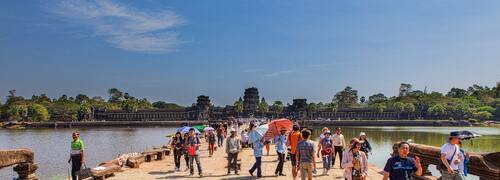
Angkor Wat is an enormous Buddhist temple complex located in northern Cambodia. It was originally built in the first half of the 12th century as a Hindu temple. Spread across more than 400 acres, Angkor Wat is said to be the largest religious monument in the world. Its name, which translates to “temple city” in the Khmer language of the region, references the fact it was built by Emperor Suryavarman II, who ruled the region from 1113 to 1150, as the state temple and political center of his empire.

Originally dedicated to the Hindu god Vishnu, Angkor Wat became a Buddhist temple by the end of the 12th century.

Although it is no longer an active temple, it serves as an important tourist attraction in Cambodia, despite the fact it sustained significant damage during the autocratic rule of the Khmer Rouge regime in the 1970s and in earlier regional conflicts.

Where Is Angkor Wat?

Angkor Wat is located roughly five miles north of the modern Cambodian city of Siem Reap, which has a population of more than 200,000 people.

However, when it was built, it served as the capital of the Khmer empire, which ruled the region at the time. The word “Angkor” means “capital city” in the Khmer language, while the word “Wat” means “temple.”

Initially, Angkor Wat was designed as a Hindu temple, as that was the religion of the region’s ruler at the time, Suryavarman II. However, by the end of the 12th century, it was considered a Buddhist site.

Unfortunately, by then, Angkor Wat had been sacked by a rival tribe to the Khmer, who in turn, at the direction of the new emperor, Jayavarman VII, moved their capital to Angkor Thom and their state temple to Bayon, both of which are a few miles to the north of the historic site.

As Angkor Wat’s significance within the Buddhist religion of the region increased, so too did the legend surrounding the site. Many Buddhists believe the temple’s construction was ordered by the god Indra, and that the work was accomplished in one night.

However, scholars now know it took several decades to build Angkor Wat, from the design phase to completion.

Angkor Wat’s Design

Although Angkor Wat was no longer a site of political, cultural or commercial significance by the 13th century, it remained an important monument for the Buddhist religion into the 1800s.

Indeed, unlike many historical sites, Angkor Wat was never truly abandoned. Rather, it fell gradually into disuse and disrepair.

Nonetheless, it remained an architectural marvel unlike anything else. It was “rediscovered” in 1840s by the French explorer Henri Mouhot, who wrote that the site was “grander than anything left to us by Greece or Rome.”

The compliment can likely be attributed to the temple’s design, which is supposed to represent Mount Meru, the home of the gods, according to tenets of both the Hindu and Buddhist faiths. Its five towers are intended to recreate the five peaks of Mount Meru, while the walls and moat below honor the surrounding mountain ranges and the sea.

By the time of the site’s construction, the Khmer had developed and refined their own architectural style, which relied on sandstone. As a result, Angkor Wat was constructed with blocks of sandstone.

A 15-foot high wall, surrounded by a wide moat, protected the city, the temple and residents from invasion, and much of that fortification is still standing. A sandstone causeway served as the main access point for the temple.

Inside these walls, Angkor Wat stretches across more than 200 acres. It’s believed that this area included the city, the temple structure and the emperor’s palace, which was just north of the temple.

However, in keeping with tradition at the time, only the city’s outer walls and the temple were made of sandstone, with the rest of the structures built from wood and other, less durable materials. Hence, only portions of the temple and city wall remain.

Even so, the temple is still a majestic structure: At its highest point—the tower above the main shrine—it reaches nearly 70 feet into the air.

The temple walls are decorated with thousands of bas-reliefs representing important deities and figures in the Hindu and Buddhist religions as well as key events in its narrative tradition. There is also a bas-relief depicting Emperor Suryavarman II entering the city, perhaps for the first time following its construction.

Angkor Wat Today

Unfortunately, although Angkor Wat remained in use until fairly recently—into the 1800s—the site has sustained significant damage, from forest overgrowth to earthquakes to war.

The French, who ruled what is now known as Cambodia for much of the 20th century, established a commission to restore the site for tourism purposes in the early 1900s. This group also oversaw ongoing archeological projects there.

While restoration work was accomplished in bits and pieces under French rule, major efforts didn’t begin in earnest until the 1960s. By then, Cambodia was a country transitioning from colonial rule to a limited form of constitutional monarchy.

When Cambodia fell into a brutal civil war in the 1970s, Angkor Wat, somewhat miraculously, sustained relatively minimal damage. The autocratic and barbarous Khmer Rouge regime did battle troops from neighboring Vietnam in the area near the ancient city, and there are bullet holes marking its outer walls as a result.

Since then, with the Cambodian government undergoing numerous changes, the international community, including representatives of India, Germany and France, among others, have contributed to the ongoing restoration efforts.

The site remains an important source of national pride for Cambodians.

In 1992, it was named United Educational Scientific, and Cultural Organization (UNESCO) World Heritage site. Although visitors to Angkor Wat numbered in just the few thousands at the time, the landmark now welcomes some 500,000 visitors each year—many of whom arrive early in the morning to capture images of the sunrise over what still is a very magical, spiritual place.

Link: https://wisdomtea.org/2022/01/26/angkor-wat/

https://www.history.com/topics/landmarks/angkor-wat

Giving thanks can make you happier

August 14, 2021

Giving thanks can make you happier

Each holiday season comes with high expectations for a cozy and festive time of year. However, for many this time of year is tinged with sadness, anxiety, or depression. Certainly, major depression or a severe anxiety disorder benefits most from professional help. But what about those who just feel lost or overwhelmed or down at this time of year? Research (and common sense) suggests that one aspect of the Thanksgiving season can actually lift the spirits, and it’s built right into the holiday — being grateful.

The word gratitude is derived from the Latin word gratia, which means grace, graciousness, or gratefulness (depending on the context). In some ways, gratitude encompasses all of these meanings. Gratitude is a thankful appreciation for what an individual receives, whether tangible or intangible. With gratitude, people acknowledge the goodness in their lives. In the process, people usually recognize that the source of that goodness lies at least partially outside themselves. As a result, being grateful also helps people connect to something larger than themselves as individuals — whether to other people, nature, or a higher power.

In positive psychology research, gratitude is strongly and consistently associated with greater happiness. Gratitude helps people feel more positive emotions, relish good experiences, improve their health, deal with adversity, and build strong relationships.

People feel and express gratitude in multiple ways. They can apply it to the past (retrieving positive memories and being thankful for elements of childhood or past blessings), the present (not taking good fortune for granted as it comes), and the future (maintaining a hopeful and optimistic attitude). Regardless of the inherent or current level of someone’s gratitude, it’s a quality that individuals can successfully cultivate further.

Research on gratitude

Two psychologists, Dr. Robert A. Emmons of the University of California, Davis, and Dr. Michael E. McCullough of the University of Miami, have done much of the research on gratitude. In one study, they asked all participants to write a few sentences each week, focusing on particular topics.

One group wrote about things they were grateful for that had occurred during the week. A second group wrote about daily irritations or things that had displeased them, and the third wrote about events that had affected them (with no emphasis on them being positive or negative). After 10 weeks, those who wrote about gratitude were more optimistic and felt better about their lives. Surprisingly, they also exercised more and had fewer visits to physicians than those who focused on sources of aggravation.

Another leading researcher in this field, Dr. Martin E. P. Seligman, a psychologist at the University of Pennsylvania, tested the impact of various positive psychology interventions on 411 people, each compared with a control assignment of writing about early memories. When their week’s assignment was to write and personally deliver a letter of gratitude to someone who had never been properly thanked for his or her kindness, participants immediately exhibited a huge increase in happiness scores. This impact was greater than that from any other intervention, with benefits lasting for a month.

Of course, studies such as this one cannot prove cause and effect. But most of the studies published on this topic support an association between gratitude and an individual’s well-being.

Other studies have looked at how being grateful  can improve relationships. For example, a study of couples found that individuals who took time to express gratitude for their partner not only felt more positive toward the other person but also felt more comfortable expressing concerns about their relationship.

Managers who remember to say “thank you” to people who work for them may find that those employees feel motivated to work harder. Researchers at the Wharton School at the University of Pennsylvania randomly divided university fund-raisers into two groups. One group made phone calls to solicit alumni donations in the same way they always had. The second group — assigned to work on a different day — received a pep talk from the director of annual giving, who told the fund-raisers she was grateful for their efforts. During the following week, the university employees who heard her message of gratitude made 50% more fund-raising calls than those who did not.

There are some notable exceptions to the generally positive results in research on gratitude. One study found that middle-aged divorced women who kept gratitude journals were no more satisfied with their lives than those who did not. Another study found that children and adolescents who wrote and delivered a thank-you letter to someone who made a difference in their lives may have made the other person happier — but did not improve their own well-being. This finding suggests that gratitude is an attainment associated with emotional maturity.

Ways to cultivate gratitude

Gratitude is a way for people to appreciate what they have instead of always reaching for something new in the hopes it will make them happier or thinking they can’t feel satisfied until every physical and material need is met. Gratitude helps people refocus on what they have instead of what they lack. And, although it may feel contrived at first, this mental state grows stronger with use and practice.

Here are some ways to cultivate gratitude on a regular basis.

Write a thank-you note. You can make yourself happier and nurture your relationship with another person by writing a thank-you letter or email expressing your enjoyment and appreciation of that person’s impact on your life. Send it, or better yet, deliver and read it in person if possible. Make a habit of sending at least one gratitude letter a month. Once in a while, write one to yourself.

Thank someone mentally. No time to write? It may help just to think about someone who has done something nice for you, and mentally thank the individual.

Keep a gratitude journal. Make it a habit to write down or share with a loved one thoughts about the gifts you’ve received each day.

Count your blessings. Pick a time every week to sit down and write about your blessings — reflecting on what went right or what you are grateful for. Sometimes it helps to pick a number — such as three to five things — that you will identify each week. As you write, be specific and think about the sensations you felt when something good happened to you.

Pray. People who are religious can use prayer to cultivate gratitude.

Meditate. Mindfulness meditation involves focusing on the present moment without judgment. Although people often focus on a word or phrase (such as “peace”), it is also possible to focus on what you’re grateful for (the warmth of the sun, a pleasant sound, etc.).

Link: https://wisdomtea.org/2022/01/19/giving-thanks-can-make-you-happier/

https://www.health.harvard.edu/healthbeat/giving-thanks-can-make-you-happier#:~:text=In%20positive%20psychology%20research%2C%20gratitude,adversity%2C%20and%20build%20strong%20relationships.

Maitreya Buddha – The Future Buddha

Maitreya Buddha
Maitreya Buddha is said to be Future Buddha. In various Buddhist sutra such as Amitabha Sutra, as well as Lotus Sutra, Maitreya Buddha is believed to be called as Ajita.

Maitreya Buddha

In the world of Buddhist eschatologyMaitreya literally means the future BuddhaMaitreya Buddha is considered as the 5th Buddha that is believed to appear in this Kalpa or era. Thus, Maitreya Buddha is considered as the Future Buddha that is yet to appear in this age. In various Buddhist sutra such as Amitabha Sutra, as well as Lotus SutraMaitreya Buddha is believed to be called as Ajita.

According to Buddhist history and tradition, Maitreya Buddha is believed to be Bodhisattva who will appear in the Earth in the future, will achieve Nirvana and will teach the people of Earth the pure Dharma just like Shakyamuni Buddha did. According to the Buddhist texts as well scriptures, Maitreya Buddha will be considered as the successor of the living Buddha i.e. Gautama Buddha. The Prophecy of Maitreya Buddha coming back to the terrestrial world is written in most of the major Schools of Buddhism in many Buddhist countries

Attributes of Maitreya Buddha

Maitreya Buddha - The future Buddha

Many Maitreya Buddha statues, Buddha images are shown with different attributes as well as Hand mudras as well as postures. The Maitreya Buddha statues are represented with all the attributes that must be in the attributes of Bodhisattva. Most of the Buddha statues of Maitreya Buddha are pdepicted with both hands using Dharmachakra Mudra.

Maitreya Buddha is also represented as holding lotus flower in each hand of the statues. Each hands also possessed a Wheel of Dharma as well a ritual base. Both Wheel of Dharmaas well as ritual vase are shown on the top of lotus flower. The wheel of dharma on the top of lotus shows that maitreya Buddha emphasize his mission to spread and teach Dharma to all beings. While the Ritual vase on the top of lotus shows that Maitreya Buddha will be born in the family of low cast while Buddhist history shows that Shakyamuni Buddha was born in the family of high cast.

Laughing Buddha as Maitreya Buddha

Laughing Buddha is shown as the next Maitreya Buddha in the Chinese BuddhismLaughing Buddha is also believed to be a Bodhisattva and will be the next Matreya Buddha. There are various Buddha statues that represents Maitreya Buddha but Laughing Buddha is one of the most popular known Buddha in the whole world especially for his fat belly and smiling face.

Link: https://wisdomtea.org/2022/01/12/maitreya-buddha/

https://www.burmese-art.com/blog/maitreya-buddha

Buddhist Beliefs

Buddhist Beliefs

What are Buddhist Beliefs? All living beings have the same basic wish to be happy and avoid suffering, but very few people understand the real causes of happiness and suffering.

We generally believe that external conditions such as food, friends, cars, and money are the real causes of happiness, and as a result we devote nearly all our time and energy to acquiring these. Superficially it seems that these things can make us happy, but if we look more deeply we shall see that they also bring us a lot of suffering and problems.

Happiness and suffering are opposites, so if something is a real cause of happiness it cannot give rise to suffering. If food, money, and so forth really are causes of happiness, they can never be causes of suffering; yet we know from our own experience that they often do cause suffering. For example, one of our main interests is food, but the food we eat is also the principal cause of most of our ill health and sickness.

In the process of producing the things we feel will make us happy, we have polluted our environment to such an extent that the very air we breathe and the water we drink now threaten our health and well-being. We love the freedom and independence a car can give us, but the cost in accidents and environmental destruction is enormous.

We feel that money is essential for us to enjoy life, but the pursuit of money also causes immense problems and anxiety. Even our family and friends, with whom we enjoy so many happy moments, can also bring us a lot of worry and heartache.

In recent years our understanding and control of the external world have increased considerably, and as a result, we have witnessed remarkable material progress; but there has not been a corresponding increase in human happiness.

There is no less suffering in the world today, and there are no fewer problems. Indeed, it could be said that there are now more problems and greater unhappiness than ever before. This shows that the solution to our problems, and to those of society as a whole, does not lie in knowledge or control of the external world.

Why is this? Happiness and suffering are states of mind, and so their main causes cannot be found outside the mind. The real source of happiness is inner peace. If our mind is peaceful, we shall be happy all the time, regardless of external conditions, but if it is disturbed or troubled in any way, we shall never be happy, no matter how good our external conditions may be.

External conditions can only make us happy if our mind is peaceful. We can understand this through our own experience. For instance, even if we are in the most beautiful surroundings and have everything we need, the moment we get angry any happiness we may have disappears. This is because anger has destroyed our inner peace.

We can see from this that if we want true, lasting happiness we need to develop and maintain a special experience of inner peace. The only way to do this is by training our mind through spiritual practice – gradually reducing and eliminating our negative, disturbed states of mind and replacing them with positive, peaceful states.

Eventually, through continuing to improve our inner peace we shall experience permanent inner peace, or “nirvana.” Once we have attained nirvana we shall be happy throughout our life, and in life after life. We shall have solved all our problems and accomplished the true meaning of our human life.

Link: https://wisdomtea.org/2022/01/05/buddhist-beliefs/

https://www.kadampanewyork.org/buddhistbeliefs

What is Karma?

Photo by Binyamin Mellish on Pexels.com

The law of karma is a special instance of the law of cause and effect, according to which all our actions of body, speech and mind are causes and all our experiences are their effects. The law of karma explains why each individual has a unique mental disposition, a unique physical appearance and unique experiences. These are the various effects of the countless actions that each individual has performed in the past. We cannot find any two people who have created exactly the same history of actions throughout their past lives, and so we cannot find two people with identical states of mind, identical experiences or identical physical appearances. Each person has different individual karma. Some people enjoy good health while others are constantly ill. Some people are seen as very beautiful while others are seen as very ugly. Some people have a happy disposition that is easily pleased while others have a sour disposition and are rarely delighted by anything. Some people easily understand the meaning of spiritual teachings while others find them difficult and obscure.

Every action we perform leaves an imprint, or potentiality, on our very subtle mind, and each imprint eventually gives rise to its own effect. Our mind is like a field, and performing actions is like sowing seeds in that field. Virtuous actions sow seeds of future happiness and non-virtuous actions sow seeds of future suffering. These seeds remain dormant in our mind until the conditions for them to ripen occur, and then they produce their effect. In some cases, this can happen many lifetimes after the original action was performed.

It is because of our karma or actions that we are born in this impure, contaminated world and experience so many difficulties and problems. Our actions are impure because our mind is contaminated by the inner poison of self-grasping. This is the fundamental reason why we experience suffering. Suffering is created by our own actions or karma – it is not given to us as a punishment. We suffer because we have accumulated many non-virtuous actions in our previous lives. The source of these non-virtuous actions is our own delusions such as anger, attachment and self-grasping ignorance.

Once we have purified our mind of self-grasping and all other delusions, all our actions will naturally be pure. As a result of our pure actions or pure karma, everything we experience will be pure. We will abide in a pure world, with a pure body, enjoying pure enjoyments and surrounded by pure beings. There will no longer be the slightest trace of suffering, impurity or problems. This is how to find true happiness from within our mind.

Link: https://wisdomtea.org/2021/12/29/what-is-karma/

Link: https://www.kadampanewyork.org/what-is-karma/

7 Reasons To Make Time For Jogging

Written by Amber Petty on March 18, 2020

It’s good for mental health

Depression and anxiety are growing health concerns in the United States. About 7 percent of adults will likely experience a major depressive episode in their lifetime. Since it’s an election year, that number might go up to 259 percent (this isn’t based on science, just on the looks of our Facebook feeds).

Jogging certainly isn’t a cure for depression or anxiety, but there’s growing evidence that it helps ease the symptoms. A 2004 review of studies about exercise and depression found that working out lifted people’s moods.

In a 1999 study mentioned in the review, a 16-week walking or jogging regimen (30 minutes, three times a week) was as effective at reducing depression symptoms as taking medication for the same length of time. (Of course, we don’t recommend you ditch therapy or toss your Lexapro prescription just because you put on your running shoes.)

And you don’t have to be a marathoner or a super-fast sprinter to see results from jogging. A small 1998 study found that jogging improved participants’ moods regardless of whether they exercised at low, moderate, or high intensity.

It reduces stress

If you’ve never felt stressed, we’d love to pull a “Freaky Friday” and swap bodies with you. But if you’re one of the 40 million adults who have an anxiety disorder, jogging could help reduce your stress level.

In a 2018 review of studies, researchers concluded that aerobic exercise is helpful for people who experience increased anxiety. Not too shabby!

It helps you sleep better

The benefits of a jog don’t end after your cooldown stretch. They can improve your entire day… and night!

A 2017 review noted that scientists aren’t 100 percent sure why exercise and sleep are connected, but they definitely are. Overall, study participants who performed cardiovascular exercise like jogging had improved sleep.

Moderate aerobic exercise can also help with chronic insomnia, according to a 2012 review of studies. Fewer hours lying awake, tossing and turning? Sign us up!

It strengthens your immune system

Your body’s ability to fight off disease is super important, so anything you can do to bolster it is probably a good idea.

A 2018 review found that people who exercised regularly were less likely to get bacterial and viral infections. It didn’t address jogging specifically but found that any physical activity can provide an immunity boost.

It decreases insulin resistance

If you’re insulin-resistant, it means your body doesn’t respond to insulin properly. That can lead to high blood sugar and possibly diabetes. In other words, insulin resistance = bad.

Thankfully, regular jogging has been shown to decrease insulin resistance. A 2015 review found that exercise decreased insulin resistance, overall cholesterol, and risk of heart disease in most patients.

If you’re at risk for diabetes, be sure to talk to your healthcare provider to find out whether you could benefit from changing your diet in addition to getting your jog on. Even if you don’t have any blood sugar issues, jogging could help improve your overall blood work results.

It increases lifespan

“I’m gonna live forever” is not how everyone feels after a long jog. But truly, jogging may help you live longer.

In a 2017 review that included data from more than 55,000 people, researchers found that jogging could reduce the risk of dying from heart attack or stroke by 45 percent. Plus, it could reduce the chance of dying from any cause by 30 percent.

Obviously, this doesn’t factor in car crashes or freak accidents involving falling air conditioners. But a 30 percent decreased risk of death by disease is pretty incredible!

It makes your wallet happy

OK, this isn’t a health benefit, per se. But if you’re on a budget, not worrying about paying gym fees will definitely lead to less stress. Jogging is cheap! Technically, you don’t need anything to jog except a pair of sneakers, which you probably already own.

Since you can jog almost any time and any place, it’s easy to fit into a busy schedule. And you never have to deal with weird gym bros.

Link:https://wisdomtea.org/2021/12/22/7-reasons-to-make-time-for-jogging/

How to Get the Biggest Benefits of Walking

Lose weight, lower blood pressure, and reduce stress when you walk this way

By Sally WadykaUpdated

May 2, 202

Getting exercise through walking is as easy as lacing up your sneakers and hitting the pavement or trail. Doing so is a safe way to get a workout without needing a gym, and it can boost your mental and physical health in several important ways.

“Walking is the most studied form of exercise, and multiple studies have proven that it’s the best thing we can do to improve our overall health, and increase our longevity and functional years,” says Robert Sallis, MD, a family physician and sports medicine doctor with Kaiser Permanente.

In its 2018 scientific report to the Department of Health and Human Services, the Physical Activity Guidelines Advisory Committee noted that walking is the most popular aerobic activity and has one of the lowest injury rates of any form of exercise.

And a 2019 study of more than 44,000 Canadians found that people living in more walkable neighborhoods had a lower overall risk of cardiovascular disease. That’s a reason to advocate for local infrastructure that makes walking easier, says lead author Nicholas Howell, PhD, of the Li Ka Shing Knowledge Institute at St. Michael’s Hospital in Toronto.

Still, in the short term, “even in less walkable neighborhoods, there are ways to be active in your daily routines,” Howell says. He suggests running errands on foot, parking farther from your destination, or getting off the bus a stop early. Those small adjustments “can help fit in a few extra steps each day,” Howell says. “And they all add up.”

Here, we explain what walking can do for you—and how to maximize its many benefits.

Benefits of Walking

1. Lower body mass index (BMI): A study from the University of Warwick in Coventry, England, published in 2017 in the International Journal of Obesity confirms that those who walk more and sit less have lower BMIs, which is one indicator of obesity. In the study, those who took 15,000 or more steps per day tended to have BMIs in the normal, healthy range.

2. Lower blood pressure and cholesterol: The National Walkers’ Health study found that regular walking was linked to a 7 percent reduced risk of high blood pressure and high cholesterol.

3. Lower fasting blood sugar (glucose): Higher blood glucose levels are a risk factor for diabetes, and the National Walkers’ Health Study also found that walkers had a 12 percent lower risk of type 2 diabetes.

4. Better memory and cognitive function: A 2021 study published in the Journal of Alzheimer’s Disease found that when adults 55 or older with mild cognitive impairment were assigned to either stretching and toning exercises or to aerobic training—mostly walking—both groups showed some improvement on cognitive tests. But when compared with the stretching and toning group, the group that walked for fitness improved aerobic fitness more, had decreased stiffness in neck arteries, and showed increased blood flow to the brain in ways that researchers think could provide more cognitive benefits in the long term.

clinical trial of older adults in Japan published in the Journal of the American Geriatrics Society in 2015 found that after 12 weeks, men and women in a prescribed daily walking exercise group had significantly greater improvements in memory and executive function (the ability to pay focused attention, to switch among various tasks, and to hold multiple items in working memory) compared with those in a control group who were told just to carry on with their usual daily routine.

And a study of 299 adults, published in the journal Neurology in 2010, found that walking was associated with a greater volume of gray matter in the brain, a measure of brain health.

5. Lower stress and improved mood: Like other types of aerobic exercise, walking—especially out in nature—stimulates the production of neurotransmitters in the brain (such as endorphins) that help improve your mental state.

6. Longer life: In a review of studies published in 2014 in the International Journal of Behavioral Nutrition and Physical Activity, researchers found that walking for roughly 3 hours a week was associated with an 11 percent reduced risk of premature death compared with those who did little or no activity.

And it’s never too late to reap the benefits of walking: A small 2013 study in the journal Maturitas found that seniors with an average age of 80 who walked just four times a week were much less likely to die over the study’s 10-year follow-up period than those who walked less.

Link:https://wisdomtea.org/2021/12/15/how-to-get-the-biggest-benefits-of-walking/

Supernormal Powers

Supernormal Powers

Every disciple who has received initiation has the potential to quickly obtain supernormal dharma powers through practice. One has the potential to easily assume an infinite variety of forms and obtain good worldly fortune. However, if you violate the precept of lying to your master, even a minor lie, you will not be able to obtain any supernormal powers or good fortune unless you immediately repent and resolve never to violate this rule again. It can be proper to desire such powers, depending upon your motivation. It is not proper to desire such powers primarily for your own use, to appear impressive or show off, subdue people, reap fame and gain, cheat people out of money, hoodwink people into sexual misconduct, or further your worldly selfish and evil intentions. It is not blameworthy to desire miraculous powers to enlighten yourself and others.

The five great supernormal powers or superknowledges (abhijna) are 1) rddhi-saksatkriya: the ability to be anywhere or do anything at will including flying through the air and performing other miracles; 2) divyasrotra: the ability to hear sounds anywhere including those that normally cannot be heard, such as the sounds of ants walking or sounds emanating from a far away place, even in another realm of existence. This is also known as clairaudiance or “the divine ear;” 3) paracittajnana: the ability to know the thoughts or read the minds of other beings; 4) purvanivasanu-smrtijnana: the ability to recollect previous existences or past-lives of oneself and others; and 5) divyacakus: instantaneous view of anything anywhere including the ability to see things that occur outside one’s presence, such as things happening at a far away place, even in another realm of existence. This is also known as clairvoyance or “the divine eye.” The sixth supernormal power (asavakkhaya) is unique to Buddhism and enhances the powers of the other five. Non-Buddhist can achieve the first five powers, but without the wisdom that comes from complete enlightenment they are not as great as those available to a buddha. For example, a Hindu is still bound by the world of Brahma, a Buddhist is not. A Buddha’s powers are limitless. The sixth power is knowing that your defilements are extinguished and that you have attained liberation from the cycle of reincarnation. You have become enlightened. This is also sometimes referred to as anasrava–the cessation of outflows or asravas. These powers are also known as the six superknowledges (abhijna) or supernatural cognitions.

At the Ultimate Bathing the Buddha Dharma Assembly, there was a tub used to bathe the Buddha. When filled with water, that tub weighed more than 4,200 pounds. About a dozen people together tried to lift that tub a few times but did not succeed in moving the tub in the slightest. However, two people of great virtue and high states of realization were able to lift it by themselves. There was also a person of holy virtue who lifted it alone.

Venerable Akou Lamo Rinpoche of Tibet and Venerable Ciren Jiacuo (Gyatso) together lift the two ton lotus tub. What ordinary person in this world could lift such a tub? Only those who learned the true Buddha-dharma can lift it.

The Dharma Protectors guard the use of these powers very closely. They will block the chakras of those unworthy to obtain these powers. Likewise, they will untie the knots in the chakras of those cultivators who are worthy of such powers, causing the supernormal dharma powers of the buddhas and bodhisattvas to suddenly turn into light and enter the chakras. At that time, the mandala in each practitioner’s body will respond and will accept the powers. When your three karmas of body, speech, and mind unite into one body and correspond with the teachings, supernormal dharma powers will come into being. When your state of realization and state of virtue have reached the level where it is appropriate to obtain supernormal dharma powers, then as soon as you practice according to the dharma, supernormal dharma powers will appear. You cannot attain supernormal powers without proper moral discipline, concentration and wisdom. You must first be able to master the Dharma.

Link:https://wisdomtea.org/2021/12/08/supernormal-powers/