In the first week in October I noticed some kind of growth inside my left nostril. It looked like a pink skin tag that is about one eighth inch long. About two weeks later I noticed the growth had grown and was hanging out of my nostril. Not only was it unattractive, but I didn’t know what it was. Cancer runs in my family and I started worrying that it was a malignant growth. Since I didn’t have insurance I started to look for a low cost clinic to go to. I didn’t have much luck finding a clinic, or doctor that was cost effective and trust worthy.
I talked to Ningbu Rinpoche about my dilemma. In our conversation she told me about the mediation class the Sunday before, which I missed because I was working overtime. She told me about the story that Qupei Rinpoche related in class about a man chanting the six syllable heart mantra, which had a powerful effect on me. Here is a summation of the story Qupei Rinpoche told.
Reciting the sixth syllable heart mantra brings great merit. You don’t have to be a Buddhist to receive the empowerment of Quan Yin Bodhisattva. Many people chant it and gain good results from it. Today I will tell you about a story of an ordinary man. This man was working with a friend who was a Buddhist. His friend told him about the sixth syllable heart mantra and how beneficial it is to chant. He began reciting it 1000 times a day. He experienced tranquility and a great joy in his heart. Since he liked doing it so much he began to increase chanting the mantra ten thousand times a day.
One day he was invited to a diligent practice event. When he went to the retreat he increased chanting the six syllable mantra to thirty thousand times a day. Several days after the retreat began he saw Quan Yin Bodhisattva appear before him. Quan Yin Bodhisattva’s appearance was very solemn and she was imposingly large and tall. Since he saw Quan Yin Bodhisattva appear before him, he decided to increase his chanting to sixty thousand times a day.
After half a month Quan Yin appeared before him again. This time she took him to the Western Paradise where he saw his own white lotus flower that was the size of a car wheel. The white lotus flower looked very beautiful and pure. It dawned on him that reciting Amithaba Buddha’s name, or the six syllable heart mantra, will help one be reborn in the Western Paradise. Seeing the Western Paradise state strengthened his faith and he now began to recite the six syllable heart mantra seventy thousand times a day. After a period of time he had another visitation of Quan Yin Bodhisattva. She again took him to see his lotus flower. Now he can see the center of the flower. Right in the middle of it is a seat he can sit upon. After this experience he chants even more diligently.
As the retreat is about to conclude he now sees Amithaba Buddha appear before him. The Buddha was as tall as a skyscraper and emitted a bright golden light. Amithaba Buddha was very solemn as he descended from the sky and stood on his lotus flower to speak dharma. The man looked up at the sky and saw Quan Yin Bodhisattva and Mahashamaprapta Bodhisattva standing together. Their image is identical to a picture he had seen depicting them. They were both several dozen floors tall.
Amithaba Buddha began to speak to him. He told him that he would be born in the Western Paradise in the future. Now I will transmit you a high dharma. You must focus on this practice. This will guarantee your rebirth in the Western Paradise. When it is time in the future I will personally come to retrieve you. The Buddha told him to write down all his experiences to help strengthen Buddhist cultivator’s faith and encourage them to practice better. He wrote down his story and that is why we can listen to it today.
After I heard the story it motivated me to sit down to do some serious chanting that night. Before I went to bed I chanted the six syllable heart mantra over seven hundred times. I went to sleep and woke up at around 1:30 AM. I couldn’t get back to sleep so I decided to do meditation for about 45 minutes, which helped increase my energy. Then, ironically, my body was too energized to get back to sleep, so I decided to take a walk in the neighborhood. This was at around 2 AM in the morning. When I got back I decided to chant the one hundred syllable bright mantra. When I chanted this about one hundred and sixty times I felt something wet around my nose. I dabbed my nose with a tissue and found blood on it. I was able to stop the bleeding in a short time. I went into the bathroom to check on it. When I looked at the reflection of my left nostril in the mirror, I discovered that the growth had disappeared. At the place where the growth had been now had fresh healthy looking skin covering the area. I was overjoyed and couldn’t wait to report this to Master. To me this is concrete proof that the dharma is real and beneficial for our life. It has motivated me to put more energy into my practice and when I get spare time I utilize the time to chant.
Once upon a time, the Enlightenment Being lived in a world where most religions were very similar. They taught that the way to remove suffering from the mind was to make the body suffer instead. As strange as it seems, most people thought that the holiest of the holy were the ones who tortured their bodies the most! Since everyone seemed to agree with this, the Bodhisatta decided to find out for himself if it was true.
He stopped living as an ordinary everyday person and became a holy man according to the custom of the times. This meant that he gave up everything, even his clothes. He went naked, with his body covered only by dust and dirt.
So he wouldn’t be spoiled by the taste of good food, he forced himself to eat only filthy things – dirt, ashes, urine and cow dung.
So he could concentrate without being interrupted by anyone, he went to live in the most dangerous part of the forest. If he did see a human being, he ran away like a timid deer.
In the wintertime he spent his days under the trees and his nights out in the open. So in the daytime he was soaked by the cold water dripping from the icicles hanging from the tree branches. And at night he was covered by the falling snow. In this way, in winter, he made his body suffer the most extreme cold in both day and night.
In the summertime he spent his days out in the open and his nights under the trees. So in the daytime he was burned by the most severe rays of the sun. And at night he was blocked from the few cooling breezes of the open air. In this way, in summer, he made his body suffer the most extreme heat in both day and night.
This was how he struggled, trying to bring peace to his mind. He was so determined that he lived his entire life in this way.
Then, just as he was about to die, he saw a vision of himself reborn in a hell world. The vision struck him like lightning, and instantly he knew that all the ways he had tortured his body were completely useless! They had not brought him peace of mind. Lo and behold, as he gave up his false beliefs and held on to the truth, he died and was reborn in a heaven world!
The moral is: Even at the very last moment, “The truth shall make you free.”
Once upon a time, King Brahmadatta of Benares had a son. He grew up to be a mean and cruel he-man – the type that’s always trying to prove he’s tougher than everyone else. He was a bully who constantly pushed people around and picked fights. Whenever he spoke to people it was with a stream of obscenities – right out of the gutter. And he was always quick to anger – just like a hissing snake that’s just been stepped on.
People inside and outside the palace ran from him as they would from a starving man-eating demon. They avoided him as they would a speck of dirt in the eye. Behind his back everyone called him the ‘Evil Prince’. In short – he was not a nice man!
One day the prince decided to go swimming. So he went down to the river with his servants and attendants. Suddenly it became almost as dark as night. A huge storm came up. Being so rough and tough, the prince was always trying to show he wasn’t scared of anything. So he yelled at his servants, “Take me into the middle of the river and bathe me. Then bring me back to shore.” Following his orders, they took him out to midstream. Then they said, “Now is our chance! Whatever we do here, the king will never find out. So let’s kill the Evil Prince. Into the flood you go, good-for-nothing!” With that they threw him into the stormy raging river.
When they returned to the bank, the others asked where the prince was. They replied, “We don’t know. As the rain came up, he must have swum faster than us and gone back to Benares.” When they returned to the palace, the king asked, “Where is my son?” They said, “We don’t know, your majesty. When the storm came up, we thought he went back ahead of us.” King Brahmadatta collected a search party and began looking for the prince. They searched carefully, all the way to the riverside, but couldn’t find him.
What had happened was this. In the darkness and wind and rain the prince had been swept down the flooding river. Luckily he was able to grab onto a floating dead tree trunk. Frantically he held on for dear life. As he was being swept along, the tough he-man was so afraid of drowning that he cried like a terrified helpless baby!
It just so happened that, not long before, a very rich man had died in Benares. He had buried his treasure hoard in the riverbank, along the same stretch of river. His fortune amounted to 40 million gold coins. Because of his miserly craving for riches, he was reborn as a lowly snake, slithering on his belly while still guarding his treasure.
At a nearby spot on the riverbank another rich miser had buried a treasure of 30 million gold coins. Likewise, due to his stingy clawing after wealth, he had been reborn as a water rat. He too remained to guard his buried treasure.
Lo and behold. when the storm came up, both the snake and the water rat were flooded out of their holes and washed into the raging river. In fear of drowning, they both happened to grab onto the same dead log carrying the frightened wailing prince. The snake climbed up on one end and the water rat on the other.
There also happened to be a tall cotton tree growing nearby. There was a young parrot roosting in it. When the storm-flooded river rose up, the cotton tree’s roots were washed away and it fell into the water. When he tried to fly away, the wind and rain swept the little parrot onto the same dead log with the snake, the water rat and the Evil Prince.
Now there were four on the log, floating towards a bend in the river. Nearby a holy man was living humbly in a little hut. He just happened to be the Bodhisatta – the Enlightenment Being. He had been born into a rich high class family in Kasi. When he had grown up, he had given up all his wealth and position, and had come to live by himself next to the river.
It was the middle of the night when the holy man heard the cries of panic coming from the Evil Prince. He thought, “That sounds like a frightened human being. My loving-kindness will not let me ignore him. I must save him.”
He ran down to the river and shouted. “Don’t be afraid! I will save you!” Then he jumped into the rushing torrent, grabbed the log, and used his great strength to pull it to shore.
He helped the prince step safely onto the riverbank. Noticing the snake, water rat and parrot, he took them and the man to his cozy little hut. He started up his cooking fire. Thinking of the weakness of the animals, he gently warmed them by the fire. When they were warm and dry he set them aside. Then he let the prince warm himself. The holy man brought out some fruits and nuts. Again he fed the more helpless animals first, followed by the waiting prince.
Not surprisingly this made the Evil Prince furious! He thought, “This stupid holy man doesn’t care at all for me, a great royal prince. Instead he gives higher place to these three dumb animals!” Thinking this way, he built up a vengeful hatred against the gentle Bodhisatta.
The next day the holy man dried the deadwood log in the sun. Then he chopped it up and burned it, to cook their food and keep them warm. In a few days the four who had been rescued by that same log were strong and healthy.
The snake came to the holy man to say good-bye. He coiled his body on the ground, arched himself up, and bowed his head respectfully. He said, “Venerable one, you have done a great thing for me! I am grateful to you, and I am not a poor snake. In a certain place I have a buried treasure of 40 million gold coins. And I will gladly give it to you – for all life is priceless! Whenever you are in need of money, just come down to the riverbank and call out. “Snake! Snake!”
The water rat, too, came to the holy man to say good-bye. He stood up on his hind legs and bowed his head respectfully. He said, “Venerable one, you have done a great thing for me! I am grateful to you, and I am not a poor water rat. In a certain place I have a buried treasure of 30 million gold coins. And I will gladly give it to you – for all life is priceless! Whenever you are in need of money, just come down to the riverbank and call out, “Rat! Rat!”
Such grateful generosity from a snake and a water rat! A far cry from their previous stingy human lives! Then came the parrot to say his good-bye to the holy man. He bowed his head respectfully and said, “Venerable one, you have done a great thing for me! I am grateful to you, but I possess no silver or gold. However, I am not a poor parrot. For if you are ever in need of the finest rice, just come down to the riverbank and call out. ‘Parrot! Parrot!’ Then I will gather together all my relatives from all the forests of the Himalayas and we will bring you many cart loads of the most precious scented red rice. For all life is priceless!”
Finally the Evil Prince came to the holy man. Because his mind was filled with the poison of vengeance, he thought only about killing him if he ever saw him again. However, what he said was, “Venerable one, when I become king, please come to me and I will provide you with the Four Necessities.” He returned to Benares and soon became the new king.
In a while the holy man decided to see if the gratitude of these four was for real. First he went down to the riverbank and called out, “Snake! Snake!” At the sound of the first word, the snake came out of his home under the ground. He bowed respectfully and said, “Holy one, under this very spot are buried 40 million gold coins. Dig them up and take them with you!” “Very well,” said the holy man, “When I am in need I will come again.”
Taking leave of the snake, he walked along the riverbank and called out,’ “Rat! Rat!” The water rat appeared and all went just as it had with the snake.
Next, he called out, “Parrot! Parrot!” The parrot flew down from his treetop home, bowed respectfully and said, “Holy one, do you need red rice? I will summon my relatives and we will bring you the best rice in all the Himalayas.” The holy man replied, “Very well, when I am in need I will come again.” Finally he set out to see the king. He walked to the royal pleasure garden and slept there overnight. In the morning, in a very humble and dignified manner, he went to collect alms food in the city of Benares.
On that same morning the ungrateful king, seated on a magnificently adorned royal elephant, was leading a vast procession around the city. When he saw the Enlightenment Being coming from a distance he thought, “Aha! This lazy homeless bum is coming to sponge off me. Before he can brag to everyone how much he did for me, I must have him beheaded!”
Then he said to his servants, “This worthless beggar must be coming to ask for something. Don’t let the good-for-nothing get near me. Arrest him immediately, tie his hands behind his back, and whip him at every street corner. Take him out of the city to the execution block and cut off his head. Then raise up his body on a sharpened stake and leave it for all to see. So much for lazy beggars!”
The king’s men followed his cruel orders. They tied up the blameless Great Being like a common criminal. They whipped him mercilessly at every street corner on the way to the execution block. But no matter how hard they whipped him, cutting into his flesh, he remained dignified. After each whipping he simply announced, for all to hear: “This proves the old saying is still true – ‘There’s more reward in pulling deadwood from a river, than in helping an ungrateful man!'”
Some of the bystanders began to wonder why he said only this at each street corner. They said to each other, “This poor man’s pain must be caused by an ungrateful man.” So they asked him, “Oh holy man, have you done some service to an ungrateful man?”
Then he told them the whole story. And in conclusion he said, “I rescued this king from a terrible flood, and in so doing I brought this pain upon myself I did not follow the saying of the wise of old, that’s why I said what I said.”
Hearing this story, the people of Benares became enraged and said to each other, ‘This good man saved the king’s life. But he is so cruel that he has no gratitude in him at all. How could such a king possibly benefit us? He can only be dangerous to us. Let’s get him!”
Their rage turned the citizens of Benares into a mob. They pelted the king with arrows, knives, clubs and stones. He died while still sitting on the royal elephant. Then they threw the dead body of the one-time Evil Prince into a ditch by the side of the road.
Afterwards they made the holy man their new king. He ruled Benares well. Then one day he decided to go see his old friends. So he rode in a large procession down to the riverbank.
He called out, “Snake! Snake!” The snake came out, offered his respect and said, “My lord, if you wish it. You are welcome to my treasure.” The king ordered his servants to dig up the 40 million gold coins. He went to the water rat’s home and called out, “Rat! Rat!” He too appeared, offered his respect and said, “My lord, if you wish it, you are welcome to my treasure.” This time the king’s servants dug up 30 million gold coins.
Then the king called out “Parrot! Parrot!” The parrot flew to the king, bowed respectfully and said, “If you wish, my lord, I will collect the most excellent red rice for you.” But the holy man king said, “Not now my friend. When rice is needed I will request it of you. Now let us all return to the city.” After they arrived at the royal palace in Benares, the king had the 70 million gold coins put under guard in a safe place. He had a golden bowl made for the grateful snake’s new home. He had a maze made of the finest crystals for the generous rat to live in. And the kind parrot moved into a golden cage, with a gate he could latch and unlatch from the inside.
Every day the king gave rice puffs and the sweetest bee’s honey on golden plates to the snake and the parrot. And on another golden plate he gave the most aromatic scented rice to the water rat. The king became famous for his generosity to the poor. He and his three animal friends lived together in perfect harmony for many years. When they died, they were all reborn as they deserved.
The moral is: Gratitude is a reward, which is itself rewarded.
It is said that there are two ways to practice religion. One is to live apart from the ordinary everyday world as a monk, a nun or a holy one. Those who are sincere in this way have as their highest goal the direct experience of complete Truth – full Enlightenment. The other way to practice religion is within the ordinary world. Those who are sincere in this way have as their highest goal the harmony of an undivided world, living peacefully under a perfectly wholesome ruler – a ‘King of the World’. Once upon a time the Enlightenment Being was born and given the name ‘Clear-sighted’. As he grew up he developed ten rules of good government: absence of hidden ill will. absence of open hostility, harmlessness, self-control, patience, gentleness, charity, generosity, straightforwardness and goodness.
The people of the world began to notice the wholesomeness and fairness of Clear-sighted, who lived strictly according to these rules. Gradually those in his vicinity volunteered to live under his authority as king, rather than under the dishonest politicians of the time. As his reputation spread, every king in the world came to Clear-sighted and said, “Come, oh lord. You are welcome. My kingdom is your kingdom. Advise me how to rule in your name.” Then Clear-sighted said, “Do not destroy life. Do not take what is not given. Do not behave wrongly in sexual desires. Do not speak falsely. Do not take alcohol that clouds the mind. My commands to the world are only these five. As long as these five are obeyed, my sixth rule is freedom for all to follow local customs and religions.” After all the people on earth had come to live under his peaceful rule, he became known as Clear-sighted the Great, King of the World. His royal city, the capital of the whole world, was called Kusavati. It was a beautiful and prosperous city with four magnificent gates – one golden, one silver, one jade and one crystal.
Outside the gates, Kusavati was surrounded by seven rows of palm trees – a row with golden trunks and silver leaves and fruits; a row with silver trunks and golden leaves and fruits; a row with cat’s-eye trunks and crystal leaves and fruits; a row with crystal trunks and cat’s-eye leaves and fruits; a row with agate trunks and coral leaves and fruits; a row with coral trunks and agate leaves and fruits; and finally a row with trunks and leaves and fruits of every kind of jewel found in the world! When breezes blew through these marvelous palms the sweet sounds of gentle music were heard throughout the city. This music was so enticing and pleasant that some of the citizens were enchanted into stopping their work and dancing for joy! Clear-sighted the Great, King of the World, had a couch encrusted with jewels from the wonderful palms. After a long, righteous and peaceful reign, he lay on the rich couch for the last time. He knew that his end was near.
Of all his 84,000 queens, the one who loved him most was called, ‘Most-pleasant’. Sensing the state of his mind she said, “You rule over all the cities of the world, including this beautiful Kusavati with its four magnificent gates and seven rows of marvelous palms. Think about this and be happy!”
The King of the World said, “No, my dear queen. don’t say that. Instead you should advise me to give up attachment to the cities of the world and all they contain.” Surprised. she asked, “Why do you say this, my lord?” “Because today I will die,” he said.
Then Queen Most-pleasant started to cry, wiping away the tears as they flowed. And all the other 84,000 queens also broke into tears. And the king’s ministers and his whole court, both men and women, could not keep from weeping and sobbing. All eyes overflowed with tears.
But King Clear-sighted the Great said, “Your tears are useless. Be at peace.” Hearing this the wailing subsided and his subjects became silent. Then he said to Queen Most-pleasant, “Oh my queen, do not cry, do not lament. Anything that comes into being, whether it be a kingdom including the whole world, or just a tiny sesame seed – it cannot last forever. Anyone who comes into being, whether it be the King of the World, or the poorest petty thief – all must decay and die. Whatever is built up, falls apart. Whatever becomes, decays. The only true happiness is in the moment when becoming and decaying are not.”
In this way the Enlightenment Being got them to think about what most people don’t want to think about – that all things come to an end. He advised them to be generous and wholesome. Then the King of the World, like everyone else, died. He was reborn as a god in a heaven world, where in time, like everyone else, he died.
Once upon a time there was a world famous teacher in Takkasila, in north-western India. He had 500 high class students who learned sacred teachings from him.
It just so happened that one of these high class students had been named ‘Bad’ by his parents. One day he thought, “When I am told, ‘Come Bad’, ‘Go Bad’, ‘Do this Bad’. it is not nice for me or others. It even sounds disgraceful and unlucky.”
So he went to the teacher and asked him to give him a more pleasant name, one that would bring good fortune rather than bad. The teacher said, “Go. my son, go wherever you like and find a more fortunate name. When you return, I will officially give you your new name.”
The young man named Bad left the city, and traveled from village to village until he came to a big city. A man had just died and Bad asked what his name was. People said. “His name was Alive.” “Alive also died?” asked Bad. The people answered, “Whether his name be Alive or whether it be Dead, in either case he must die. A name is merely a word used to recognize a person. Only a fool would not know this!” After hearing this, Bad no longer felt badly about his own name – but he didn’t feel good about it either.
As he continued on his way into the city, a debt-slave girl was being beaten by her masters in the street. He asked, “Why is she being beaten?” He was told, “Because she is a slave until she pays a loan debt to her masters. She has come home from working, with no wages to pay as interest on her debt.” “And what is her name?” he asked. “Her name is Rich.” they said. “By her name she is Rich. but she has no money even to pay interest?” asked Bad. They said, ‘Whether her name be Rich or whether it be Poor, in either case she has no money. A name is merely a word used to recognize a person. Only a fool would not know this!” After hearing this, Bad became even less interested in changing his name.
After leaving the city, along the roadside he met a man who had lost his way. He asked him, “What is your name? ” He replied, ‘My name is Tourguide.” “You mean to say that even a Tourguide has gotten lost?” asked Bad. Then the man said, “Whether my name be Tourguide or whether it be Tourist, in either case I have lost my way. A name is merely a word used to recognize a person. Only a fool would not know this!”
Now completely satisfied with his own name, Bad returned to his teacher.
The world famous teacher of Takkasila asked him, “How are you, my son? Have you found a good name?” He answered, “Sir, those named Alive and Dead both die, Rich and Poor may be penniless, Tourguide and Tourist can get lost. Now I know that a name is merely a word used to recognize a person. The name does not make things happen, only deeds do. So I’m satisfied with my name. There’s no point in changing it.”
The teacher summarized the lesson his pupil had learned this way – “By seeing Alive as dead, Rich as poor, Tourguide as lost, Bad has accepted himself.”
The moral is: “A rose by any other name would smell as sweet.”
Once upon a time the Bodhisatta – the Enlightenment Being – was born into a high class family in northern India. When he grew up he gave up the ordinary desires of the everyday world and became a holy man. He went to the Himalayan Mountains where 500 other holy men became his followers.
He meditated throughout his long life. He gained supernatural powers – like flying through the air and understanding people’s thoughts without their speaking. These special powers impressed his 500 followers greatly.
One rainy season, the chief follower took 250 of the holy men into the hill country villages to collect salt and other necessities. It just so happened that this was the time when the master was about to die. The 250 who were still by his side realized this. So they asked him, “Oh most holy one, in your long life practicing goodness and meditation, what was your greatest achievement?”
Having difficulty speaking as he was dying, the last words of the Enlightenment Being were, “No Thing.” Then he was reborn in a heaven world.
Expecting to hear about some fantastic magical power, the 250 followers were disappointed. They said to each other. “After a long life practicing goodness and meditation. our poor master has achieved ‘nothing’.” Since they considered him a failure, they burned his body with no special ceremony, honors, or even respect.
When the chief follower returned he asked, “Where is the holy one?” “He has died,” they told him. “Did you ask him about his greatest achievement?” “Of course we did,” they answered. “And what did he say?” asked the chief follower. “He said he achieved ‘nothing’,” they replied, “so we didn’t celebrate his funeral with any special honors.”
Then the chief follower said, “You brothers did not understand the meaning of the teacher’s words. He achieved the great knowledge of ‘No Thing’. He realized that the names of things are not what they are. There is what there is, without being called ‘this thing’ or ‘that thing’. There is no ‘Thing’.” In this way the chief follower explained the wonderful achievement of their great master, but they still did not understand.
Meanwhile, from his heaven world, the reborn Enlightenment Being saw that his former chief follower’s words were not accepted. So he left the heaven world and appeared floating in the air above his former followers’ monastery. In praise of the chief follower’s wisdom he said, “The one who hears the Truth and understands automatically, is far better off than a hundred fools who spend a hundred years thinking and thinking and thinking.”
By preaching in this way, the Great Being encouraged the 500 holy men to continue seeking Truth. After lives spent in serious meditation, all 500 died and were reborn in the same heaven world with their former master.
Since ancient times, Buddhists all over the world celebrate Buddha’s birthday by using fragrant water to bathe the image of the infant Buddha. There is great significance in the act as the fragrant water is poured over the statue of the infant Buddha three times.
It symbolizes the cleansing of our body, speech and thoughts to eradicate anger, greed and ignorance in order to purify our minds to cultivate merits and wisdom.
The universal message is that “it’s easy to wash away physical dirt, but much more difficult to cleanse one’s inner impurity of greed, anger and ignorance”. This is the true meaning of the Bathing of the Buddha Ritual.
Buddhists and non-Buddhists alike are welcome to partake in this significant ritual which involves kneeling in front of the baby Buddha with sincerity and pouring water over the shoulder three times by saying:
Tai chi helps reduce stress and anxiety. And it also helps increase flexibility and balance.
By Mayo Clinic Staff
If you’re looking for a way to reduce stress, consider tai chi (TIE-CHEE). Originally developed for self-defense, tai chi has evolved into a graceful form of exercise that’s now used for stress reduction and a variety of other health conditions. Often described as meditation in motion, tai chi promotes serenity through gentle, flowing movements.
What is tai chi?
Tai chi is an ancient Chinese tradition that, today, is practiced as a graceful form of exercise. It involves a series of movements performed in a slow, focused manner and accompanied by deep breathing.
Tai chi, also called tai chi chuan, is a noncompetitive, self-paced system of gentle physical exercise and stretching. Each posture flows into the next without pause, ensuring that your body is in constant motion.
Tai chi has many different styles. Each style may subtly emphasize various tai chi principles and methods. There are variations within each style. Some styles may focus on health maintenance, while others focus on the martial arts aspect of tai chi.
Tai chi is different from yoga, another type of meditative movement. Yoga includes various physical postures and breathing techniques, along with meditation.
Who can do tai chi?
Tai chi is low impact and puts minimal stress on muscles and joints, making it generally safe for all ages and fitness levels. In fact, because tai chi is a low-impact exercise, it may be especially suitable if you’re an older adult who otherwise may not exercise.
You may also find tai chi appealing because it’s inexpensive and requires no special equipment. You can do tai chi anywhere, including indoors or outside. And you can do tai chi alone or in a group class.
Although tai chi is generally safe, women who are pregnant or people with joint problems, back pain, fractures, severe osteoporosis or a hernia should consult their health care provider before trying tai chi. Modification or avoidance of certain postures may be recommended.
Why try tai chi?
When learned correctly and performed regularly, tai chi can be a positive part of an overall approach to improving your health. The benefits of tai chi may include:
Decreased stress, anxiety and depression
Improved mood
Improved aerobic capacity
Increased energy and stamina
Improved flexibility, balance and agility
Improved muscle strength and definition
More research is needed to determine the health benefits of tai chi. Some evidence indicates that tai chi may also help:
Enhance quality of sleep
Enhance the immune system
Help lower blood pressure
Improve joint pain
Improve symptoms of congestive heart failure
Improve overall well-being
Reduce risk of falls in older adults
How to get started with tai chi
Although you can rent or buy videos and books about tai chi, consider seeking guidance from a qualified tai chi instructor to gain the full benefits and learn proper techniques.
You can find tai chi classes in many communities today. To find a class near you, contact local fitness centers, health clubs and senior centers. Tai chi instructors don’t have to be licensed or attend a standard training program. It’s a good idea to ask about an instructor’s training and experience, and get recommendations if possible.
A tai chi instructor can teach you specific positions and breathing techniques. An instructor can also teach you how to practice tai chi safely, especially if you have injuries, chronic conditions, or balance or coordination problems. Although tai chi is slow and gentle, and generally doesn’t have negative side effects, it may be possible to get injured if you don’t use the proper techniques.
After learning tai chi, you may eventually feel confident enough to do tai chi on your own. But if you enjoy the social aspects of a class, consider continuing with group tai chi classes.
Maintaining the benefits of tai chi
While you may gain some benefit from a tai chi class that lasts 12 weeks or less, you may enjoy greater benefits if you continue tai chi for the long term and become more skilled.
You may find it helpful to practice tai chi in the same place and at the same time every day to develop a routine. But if your schedule is erratic, do tai chi whenever you have a few minutes. You can even practice the soothing mind-body concepts of tai chi without performing the actual movements when you are in a stressful situation, such as a traffic jam or a tense work meeting, for instance.
Squat exercises aren’t just for athletes. You can do them as part of your regular exercise routine.
They strengthen your lower body, targeting your glutes and quadriceps.
They also make you use your core muscles.
Other muscles that benefit from squats are:
Hip muscles
Calves
Hamstrings
Obliques
Squats burn calories and might help you lose weight.
They also lower your chances of injuring your knees and ankles. As you exercise, the movement strengthens your tendons, bones, and ligaments around the leg muscles. It takes some of the weight off your knees and ankles.
They help make your knees more stable, too.
What’s more, squats may also help boost your bone mineral density for stronger bones. It adds strength to your skeleton, mainly in the spine and lower body.
Squats improve your flexibility, too. As you become older, your tendons, muscles, and ligaments become less elastic. Regularly doing squats can help slow down this process and limber you up.
Squats help you feel and look good. Squatting helps shape up your legs and butt since it targets the glute and inner thigh muscles. As your buttocks become firm, your posture and balance might improve.
How to Do Squats
Do squats the right way to protect yourself from getting injured. Poor form can take a toll on your spine and knees over time.
The right way to do a squat is to:
Stand with your feet apart and parallel to each other.
Place your hands on your thighs.
Look up and lift your chest.
Bend your knees to a 90-degree angle, putting all your weight on your heels and sitting back slowly.
Your knees shouldn’t go beyond your toes, and your head and chest should stay upright.
Hold the position for 5 seconds.
Rise back up, pressing through your heels, and straighten your hips back to the starting position.
Repeat five times.
Squats are one of the most effective strength-training exercises around. If you’re not working out already, talk to your doctor before you get started. They can let you know if squats are safe for you to do. You might also want to think about working with a professional strength trainer, who can make sure you’re using the right form.
Do you want to prevent back pain? Try these exercises to stretch and strengthen your back and supporting muscles. Repeat each exercise a few times, then increase the repetitions as the exercise gets easier.
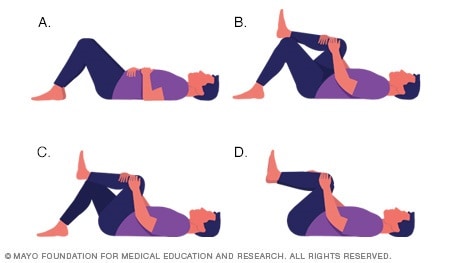
Knee-to-chest stretch
Lie on your back with your knees bent and your feet flat on the floor (A). Using both hands, pull up one knee and press it to your chest (B). Tighten your abdominals and press your spine to the floor. Hold for 5 seconds. Return to the starting position and repeat with the opposite leg (C). Return to the starting position and then repeat with both legs at the same time (D). Repeat each stretch 2 to 3 times — preferably once in the morning and once at night.
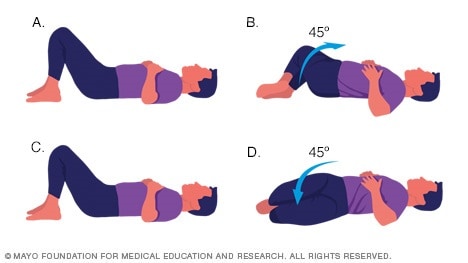
Lower back rotational stretch
Lie on your back with your knees bent and your feet flat on the floor (A). Keeping your shoulders firmly on the floor, roll your bent knees to one side (B). Hold for 5 to 10 seconds. Return to the starting position (C). Repeat on the opposite side (D). Repeat each stretch 2 to 3 times — preferably once in the morning and once at night.
Lower back flexibility exercise
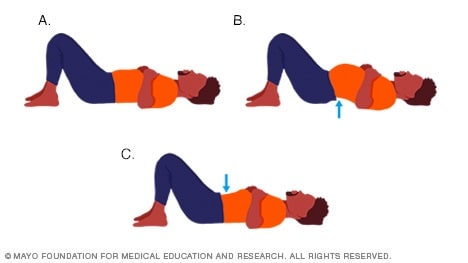
Lie on your back with your knees bent and your feet flat on the floor (A). Tighten your abdominal muscles so your stomach pulls away from your waistband (B). Hold for five seconds and then relax. Flatten your back, pulling your bellybutton toward the floor (C). Hold for five seconds and then relax. Repeat. Start with five repetitions each day and gradually work up to 30.
Bridge exercise
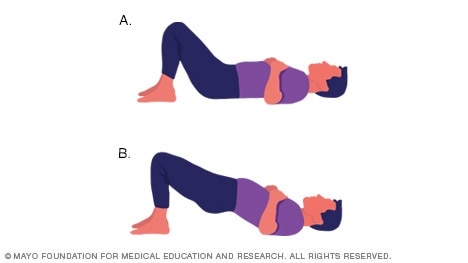
Lie on your back with your knees bent and your feet flat on the floor (A). Keeping your shoulders and head relaxed on the floor, tighten your abdominal and gluteal muscles. Then raise your hips to form a straight line from your knees to your shoulders (B). Try to hold the position long enough to complete three deep breaths. Return to the starting position and repeat. Start with five repetitions each day and gradually work up to 30.
Cat stretch
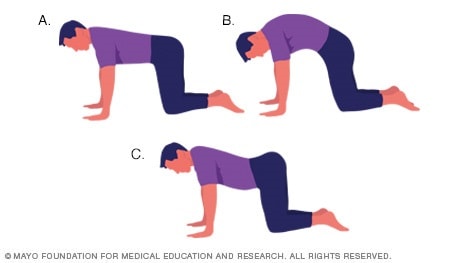
Position yourself on your hands and knees (A). Slowly arch your back, as if you’re pulling your abdomen up toward the ceiling (B). Then slowly let your back and abdomen sag toward the floor (C). Return to the starting position (A). Repeat 3 to 5 times twice a day.
Seated lower back rotational stretch
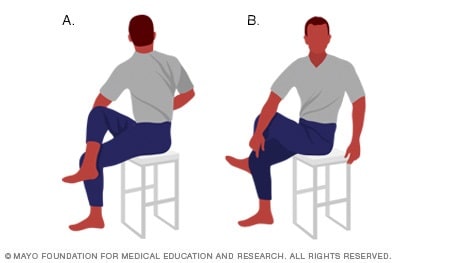
Sit on an armless chair or a stool. Cross your right leg over your left leg. Bracing your left elbow against the outside of your right knee, twist and stretch to the side (A). Hold for 10 seconds. Repeat on the opposite side (B). Repeat this stretch 3 to 5 times on each side twice a day.
Shoulder blade squeeze
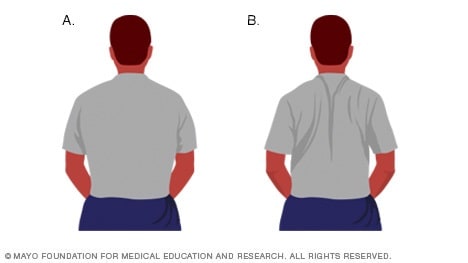
Sit on an armless chair or a stool (A). While maintaining good posture, pull your shoulder blades together (B). Hold for five seconds and then relax. Repeat 3 to 5 times twice a day.





 Wisdom Tea