Translated from the Pali by Ñanamoli Thera from the Anguttara Nikaya of the Tripitaka: AN 4.125
In the teachings, it is said that there is a person who holds within their heart a boundless love, extending it in all directions – to the north, south, east, west, above, below, and to everyone as if they were themselves. This person carries a heart full of love, free from any trace of hostility or ill-will, embracing the entire world.
They derive joy from this loving-kindness, finding it not only pleasant but also essential for their well-being. They remain steadfast and unwavering in this practice, dedicating a significant portion of their life to it. If they pass away without losing this love, they are reborn among the divine beings in a heavenly realm of great purity and splendor.
Now, these divine beings have a lifespan of an entire eon. For an ordinary person who has not yet attained the Noble Eightfold Path, their stay in this heavenly abode lasts for the full extent of the divine lifespan. However, when that divine lifespan is exhausted, the ordinary person may be subjected to various forms of rebirth, such as descent into the realms of suffering, rebirth as an animal, or existence in the ghostly realms. But for the one who has heeded the wisdom of the Perfect One, their residence in this heavenly realm continues for their entire divine lifespan. When this divine lifespan comes to an end, they ultimately reach a state of complete liberation from desire, hatred, and delusion within the same heavenly existence.
This differentiation, the wisdom that distinguishes and elevates the enlightened listener who has reached the Noble Path from the unenlightened, ordinary individual, is evident in the existence of a destination for rebirth after death. The enlightened one, an arahant, has transcended the cycle of birth and death, achieving the ultimate goal of liberation.
Once upon a time, in the city of Savatthi, the Lord resided at the mansion of Migara’s mother in the East Park. During this time, two individuals named Vasettha and Bharadvaja, aspiring to become monks, were residing among the monastic community. One evening, as the Lord emerged from his meditation and walked in the mansion’s shade, Vasettha noticed and said to Bharadvaja, “Friend Bharadvaja, the Lord has come out. Let’s approach him; perhaps we’ll be fortunate to hear a Dhamma talk from the Lord himself.” Bharadvaja agreed, and they went to the Lord, saluted him, and walked beside him.
The Lord inquired, “Vasettha, both of you are Brahmins by birth, having renounced your household lives to become monks. Do the Brahmins not criticize and belittle you?”
Vasettha replied, “Indeed, Lord, the Brahmins revile us. They spare no words in their reproach.”
“What kind of accusations do they hurl at you?” the Lord asked.
Vasettha explained, “Lord, the Brahmins claim their caste is superior, labeling other castes as inferior. They assert Brahmins are fair, while others are dark-skinned. According to them, Brahmins alone are purified, while non-Brahmins are not. They declare Brahmins as the true offspring of Brahma, born from his mouth. They chastise us for abandoning the noble caste to join the ranks of ascetics, considering it improper for us to associate with such people. That’s how the Brahmins insult us, Lord.”
The Lord responded, “Vasettha, these Brahmins have strayed from their ancient traditions. Brahmin women, wives of Brahmins, menstruate, give birth, and nurse their infants. Yet these Brahmins falsely claim to be born from Brahma’s mouth. They distort the truth, earning demerit in the process.
“In reality, there are four castes: Kshatriyas, Brahmins, merchants, and artisans. Virtuous and immoral qualities can be found among individuals from all these castes. Immoral actions, censured by the wise, occur in all castes, while moral conduct, praised by the wise, is also present in all. The wise do not uphold the Brahmin caste as supreme, as dark and bright qualities are scattered across all castes.
“Anyone from these castes who becomes an Arahant, transcending the worldly limitations, is truly supreme through Dhamma, not by birth. Dhamma is the ultimate guide for people in this life and the next.
“Let me illustrate why Dhamma is paramount in both worlds. King Pasenadi of Kosala acknowledges the Sakyan ascetic Gotama. Just as the Sakyans venerate their king, King Pasenadi pays homage to the Tathagata, honoring the Dhamma. It is through their reverence for Dhamma that King Pasenadi humbly serves the Tathagata, acknowledging the supremacy of Dhamma.
“Vasettha, regardless of your birth, name, clan, or family, if asked, identify yourselves as ascetics, followers of the Sakyan. One whose faith in the Tathagata is unwavering can rightfully claim to be a true disciple of the Blessed Lord, born from his mouth, born of Dhamma, created by Dhamma, and an heir of Dhamma. This is because the Tathagata embodies the essence of Dhamma, the embodiment of Brahma.
“In the cosmic cycle, there are times when the world contracts, and beings reside in the Abhassara Brahma world. After a long period, the world expands again, and these beings are reborn here. Initially, there was only water and darkness. Moon, sun, stars, and days were yet to exist. Beings were undistinguished, and male and female identities did not exist. Eventually, earth appeared over the waters, akin to the skin forming on cooled milk. It had color, smell, and taste similar to ghee or honey.
“Beings savored this earth, and their luminous bodies diminished. Moon and sun arose, night and day were distinguished, and life progressed. As beings indulged excessively, distinctions in looks and genders emerged. Due to their arrogance, the savory earth vanished. Fungus, creepers, and rice followed, each marking a new stage of evolution.
“As they indulged, their bodies coarsened, and distinctions became more pronounced. Greed, lust, and sexual activity entered their lives. Punishment originated as immoral deeds surfaced. When humans formed societies, they introduced rules and punishments.
“Over time, societal structures emerged. Khattiya, Brahmin, Vessa, and Sudda classes came into being based on their occupations and actions. The class of ascetics was formed when individuals from these classes chose the path of renunciation.
“However, one’s birth doesn’t define their worth. A person’s actions and intentions determine their destiny. A virtuous life leads to a heavenly realm, while immoral conduct results in suffering. Those who balance good and bad experiences both pleasure and pain.
“Ultimately, one who achieves restraint in body, speech, and thought, and develops enlightenment’s requisites, attains enlightenment in this lifetime. Such a person transcends the cycle of rebirth and experiences ultimate liberation.
“It was Brahma Sanankumara who proclaimed:
The Khattiya’s best among those who value clan; He with knowledge and conduct is best of gods and men.
This verse holds true, Vasettha. Dhamma is the supreme guide for all beings, in this life and the next.”
Vasettha and Bharadvaja were delighted and inspired by the Lord’s words, recognizing the profound truth in his teachings.
Once the Blessed One was staying at Rajagaha in the Bamboo Grove near the Squirrels’ Feeding Place. Now the brahman Akkosa Bharadvaja heard this: “The brahman Bharadvaja, it seems, has become a monk under the Great Monk Gotama.” Angry and unhappy, he went to where the Blessed One was. Having approached the Blessed One, he abused and criticized the Blessed One in foul and harsh words. Thus reviled, the Blessed One spoke to the brahman Akkosa Bharadvaja: ‘Well, brahman, do friends, confidants, relatives, kinsmen and guests visit you?”
“Yes, Gotama, sometimes friends, confidants, relatives, kinsmen and guests do visit me.”
“Well, brahman, do you not offer them snacks or food or tidbits?”
“Yes, Gotama, sometimes I do offer them snacks or food or tidbits.”
“But if, brahman, they do not accept it, who gets it?”
“If Gotama, they do not accept it, I get it back.”
“Even so, brahman, you are abusing us who do not abuse, you are angry with us who do not get angry, you are quarreling with us who do not quarrel. All this of yours we don’t accept. You alone, brahman, get it back; all this, brahman, belongs to you.
“When, brahman, one abuses back when abused, repays anger in kind, and quarrels back when quarreled with, this is called, brahman, associating with each other and exchanging mutually. This association and mutual exchange we do not engage in. Therefore you alone, brahman, get it back; all this, brahman, belongs to you.”
“People, including the king, know the Venerable Gotama thus: ‘The Monk Gotama is the Worthy One.’ When does the Venerable Gotama become angry?”
Said the Buddha:
“Where is anger for one freed from anger, Who is subdued and lives perfectly equanimous, Who truly knowing is wholly freed, Supremely tranquil and equipoised? He who repays an angry man in kind Is worse than the angry man; Who does not repay anger in kind, He alone wins the battle hard to win. He promotes the weal of both, His own, as well as of the other. Knowing that the other man is angry, He mindfully maintains his peace And endures the anger of both, His own, as well as of the other, Even if the people ignorant of true wisdom Consider him a fool thereby.”
When the Lord proclaimed this, the brahman Akkosa Bharadvaja said this to the Blessed One: “Wonderful, indeed, O Venerable Gotama! Herewith I go to the Venerable Gotama for refuge, to his Teaching and to his Holy Order of Monks. Most venerable sir, may I have the privilege to receive at the hands of the revered Lord Gotama the initial monastic ordination and also the higher ordination of a bhikkhu.”
And the brahman Akkosa Bharadvaja received at the hands of the Blessed One the initial monastic ordination and he also received the higher ordination of a bhikkhu. And within a short time of his ordination, the Venerable Akkosa Bharadvaja, living alone, secluded, diligent, zealous and unrelenting, reached that incomparable consummation of holiness for which sons of noble families, having totally abandoned the household life, take to the life of homelessness. With direct knowledge he realized the ultimate, then and there, and lived having access to it. He saw with his supernormal vision: “Ceased is rebirth, lived is the holy life, completed is the spiritual task and henceforth there is nothing higher to be achieved.”
The Venerable Akkosa Bharadvaja, indeed, became one of the Arahats.
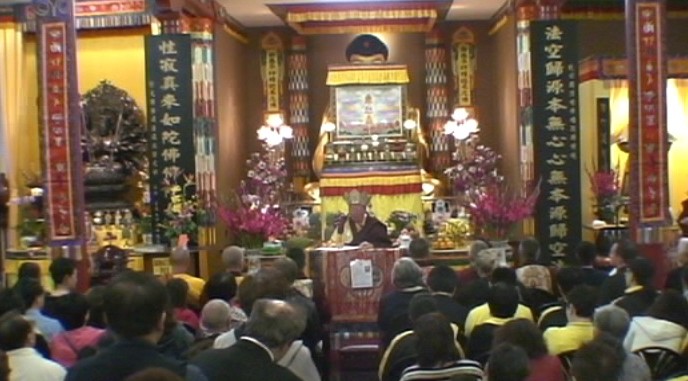
by Zhaxi Zhuoma Rinpoche at Hua Zang Si in San Francisco on something extraordinary that had recently been revealed at the Xuanfa Institute:
“People have heard of Buddhism in the West, but in the most recent 100 years, there has been little evidence of the power of the true Buddha-dharma brought to this world 2,500 years ago by the World-Honored One, Shakyamuni Buddha. People have been searching for the Buddha-dharma that can liberate them from the sufferings of this world, but they cannot even reach a semblance of the Truth expounded by the Buddha.
“But something has happened that is the source of great rejoicing!
“The great primordial Buddha, the teacher of Shakyamuni Buddha and all the Buddhas has incarnated into this world and is living in America.
Ven. Zhaxi Zhuoma gives discourse at Hua Zang Si
“This event has brought joy and happiness to beings in the six realms.
“And there is now a holy place in the west where students can learn and practice the correct Buddha-dharma, find true happiness, and be free from suffering.
“Where can this be?
“A vajra throne or vajra treasure place has appeared near Sanger, California that will bring blessings to all living beings, grant humankind wisdom and happiness, and enable ordinary people to become holy beings.
“It is the greatest news that has happened in the western world in the past thousands of years.
“First, you may ask, ‘Just what is a vajra throne?’
“Vajra thrones are sometimes referred to as bodhimandas or bodhimandalas and literally translated as ‘places of enlightenment.’ There has been misconceptions concerning the use of the term bodhimanda. Many Chinese, for example, think that all temples are bodhimandas, but where is there evidence to support this? What is there to support that they are holy places inhabited by great holy beings where one can become empowered to likewise become enlightened?
“Bodhimandas or vajra thrones are places where both great holy beings became enlightened and sites empowered by these holy beings so that others who practice there may also become enlightened.
“Before Dorje Chang Buddha returned to this world, there were only three such places in the whole world and they were all in Asia.
“All of the world’s bodhimandas or vajra thrones are very holy places.
Bodhgaya, India, site of the First Vajra Throne where Shakyamuni Buddha was enlightened
“The first vajra throne is under the Bodhi Tree in India where Shakyamuni Buddha was enlightened.
Wu-Tai Shan, China, home of the Second Vajra Throne of Manjurshri
“The second vajra throne is at Wu-Tai Shan, a mountain in Shanxi, China. It is the bodhimanda of a great ancient Buddha—Manjushri Bodhisattva. Many holy beings including Manjushri Bodhisattva are said to still live there and can be seen by those with great realization.
“The third vajra throne was in Tibet and was established by Guru Padmasambhava. Guru Padmasambhava had his vajra throne at Kathok Monastery where in times past over 100,000 became enlightened and attained the rainbow body state. No one from there has achieved that level in recent times.
“The rainbow body dharma was first expounded by Guru Padmasambhava and has been in this world for centuries. The Xian-Liang Great Perfection Dharma was brought to this world by our Buddha Master and isaround 10,000 times higher than the rainbow body dharma. It does not belong to the regular rainbow body dharma system that already exists in this world.
“All the vajra thrones exist bedause of the dharma connection to the great primodial Buddha—Dorje Chang Buddha.
“Now, Dorje Chang Buddha has come to this world as H.H. Dorje Chang Buddha III. Wherever H.H. Dorje Chang Buddha III is at a given moment should certainly be a great vajra throne. But H.H. Dorje Chang Buddha III said, “I don’t have any vajra throne. If you insist on saying that I have some kind of throne, then I will tell you that the only throne I have is called ‘the throne of saving living beings with compassion.’ Vajra thrones all belong to my disciples.”
“In that case, the fourth vajra throne in this world is the site of the Xuanfa Temple and Retreat Center near Sanger, California. And it will be accessible to Buddhist and non-Buddhist alike.
“If someone wants to learn the Buddha-dharma or listen to the Dharma Voice of H.H. Dorje Chang Buddha III and believes it, accepts it, and follows it according to the discourses of the Buddha, then that person will definitely get unlimited good fortune, be able to ascend to the heavens or Buddha-lands, and become a holy virtuous one who is above the common person.
“Shakyamuni Buddha learned the dharma that He expounded in this world from Dorje Chang Buddha, but He did not teach all that He learned. The world was not ready for certain more advanced teachings.
“Dorje Chang Buddha has come to this world at this time to transmit those higher teachings to those who are ready to receive them.
“Now, how did the Xuanfa Temple and Retreat Center in Sanger become recognized as the fourth vajra throne in this world? How did we discover that this was such a holy site?
“This story begins in 2003 when I traveled to see my Buddha Master, H.H. Dorje Chang Buddha III. Early in the morning as I left San Francisco, auspicious rainbow clouds appeared over the Oakland hills even though there was no sign of rain anywhere. Later on, I suddenly saw a colorful and large rainbow light appear in the sky. The rainbow completely surrounded the sun. There were also Sanskrit symbols in the sky. Just as the rainbow was fading from sight, I was able to take a picture of the bottom half of this light by focusing the camera below the sun. A dignified Buddha–Dorje Chang Buddha–appeared in the middle of the rainbow. This Buddha became my Buddha master, who was wearing a red robe and was sitting in the middle of the rainbow. The scene was awesome and extremely wonderful. The rainbow light appeared in the sky for several hours.
“This and what happened after I arrived has been reported in the treasure book H.H. Dorje Chang Buddha III.
“The Buddha Master bestowed me with two true red holy vajra pills. Unexpectedly the Vajra Pills in my hand started to jump. At that time the Vajra Pills jumped in my hand just as if they were alive. They not only jumped but one of them started to circle around and left my hand. It transformed into a dazzling bright red light and soared into the sky. I understood that my merit was not sufficient at that time for me to keep that pill and that it had gone to a Buddha Land or holy place for safe keeping, but that when conditions were right, it would reappear. It was also at that time, that I saw my Buddha Master, who sat far away on the dais, as the dignified bright blue Buddha Vajradhara. This was before we knew the true identity of our Buddha Master.
“A thought came to me that the coming into this world, and particularly to America, of Dorje Chang Buddha was one of the most important events in the history of Buddhism. We needed a stupa to mark this event and the Sanger retreat center would be perfect. However, I did not yet know why this was such a great idea.
“About the time I made this intention known, strange and wonderful sights began to appear at the Xuanfa Temple and Retreat Center we were establishing near Sanger.
Students erect walls to yurt.
“Students came to the future temple site to meditate and work on various projects. While erecting a small yurt, circular light beings were recorded on many photos taken of students working there.
“We had seen many of these lights in photos taken while on the tour to introduce the treasure book H.H. Dorje Chang Buddha III to the American people.
“They seem to be beings from another dimension and are often reported in all sorts of photos as ‘orbs.’ Some claim they are the souls of departed beings, others claim they are aliens from another world, but we recognize them as being auspicious and illusory phenomena that seem to be most visible when the dharma is being or about to be propagated.
“The Buddha Master has told us that some of them, at least, are Dharma Wheel Mandalas.”
Many Dharma Wheel Mandalas and a small rainbow appeared when yurt was constructed
A rainbow even appeared together with many of these mandalas inside the yurt that we were erecting.
“Other mysterious rainbow light beings manifested from time to time. Sometime they were visible to the naked eye and sometimes they could only be seen via our digital cameras.
Rainbow visitor appears
“Although we were not able to record it on the camera, we also saw a bright neon-pink column of light appear on the viewfinder of my digital camera. This phenomenon appeared several other times at the retreat center. Several students saw these lights. I had also seen this same light once before at a very powerful empowerment ceremony while I was with my Buddha Master.
“But what were they and why were we seeing them?
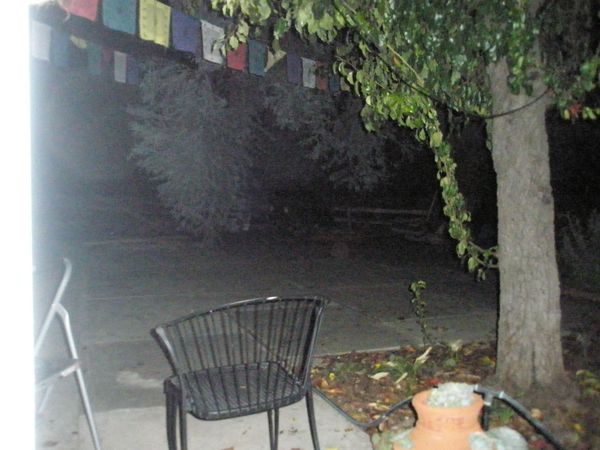
Ghost appears on patio at Xuanfa Institute
“Ghosts or spirit beings appeared and made their presence known. Lights flickered, cabinet doors opened and closed—all quite mysteriously. It seemed they meant no harm, but they only wanted to be noticed and to hear the dharma. If their actions were a problem, I asked them to stop and they always did. I invited them to come and listen to Dharma Discourses. The ghost beings came to the Xuanfa Temple and Retreat Center to seek empowerment and learn the Dharma just as many from other realms would do.
“This also included those from the animal realm. There was a very tenacious goose (named Dharma Duck) that came to the Temple and insisted on being allowed in. He would fly at the windows or peck at the door if dharma was being discussed.
Dharma Duck (goose) receives Vajra-Bodhi Pill
“A short time ago, several large koi fish performed a lovely display for H.H. Dorje Chang Buddha III when the Buddha Master visited the lake at the Xuanfa Temple and Retreat Center. The brightly colored koi raised their tails in the water and waved them in unison as the Buddha Master watched from the bank. They continued to do this for some time after the Buddha’s visit and delight other visitors. Recently we saw them exhibit this sort of behavior again, but nothing like the show they did for the Buddha Master.
Rainbow Buddha Light appears in sky for many hours at Xuanfa Institute
“On November 4, 2010, a magnificent Buddha Light filled the sky. It lasted all day and was very beautiful. Many people saw it in the Fresno area. It was even reported on the local news. Once a disciple looked up and saw a rainbow in the sky overhead outside the range of the Buddha Light very much like the one we saw this morning at the fish release. Other rainbows appeared in the sky as well and some disciples saw the Buddha Light repeatedly during the following week.
“These Buddha Lights appeared at other times as well.
“A couple of weeks later, a very beautiful multiple-colored Buddha Light appeared around the almost full moon. When a disciple called to report the Buddha Light, I could not see it at first, but instead I saw four moons together like disks in the sky. I thought it might just be my eyesight and went inside to find my glasses. When I returned outside there were only two disks in the sky, still a most unusual phenomena. The multiple moons were a sign that four very important beings would come to the Center.
“However, it was on November 8 that the most amazing event occurred.
“We were discussing removing a pole remaining from the former chain link fence that had been part of the old dilapidated shed. Suddenly the pole started shaking violently—like a giant tuning fork. Could it be an earthquake? Fresno was not known to have any seismic activity. When we looked around nothing else was shaking. This was very strange and scary. That plus all the unusual lights and visits from other dimensions were telling us something, but what?
“I did not think it wise to remove that pole and suspected it was something quite extraordinary. So the next day I went to see my Buddha Master, H.H. Dorje Chang Buddha III. Even though the Buddha Master was very, very busy, I was able to explain what had happened. The Buddha Master laughed and said that I absolutely should not cut down the pole; the Dharma Protectors had come and were making their presence known. This was a sort of Vajra Pole that the dharma protectors were using to tell us how pleased they were with what was happening here. This was all most auspicious and I should record this holy event for others.
“However, I found out later that this was a sign of something even more significant and wonderful that was beginning to manifest at the site. The true nature of this place as a holy place for enlightenment was being revealed. I learned that this was a sort of portal to another dimension whereby deities could communicate with living beings in this realm.
“When I returned, I felt very badly that we had not filmed the mysterious shaking pole event. I was wandering around the quiet vajra poles. They were not shaking at all. I muttered about how sorry I felt for not having a video that I could show to my Buddha Master. It seemed the Dharma Protectors understood. The vajra pole suddenly started to shake again! I was so happy to have a chance to record this unbelievable shaking vajra pole. This time we got the video camera and recorded the visit. We also arranged the second building so that the second pole that had also started to shake would not need to be removed either. We have subsequently removed all the buildings around the poles so that they can be more easily viewed by those who come to see them.
“On the way to see my Buddha Master, the thought had occurred to me that the new yurt we had just constructed should be used as a chapel for the Dharma Protectors. Now, this was before I knew that we had been blessed by their presence or had any understanding of what a holy place this was. For some reason, somehow, I just knew the yurt we had built was not to be used for housing disciples as was originally planned. We would build a shrine at the pole where the Dharma Protectors had communicated with us and dedicate the beautiful new yurt to them.
“I had been transmitted dharma that could be used in the yurt chapel that I could teach to those who came to do retreats at the center. Only those who had this dharma would be able to use the chapel. However, as the true nature of this site was revealed, I found that this was only a very small part of what would happen here. H.H. Dorje Chang Buddha III would give inner tantric initiation to those who were qualified and who came here for retreats that would enable them to have the power and blessings of the Dharma Protectors and thus be able to quickly progress toward enlightenment. This would truly become a place where ordinary beings could train and be able to become accomplished, just like it was in the past at Kathok Monastery.
“The poles continued to tremble from time to time including shaking for a couple of nuns who had come to visit, but it was over the Christmas holidays that they gave their most magnificent display to date. This was for a group of students who had come to visit and work on various projects including furnishing the yurt as a Protector Chapel.
“When I first went to the yurt, to photograph what they had done, I again saw the pillar of bright pink neon light, this time on the viewfinder of my video camera. I called nearby students to quickly come and see this and one of the students actually saw the pillar of light enter the dome skylight and go into the Chapel.
“Other students reported feeling the earth shake in the vicinity of the poles while they were shaking. It gave them goose bumps.
“Sightings of holy phenomena continued into the New Year.
“On January 10, 2011, I looked at the site where a Tibetan-style temple was to be erected as part of the Retreat Center.
Pink light appears in trees at Xuanfa Institute
“At first I thought my eyes were just playing tricks on me, but I looked again and I saw round rosy-pink light formsbouncing around these Cypress and Modesto Ash trees.
“I looked around, but they were only visible at the site of the future temple.
“This was truly a magical place and people’s lives were being transformed by what they learned and experienced here. Recently a neighbor stopped by to see what was going on. She came by a few days later to bring another curious neighbor to see the Vajra Poles. She was radiant and smiling and told me she had a wonderful dream the night she visited us, something that never happened to her. She woke up feeling happy and very good. Several students have also experienced healings—both emotional and physical while staying at the temple.
“But it was only after I presented a documentary of all these events to my Buddha Master that I learned their genesis and this whole story came together.
“Where had the red holy vajra pill that I had received eight years earlier flown?
“Why had I been given this beautiful site to develop?
MRI image of Zhaxi Zhuoma’s skull after Ni-wan initiation
“Why had I received the Ni-wan Dharma initiation that opened my crown so that I could manifest the body of a holy person?
“Why were my good students and others who visited this site experiencing such beneficial effects and life affirming experiences?
“Why were all these supernatural events happening here?
“What I found was that the red holy vajra pill that flew out of my hand during the empowerment ceremony in 2003 had flown to Sanger. All I knew then was that it had flown to a holy place for safe keeping until I was ready to receive it.
“This was truly a holy site and it was my destiny to develop this site into a holy retreat center where many would come and learn and practice the Buddha-dharma to transform their lives and become enlightened.
“In fact, it was the most holy site in the western world that was accessible to ordinary beings.
“So this would be a perfect site to establish the retreat and build a stupa marking the Buddha’s coming to this world.
“This would be a holy mandala—a bodimandala—or place where ordinary beings could come and become enlightened.
“Mandalas represent a Buddha land–it’s landscape, people, holy instruments, etc.
“They are holy places inhabited by holy beings.
Kathok Monastery, site of the Third Vajra Throne of Guru Padmasambhava
“I was told that Sanger was even more powerful than Kathok and those who come here to practice and who receive the empowerment of the Dharma Protectors here WOULD become enlightened.
“I was also told that this holy site was not just for Buddhists, but to provide benefit to other religions as well.
“All sincere cultivators of any faith who adhere to the three pure precepts of doing no harm, doing only good, and helping other living beings could practice and meditate here and become accomplished in their religion.
“Anyone who comes here to sincerely practice will gain wisdom and good fortune.
“And since this is a holy place, if they come here to cultivate themselves they will gain blessings, and, if they have sufficient merit, deities may communicate with them through the Vajra Poles.
“Although this is a Buddhist holy site, the deities of other religions may come here as well.
“Buddhists, Jews, Muslims, Catholics, Protestants, Mormons, and others can come together and be blessed.
“Those who have visited the site have expressed a strong feeling of joy and the presence of great energetic beings.
“They are energized by just being here.
“One knows that this is a holy place.
“Not only has H.H. Dorje Chang Buddha III come to America, but also the Buddha-dharma has come and can be seen, learned, and practiced here.
“So we must build a retreat center and have a stupa marking H.H. Dorje Chang Buddha III’s coming to this world and specifically to America and the teachings that the Buddha will transmit to us. May we quickly complete the retreat center, cabins, temples, and stupa and may many come and obtain liberation.
1. Thus have I heard. Once the Blessed One was staying at Sàvatthi, in Jeta’s Grove, Anàthapiõóika’s monastery. There he addressed the monks thus: “Monks.” — “Venerable sir,” they replied. The Blessed One said this:
2. “Monks, suppose a cloth were stained and dirty, and a dyer dipped it in some dye or other, whether blue or yellow or red or pink, it would take the dye badly and be impure in colour. And why is that? Because the cloth was not clean. So too, monks, when the mind is defiled, an unhappy destination [in a future existence] may be expected.
“Monks, suppose a cloth were clean and bright, and a dyer dipped it in some dye or other, whether blue or yellow or red or pink, it would take the dye well and be pure in colour. And why is that? Because the cloth was clean. So too, monks, when the mind is undefiled, a happy destination [in a future existence] may be expected.
3. “And what, monks, are the defilements of the mind? (1) Covetousness and unrighteous greed are a defilement of the mind; (2) ill will is a defilement of the mind; (3) anger is a defilement of the mind; (4) hostility…(5) denigration…(6) domineering…(7) envy…(8) jealousy…(9) hypocrisy…(10) fraud…(11) obstinacy…(12) presumption…(13) conceit…(14) arrogance…(15) vanity…(16) negligence is a defilement of the mind.
4. “Knowing, monks, covetousness and unrighteous greed to be a defilement of the mind, the monk abandons them. Knowing ill will to be a defilement of the mind, he abandons it. Knowing anger to be a defilement of the mind, he abandons it. Knowing hostility to be a defilement of the mind, he abandons it. Knowing denigration to be a defilement of the mind, he abandons it. Knowing domineering to be a defilement of the mind, he abandons it. Knowing envy to be a defilement of the mind, he abandons it. Knowing jealousy to be a defilement of the mind, he abandons it. Knowing hypocrisy to be a defilement of the mind, he abandons it. Knowing fraud to be a defilement of the mind, he abandons it. Knowing obstinacy to be a defilement of the mind, he abandons it. Knowing presumption to be a defilement of the mind, he abandons it. Knowing conceit to be a defilement of the mind, he abandons it. Knowing arrogance to be a defilement of the mind, he abandons it. Knowing vanity to be a defilement of the mind, he abandons it. Knowing negligence to be a defilement of the mind, he abandons it.
5. “When in the monk who thus knows that covetousness and unrighteous greed are a defilement of the mind, this covetousness and unrighteous greed have been abandoned; when in him who thus knows that ill will is a defilement of the mind, this ill will has been abandoned;…when in him who thus knows that negligence is a defilement of the mind, this negligence has been abandoned —
6. — he thereupon gains unwavering confidence in the Buddha thus: ‘Thus indeed is the Blessed One: he is accomplished, fully enlightened, endowed with [clear] vision and [virtuous] conduct, sublime, knower of the worlds, the incomparable guide of men who are tractable, the teacher of gods and men, enlightened and blessed.’
7. — he gains unwavering confidence in the Dhamma thus: ‘Well proclaimed by the Blessed One is the Dhamma, realizable here and now, possessed of immediate result, bidding you come and see, accessible and knowable individually by the wise.
8. — he gains unwavering confidence in the Sangha thus: ‘The Sangha of the Blessed One’s disciples has entered on the good way, has entered on the straight way, has entered on the true way, has entered on the proper way; that is to say, the four pairs of men, the eight types of persons; this Sangha of the Blessed One’s disciples is worthy of gifts, worthy of hospitality, worthy of offerings, worthy of reverential salutation, the incomparable field of merit for the world.’
9. “When he has given up, renounced, let go, abandoned and relinquished [the defilements] in part, he knows: ‘I am endowed with unwavering confidence in the Buddha…in the Dhamma…in the Sangha; and he gains enthusiasm for the goal, gains enthusiasm for the Dhamma, gains gladness connected with the Dhamma. When he is gladdened, joy is born in him; being joyous in mind, his body becomes tranquil; his body being tranquil, he feels happiness; and the mind of him who is happy becomes concentrated.
10. “He knows: ‘I have given up, renounced, let go, abandoned and relinquished [the defilements] in part’; and he gains enthusiasm for the goal, gains enthusiasm for the Dhamma, gains gladness connected with the Dhamma. When he is gladdened, joy is born in him; being joyous in mind, his body becomes tranquil; when his body is tranquil, he feels happiness; and the mind of him who is happy becomes concentrated.
11. “If, monks, a monk of such virtue, such concentration and such wisdom eats almsfood consisting of choice hill-rice together with various sauces and curries, even that will be no obstacle for him.
“Just as cloth that is stained and dirty becomes clean and bright with the help of pure water, or just as gold becomes clean and bright with the help of a furnace, so too, if a monk of such virtue, such concentration and such wisdom eats almsfood consisting of choice hill-rice together with various sauces and curries, even that will be no obstacle for him.
12. “He abides, having suffused with a mind of loving-kindness one direction of the world, likewise the second, likewise the third, likewise the fourth, and so above, below, around and everywhere, and to all as to himself; he abides suffusing the entire universe with loving-kindness, with a mind grown great, lofty, boundless and free from enmity and ill will.
“He abides, having suffused with a mind of compassion…of sympathetic joy…of equanimity one direction of the world, likewise the second, likewise the third, likewise the fourth, and so above, below, around and everywhere, and to all as to himself; he abides suffusing the entire universe with equanimity, with a mind grown great, lofty, boundless and free from enmity and ill will.
13. “He understands what exists, what is low, what is excellent, and what escape there is from this [whole] field of perception.
14. “When he knows and sees in this way, his mind becomes liberated from the canker of sensual desire, liberated from the canker of becoming, liberated from the canker of ignorance. When liberated, there is knowledge: ‘It is liberated’; and he knows: ‘Birth is exhausted, the life of purity has been lived, the task is done, there is no more of this to come.’ Such a monk is called ‘one bathed with the inner bathing.”
15. Now at that time the brahmin Sundarika Bharadvaja was seated not far from the Blessed One, and he spoke to the Blessed One thus: “But does Master Gotama go to the Bahuka River to bathe?”
“What good, brahmin, is the Bahuka River? What can the Bahuka River do?”
“Truly, Master Gotama, many people believe that the Bahuka River gives purification, many people believe that the Bahuka River gives merit. For in the Bahuka River many people wash away the evil deeds they have done.”
16. Then the Blessed One addressed the brahmin Sundarika Bharadvaja in these stanzas:
Bahuka and Adhikakka,
Gaya and Sundarika,
Payaga and Sarassati,
And the stream Bahumati —
A fool may there forever bathe, Yet will not purify his black deeds.
What can Sundarika bring to pass?
What can the Payaga and the Bahuka?
They cannot purify an evil-doer,
A man performing brutal and cruel acts.
One pure in heart has evermore
The Feast of Cleansing and the Holy Day;
One pure in heart who does good deeds
Has his observances perfect for all times.
It is here, O brahmin, that you should bathe
To make yourself a safe refuge for all beings.
And if you speak no untruth,
Nor work any harm for breathing things,
Nor take what is not offered,
With faith and with no avarice,
To Gaya gone, what would it do for you?
Let any well your Gaya be!
17. When this was said, the brahmin Sundarika Bharadvaja spoke thus:
“Magnificent, Master Gotama! Magnificent, Master Gotama! The Dhamma has been made clear in many ways by Master Gotama, as though he were righting the overthrown, revealing the hidden, showing the way to one who is lost, or holding up a lamp in the dark for those with eyesight to see forms.
18. “I go to Master Gotama for refuge, and to the Dhamma, and to the Sangha. May I receive the [first ordination of] going forth under Master Gotama, may I receive the full admission!
19. And the brahmin Sundarika Bharadvaja received the [first ordination of] going forth under the Blessed One, and he received the full admission. And not long after his full admission, dwelling alone, secluded, diligent, ardent and resolute, the venerable Bharadvaja by his own realization understood and attained in this very life that supreme goal of the pure life, for which men of good family go forth from home life into homelessness. And he had direct knowledge thus: “Birth is exhausted, the pure life has been lived, the task is done, there is no more of this to come.”
And the venerable Bharadvaja became one of the Arahats.
From The Simile of the Cloth & the Discourse on Effacement, edited by Nyanaponika Thera, (Kandy: Buddhist Publication Society, 1988, by arrangement with the Buddhist Publication Society.
At Savatthi. There the Blessed One said, “I tell you, monks: It is for one who knows & sees that there is the ending of the effluents. For one who knows what & sees what is there the ending of the effluents? ‘Such is form, such its origination, such its passing away. Such is feeling… Such is perception… Such are fabrications… Such is consciousness, such its origination, such its passing away.’ It is for one who knows & sees in this way that there is the ending of the effluents.
“Even though this wish may occur to a monk who dwells without devoting himself to development — ‘O that my mind might be released from effluents through lack of clinging!’ — still his mind is not released from the effluents through lack of clinging. Why is that? From lack of developing, it should be said. Lack of developing what? The four frames of reference, the four right exertions, the four bases of power, the five faculties, the five strengths, the seven factors for Awakening, the noble eightfold path.
“Suppose a hen has eight, ten, or twelve eggs: If she doesn’t cover them rightly, warm them rightly, or incubate them rightly, then even though this wish may occur to her — ‘O that my chicks might break through the egg shells with their spiked claws or beaks and hatch out safely!’ — still it is not possible that the chicks will break through the egg shells with their spiked claws or beaks and hatch out safely. Why is that? Because the hen has not covered them rightly, warmed them rightly, or incubated them rightly. In the same way, even though this wish may occur to a monk who dwells without devoting himself to development — ‘O that my mind might be released from effluents through lack of clinging!’ — still his mind is not released from the effluents through lack of clinging. Why is that? From lack of developing, it should be said. Lack of developing what? The four frames of reference, the four right exertions, the four bases of power, the five faculties, the five strengths, the seven factors for Awakening, the noble eightfold path.
“Even though this wish may not occur to a monk who dwells devoting himself to development — ‘O that my mind might be released from effluents through lack of clinging!’ — still his mind is released from the effluents through lack of clinging. Why is that? From developing, it should be said. Developing what? The four frames of reference, the four right exertions, the four bases of power, the five faculties, the five strengths, the seven factors for Awakening, the noble eightfold path.
“Suppose a hen has eight, ten, or twelve eggs that she covers rightly, warms rightly, & incubates rightly: Even though this wish may not occur to her — ‘O that my chicks might break through the egg shells with their spiked claws or beaks and hatch out safely!’ — still it is possible that the chicks will break through the egg shells with their spiked claws or beaks and hatch out safely. Why is that? Because the hen has covered them, warmed them, & incubated them rightly. In the same way, even though this wish may not occur to a monk who dwells devoting himself to development — ‘O that my mind might be released from effluents through lack of clinging!’ — still his mind is released from the effluents through lack of clinging. Why is that? From developing, it should be said. Developing what? The four frames of reference, the four right exertions, the four bases of power, the five faculties, the five strengths, the seven factors for Awakening, the noble eightfold path.
“Just as when a carpenter or carpenter’s apprentice sees the marks of his fingers or thumb on the handle of his adze but does not know, ‘Today my adze handle wore down this much, or yesterday it wore down that much, or the day before yesterday it wore down this much,’ still he knows it is worn through when it is worn through. In the same way, when a monk dwells devoting himself to development, he does not know, ‘Today my effluents wore down this much, or yesterday they wore down that much, or the day before yesterday they wore down this much,’ still he knows they are worn through when they are worn through.
“Just as when an ocean-going ship, rigged with masts & stays, after six months on the water, is left on shore for the winter: Its stays, weathered by the heat & wind, moistened by the clouds of the rainy season, easily wither & rot away. In the same way, when a monk dwells devoting himself to development, his fetters easily wither & rot away.”
Foundation of Buddha’s hut (Gandhakuti) at Jeta’s Grove (Jetavana Monastery) near Savatthi (Sravasti).
I have heard that on one occasion the Blessed One was staying in Savatthi, at Jeta’s Grove, Anathapindika’s monastery. There he addressed the monks: “Monks!”
“Yes, lord,” the monks responded.
The Blessed One said: “Monks, I will teach you the summary & exposition of one who has had an auspicious day. Listen & pay close attention. I will speak.”
“As you say, lord,” the monks replied.
The Blessed One said:
You shouldn’t chase after the past or place expectations on the future. What is past is left behind. The future is as yet unreached. Whatever quality is present you clearly see right there, right there. Not taken in, unshaken, that’s how you develop the heart. Ardently doing what should be done today, for — who knows? — tomorrow death. There is no bargaining with Mortality & his mighty horde.
Whoever lives thus ardently, relentlessly both day & night, has truly had an auspicious day: so says the Peaceful Sage.
“And how, monks, does one chase after the past? One gets carried away with the delight of ‘In the past I had such a form (body)’… ‘In the past I had such a feeling’… ‘In the past I had such a perception’… ‘In the past I had such a thought-fabrication’… ‘In the past I had such a consciousness.’ This is called chasing after the past.
“And how does one not chase after the past? One does not get carried away with the delight of ‘In the past I had such a form (body)’… ‘In the past I had such a feeling’… ‘In the past I had such a perception’… ‘In the past I had such a thought-fabrication’… ‘In the past I had such a consciousness.’ This is called not chasing after the past.
“And how does one place expectations on the future? One gets carried away with the delight of ‘In the future I might have such a form (body)’… ‘In the future I might have such a feeling’… ‘In the future I might have such a perception’… ‘In the future I might have such a thought-fabrication’… ‘In the future I might have such a consciousness.’ This is called placing expectations on the future.
“And how does one not place expectations on the future? One does not get carried away with the delight of ‘In the future I might have such a form (body)’… ‘In the future I might have such a feeling’… ‘In the future I might have such a perception’… ‘In the future I might have such a thought-fabrication’… ‘In the future I might have such a consciousness.’ This is called not placing expectations on the future.
“And how is one taken in with regard to present qualities? There is the case where an uninstructed run-of-the-mill person who has not seen the noble ones, is not versed in the teachings of the noble ones, is not trained in the teachings of the noble ones, sees form as self, or self as possessing form, or form as in self, or self as in form.
“He/she sees feeling as self, or self as possessing feeling, or feeling as in self, or self as in feeling.
“He/she sees perception as self, or self as possessing perception, or perception as in self, or self as in perception.
“He/she sees thought-fabrications as self, or self as possessing thought-fabrications, or thought-fabrications as in self, or self as in thought-fabrications.
“He/she sees consciousness as self, or self as possessing consciousness, or consciousness as in self, or self as in consciousness. This is called being taken in with regard to present qualities.
“And how is one not taken in with regard to present qualities? There is the case where a disciple of the noble ones who has seen the noble ones, is versed in the teachings of the noble ones, is well-trained in the teachings of the noble ones, does not see form as self, or self as possessing form, or form as in self, or self as in form.
“He/she does not see feeling as self, or self as possessing feeling, or feeling as in self, or self as in feeling.
“He/she does not see perception as self, or self as possessing perception, or perception as in self, or self as in perception.
“He/she does not see thought-fabrications as self, or self as possessing thought-fabrications, or thought-fabrications as in self, or self as in thought-fabrications.
“He/she does not see consciousness as self, or self as possessing consciousness, or consciousness as in self, or self as in consciousness. This is called not being taken in with regard to present qualities.
You shouldn’t chase after the past or place expectations on the future. What is past is left behind. The future is as yet unreached. Whatever quality is present you clearly see right there, right there. Not taken in, unshaken, that’s how you develop the heart. Ardently doing what should be done today, for — who knows? — tomorrow death. There is no bargaining with Mortality & his mighty horde.
Whoever lives thus ardently, relentlessly both day & night, has truly had an auspicious day: so says the Peaceful Sage.
“‘Monks, I will teach you the summary & exposition of one who has had an auspicious day.’ Thus was it said, and in reference to this was it said.”
That is what the Blessed One said. Gratified, the monks delighted in the Blessed One’s words.
At one time the Blessed One was in Rajagriha, on Eagles Peak, together with one thousand, two hundred and fifty monks. There were also an immeasurable, unlimited multitude of Bodhisattvas and the eight classes of gods, nagas and so forth, who were all assembled. At that time, the Pure Wisdom Bodhisattva was seated in the midst of this assembly. Because he aspired to extend compassion toward all sentient beings, he thought: “by what means do the Buddhas, Tathágatas, obtain the pure body, furnished with the marks of the great person?” Again he thought: “all classes of living beings are able to meet the Tathágata and approach him with offerings. The blessings that are obtained are without measure or limit. I do not yet know, however, what offerings living beings will make or what merit they will cultivate after the death of the Tathágata so as to bring about those roots of good merit that quickly lead to final, supreme enlightenment.” After thinking this, he then arose from his seat and bared his right shoulder, having bowed his head at the feet of the Buddha; he knelt upright, with palms in salutation and spoke to the Buddha, saying, “World Honored One, I wish to ask questions and hope that you deign to acknowledge them.” The Buddha said, “Noble son, I will teach according to what you ask.”
At that time the Pure Wisdom Bodhisattva spoke to the Buddha saying, “By what means do the Buddhas, Tathágatas, perfectly enlightened ones obtain the pure body, furnished with the marks of the great person? Also, all living beings are able to meet the Tathágata and approach him with offerings. The blessings that are obtained are without merit or limit. I have not yet discerned what offerings living beings will make or what merit they will cultivate after the death of the Tathágata so as to bring about those good qualities that quickly lead to final, supreme enlightenment.”
At that time, the World Honored One said to the Pure Wisdom Bodhisattva: “Excellent, excellent, that you are able for the sake of future beings to bring forth such questions! Now listen carefully, reflect on this well, and practice as I say. I will explain for you in detail.”
The Pure Wisdom Bodhisattva said, “So be it, World Honored One, I dearly wish to listen.”
The courtyard at Hua Zang Si before the Bathing of the Buddha Ceremony held in 2006.
The Buddha explained to the Pure Wisdom Bodhisattva: “Noble son, you should know that because giving, morality, patience, vigor, meditation, and knowledge and experience of liberation; the ten strengths; and the four confidences are all the characteristics of the Buddha and are all various kinds of knowledge, virtue, and purity, they are the purity of the Tathágata.
If the Buddhas, Tathágatas, are in this way given various offerings with a pure heart—incense, flowers, gems, garlands, banners, parasols, and cushions—displayed before the Buddha, multifariously adorning him, and the marvelously scented water is used to bathe his noble form, the dark smoke of the burning incense will carry your mind to the Dharma realm. Furthermore, you celebrate the extraordinary merit of the Tathágata with food and drink, percussion and stringed music; you will manifest the superb vow to direct your mind to the supreme ocean of omniscience. The merit thereby produced will be immeasurable and without limit; it will be perpetually continued through successive rebirths to the point of enlightenment. Why is this? The blessed wisdom of the Tathágata is inconceivable, infinite, and unequaled.
Noble son, all Buddhas, World Honored Ones, have three bodies. They are known as the Dharma body or Dharmakaya, the glorified body or the Sambhogakaya, and the manifestation body or the Nirmanakaya. After my Nirvana, if you wish to do homage to these three bodies then you should do homage to my relics [sharira]. But these are of two kinds: the first is the bodily relic; the second is the Dharma-verse relic. I will now recite the verse:”
All things arise from a cause.
The Tathágata has explained their cause
and the cessation of the cause of these things.
This the great ascetic has explained.
“If men, women, or the five groups of mendicants would build an image of the Buddha; or if those without strength would deposit one as large as a grain of barley, or build a stupa—its body the size of a jujube, its mast the size of a needle, its parasol equal to a flake of bran, its relic like a mustard seed—or if someone writes the Dharma verse and installs it inside the stupa, it would be like doing homage by offering up a rare jewel. If in accordance with one’s own strength and ability one can be truly sincere and respectful, it (the image or stupa) would be like my present body, equal without difference.
Noble son, if there are beings who are able to make such excellent offerings, they will glorify themselves by achieving the fifteen superb virtues. First, they will always be modest. Second, they will manifest a mind of pure faith. Third, their hearts will be simple and honest. Fourth, they will cleave to good friends. Fifth, they will enter a state of passionless wisdom. Sixth, they will constantly encounter Buddhas. Seventh, they will always maintain the correct teaching. Eighth, they will be able to act according to my teaching. Ninth, they will be reborn in pure Buddha fields according to their wishes. Tenth, if they are reborn among men, they will be noblemen of great families; being respected among men, they will produce joyous thoughts. Eleventh, being born among men, they will naturally set their minds on the Buddha. Twelfth, an army of demons will not be able to harm them. Thirteenth, they will be able in the final age to protect and maintain the True Dharma. Fourteenth, they will be protected by the Buddhas of the ten directions. Fifteenth, they will be able to quickly obtain the five attributes of the Dharma body.”
At that time, the World Honored One uttered these verses:
After my death
You will be able to honor my relics
Some will build stupas
Or images of the Tathágata.
At the place of the image or stupa,
One who anoints that spot of ground
With various incenses and flowers
Scattering them over its surface
Uses pure, beautifully scented water
To pour onto the body of this image,
Offers it various flavorful drinks and foods,
Fully maintaining it with oblations,
Eulogizes the virtue of the Tathágata,
Which is endlessly difficult to conceive;
Through the wisdom of skillful means and the supernatural power of the Buddha
Such a one will quickly reach the other shore of Nirvana.
He will obtain the diamond body
Complete with the thirty-two marks of a great person
And the eighty minor signs of excellence.
He will ferry the multitude of living beings to the shore of Nirvana.
At that time, the Pure Wisdom Bodhisattva, having heard these verses, addressed the Buddha saying, “Future living beings will ask, ‘why bathe the image?’”
The Buddha answered the Pure Wisdom Bodhisattva: “Because you will equal the Tathágata in producing right mindfulness. You will not be attached to the two sides that deceive people with ‘emptiness’ and ‘being.’ You will long insatiably for virtuous conduct. The three emancipations, morality, and wisdom will be constantly sought to escape the endless cycle of birth and death. You will produce great compassion toward all living beings. You will aspire to obtain and quickly perfect the three kinds of bodies.
Noble son, I have already expounded for your sake the four noble truths, the twelve conditioned co-productions and the six perfections. Now I teach the method of bathing the image for your sake and the sake of the various kings, princes, ministers, concubines, princesses, gods, nagas, men and demons. Among the various types of homage, this (the bathing of the image) is the best. It excels the giving of the seven jewels equal to the sands of the Ganges.
When you bathe the image, you should use ox-head sandalwood, white sandalwood, red sandalwood, or aloe-wood incenses. You should burn Mountain Top Tulip incense, ‘Dragons Brain’ incense, Ling-ling (Mountain) incense, and so forth. On the surface of a clean stone you should grind these to make paste; use this paste to make scented water and place it in a clean vessel. At a clean spot, make an altar with good earth, square or round, its size suited to the circumstances. On top establish the bathing platform and place the Buddha image in the middle. Pour on the scented hot water, purifying and cleansing it, repeatedly pouring the pure water over it. The water that is used must be completely filtered so as not to cause harm to insects. Drops from two fingers of the water with which you bathed the image should be taken and placed on your own head—this is called ‘good luck water.’ Drain off the water onto clean ground without allowing your feet to tread upon it. With a fine, soft towel wipe the image, making it clean. Burn the above name incenses spreading the aroma all around and put the image back in its original place.
“Noble son, the consequence of performing this bathing of the Buddha image is that you and the great multitude of men and gods will presently receive wealth, happiness, and long life without sickness; your every wish will be fulfilled. Your relatives, friends, and family will all be at ease. You will bid a long farewell to the eight conditions of trouble and forever escape the fount of suffering. You will never again receive the body of a woman and will quickly achieve enlightenment.
When you have set up the image and burned the various incenses, face the image, clasp your palms together in pious salutation and recite these praises:
I now bathe the Tathágata.
His pure wisdom and virtue adorn the assembly.
I vow that those living beings of this period of the five impurities
May quickly witness the pure Dharma body of the Tathágata.
May the incense of morality, meditation, wisdom and the knowledge and experience of liberation
Constantly perfume every realm of the ten directions.
I vow that the smoke of this incense will likewise
Do the Buddhas work of salvation without measure or limit.
I also vow to put a stop to the three hells and the wheel of samsara,
Completely extinguishing the fires and obtaining the coolness of relief
So that all may manifest the thought of unsurpassed enlightenment
Perpetually escaping the river of desires and advancing to the other shore of Nirvana.”
The Buddha finished expounding this Sutra. At this time there were among this assembly an immeasurable, unlimited number of Bodhisattvas who obtained stainless concentration. The countless gods obtained never lapsing wisdom. The multitude of Voice Hearers vowed to seek the fruits of Buddhahood. The eighty-four thousand living beings all manifested the thought toward unexcelled, complete enlightenment.
At that time, the Pure Wisdom Bodhisattva said to the Buddha: “World Honored One, being fortunate to receive the compassion and pity of the Great Teacher (the Buddha), we shall teach the method of bathing the image. I will now convert kings, ministers, and all those of good faith, cheer, or merit. Every day I will bathe the noble image to procure great blessings. I pledge to always receive and carry out with pleasure “The Sutra On The Merit Of Bathing The Buddha.”
[NOTE: Several months after his Awakening, the Buddha delivers this sermon to an audience of 1,000 fire-worshipping ascetics. In his characteristically brilliant teaching style, the Buddha uses a metaphor that quickly penetrates to the heart of the audience — in this case, the metaphor of fire. Upon hearing this sermon, the entire audience attains full Awakening (arahatta).]
(The Fire Sermon)
Thus have I heard:
The Blessed One was once living at Gayaslsa in Gaya with a thousand Bhikkhus.
There he addressed the Bhikkhus: Bhikkhus, all is burning.
And what is all that is burning? Bhikkhus, the eye is burning, visible forms are burning, visual consciousness is burning, visual impression is burning, also whatever sensation, pleasant or painful or neither painful, nor pleasant, arises on account of the visual impression, that too is burning. Burning with what? Burning with the fire of craving, with the fire of hate, with the fire of delusion; I say it is burning with birth, aging and death, with sorrows, with lamentations, with pains, with grief’s, and with despairs.
The ear is burning, sounds are burning, auditory consciousness is burning, auditory impression is burning, also whatever sensation, pleasant or painful or neither painful nor pleasant, arises on account of the auditory impression, that too is burning. Burning with what? Burning with the fire of craving…
The nose is burning, odors are burning, olfactory consciousness is burning, olfactory impression is burning, also whatever sensation, pleasant or painful, or neither painful nor pleasant, arises on account of the olfactory impression, that too is burning. Burning with what? Burning with the fire of craving…
The tongue is burning, favors are burning, gustative consciousness is burning, gustative impression is burning, also whatever sensation, pleasant or painful or neither painful nor pleasant, arises on account of the gustative impression, that too is burning. Burning with what? Burning with the fire of craving…
The body is burning, tangible things are burning, tactile consciousness is burning, tactile impression is burning, also whatever sensation, pleasant or painful or neither painful nor pleasant, arises on account of the tactile sensation, that too is burning. Burning with what? Burning with the fire of craving…
The mind is burning, mental objects (ideas, etc.) are burning, mental consciousness is burning, mental impression is burning, also whatever sensation, pleasant or painful or neither painful nor pleasant, arises on account of the mental impression is burning. Burning with what? Burning with the fire of craving, with the fire of hate, with the fire of delusion; I say it is burning with birth, aging and death, with sorrows, with lamentations, with pains, with grief’s, and with despairs.
Bhikkhus, a learned and noble disciple, who sees things thus, becomes dispassionate with regard to the eye, becomes dispassionate with regard to visible forms, becomes dispassionate with regard to the visual consciousness, becomes dispassionate with regard to the visual impression, also whatever sensation, pleasant or painful or neither painful nor pleasant, arises on account of the visual impression, with regard to that too he becomes dispassionate.
He becomes dispassionate with regard to the ear, with regard to sounds…
He becomes dispassionate with regard to the nose… with regard to odors…
He becomes dispassionate with regard to the tongue…with regard to favors….
He becomes dispassionate with regard to the body… with regard to tangible things…
He becomes dispassionate with regard to the mind… with regard to mental consciousness, becomes dispassionate with regard to mental impression, also whatever sensation, pleasant or painful or neither painful nor pleasant, arises on account of mental impression, with regard to that too he becomes dispassionate.
Being dispassionate, he becomes detached; through detachment he is liberated. When liberated there is knowledge that he is liberated. And he knows: Birth is exhausted, the holy life has been lived, what has to be done is done, there is no more left to be done on this account.
This the Blessed One said. The Bhikkhus were glad, and they rejoiced at his words. While this exposition was being delivered, the minds of those thousand Bhikkhus were liberated from impurities, without attachment.
I have heard that on one occasion the Blessed One was staying at Savatthi, in Jeta’s Grove, Anathapindika’s monastery. There he addressed the monks, “Monks!”
“Yes, lord,” the monks replied.
The Blessed One said: “When a monk is intent on the heightened mind, there are five themes he should attend to at the appropriate times. Which five?
“There is the case where evil, unskillful thoughts — connected with desire, aversion, or delusion — arise in a monk while he is referring to and attending to a particular theme. He should attend to another theme, apart from that one, connected with what is skillful. When he is attending to this other theme, apart from that one, connected with what is skillful, then those evil, unskillful thoughts — connected with desire, aversion, or delusion — are abandoned and subside. With their abandoning, he steadies his mind right within, settles it, unifies it, and concentrates it. Just as a skilled carpenter or his apprentice would use a small peg to knock out, drive out, and pull out a large one; in the same way, if evil, unskillful thoughts — connected with desire, aversion, or delusion — arise in a monk while he is referring to and attending to a particular theme, he should attend to another theme, apart from that one, connected with what is skillful. When he is attending to this other theme, apart from that one, connected with what is skillful, then those evil, unskillful thoughts — connected with desire, aversion, or delusion — are abandoned and subside. With their abandoning, he steadies his mind right within, settles it, unifies it, and concentrates it.
“If evil, unskillful thoughts — connected with desire, aversion, or delusion — still arise in the monk while he is attending to this other theme, connected with what is skillful, he should scrutinize the drawbacks of those thoughts: ‘Truly, these thoughts of mine are unskillful, these thoughts of mine are blameworthy, these thoughts of mine result in stress.’ As he is scrutinizing the drawbacks of those thoughts, those evil, unskillful thoughts — connected with desire, aversion, or delusion — are abandoned and subside. With their abandoning, he steadies his mind right within, settles it, unifies it, and concentrates it. Just as a young woman — or man — fond of adornment, would be horrified, humiliated, and disgusted if the carcass of a snake or a dog or a human being were hung from her neck; in the same way, if evil, unskillful thoughts — connected with desire, aversion, or delusion — still arise in the monk while he is attending to this other theme, connected with what is skillful, he should scrutinize the drawbacks of those thoughts: ‘Truly, these thoughts of mine are unskillful, these thoughts of mine are blameworthy, these thoughts of mine result in stress.’ As he is scrutinizing the drawbacks of those thoughts, those evil, unskillful thoughts — connected with desire, aversion, or delusion — are abandoned and subside. With their abandoning, he steadies his mind right within, settles it, unifies it, and concentrates it.
“If evil, unskillful thoughts — connected with desire, aversion or delusion — still arise in the monk while he is scrutinizing the drawbacks of those thoughts, he should pay no mind and pay no attention to those thoughts. As he is paying no mind and paying no attention to them, those evil, unskillful thoughts are abandoned and subside. With their abandoning, he steadies his mind right within, settles it, unifies it, and concentrates it. Just as a man with good eyes, not wanting to see forms that had come into range, would close his eyes or look away; in the same way, if evil, unskillful thoughts — connected with desire, aversion or delusion — still arise in the monk while he is scrutinizing the drawbacks of those thoughts, he should pay no mind and pay no attention to those thoughts. As he is paying no mind and paying no attention to them, those evil, unskillful thoughts are abandoned and subside. With their abandoning, he steadies his mind right within, settles it, unifies it, and concentrates it.
“If evil, unskillful thoughts — connected with desire, aversion or delusion — still arise in the monk while he is paying no mind and paying no attention to those thoughts, he should attend to the relaxing of thought-fabrication with regard to those thoughts. As he is attending to the relaxing of thought-fabrication with regard to those thoughts, those evil, unskillful thoughts are abandoned and subside. With their abandoning, he steadies his mind right within, settles it, unifies it, and concentrates it. Just as the thought would occur to a man walking quickly, ‘Why am I walking quickly? Why don’t I walk slowly?’ So he walks slowly. The thought occurs to him, ‘Why am I walking slowly? Why don’t I stand?’ So he stands. The thought occurs to him, ‘Why am I standing? Why don’t I sit down?’ So he sits down. The thought occurs to him, ‘Why am I sitting? Why don’t I lie down?’ So he lies down. In this way, giving up the grosser posture, he takes up the more refined one. In the same way, if evil, unskillful thoughts — connected with desire, aversion or delusion — still arise in the monk while he is paying no mind and paying no attention to those thoughts, he should attend to the relaxing of thought-fabrication with regard to those thoughts. As he is attending to the relaxing of thought-fabrication with regard to those thoughts, those evil, unskillful thoughts are abandoned and subside. With their abandoning, he steadies his mind right within, settles it, unifies it, and concentrates it.
“If evil, unskillful thoughts — connected with desire, aversion or delusion — still arise in the monk while he is attending to the relaxing of thought-fabrication with regard to those thoughts, then — with his teeth clenched and his tongue pressed against the roof of his mouth — he should beat down, constrain, and crush his mind with his awareness. As — with his teeth clenched and his tongue pressed against the roof of his mouth — he is beating down, constraining, and crushing his mind with his awareness, those evil, unskillful thoughts are abandoned and subside. With their abandoning, he steadies his mind right within, settles it, unifies it, and concentrates it. Just as a strong man, seizing a weaker man by the head or the throat or the shoulders, would beat him down, constrain, and crush him; in the same way, if evil, unskillful thoughts — connected with desire, aversion or delusion — still arise in the monk while he is attending to the relaxing of thought-fabrication with regard to those thoughts, then — with his teeth clenched and his tongue pressed against the roof of his mouth — he should beat down, constrain, and crush his mind with his awareness. As — with his teeth clenched and his tongue pressed against the roof of his mouth — he is beating down, constraining, and crushing his mind with his awareness, those evil, unskillful thoughts are abandoned and subside. With their abandoning, he steadies his mind right within, settles it, unifies it, and concentrates it.
“Now when a monk… attending to another theme… scrutinizing the drawbacks of those thoughts… paying no mind and paying no attention to those thoughts… attending to the relaxing of thought-fabrication with regard to those thoughts… beating down, constraining and crushing his mind with his awareness… steadies his mind right within, settles it, unifies it and concentrates it: He is then called a monk with mastery over the ways of thought sequences. He thinks whatever thought he wants to, and doesn’t think whatever thought he doesn’t. He has severed craving, thrown off the fetters, and — through the right penetration of conceit — has made an end of suffering and stress.”
That is what the Blessed One said. Gratified, the monks delighted in the Blessed One’s words.











 Wisdom Tea