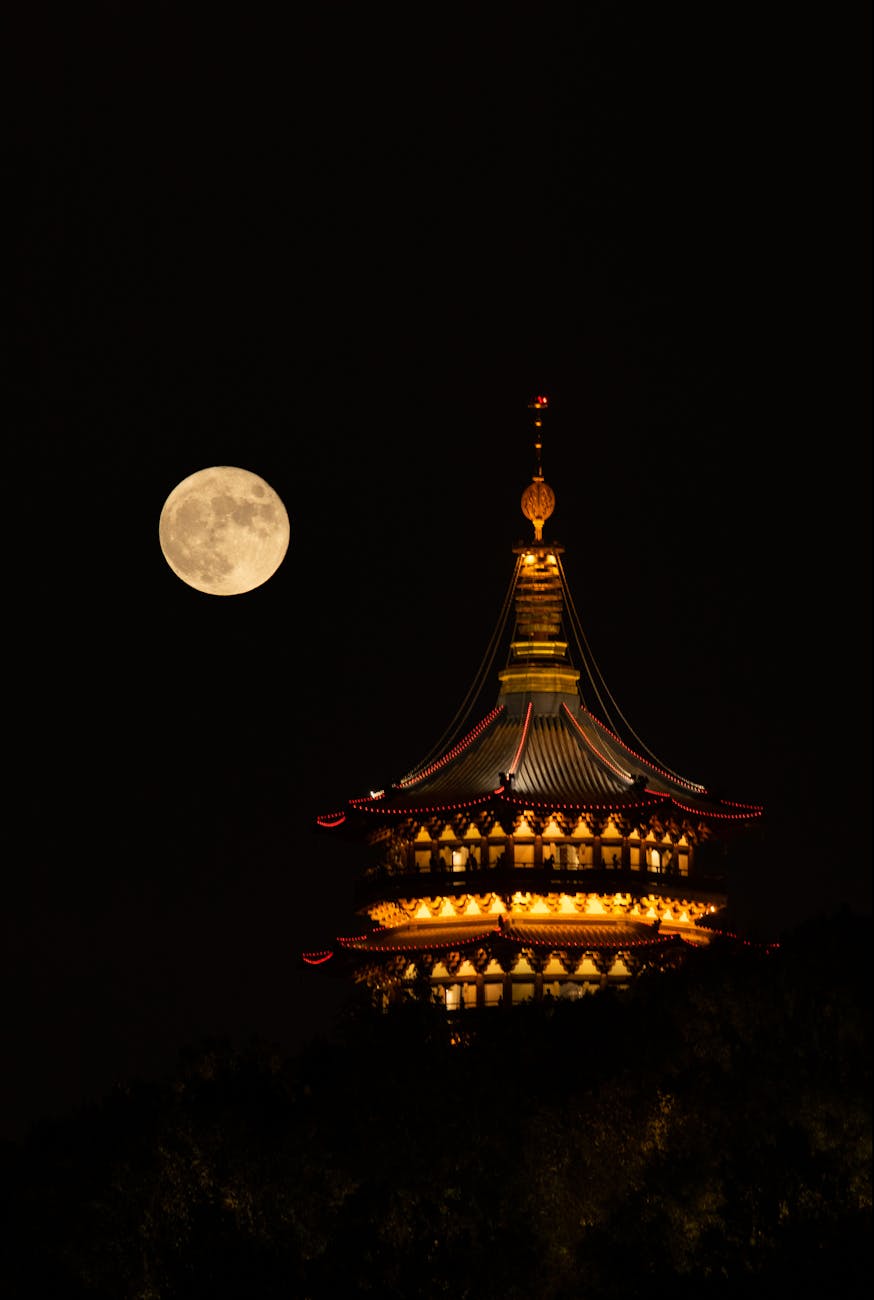
The Two Listeners and the Moonlit Teaching
In a quiet valley embraced by soft green hills, there lay a small village where life moved gently and without hurry. Each full moon, when the sky glowed like a polished pearl, the villagers gathered beneath an ancient banyan tree to hear the teachings of Venerable Samita. His voice was calm and steady, like water flowing over smooth stones, and his presence alone seemed to settle the hearts of those who came to listen.
Among the villagers were two young men: Sura, whose mind was naturally reflective and open, and Venu, whose thoughts often tangled into knots of restlessness and doubt. Though they had grown up side by side, their inner worlds could not have been more different.
On one particularly luminous night, the villagers sat in a wide circle as Venerable Samita began to speak. “Children of the valley,” he said, “the Dharma is like the moon above us. It shines with the same brightness for all. Yet not all who look upon it see its light clearly. Some minds are ready to receive the truth. Others are veiled by their own conditions.”
Sura listened with quiet attention, his breath steady, his heart open. Venu shifted where he sat, already feeling impatience rise within him.
The elder continued, explaining that some people carry obstructions born of their present actions, stains of defilement that cloud the heart, and the lingering weight of past unskillful deeds. Without trust, without the wish to listen, and without clarity of mind, even the purest teaching cannot take root. It is like trying to plant a seed in soil hardened by drought.
Venu felt a flicker of discomfort. The elder’s words seemed to brush against the very places he avoided within himself — the grudges he clung to, the mistakes he refused to acknowledge, the stubborn certainty that he already understood enough. Sura, meanwhile, felt the teaching settle into him like gentle rain falling on fertile ground.
Then Venerable Samita spoke of the opposite state — a mind unburdened by present obstruction, unclouded by defilement, and no longer weighed down by the echoes of past deeds. A mind supported by trust, by the sincere wish to listen, and by the clarity that comes from honest reflection. In such a mind, even a single phrase of Dharma can blossom into understanding. When these six qualities are present, the heart becomes like fertile soil, ready to receive the seed of truth.
As these words drifted through the night air, Sura felt a quiet joy. He knew he was far from perfect, but he also knew he genuinely wished to understand. That wish alone made his heart spacious. Venu, however, felt resistance tightening within him. His thoughts wandered. He judged the teaching as too idealistic, too demanding. He blamed the heat, the insects, the length of the talk — anything but the state of his own mind.
When the teaching ended, the villagers bowed and slowly dispersed into the moonlit paths leading home.
Venu let out a frustrated sigh. “Sura, I don’t know how you sit through these talks. I hear the same words you do, but they don’t do anything for me.”
Sura turned to him with a gentle smile. “Maybe it isn’t the words,” he said softly. “Maybe it’s the mind that receives them.”
Venu frowned. “So you’re saying my mind is flawed?”
“Not flawed,” Sura replied. “Just unsettled. Like a pond after a storm. When the mud settles, the water becomes clear again.”
Venu looked down, embarrassed. Yet Sura’s voice held no judgment — only kindness and understanding.
“How do I let it settle?” Venu asked quietly.
Sura placed a hand on his friend’s shoulder. “Begin with one simple thing. Tonight, choose to listen. Not perfectly. Just sincerely.”
For the first time that evening, Venu felt something soften inside him — a small opening, like a door left slightly ajar.
When the next full moon rose, Venu arrived early. He sat closer to the front, not beside Sura but on his own, as if stepping into new territory. This time, when Venerable Samita spoke, the words did not bounce off him. They entered slowly, gently, like morning light filtering through mist. He did not understand everything, but he wanted to. And that simple wanting began to loosen the knots within him.
Sura watched from a distance, smiling quietly. He knew that the Dharma was never forced upon the mind — it was welcomed when the mind was ready.
In the months that followed, Venu changed in small but steady ways. He listened more. He reacted less. He apologized when he was wrong. He asked questions. He reflected. The villagers noticed. Even Venerable Samita noticed.
One evening, after a teaching, the elder approached him. “Your mind is clearing, Venu,” he said. “Not because the Dharma has changed, but because you have.”
Venu bowed deeply. “Teacher, I think I finally understand. The six qualities that open the path — freedom from present obstruction, freedom from defilement, freedom from the weight of past deeds, trust in the teaching, the sincere wish to listen, and the clarity to discern — they were all within me. I only needed to uncover them.”
The elder smiled. “Exactly. The Dharma is like the moon. It always shines. Whether we see it or not depends on the clouds in our own sky.”
And under that same moon, Venu felt a quiet gratitude — for the teaching, for his friend, and for the simple truth that the path begins the moment one chooses, even imperfectly, to listen.
Link: https://wisdomtea.org/2026/04/02/the-two-listeners-and-the-moonlit-teaching/

 Wisdom Tea