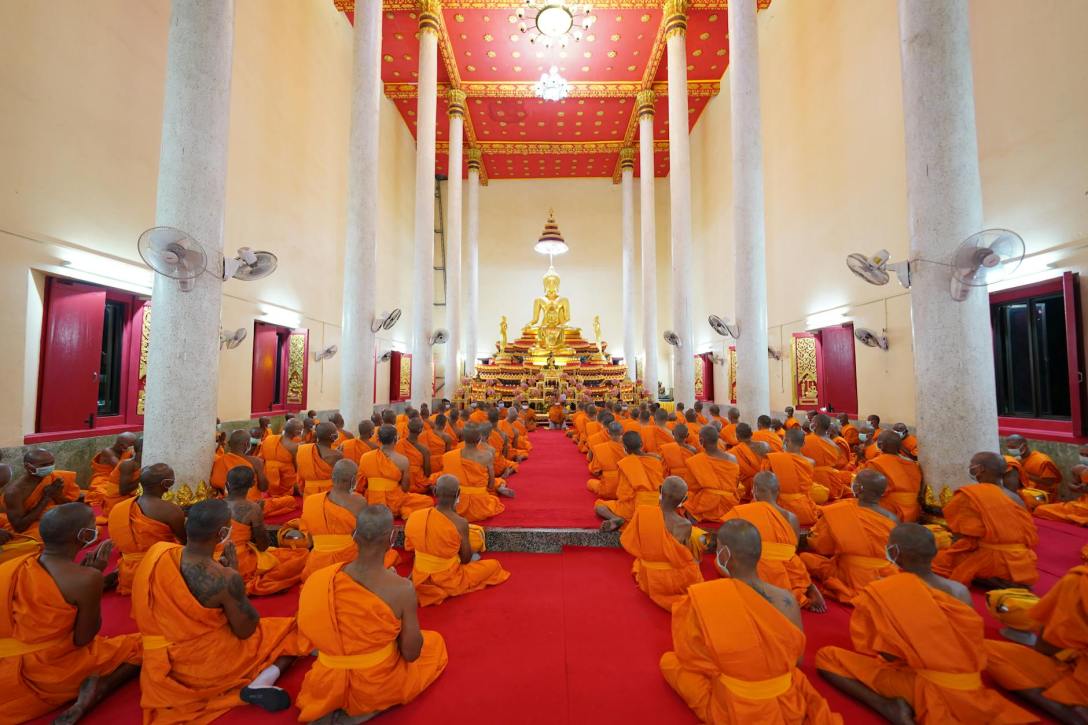
The Five Qualities of a True Teacher

The Five Qualities of a True Teacher

Once upon a time, the Blessed One, the Buddha, was staying in the great city of Kosambī, at the peaceful Ghosita’s monastery. The monastery stood just outside the busy town, surrounded by trees and open spaces, a place where monks and lay people often came seeking quiet, guidance, and the company of wise friends.

On one particular day, Venerable Udāyin was sitting in the shade of a large hall within the monastery grounds. Around him was gathered a great crowd of householders—men, women, young and old—who had come to hear the Dharma. They sat close together, some on mats, some on the bare ground, their eyes fixed on him with curiosity and respect. Udāyin spoke with energy, explaining the teachings, answering questions, and holding the attention of the assembly.

Venerable Ānanda happened to walk by and saw this scene. He noticed how Udāyin sat surrounded by such a large gathering of lay people, sharing the Buddha’s words. A thought arose in Ānanda’s mind: “It is good that people wish to hear the Dharma, but teaching many at once is not an easy task.” With this thought, he decided to go directly to the Blessed One to report what he had seen.

Ānanda went to the Buddha’s dwelling. When he arrived, he bowed deeply in respect, then sat quietly to one side, as was the custom. After a moment of silence, he said:

“Lord, Venerable Udāyin is there, surrounded by a large assembly of householders, teaching the Dharma.”

The Buddha listened carefully, and then replied in a calm and steady voice:

“Ānanda, it is not an easy thing to teach the Dharma to others. Speaking about the truth requires more than words. It requires patience, understanding, and the right intention. One should teach the Dharma only when five qualities are well established in oneself. Without these, teaching may confuse more than it clarifies. And what are these five qualities?”

The monks seated nearby leaned in a little closer, and even Ānanda, who knew the Dharma well, straightened with attention.

“First,” the Buddha said, “when teaching the Dharma, one should think: ‘I will speak step by step.’ Do not hurry, and do not overwhelm people with too much at once. Just as one climbs a staircase one step at a time, so too should the teaching be given gradually, beginning with what is simple and clear, and then rising toward the deeper truths.

“Second, one should think: ‘I will explain the sequence of cause and effect.’ People should see how things are connected—how our thoughts shape our actions, how actions bear fruit, how wholesome actions bring happiness and peace, and unwholesome actions bring sorrow and difficulty. If cause and effect are not explained, the teaching will not take root in people’s hearts.

“Third, one should think: ‘I will speak out of compassion.’ The words of the Dharma are not for showing off knowledge or for gaining praise. They should come from a heart of kindness, with the intention to ease suffering and to guide others toward peace. Without compassion, the words may sound empty, sharp, or self-serving.

“Fourth, one should think: ‘I will not speak for the sake of material gain.’ If one teaches with the desire for money, fame, or personal advantage, then the Dharma is misused. The purity of the teaching is lost when it is spoken for the sake of wealth or recognition.

“Fifth, one should think: ‘I will speak in a way that does not harm myself or others.’ The Dharma should never be taught with harshness, arrogance, or anger. True teaching is like a gentle rain that nourishes all it touches, not a storm that breaks branches. It should uplift the listener, bring steadiness to the heart, and offer benefit to both speaker and listener alike.

“So, Ānanda,” the Buddha concluded, “it is not an easy thing to teach the Dharma to others. The Dharma should be shared only when these five qualities are firmly established within the teacher.”

As the Blessed One spoke, the monks reflected silently, some remembering times when they had spoken too quickly, or without compassion, or with hidden motives. Others felt encouraged, understanding more clearly how to approach their own teaching. And Ānanda himself bowed deeply, realizing that the act of teaching was not merely passing on words, but a practice of patience, kindness, and wisdom.

From then on, those who heard this teaching carried it with them—whether they were monks guiding others, or lay people sharing words of kindness at home—remembering that the Dharma shines brightest when it is spoken step by step, with clarity, compassion, and sincerity.

Link: https://wisdomtea.org/2025/08/21/the-five-qualities-of-a-true-teacher/

The Strengths of One Who Is Free

The Strengths of One Who Is Free

One quiet day, Venerable Sāriputta went to visit the Blessed One. The morning was cool, and the forest was alive with soft, scattered sounds—the faint chirping of birds, the rustle of leaves stirred by a passing breeze, the distant crack of a branch falling somewhere deep in the grove. The sunlight filtered through the tall sal trees, casting shifting patterns of gold and green on the forest floor.

When Sāriputta arrived, he bowed deeply, lowering his head in reverence, as one who has found a safe harbor bows to the one who showed him the shore. He then sat quietly to one side, folding his robe neatly, settling his body into stillness. The Blessed One regarded him with eyes full of calm and kindness, his presence like the steady warmth of the morning sun.

After a moment of silence, the Blessed One spoke in a voice that was neither hurried nor slow, but carried the weight of deep knowing.
“Sāriputta, tell me—how many strengths does a monk possess when his mind is completely free from all stains, all clinging, all defilements? Strengths that allow him to speak with unshakable certainty, ‘The defilements are ended in me’?”

Sāriputta’s face lit with respect, for he knew the question was not just about knowledge, but about living truth. “Lord,” he said, “there are eight such strengths. And when these are fully present, a monk can speak not from memory, not from hearsay, but from the direct, clear seeing of his own heart.”

He began to describe them, his voice unhurried, allowing the meaning to sink in.

He spoke first of the deep seeing of impermanence—the quiet but unshakable understanding that nothing in this world stands still. Every sight, sound, thought, feeling, and form is like a cloud drifting across the sky—changing shape, dissolving into something new. The seasons turn; the rivers flow without pausing; even the mountains, solid as they seem, are slowly wearing away. To see this truth with clarity is to loosen the grip of clinging, to stand on ground that no change can disturb.

He spoke of how one who has ended the defilements understands the nature of sensual desire. To those untrained, pleasures of the senses seem sweet and safe, like a bright fire on a cold night. But with wisdom, they are seen as dangerous, like embers that may look harmless yet will burn the hand that grasps them. This seeing does not come from fear, but from understanding; it is the calm knowledge that such pleasures cannot give lasting peace, and that reaching for them is like reaching for smoke.

Sāriputta’s words flowed like water over smooth stones as he spoke of the mind’s turning toward solitude. Such a monk delights in quiet places: the shade beneath a forest tree, the open expanse of a moonlit clearing, the hush before dawn when the world is still asleep. In seclusion, his heart feels light, unburdened, like a traveler who has set down a heavy load after a long journey. Noise and distraction hold no pull over him; renunciation is not a loss, but a gain beyond measure.

His mindfulness is steady, clear, and unbroken. He knows the body simply as it is—breathing, moving, changing—not as “I” or “mine,” but as part of the great stream of nature. He notices feelings—pleasant, unpleasant, and neutral—without clinging or pushing away. He watches the mind, knowing whether it is restless or calm, clouded or clear, and he understands the mental qualities that lead toward harm and those that lead toward peace. His awareness is like a lamp that continues to burn even in the wind—protected, unwavering, and bright.

Sāriputta spoke of the inner powers that such a monk develops: the power of aspiration that keeps his direction true, the power of energy that keeps him from laziness, the power of concentration that keeps the mind collected, and the power of wisdom that keeps it rightly guided. Together, they are like the firm pillars of a well-built house, holding everything in balance and security.

He spoke of the inner faculties—faith, energy, mindfulness, concentration, and wisdom—that have grown strong and harmonious. Faith steadies the heart like a deep-rooted tree in the wind. Energy moves him forward like a boat catching the right current. Mindfulness keeps him anchored in the present moment, concentration gathers his mind into stillness, and wisdom lights the way like a lantern in the night. Each faculty supports the others, like skilled musicians playing in perfect harmony.

He described the wholesome qualities that awaken the heart—mindfulness, investigation, energy, joy, tranquility, concentration, and equanimity. These grow within him like rare flowers in a well-tended garden, each with its own beauty and fragrance. Mindfulness opens the way, investigation sharpens understanding, energy keeps the path alive, joy refreshes the spirit, tranquility soothes the heart, concentration gathers the mind, and equanimity spreads a boundless calm over all experiences.

And finally, Sāriputta spoke of the noble eightfold path, fully lived and completed—right view, right intention, right speech, right action, right livelihood, right effort, right mindfulness, and right concentration. Together they are like the eight spokes of a perfectly balanced wheel, carrying the traveler smoothly to the far shore of liberation.

When these qualities are present, Sāriputta said, there is no doubt, no hesitation, no uncertainty. The monk knows for himself, as surely as one holding a clear jewel in his hand, “The defilements are ended in me.” And in that knowing, there is no pride, only peace—deep, steady, and unshakable.

The forest was silent when Sāriputta finished speaking, as if the trees themselves were listening. The Blessed One simply nodded, and in that moment, nothing more needed to be said.

Link: https://wisdomtea.org/2025/08/14/the-strengths-of-one-who-is-free/

The Seed You Plant, the Life You Grow

The Seed You Plant, the Life You Grow

When a person starts off with a wrong way of seeing—holding harmful beliefs, thinking in ways that lead to trouble, speaking with harshness or dishonesty, acting in ways that hurt, earning a living through harmful means, putting effort into destructive things, paying attention to what is unhelpful, training the mind in the wrong direction, misunderstanding how life works, and letting go of things in an unhealthy way—then everything they do flows from that starting point.

Their actions follow that view.
Their words follow that view.
Their thoughts, plans, promises, and projects all grow from that same soil.

And no matter how much energy they put in, the results lean toward what is unpleasant, unwanted, and full of stress.

Why is that?
Because the starting point—their view—is unhealthy.

It’s like planting a bitter seed. Imagine putting a neem tree seed, a bitter vine seed, or a bitter melon seed into rich, moist soil. You can water it every day, give it sunlight, protect it from pests—but no matter how much care you give it, it will still grow into something bitter. The soil and water will only help it become more bitter, because that’s its nature from the very beginning.

Life works the same way. If the seed of your thinking is wrong, everything that grows from it—your words, your choices, your habits—will carry that same bitter taste.

But when a person starts with a right way of seeing—holding wholesome, beneficial beliefs, thinking in kind and wise ways, speaking with honesty and care, acting in ways that bring no harm, earning a living honestly, putting effort into what is good, paying attention to what truly matters, training the mind toward peace, understanding life as it really is, and letting go in a healthy way—then the same pattern works in the other direction.

Their actions follow that view.
Their words follow that view.
Their thoughts, plans, promises, and projects all grow from that same soil.

And the result is a life that leans toward peace, kindness, and joy.

Why is that?
Because the starting point—their view—is healthy.

It’s like planting a sweet seed. Think of sugarcane, grapes, or fragrant rice. You put the seed into fertile soil, water it, give it sunlight, protect it from harm—and everything it takes in makes it sweeter and more nourishing. The outcome is set from the beginning, because the seed itself is good.

In the same way, if your understanding is clear from the start, every word, action, and thought will carry that same sweetness. It’s like cooking with fresh, pure ingredients—whatever you make will taste better because you began with what was good.

So the question is:
What seed are you planting in the soil of your mind?
Because bitter seed, bitter fruit.
Sweet seed, sweet fruit.

Choose the right seed, and let your life grow in the direction of peace.


Reflection for daily life:
Every day, we plant seeds in the soil of our mind. Some seeds are planted on purpose—through our choices, our values, and our intentions. Others are planted without us even noticing—through the company we keep, the media we consume, and the thoughts we allow to linger.

A bitter word we speak plants a seed.
A kind smile we offer plants a seed.
A moment of anger plants a seed.
A patient breath plants a seed.

These seeds don’t stay as they are—they grow. And what they grow into depends on their nature, not just on how much we water them.

If we spend our days planting seeds of resentment, worry, and greed, we will eventually walk through a garden filled with those same thorns and weeds. But if we plant seeds of kindness, patience, and understanding, our garden will be a place of shade, rest, and sweetness.

Changing the garden begins by changing the seed. This is why right view matters—it is the seed from which the whole tree of our life grows. Right view guides right thought. Right thought guides right speech. Right speech guides right action. And step by step, the whole path unfolds.

So each morning, before the busyness begins, pause and ask:
“What seed am I about to water today?”
Notice the mood you are carrying. Notice the thoughts you are feeding. If you find you are holding a bitter seed, set it down. Plant a new one—through a kind intention, a gentle word, or a mindful breath.

At first, the change will be small—just a sapling among the weeds. But with steady care, the weeds will thin, the sapling will grow, and in time, the whole garden will be transformed.

And when that day comes, the sweetness will not only be for you—it will be shared with everyone who walks through your garden.

Link: https://wisdomtea.org/2025/08/07/the-seed-you-plant-the-life-you-grow/

Letting Go of Everything

Letting Go of Everything

Near the city of Sāvatthī, in a quiet forest grove, the Buddha was seated with a group of monks. It was a peaceful time. The air was calm, the trees gently swayed, and the birds sang softly in the distance. The Buddha was speaking, offering his teachings with clarity and compassion. He was guiding the monks toward the freedom of heart and mind, encouraging them to understand the path that leads beyond suffering. His words were kind and clear, filled with wisdom that pointed to release, to peace, to unbinding from all clinging.

The monks were sitting quietly, deeply focused. They listened not just with their ears, but with their whole being. Their hearts were open. Their minds were steady. They paid close attention to the Dharma, allowing the Buddha’s words to sink deep. They were present, fully engaged in the moment, undistracted and receptive.

Far from that serene place, Māra—the one who delights in restlessness and attachment—was watching. He saw the Buddha teaching. He saw the monks absorbing the Dharma. And he felt uneasy. He began to worry that these monks were slipping away from his control, that they were beginning to understand something that would carry them beyond his reach.

Māra thought of a plan. He decided to go to the Buddha and try to disturb his mind, to confuse his vision, to stop the flow of clarity. But he didn’t appear as himself. Instead, he disguised himself as a tired farmer. He carried a large plow across his shoulder and a long stick in his hand. His hair was unkempt, his clothes were rough and made of coarse fabric, and his feet were muddy, as though he had just come in from the fields.

Looking like an ordinary laborer, Māra approached the Buddha and asked if he had seen his missing oxen. The Buddha, calm and knowing, asked him what he meant by oxen.

Māra explained that the eye belonged to him, along with all the forms that are seen, and the awareness and contact that come through seeing. He said that the ear was his as well, along with all sounds. The nose and all smells were his too, as were the tongue and all tastes. The body and all sensations, the mind and all thoughts, all ideas and memories and plans—they all belonged to him. He claimed that wherever the senses operated, wherever there was contact, consciousness, and perception, that was his domain. And he insisted that there was nowhere the monk could go to escape his reach.

But the Buddha replied with deep peace and insight. He acknowledged that the senses and their objects did indeed belong to Māra in the world of ordinary experience. The eye, the forms, the awareness that arises from them, these were Māra’s. The same went for hearing, smelling, tasting, touching, and thinking. But he said there is a place beyond all that. A place where the eye does not arise, where forms are not perceived, where there is no contact, no feeling, no consciousness through the eye. And in that place, Māra cannot go. He explained that the same is true for the other senses. There is a state beyond sound, smell, taste, touch, and thought—a state beyond the reach of all sensory contact. In that state, there is no foothold for Māra. He cannot follow. He cannot touch what is beyond clinging.

Still trying, Māra argued that wherever people say “this is mine,” or cling to things as “me” or “mine,” he still has a way in. As long as someone holds to a sense of self, or ownership, or identity, Māra has power. If the mind is still grasping at anything, then escape is impossible.

But the Buddha had let go of all clinging. He did not claim anything as his. He did not identify with anything in the world. He did not speak from a place of self or ownership. He had gone beyond that. There was nothing Māra could grasp. No belief, no thought, no sense of “I” or “mine” remained. There wasn’t even a trace of a path to follow. No mental footprints left behind.

At that moment, Māra saw the truth. He realized that the Buddha saw him clearly, knew him completely, and had gone entirely beyond his reach. He had no power there. No influence. No way in.

Filled with disappointment and sorrow, Māra faded away. There was nothing more he could do.

Link: https://wisdomtea.org/2025/07/31/letting-go-of-everything/

Staying Steady Through the Day

Staying Steady Through the Day

There was once a monk named Anuruddha who, even while suffering from severe illness, managed to keep his mind calm and undisturbed. When other monks came to visit and asked him, “How are you managing to stay so peaceful in the middle of all that pain?” — he replied:

“I dwell with my mind grounded in mindfulness. That’s what keeps the pain in the body from invading the peace of the heart.”

That might sound like something reserved for monks in distant forests — but it’s actually something we can all apply, right here in our everyday lives.

It doesn’t mean we pretend pain isn’t there. It doesn’t mean we push it away or ignore it. It means we learn to stay with our experience — with gentleness, clarity, and perspective — so that the body might be hurting, but the heart doesn’t have to collapse around it.

Anuruddha practiced this through four kinds of mindfulness. First, by being present with the body. In your day, this might look like taking a few conscious breaths when you feel tension in your shoulders. It might mean noticing when you’re slumping in your chair or rushing through your steps. Feeling the weight of your feet on the ground while you stand in line. Bringing awareness to eating, walking, stretching — whatever the body is doing. Even when the body is tired or in pain, you can say: “This is what the body feels like right now — and it’s okay to notice it.”

Second, he was honest with feelings. This means simply noticing: “This feels pleasant.” “This feels unpleasant.” “This feels neutral.” Without needing to fix it, chase it, or reject it. In daily life, this could be feeling a pang of irritation in traffic and just naming it: “Irritation is here.” Or noticing how good a cup of tea feels and enjoying it fully — without clinging. Or recognizing loneliness or stress when it arises — and breathing with it. You don’t have to drown in your feelings or pretend they’re not there. You just stay with them like a kind observer: “This is what’s here right now. And that’s okay.”

Third, Anuruddha was curious about the mind. Throughout the day, you can check in with your own mind: Is it cloudy or sharp? Anxious or relaxed? Busy or still? You don’t have to “fix” it — just notice: “Ah, the mind is racing today.” “The mind feels heavy this morning.” “The mind is quite light right now.” Seeing the mind clearly helps us not take it so personally. It’s just weather — passing through the sky of awareness.

Fourth, he watched thoughts and tendencies come and go. This means noticing: “Oh, that’s a craving thought.” “Here’s anger arising.” “Here’s compassion, here’s patience — good seeds to water.” In daily life, we often act on autopilot. But when we pause and see a habit arise — whether helpful or harmful — we give ourselves a choice. “I don’t have to believe everything I think.” “I can meet this moment with more kindness, more awareness.”

When we ground ourselves in these simple kinds of mindfulness — body, feelings, mind, and mental patterns — something shifts. We start to respond instead of react. We stay steady in discomfort. We enjoy small joys more deeply. We catch unhelpful patterns before they take over. Like Ven. Anuruddha, we learn that even when life hurts — whether it’s physical pain, stress, or emotional difficulty — we can stay rooted. The storm might pass through the body, but it doesn’t have to knock down the heart.

Try saying this to yourself sometime today — maybe when you’re tired, frustrated, or just need a breath:

“I am aware of this body. I am aware of this feeling. I am aware of this mind. I see the patterns moving through me — and I am not swept away. I return to presence, again and again.”

One breath. One moment. One choice at a time. That’s how we dwell in mindfulness — even on ordinary days.

Link: https://wisdomtea.org/2025/07/24/staying-steady-through-the-day/

The Noble Growth

The Noble Growth

When a woman devoted to the path of the noble ones nurtures five qualities in her life, she is said to be growing—not just outwardly, but inwardly, in the kind of growth that truly matters. Her life becomes a field of noble growth, a garden where the most precious and lasting qualities are cultivated. In doing so, she grasps what is essential—what is excellent—not something abstract or far off, but something embodied, real, and rooted in her very being.

What are these five ways in which she grows?

She grows in faith.
She develops a steady confidence in the path of truth. Even when life is uncertain or difficult, she trusts that goodness is not wasted, that wholesome actions bear fruit. Her faith is not blind, but bright—like a lamp in the dark, helping her take each next step with courage and conviction.

She grows in virtue.
She learns to live with integrity. She watches her actions, her words, and her thoughts, choosing what brings no harm to herself or others. When tempted to react out of anger, fear, or greed, she remembers what matters and chooses restraint. In this way, her life becomes peaceful, her conscience light.

She grows in learning.
She listens carefully to teachings that point toward wisdom. She reflects on them deeply—not just hearing words, but applying them, testing them in her own experience. Through this, she begins to understand what leads to suffering and what leads beyond it.

She grows in generosity.
She opens her heart and her hands. Whether she gives a kind word, a warm meal, a moment of her time, or a material gift, she gives with joy. She does not give to impress, to gain, or to control, but simply because giving frees the heart. In letting go, she discovers richness.

She grows in discernment.
Through reflection, quiet observation, and wise attention, she begins to see the nature of things: that all things change, that clinging leads to sorrow, that freedom is found in letting go. She begins to understand herself and the world more clearly, seeing beyond surface appearances.

In cultivating these five kinds of growth, she matures in the highest way. Her life leans toward awakening. She does not waste her human birth, but honors it. She holds fast to what is truly valuable—not wealth or status or fleeting pleasures, but the deep peace that comes from living wisely and kindly.

And all this, she develops not in some distant world or future life, but here and now, in this very body, in this very heart. In her own lived experience, she grasps what is essential and excellent—the noble growth that leads to lasting freedom.

Link: https://wisdomtea.org/2025/07/17/the-noble-growth/

The Six Hooks of Māra

The Six Hooks of Māra

“Monks, imagine a fisherman who casts a baited hook into a deep, still lake. In that vast expanse of water, a fish—restless and ever searching, its mind set upon the pursuit of food—catches sight of the bait. Drawn by hunger and blinded by desire, the fish seizes the hook with its mouth. The moment it swallows the bait, it is caught, ensnared by the snare it failed to discern. From that point onward, the fish is no longer free. It has fallen into misfortune and ruin. The fisherman, having trapped it, may do with it whatever he wishes—whether to keep it alive or to kill it.

“In the same manner, monks, there are six kinds of hooks in the world—deceptive and dangerous, baited with pleasantness and alluring to the unguarded mind. These six serve as instruments of Māra, the Evil One, laid out for the misfortune of sentient beings, for the downfall and destruction of those who breathe. What are these six?

“Monks, there are forms cognizable through the eye—forms that are agreeable, pleasing, delightful, captivating, endowed with charm, capable of arousing craving, and enticing to the senses. If a monk delights in them, welcomes them, and clings to them, he is likened to the fish that has swallowed the fisherman’s hook. He is said to have fallen into Māra’s snare, to have succumbed to misfortune and spiritual ruin. The Evil One holds sway over him and may manipulate him at will.

“In the same way, there are sounds perceivable through the ear—sounds that are melodious, harmonious, tempting, and pleasing to the heart. If a monk becomes enamored of these sounds, welcomes them, and remains bound to them, he too is caught by Māra’s hook and becomes subject to suffering and downfall.

“There are aromas discernible through the nose—fragrances that are sweet, alluring, and intoxicating. If a monk clings to them, allows them to delight his mind, and remains attached to them, he becomes entangled, ensnared, and unable to escape Māra’s net.

“There are flavors knowable through the tongue—delicacies and tastes that arouse desire, inflame craving, and tempt indulgence. A monk who relishes these, who welcomes their taste, and who binds himself to them is likewise caught in the web of the Evil One.

“There are tactile sensations felt through the body—soft, smooth, warm, pleasurable, and seductive to touch. If a monk is drawn to them, clings to them, and remains mentally fastened to their contact, then he too is said to be under Māra’s control.

“Finally, there are ideas, thoughts, and mental images knowable through the intellect—concepts that are refined, attractive, mentally stimulating, and pleasing to contemplate. If a monk indulges in them, takes delight in them, and becomes mentally entangled in them, then he has also swallowed Māra’s hook and is vulnerable to downfall and distress. The Evil One can direct such a monk as a puppet master moves his puppet, for he has lost his spiritual autonomy.

“But, monks, consider now the one who sees clearly.

“If a monk, upon encountering forms cognizable through the eye—however pleasing, charming, and desirable they may be—does not delight in them, does not welcome them, and does not remain fastened to them, he is said to be one who has not swallowed Māra’s hook. Rather, he is one who has seen the barb hidden beneath the bait. He is one who has broken the hook, snapped the line, and swum free of the net. Such a monk does not fall into misfortune or disaster. Māra, the Evil One, has no power over him.

“And so too with sounds heard through the ear—if a monk neither welcomes nor clings to them, he escapes their snare.

“And so too with aromas known through the nose—if he does not attach, he is not trapped.

“And so with flavors tasted by the tongue—if he remains unattached, he remains unharmed.

“And so with tactile sensations felt by the body—if he does not seek or delight in them, he is unbound.

“And likewise with ideas perceived through the intellect—no matter how brilliant, engaging, or pleasurable they may appear, if the monk regards them as impermanent, unsatisfactory, and not-self, he severs their influence. He walks free of the fetter.

“Such a monk is said to have transcended Māra’s domain. The Evil One cannot ensnare him, cannot bend his mind, cannot sway his resolve. He walks the path of the awakened, firm in his vigilance, released from the hidden hooks of the world.”

Link: https://wisdomtea.org/2025/07/10/the-six-hooks-of-mara/

Quiet Moments, Clear Mind: Buddhist Insight for Busy Lives

Quiet Moments, Clear Mind: Buddhist Insight for Busy Lives

One day, the Buddha was speaking to a group of householders and said:o

“Friends, let me tell you about Sāriputta—not just as a monk, but as someone who mastered the mind in a way that any person, even a parent or family member, can learn from. His wisdom came not from escaping life, but from understanding it deeply, stage by stage.

Imagine a mother or father at home after a long day. The kids are finally asleep. For the first time all day, the house is quiet. They sit down in the living room. At first, their mind is still racing—thoughts about work, dinner, bills, school activities. But slowly, they take a breath, and feel a simple relief in the stillness.

That first feeling—relief from the chaos—is like the first stage Sāriputta entered: a peaceful joy that comes when we step back from constant demands. He noticed the thoughts, the relief, the planning mind—and how all of it came and went. Just like a parent realizes: “Wow, my mind was so busy all day. Now I can see it.” Sāriputta didn’t cling to the peace. He simply observed: this too comes and goes.

Next, Sāriputta settled deeper—like a parent who stops thinking altogether for a few minutes, just enjoying the quiet. Not planning tomorrow, not reliving arguments—just resting. That’s the second stage, where the mind becomes still not because of effort, but because it’s naturally quiet. And again, he noticed: even this calm is temporary. It rises, it fades. Don’t cling.

Then came the third stage—like when a parent no longer feels excited or stressed, but just sits peacefully with a warm heart. No highs, no lows—just a steady, balanced calm. Sāriputta noticed how this balanced state also shifts. He didn’t try to hold on to it. He let it pass, like a parent learning to enjoy peace without trying to make it last.

Then, he went even further—a fourth stage where even comfort and discomfort fall away. Imagine a parent who accepts the noise, the mess, the quiet, the stillness—all of it—with the same peaceful heart. There’s no “I wish it were different.” There’s just acceptance. Sāriputta saw: even this deep equanimity isn’t permanent.

And then—he let go of even the sense of “me.” Just like when a parent forgets themselves completely while watching a child sleep. In that moment, there’s no thought of being tired or busy—just space, just presence. That’s like entering the infinite space of awareness. But even that, Sāriputta saw, is just another experience. It too passes.

He moved beyond that—like when a parent starts to feel not just peace, but a deep knowing: “I am aware. I am conscious.” But even awareness itself, he saw, arises and passes away. It’s not permanent.

He went deeper still—to a state where there was a feeling of nothing at all. Like when a parent, totally burned out, feels empty—not sad, not happy, just… nothing. Even this, he examined and understood: this emptiness also has a beginning, middle, and end.

And then came the most subtle level—where even the sense of perception faded. Like the moment just before falling asleep, when you’re barely aware of anything. When he emerged from that, he looked back and clearly saw: every state of mind—joy, peace, emptiness, awareness—they all rise and fall. None of them are “me.” None are lasting. And because he saw this so clearly, he was free.

Finally, Sāriputta entered a state of complete stillness—no feeling, no perception—just pure rest. And when he returned from that, he knew without a doubt: there’s nothing more to chase. No more striving. He had arrived.

So I say to you, friends: if anyone is to be called truly wise, free in heart and mind, devoted not to wealth but to truth—it would be Sāriputta. And just as he walked the path with clear eyes, you too can practice this in your daily life. With each moment of awareness, you keep the wheel of truth turning.”

And when the Buddha finished, the people felt comforted and inspired—knowing that peace isn’t far away. It’s right here, in the middle of everyday life.

Link: https://wisdomtea.org/2025/07/04/quiet-moments-clear-mind-buddhist-insight-for-busy-lives/

Like Winds in the Sky

Like Winds in the Sky

One day, the Blessed One sat beneath a tree and spoke to a group of monks. With the serene clarity that only a Buddha can offer, he began by pointing to the vast sky above.

“In the sky,” he said, “winds of many kinds are always blowing. Some come from the east, others from the west. Some rise from the south, others descend from the north. There are winds that carry dust and winds that are clear. Some are cold, others hot. Some arrive with a gentle whisper; others roar with fierce force. The sky is not fixed to one kind of wind, nor does it choose one over another. It simply allows them to pass.”

In the same way, the Blessed One explained, feelings arise within the body. Sometimes they are pleasant and bring comfort. At other times, they are painful and difficult to bear. And in between these, there are neutral feelings—subtle, neither sweet nor bitter. All of them arise due to contact, like ripples spreading from a pebble dropped in water. They come, they linger for a time, and then they fade.

But the untrained, untaught person—unmindful and unaware—responds differently. When pleasure arises, he clings to it, hoping it will stay. When pain comes, he resists and recoils. When neutral feelings pass through, he grows bored and restless. He does not see feelings for what they are, but builds his identity around them. He constructs craving. He reinforces the sense of “I” and “mine.” And so, he suffers.

In contrast, the mindful practitioner—the one devoted to the Dhamma—regards feelings with wisdom. He sees each sensation clearly, just as it is. He understands that feelings are not permanent, not under his control, and not who he is. He watches joy as it arises and fades. He sees pain sharpen and then soften. Even neutral feelings, which often pass unnoticed, become part of his contemplation—like clouds drifting across a calm sky.

He is not drawn into elation nor dragged down by sorrow. Like a mountain standing tall beneath the changing heavens, he remains unmoved. Storms may pass; the sun may burn; but his mind remains serene, undisturbed.

Through diligent effort and deep inner clarity, he no longer claims feelings as “mine.” Instead, he sees them as mere events—arising conditions within a stream of experience. He likens them to leaves floating down a river, or to a bell that rings when struck by the wind.

By observing their birth and death, their emptiness and impersonality, he gradually unties the knot of attachment. With wisdom as his guide, he uproots craving from the heart.

In this very life, he becomes free. His heart is no longer bound by the fetters of greed, hatred, or delusion. Firm in understanding, grounded in the Dhamma, he walks the world released.

And when the time comes for his body to return to the elements—as all compounded things must—there is no fear, no confusion. The body dissolves, but the mind, ungrasping, has already passed beyond measure and beyond concept. Like a flame that has gone out for lack of fuel, or like boundless space, he is no longer confined.

The Blessed One continued, using the elements to teach:

Just as fire, once blazing, dies down when there is no more wood, so too the enlightened one, free of craving, leaves no smoke of rebirth. His passions have cooled. His chains have broken. There is no more fuel. No more flame.

As water, when still and undisturbed, becomes clear and pure, the mind that has been trained becomes capable of reflecting reality without distortion. It no longer clings to the images or ripples. It sees things as they are, not as the heart wishes them to be.

The earth bears all things without preference—filth and flowers, gold and refuse. Likewise, the sage endures praise and blame, gain and loss, without agitation. His patience is as vast as the plains.

The open sky cannot be stained by the clouds that drift through it. In the same way, the mind that has abandoned greed, hatred, and delusion becomes spacious and bright. His consciousness, freed from identity, shines from within like the moon freed from eclipse.

This person walks the Noble Eightfold Path. Right view gives him direction. Right effort gives him strength. Right mindfulness is his torch, and right concentration his refuge.

With right speech and right action, his behavior is gentle and harmless. With right livelihood, he takes from the world only what is needed and gives much in return. His life is simple, his needs few. He is like a deer resting peacefully in the stillness of the forest.

Such a one reflects, “This body is not mine, nor are these feelings, nor these thoughts. All arise due to conditions. When the causes end, so do the effects. There is no soul within, no self to defend. There is only a stream, flowing on until it fades.”

Because of this deep seeing, he does not cling to the past nor yearn for the future. He lives fully in the present, one breath at a time, his heart at peace and his hands free of grasping.

He has crossed the flood—while many still struggle, clinging to fragile rafts of belief or sinking in the mire of doubt. But with wisdom as his oar and virtue as his boat, he has reached the far shore. On this shore, there is no more fear.

Even if the sky were to fall or the earth split open, his peace would remain, unshaken. For he knows that nothing truly belongs to him. And he sees that the self the world clings to is like a mirage in the desert—appearing real, but empty upon approach.

So when his final breath is drawn, and the body is returned to the elements, there is no grief. No sorrow. No lamentation.

Like a bird flying free from a cage worn thin by time, his mind soars into boundlessness—directionless, measureless, at peace.

There is no more birth. No more becoming. No more bound existence.
What remains is only the unborn, the unaging, the deathless.

Such is the path of the one who sees.
Such is the journey from feeling to freedom.

Link: https://wisdomtea.org/2025/06/26/like-winds-in-the-sky/

The Discourse on Dispelling Hatred

The Discourse on Dispelling Hatred

Then the Venerable Sāriputta addressed the monks:
“Friends, monks.”

“Yes, friend,” the monks replied.

The Venerable Sāriputta said:
“There are these five ways of subduing hatred by which, when hatred arises in a monk, he should wipe it out completely. Which five?

“There is the case where some people are impure in bodily conduct but pure in verbal conduct. Hatred toward a person of this sort should be subdued.

“There is the case where some people are impure in verbal conduct but pure in bodily conduct. Hatred toward a person of this sort should likewise be subdued.

“There is the case where some people are impure in both bodily and verbal conduct, but who, from time to time, experience mental clarity and calm. Hatred toward a person of this sort should also be subdued.

“There is the case where some people are impure in both bodily and verbal conduct, and who do not experience mental clarity and calm, even occasionally. Hatred toward a person of this sort should also be subdued.

“There is the case where some people are pure in bodily conduct, pure in verbal conduct, and who from time to time experience mental clarity and calm. Hatred toward a person of this sort should also be subdued.


“Now, how should one subdue hatred toward a person who is impure in bodily conduct but pure in verbal conduct? Just as when a monk, who makes use of discarded things, sees a rag lying in the road: taking hold of it with his left foot and spreading it out with his right, he tears off the sound portion and goes on his way. In the same manner, when someone is impure in bodily conduct but pure in verbal conduct, one should, at that time, pay no attention to the impurity of his bodily conduct, and instead give attention to the purity of his verbal conduct. Thus, hatred for him should be subdued.

“And how should one subdue hatred toward a person who is impure in verbal conduct but pure in bodily conduct? Just as when there is a pond overgrown with slime and water plants, and a man comes along, burning with heat, covered with sweat, exhausted, trembling, and parched with thirst. He would step into the pond, part the slime and plants with both hands, and, cupping his hands, drink the water before going on his way. In the same way, when someone is impure in verbal conduct but pure in bodily conduct, one should, at that time, pay no attention to the impurity of his verbal conduct, and instead give attention to the purity of his bodily conduct. Thus, hatred for him should be subdued.

“And how should one subdue hatred toward a person who is impure in both bodily and verbal conduct, but who from time to time experiences mental clarity and calm? Just as when there is a small puddle in a cow’s footprint, and a man comes along, burning with heat, covered with sweat, exhausted, trembling, and parched with thirst. He would think: ‘Here is a little puddle in a cow’s footprint. If I try to drink from it with my hand or a cup, I will stir it up and make it undrinkable. What if I were to get down on all fours, like a cow, and slurp it up directly, and then go on my way?’ So he gets down on all fours, drinks like a cow, and continues on his way. In the same way, when someone is impure in both bodily and verbal conduct, yet experiences mental clarity and calm from time to time, one should, at that time, pay no attention to his bodily and verbal impurity, and instead give attention to the fact that he sometimes experiences mental clarity and calm. Thus, hatred for him should be subdued.

“And how should one subdue hatred toward a person who is impure in bodily and verbal conduct, and who does not experience mental clarity and calm, even occasionally? Just as when there is a man who is gravely ill, suffering and in pain, traveling along a remote road, far from the next village and far from the last, without access to the food he needs, the medicine he needs, a suitable companion, or anyone to carry him to safety. Now suppose another man sees him and is moved by compassion, pity, and sympathy. He would think: ‘Oh, that this man might receive the food he needs, the medicine he needs, the support he needs, and someone to bring him to safety—so that he does not perish right here.’ In the same way, when someone is impure in bodily and verbal conduct and does not experience mental clarity or calm, one should act with compassion, pity, and sympathy, thinking: ‘Oh, that this man might abandon wrong bodily conduct and develop right bodily conduct; abandon wrong verbal conduct and develop right verbal conduct; abandon wrong mental conduct and develop right mental conduct. Why is that? So that, upon the dissolution of the body after death, he may not fall into the plane of deprivation, the bad destination, the lower realms, or purgatory.’ Thus, hatred for him should be subdued.

“And how should one subdue hatred toward a person who is pure in bodily and verbal conduct, and who from time to time experiences mental clarity and calm? Just as when there is a clear, sweet, cool, and limpid pool of water, with gently sloping banks and shaded on all sides by many kinds of trees—and a man comes along, burning with heat, covered with sweat, exhausted, trembling, and parched with thirst. He would plunge into the pool, bathe, drink, and, coming out, sit or lie down in the cool shade of the trees. In the same way, when someone is pure in bodily and verbal conduct and periodically experiences mental clarity and calm, one should, at that time, give attention to the purity of his bodily conduct, the purity of his verbal conduct, and the fact that he experiences mental clarity and calm. Thus, hatred for him should be subdued. A person so inspiring can bring serenity to the mind.


“These are the five ways of subduing hatred, by which a monk, when hatred arises, should wipe it out completely.”

Link: https://wisdomtea.org/2025/06/20/the-discourse-on-dispelling-hatred/