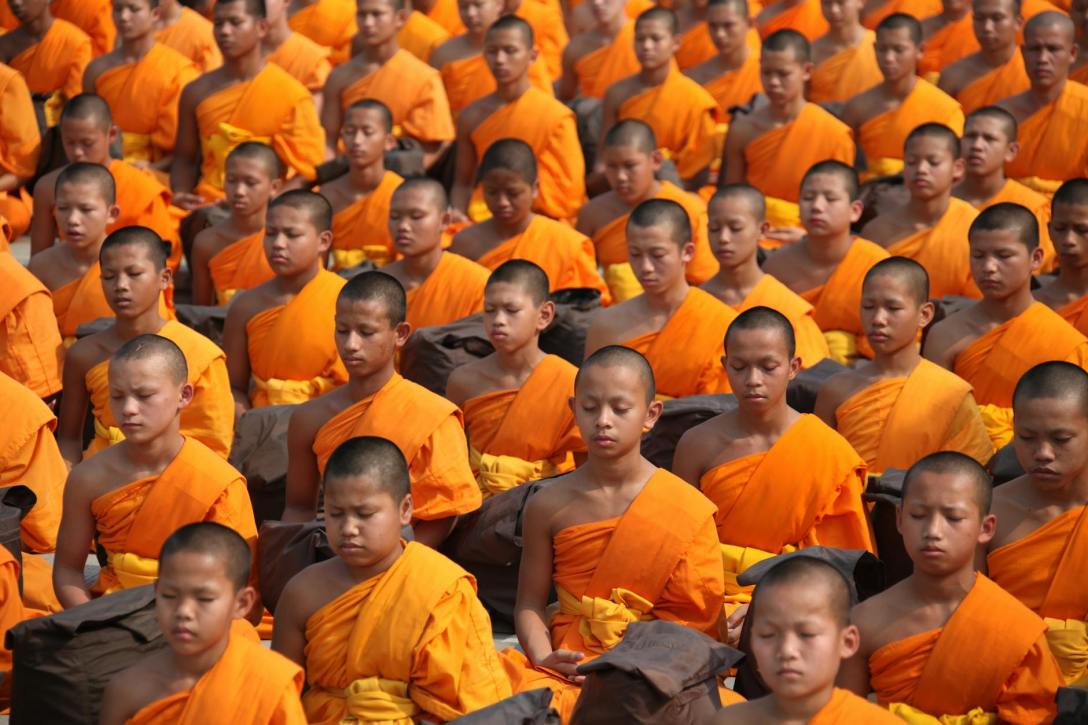
A Community That Practices Together

A Community That Practices Together

There was a time when the Buddha was staying at Rājagaha, up on Vulture Peak, together with many of his most experienced and respected senior students. They were known for their wisdom, discipline, clarity, and dedication — basically, the whole A‑team.

During this period, the senior monks were busy helping the new monks get settled into the training. All around the mountain, little groups formed. Some elders taught ten monks, others twenty, thirty, or forty — whatever made sense. They weren’t trying to impress anyone; they were just teaching from real experience.

The new monks weren’t just memorizing teachings. They were starting to notice the finer points — how paying attention changes what you feel, how your intentions shape what you do, and how letting go becomes possible once you actually see what you’re holding onto.

On the full‑moon day that marked the end of the rains retreat, the Buddha sat outside on Vulture Peak. The moon came up over the ridge, lighting up the whole gathering. Everyone sat quietly, calm and focused.

The Buddha looked around and said he was really pleased with how everyone was practicing. He felt confident in them and encouraged them to keep going — to reach what they hadn’t reached yet and understand what they hadn’t understood yet. He also mentioned he’d be staying at Rājagaha for one more month.

When monks in the countryside heard this, they started heading toward Rājagaha. Some traveled a long way with nothing but their robes and bowls, wanting to practice near the Buddha and the strong community around him.

As more monks arrived, the senior monks kept teaching. Again, some taught ten monks, some twenty, some thirty, some forty. The vibe stayed calm and steady — no drama, no competition. And the new monks kept deepening their understanding of the Dharma.

On the next full‑moon day, the Buddha again sat outside on Vulture Peak with the Saṅgha. Seeing how peaceful and unified everyone was, he talked about the qualities of the community. He said they weren’t wasting time with idle chatter or distractions — they were focused on what really matters. He said this kind of community is rare and incredibly valuable, the kind of place where even a small offering becomes meaningful.

Then he talked about the different kinds of practitioners there. Some monks were fully awakened — their work done, their minds free. Others were well on their way, having let go of major obstacles and heading toward full liberation. Some had weakened greed, anger, and confusion and would only return to this world once more. And some had entered the stream — firmly on the path, no longer headed toward painful states, moving steadily toward awakening.

He also mentioned those practicing the gradual path. Some were working on mindfulness, effort, concentration, and insight. Others were cultivating kindness, compassion, joy, and equanimity; reflecting on the body; or contemplating impermanence. Many were practicing mindfulness of breathing.

He explained that mindfulness of breathing, when you really develop it, brings huge benefits. It completes the foundations of mindfulness, which lead to the awakening factors. And when those are developed with calm, clarity, and letting go, they lead to full release.

He described how the practice unfolds: starting with simply knowing the breath — long breaths, short breaths — then becoming aware of the whole body and calming it. Then noticing joy and ease, noticing mental activity and settling it, and understanding the mind — brightening it, steadying it, freeing it. Eventually, this leads to seeing impermanence, fading, cessation, and letting go.

In this way, mindfulness of breathing supports the whole path — from mindfulness to awakening to release.

When the Buddha finished speaking, everyone sat quietly for a bit, letting it sink in.

Feeling uplifted, the monks rejoiced in the teaching.

Link: https://wisdomtea.org/2025/12/19/a-community-that-practices-together/

Everyday Reflections on Change and Awakening

Everyday Reflections on Change and Awakening

Everything around us is in motion. The world we inhabit is constantly shifting, even when we convince ourselves it is stable. The ground beneath us changes through earthquakes, erosion, and construction. Cities expand, then contract. Technology that feels cutting-edge today becomes obsolete tomorrow. The phone you hold in your hand, the apps you scroll through, the platforms you rely on—all of them will eventually be replaced, updated, or forgotten.

Our awareness itself is never fixed. Thoughts appear and vanish, emotions surge and dissolve, perceptions shift moment by moment. What we call “mind” is not a solid possession but a flowing process, constantly changing. To recognize this truth is to begin living wisely.

Consider how quickly our digital lives change. A phone that seemed essential two years ago now feels outdated. Social media trends rise and fall in days, sometimes hours. A post that feels urgent and important today is forgotten tomorrow. Even the way we communicate—texting, video calls, apps—evolves so rapidly that what was once revolutionary soon becomes ordinary.

Relationships also reflect impermanence. Friends move away, families grow and transform, love blossoms and sometimes fades. Circumstances shift—jobs begin and end, fortunes rise and fall, homes are built and abandoned. Even our minds change—what we feared yesterday may not frighten us today, and what we desired once may no longer matter.

Impermanence is not a curse. It is the very condition that makes growth possible. Because things change, we can heal, we can learn, and we can awaken. Faith opens the heart, reflection sharpens the mind, and direct realization transforms the whole being. Each path is valuable, and each step brings us closer to freedom.

When we stop clinging to what cannot last, we begin to live with greater ease, compassion, and clarity. Impermanence becomes not something to fear, but the doorway to liberation. Everything changes, and to see this clearly—whether through trust, reflection, or direct experience—is to step onto the path of freedom.

Think about the pace of modern living. The job you hold today may not exist in ten years. Entire industries rise and fall—what was once considered secure can vanish overnight. The music you listen to, the shows you stream, the memes you laugh at—all of them pass quickly, replaced by something new.

Even our bodies remind us of change. The energy of youth gives way to the wisdom of age. Strength rises and falls. Health shifts from wellness to illness and back again. We are constantly reminded that nothing stays the same.

Stress itself is a teacher of impermanence. The worries that consume us today often fade tomorrow. The deadlines that feel overwhelming eventually pass. The arguments that feel sharp and painful lose their sting with time. What seems unbearable in the moment often becomes just another memory.

Impermanence is not only about loss—it is also about possibility. Because things change, we are not trapped forever in suffering. Because things change, we can grow beyond our mistakes. Because things change, compassion can deepen, wisdom can expand, and joy can arise in unexpected places.

Technology itself shows us this lesson. The tools we use evolve, but so do we. We adapt, we learn, we discover new ways to connect. Social media may be fleeting, but the connections we make can still be meaningful. The impermanence of platforms reminds us not to cling to the medium but to cherish the message.

To live with awareness of impermanence is to live with freedom. When we see that nothing can be clung to forever, we stop grasping so tightly. We begin to appreciate each moment for what it is, knowing it will not last. We treat others with more kindness, because we know relationships are fragile. We treat ourselves with more compassion, because we know our struggles will change.

Everything changes. The rise and fall of technology, the shifting tides of social media, the stress of daily life, the quiet changes of our own hearts—all of these are reminders of impermanence. To see this clearly is to live with wisdom, compassion, and freedom. Impermanence is not something to resist—it is the doorway to awakening.

Change is everywhere. To recognize it, accept it, and live with it is to step into a life of clarity and liberation.

Link: https://wisdomtea.org/2025/12/12/everyday-reflections-on-change-and-awakening/

Rewards

Rewards

Friends, there are eight profound benefits that arise from living with wisdom and integrity. These benefits are not small or fleeting; they are deep sources of joy, nourishment for the heart, and pathways to peace. They lift us up, bring happiness, and guide us toward lives of meaning, fulfillment, and well-being. They are heavenly in nature, yet they are realized here and now, in the choices we make each day. What are these eight?

The first benefit comes when a person places their trust in the Buddha — the awakened teacher who discovered the path to freedom. To take refuge in the Buddha is to recognize that awakening is possible, that human beings can rise above confusion and suffering. This trust gives direction, hope, and confidence. It is like finding a guiding light in the darkness.

The second benefit comes when a person places their trust in the Dharma — the teachings that reveal the way. To take refuge in the Dharma is to embrace truth, wisdom, and compassion as the compass of one’s life. These teachings are not abstract; they are practical, showing us how to live with clarity, kindness, and balance. They are like a map that leads us safely through the wilderness of life.

The third benefit comes when a person places their trust in the Sangha — the community of practitioners who walk the path together. To take refuge in the Sangha is to recognize the power of companionship, encouragement, and shared effort. No one walks alone. The Sangha is like a circle of friends who remind us of our highest aspirations and help us stay true to them.

Beyond these three refuges, there are five great gifts that anyone can give simply by living ethically. These gifts are timeless, pure, and respected by the wise. They are not open to doubt, and they bring peace both to the giver and to the world. They are called “great gifts” because they are immeasurable in their reach. When we live by them, we give safety, trust, and freedom to countless beings, and we share in that freedom ourselves.

The first great gift is the choice not to harm life. When a person refrains from killing, they give safety to all beings. Every creature, from the smallest insect to the largest animal, benefits from this gift. In giving safety, the person also experiences safety in return. Their heart becomes lighter, their conscience clear, and their life more peaceful. This is the fourth benefit of merit.

The second great gift is the choice not to steal. When a person respects what belongs to others, they give freedom from fear and oppression. No one needs to worry about losing what is theirs. In giving this freedom, the person also experiences freedom in return. Their relationships are built on trust, and their life is free from suspicion. This is the fifth benefit of merit.

The third great gift is the choice to live with integrity in relationships, avoiding sexual misconduct. When a person honors boundaries and respects others, they give trust and security. Families, friendships, and communities flourish in safety. In giving trust, the person also experiences trust in return. Their life is marked by respect and dignity. This is the sixth benefit of merit.

The fourth great gift is the choice to speak truthfully, avoiding lies. When a person speaks with honesty, they give reliability and peace of mind. Others know they can be trusted, and communication becomes clear and wholesome. In giving truth, the person also experiences truth in return. Their words carry weight, and their relationships deepen. This is the seventh benefit of merit.

The fifth great gift is the choice to remain clear-minded, avoiding intoxicants. When a person refrains from substances that cloud the mind, they give stability and safety to others. Their actions are guided by mindfulness and responsibility. In giving clarity, the person also experiences clarity in return. Their life is steady, their mind sharp, and their choices wise. This is the eighth benefit of merit.

These five gifts are ancient and enduring. They are original, long-standing, traditional, and pure from the beginning. They are honored by those who see clearly, and they remain faultless in the eyes of the wise. Together with the three refuges, they complete the eight rewards of merit — benefits of skillfulness, sources of happiness, pathways to peace, leading to what is desirable, joyful, and good.

To live in this way is to live a life that is wholesome, uplifting, and deeply fulfilling. It is to walk a path that brings happiness not only to oneself but to countless others. These eight rewards are not distant promises; they are realities that unfold in the present moment, whenever we choose trust, wisdom, compassion, and integrity. They are the foundation of a life that is truly free.

Link: https://wisdomtea.org/2025/12/04/rewards/