The Three Urgent Duties
There are three urgent duties of a farming householder. What are these three?
There is the case where a farming householder, wise and diligent, does not delay in preparing his field. He knows that time waits for no one, and that a farmer who hesitates when the season arrives may find himself without a harvest.
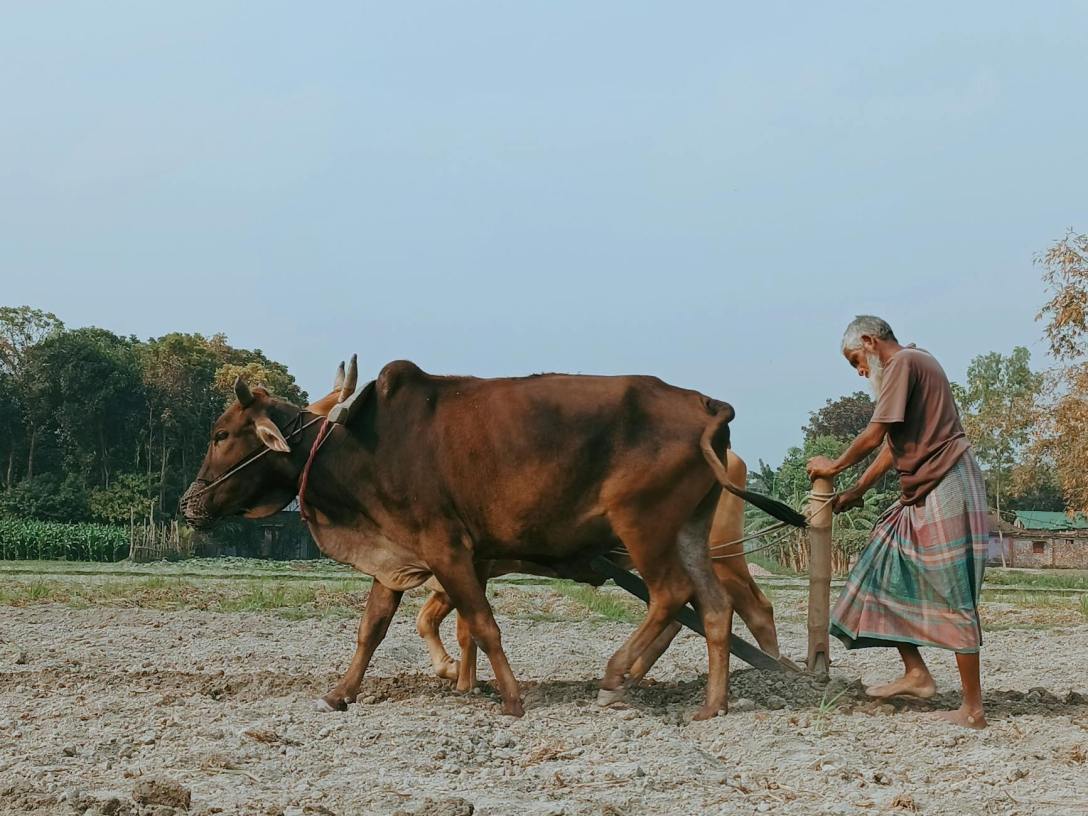
With determination, he takes up his plow and guides his oxen across the land. The sharp blade cuts deep into the earth, turning the soil, breaking apart clumps of hardened dirt, and exposing the rich nutrients hidden beneath. He labors under the sun, wiping sweat from his brow, but he does not falter. He understands that a well-prepared field is the foundation of a good harvest.
Having plowed the field, he does not stop there. He takes up his harrow and smooths the soil, breaking apart the rough clods, making the ground soft and welcoming for the seeds. He removes the weeds and stones, ensuring that nothing will hinder the young sprouts when they emerge. Only when the land is well-prepared does he proceed to the next task.
Then, with care and precision, he takes the best seeds he has—grains that are full, unblemished, and capable of yielding a strong crop. He sows them evenly, ensuring they are not too deep, nor too shallow. He does not rush, for he knows that carelessness in planting will lead to poor growth. He watches the sky, mindful of the winds and the rains, choosing the right time for each step.
Yet his work is not done. Once the seeds are in the ground, he must tend to the water. If the soil is dry, he directs the channels to let water in, ensuring that the young plants will have enough to drink. But he is also wise—he does not flood the field, nor does he allow the water to stagnate. When the time is right, he drains it out, keeping the balance so that the roots do not rot.
However, despite all his efforts, the farming householder does not possess the power to command nature. He cannot say, “May my crops sprout today, may the grains appear tomorrow, and may they ripen the next day.” Such things do not obey human will. But he knows one truth: if he fulfills his duties with care and perseverance, then when the time is right, the crops will sprout, the grains will appear, and they will ripen according to their nature.
The Three Urgent Duties of a Monk
In the same way, monks, there are three urgent duties of a monk. What are these three? The undertaking of heightened virtue, the undertaking of heightened mind, and the undertaking of heightened discernment.
Just as the farmer prepares his field with diligence, so too must a monk cultivate his virtue. A monk’s virtue is the foundation upon which wisdom and liberation grow. If his conduct is impure—if he allows deceit, unkindness, or heedlessness to take root—then his practice will be like a field overrun with weeds, where no wholesome crop can flourish.
Thus, a monk diligently undertakes the practice of virtue. He observes the precepts carefully, refraining from harming living beings, from false speech, from taking what is not given, from indulgence in intoxicants, and from engaging in unwholesome desires. He guards his actions and speech, just as a farmer guards his field from wild animals and pests. He knows that without this foundation, no progress can be made.
Once virtue is well established, the monk undertakes the training of the mind. Just as the farmer sows his seeds, the monk sows the seeds of concentration. Through meditation, he steadies his thoughts, quiets the restless chattering of the mind, and cultivates inner stillness. He does not allow distractions to overtake him, just as a farmer does not allow weeds to overrun his field. He remains steadfast, training his awareness to be sharp and unwavering, like a flame undisturbed by the wind.
Then, just as the farmer tends to his crops by managing water flow, the monk nourishes his wisdom. Through deep contemplation, study, and insight, he fosters discernment, allowing the truth to reveal itself naturally. He reflects on the impermanent nature of all things, understanding that clinging leads to suffering. He examines the causes of desire, aversion, and delusion, and through insight, he loosens the bonds that keep him tied to the cycle of suffering.
Yet, just as the farmer cannot command the crops to ripen on demand, the monk cannot will his mind to be freed from all attachments overnight. He does not have the power to declare, “May my mind be released from all clinging today, tomorrow, or the next day.” Such things unfold according to their own nature, ripening when the conditions are right.
But the monk does not despair. He knows that just as a farmer who plows, sows, and waters his field with patience will one day see the golden grains swaying in the wind, so too will the diligent practitioner, through perseverance, come to see the fruits of his practice. When the time is right—when his virtue is strong, his mind is steady, and his wisdom is deep—liberation comes as surely as the harvest follows the planting.
The Path to Liberation
Thus, monks, you should train yourselves:
“Strong will be our desire for the undertaking of heightened virtue.
Strong will be our desire for the undertaking of heightened mind.
Strong will be our desire for the undertaking of heightened discernment.”
This is how you should train yourselves.
A wise monk does not rush or seek immediate rewards, just as a farmer does not demand that his crops ripen in a day. Instead, he follows the natural path, understanding that progress is gradual. He remains diligent, unwavering, and patient, knowing that true wisdom and liberation are not forced, but arise naturally when the conditions are right.
And so, just as the diligent farmer reaps a plentiful harvest, the diligent monk will one day reap the fruits of his practice—the freedom from suffering, the end of all clinging, and the peace that surpasses all understanding.


 Wisdom Tea