The Five Qualities of a True Teacher
Once upon a time, the Blessed One, the Buddha, was staying in the great city of Kosambī, at the peaceful Ghosita’s monastery. The monastery stood just outside the busy town, surrounded by trees and open spaces, a place where monks and lay people often came seeking quiet, guidance, and the company of wise friends.
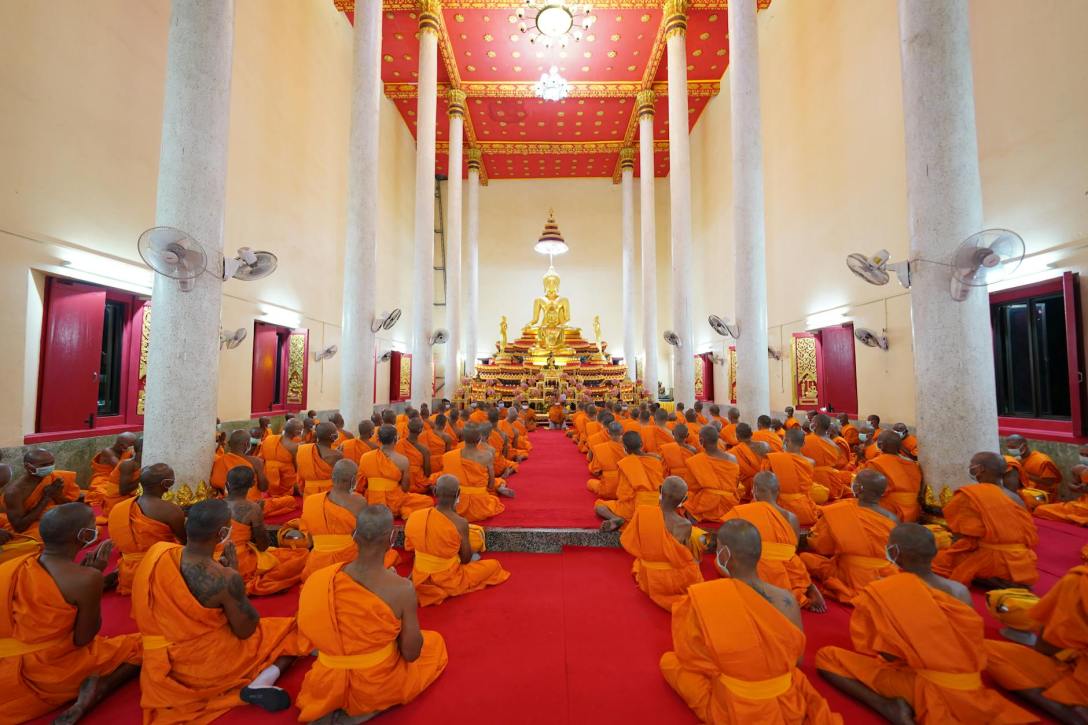
On one particular day, Venerable Udāyin was sitting in the shade of a large hall within the monastery grounds. Around him was gathered a great crowd of householders—men, women, young and old—who had come to hear the Dharma. They sat close together, some on mats, some on the bare ground, their eyes fixed on him with curiosity and respect. Udāyin spoke with energy, explaining the teachings, answering questions, and holding the attention of the assembly.
Venerable Ānanda happened to walk by and saw this scene. He noticed how Udāyin sat surrounded by such a large gathering of lay people, sharing the Buddha’s words. A thought arose in Ānanda’s mind: “It is good that people wish to hear the Dharma, but teaching many at once is not an easy task.” With this thought, he decided to go directly to the Blessed One to report what he had seen.
Ānanda went to the Buddha’s dwelling. When he arrived, he bowed deeply in respect, then sat quietly to one side, as was the custom. After a moment of silence, he said:
“Lord, Venerable Udāyin is there, surrounded by a large assembly of householders, teaching the Dharma.”
The Buddha listened carefully, and then replied in a calm and steady voice:
“Ānanda, it is not an easy thing to teach the Dharma to others. Speaking about the truth requires more than words. It requires patience, understanding, and the right intention. One should teach the Dharma only when five qualities are well established in oneself. Without these, teaching may confuse more than it clarifies. And what are these five qualities?”
The monks seated nearby leaned in a little closer, and even Ānanda, who knew the Dharma well, straightened with attention.
“First,” the Buddha said, “when teaching the Dharma, one should think: ‘I will speak step by step.’ Do not hurry, and do not overwhelm people with too much at once. Just as one climbs a staircase one step at a time, so too should the teaching be given gradually, beginning with what is simple and clear, and then rising toward the deeper truths.
“Second, one should think: ‘I will explain the sequence of cause and effect.’ People should see how things are connected—how our thoughts shape our actions, how actions bear fruit, how wholesome actions bring happiness and peace, and unwholesome actions bring sorrow and difficulty. If cause and effect are not explained, the teaching will not take root in people’s hearts.
“Third, one should think: ‘I will speak out of compassion.’ The words of the Dharma are not for showing off knowledge or for gaining praise. They should come from a heart of kindness, with the intention to ease suffering and to guide others toward peace. Without compassion, the words may sound empty, sharp, or self-serving.
“Fourth, one should think: ‘I will not speak for the sake of material gain.’ If one teaches with the desire for money, fame, or personal advantage, then the Dharma is misused. The purity of the teaching is lost when it is spoken for the sake of wealth or recognition.
“Fifth, one should think: ‘I will speak in a way that does not harm myself or others.’ The Dharma should never be taught with harshness, arrogance, or anger. True teaching is like a gentle rain that nourishes all it touches, not a storm that breaks branches. It should uplift the listener, bring steadiness to the heart, and offer benefit to both speaker and listener alike.
“So, Ānanda,” the Buddha concluded, “it is not an easy thing to teach the Dharma to others. The Dharma should be shared only when these five qualities are firmly established within the teacher.”
As the Blessed One spoke, the monks reflected silently, some remembering times when they had spoken too quickly, or without compassion, or with hidden motives. Others felt encouraged, understanding more clearly how to approach their own teaching. And Ānanda himself bowed deeply, realizing that the act of teaching was not merely passing on words, but a practice of patience, kindness, and wisdom.
From then on, those who heard this teaching carried it with them—whether they were monks guiding others, or lay people sharing words of kindness at home—remembering that the Dharma shines brightest when it is spoken step by step, with clarity, compassion, and sincerity.
Link: https://wisdomtea.org/2025/08/21/the-five-qualities-of-a-true-teacher/
 Wisdom Tea