Near the city of Sāvatthī, in a quiet forest grove, the Buddha was seated with a group of monks. It was a peaceful time. The air was calm, the trees gently swayed, and the birds sang softly in the distance. The Buddha was speaking, offering his teachings with clarity and compassion. He was guiding the monks toward the freedom of heart and mind, encouraging them to understand the path that leads beyond suffering. His words were kind and clear, filled with wisdom that pointed to release, to peace, to unbinding from all clinging.
The monks were sitting quietly, deeply focused. They listened not just with their ears, but with their whole being. Their hearts were open. Their minds were steady. They paid close attention to the Dharma, allowing the Buddha’s words to sink deep. They were present, fully engaged in the moment, undistracted and receptive.
Far from that serene place, Māra—the one who delights in restlessness and attachment—was watching. He saw the Buddha teaching. He saw the monks absorbing the Dharma. And he felt uneasy. He began to worry that these monks were slipping away from his control, that they were beginning to understand something that would carry them beyond his reach.
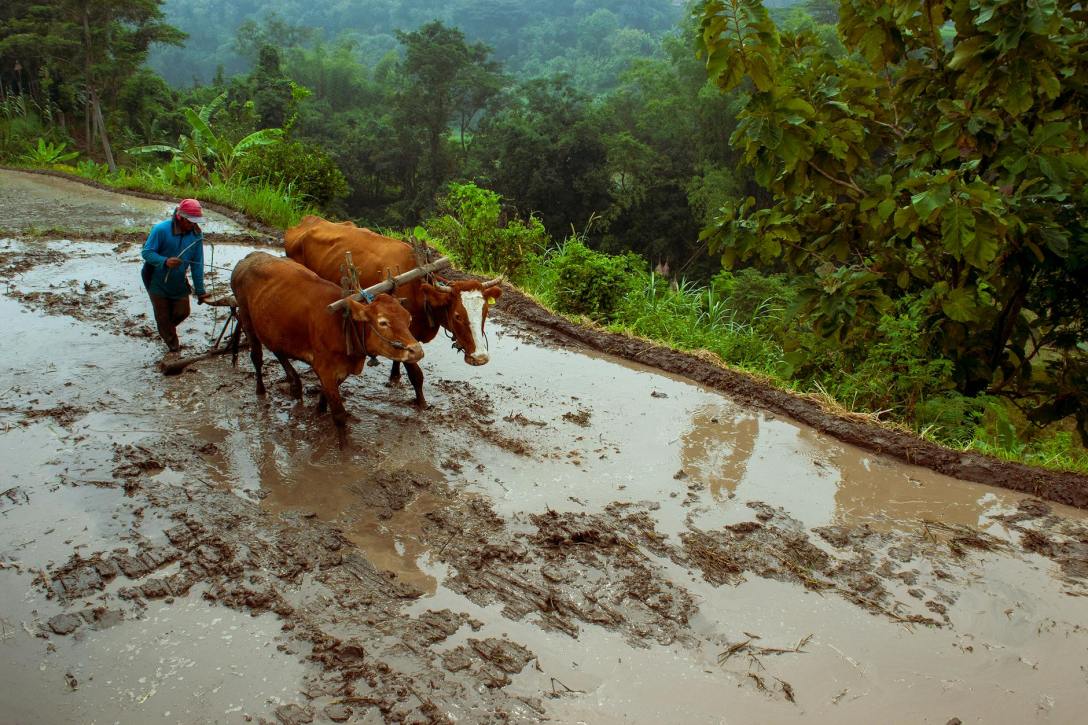
Māra thought of a plan. He decided to go to the Buddha and try to disturb his mind, to confuse his vision, to stop the flow of clarity. But he didn’t appear as himself. Instead, he disguised himself as a tired farmer. He carried a large plow across his shoulder and a long stick in his hand. His hair was unkempt, his clothes were rough and made of coarse fabric, and his feet were muddy, as though he had just come in from the fields.
Looking like an ordinary laborer, Māra approached the Buddha and asked if he had seen his missing oxen. The Buddha, calm and knowing, asked him what he meant by oxen.
Māra explained that the eye belonged to him, along with all the forms that are seen, and the awareness and contact that come through seeing. He said that the ear was his as well, along with all sounds. The nose and all smells were his too, as were the tongue and all tastes. The body and all sensations, the mind and all thoughts, all ideas and memories and plans—they all belonged to him. He claimed that wherever the senses operated, wherever there was contact, consciousness, and perception, that was his domain. And he insisted that there was nowhere the monk could go to escape his reach.
But the Buddha replied with deep peace and insight. He acknowledged that the senses and their objects did indeed belong to Māra in the world of ordinary experience. The eye, the forms, the awareness that arises from them, these were Māra’s. The same went for hearing, smelling, tasting, touching, and thinking. But he said there is a place beyond all that. A place where the eye does not arise, where forms are not perceived, where there is no contact, no feeling, no consciousness through the eye. And in that place, Māra cannot go. He explained that the same is true for the other senses. There is a state beyond sound, smell, taste, touch, and thought—a state beyond the reach of all sensory contact. In that state, there is no foothold for Māra. He cannot follow. He cannot touch what is beyond clinging.
Still trying, Māra argued that wherever people say “this is mine,” or cling to things as “me” or “mine,” he still has a way in. As long as someone holds to a sense of self, or ownership, or identity, Māra has power. If the mind is still grasping at anything, then escape is impossible.
But the Buddha had let go of all clinging. He did not claim anything as his. He did not identify with anything in the world. He did not speak from a place of self or ownership. He had gone beyond that. There was nothing Māra could grasp. No belief, no thought, no sense of “I” or “mine” remained. There wasn’t even a trace of a path to follow. No mental footprints left behind.
At that moment, Māra saw the truth. He realized that the Buddha saw him clearly, knew him completely, and had gone entirely beyond his reach. He had no power there. No influence. No way in.
Filled with disappointment and sorrow, Māra faded away. There was nothing more he could do.
Link: https://wisdomtea.org/2025/07/31/letting-go-of-everything/
 Wisdom Tea