A Community That Practices Together
There was a time when the Buddha was staying at Rājagaha, up on Vulture Peak, together with many of his most experienced and respected senior students. They were known for their wisdom, discipline, clarity, and dedication — basically, the whole A‑team.
During this period, the senior monks were busy helping the new monks get settled into the training. All around the mountain, little groups formed. Some elders taught ten monks, others twenty, thirty, or forty — whatever made sense. They weren’t trying to impress anyone; they were just teaching from real experience.
The new monks weren’t just memorizing teachings. They were starting to notice the finer points — how paying attention changes what you feel, how your intentions shape what you do, and how letting go becomes possible once you actually see what you’re holding onto.
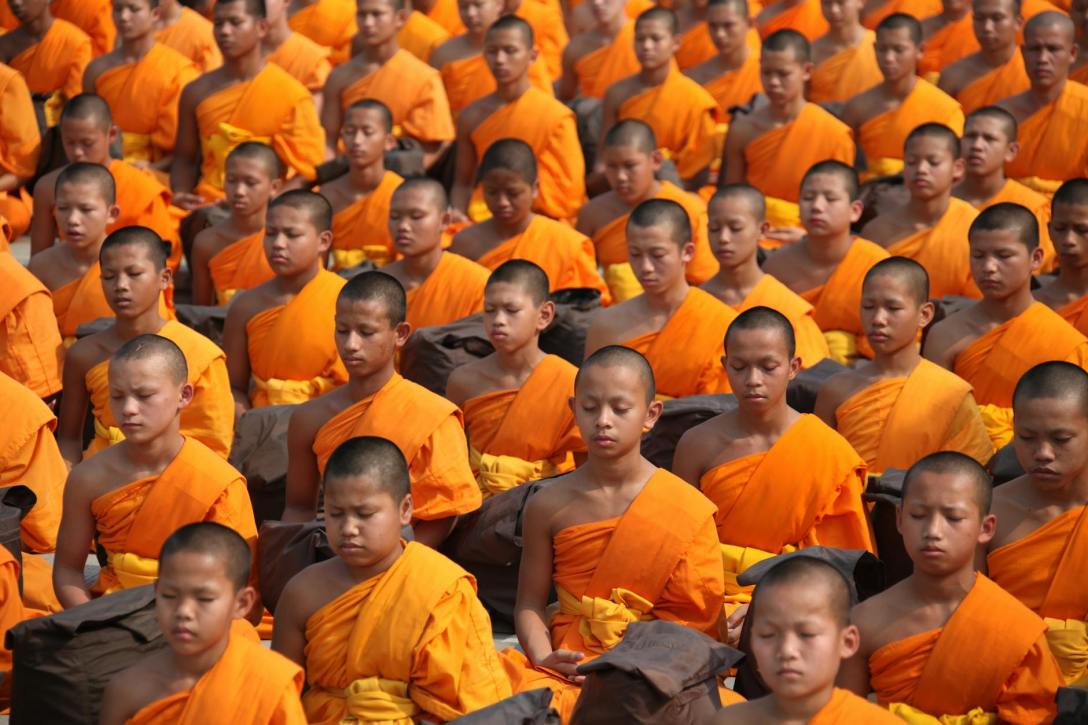
On the full‑moon day that marked the end of the rains retreat, the Buddha sat outside on Vulture Peak. The moon came up over the ridge, lighting up the whole gathering. Everyone sat quietly, calm and focused.
The Buddha looked around and said he was really pleased with how everyone was practicing. He felt confident in them and encouraged them to keep going — to reach what they hadn’t reached yet and understand what they hadn’t understood yet. He also mentioned he’d be staying at Rājagaha for one more month.
When monks in the countryside heard this, they started heading toward Rājagaha. Some traveled a long way with nothing but their robes and bowls, wanting to practice near the Buddha and the strong community around him.
As more monks arrived, the senior monks kept teaching. Again, some taught ten monks, some twenty, some thirty, some forty. The vibe stayed calm and steady — no drama, no competition. And the new monks kept deepening their understanding of the Dharma.
On the next full‑moon day, the Buddha again sat outside on Vulture Peak with the Saṅgha. Seeing how peaceful and unified everyone was, he talked about the qualities of the community. He said they weren’t wasting time with idle chatter or distractions — they were focused on what really matters. He said this kind of community is rare and incredibly valuable, the kind of place where even a small offering becomes meaningful.
Then he talked about the different kinds of practitioners there. Some monks were fully awakened — their work done, their minds free. Others were well on their way, having let go of major obstacles and heading toward full liberation. Some had weakened greed, anger, and confusion and would only return to this world once more. And some had entered the stream — firmly on the path, no longer headed toward painful states, moving steadily toward awakening.
He also mentioned those practicing the gradual path. Some were working on mindfulness, effort, concentration, and insight. Others were cultivating kindness, compassion, joy, and equanimity; reflecting on the body; or contemplating impermanence. Many were practicing mindfulness of breathing.
He explained that mindfulness of breathing, when you really develop it, brings huge benefits. It completes the foundations of mindfulness, which lead to the awakening factors. And when those are developed with calm, clarity, and letting go, they lead to full release.
He described how the practice unfolds: starting with simply knowing the breath — long breaths, short breaths — then becoming aware of the whole body and calming it. Then noticing joy and ease, noticing mental activity and settling it, and understanding the mind — brightening it, steadying it, freeing it. Eventually, this leads to seeing impermanence, fading, cessation, and letting go.
In this way, mindfulness of breathing supports the whole path — from mindfulness to awakening to release.
When the Buddha finished speaking, everyone sat quietly for a bit, letting it sink in.
Feeling uplifted, the monks rejoiced in the teaching.
Link: https://wisdomtea.org/2025/12/19/a-community-that-practices-together/
 Wisdom Tea