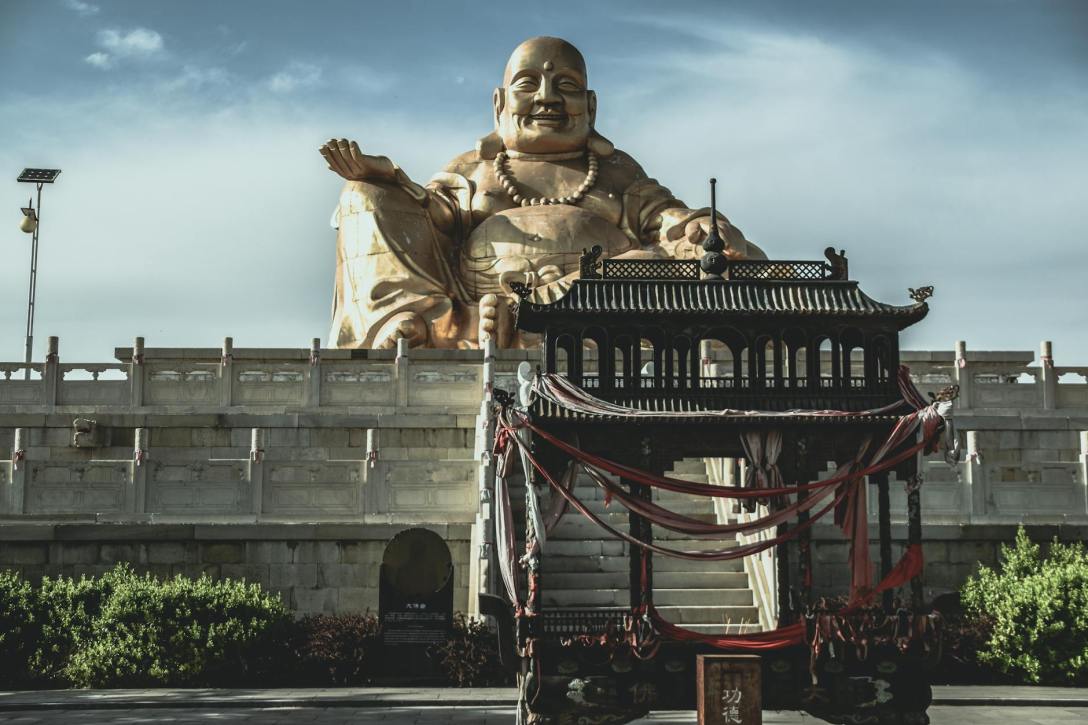
When the Future Buddha Walks the Earth
The world had grown weary. Not in a dramatic way, like storms or wars, but in a quiet, heavy way that settled into people’s bones. Smiles became rare. Laughter felt like a memory. Even the wind seemed to sigh as it moved through the valleys. Seasons still changed, but they did so without joy, as if simply fulfilling an obligation.
Then, one early dawn, something shifted.
It began as a warmth beneath the soil—subtle and gentle, like the first breath of spring after a winter that had overstayed its welcome. Birds paused mid-song, sensing it. Trees straightened their trunks. Even the rivers slowed, as if listening. It was the time of the Chinese New Year, when lanterns glowed red against the night and families gathered to welcome renewal. People prayed for luck, for peace, for a better year than the last. They did not know that their collective hope, rising like incense into the sky, was what opened the way.
From this warmth emerged a traveler.
He wore simple robes the color of sunlit clay. His steps were unhurried, as though he had all the time in the world. His face carried a smile that seemed to rise from a deep, inexhaustible well of compassion. This was Maitreya, the One Who Comes When Hearts Are Ready, though no one knew his name yet. Some traditions say he was born on the first day of the Lunar New Year, a day when the world resets itself and all things begin anew. Whether this was literal or symbolic, no one could say, but there was something about him that felt like a fresh beginning.
The first village he entered was small and tired. People moved quickly, eyes down, each carrying invisible burdens heavier than any physical load. Maitreya walked among them without speaking. He simply observed, his smile softening the air around him.
A child was the first to notice him. She tugged at her mother’s sleeve and whispered that the man was glowing. Her mother, distracted and anxious, barely looked, insisting it was just the sun. But the child was right. There was a warmth around him—not bright or blinding, but comforting, like the glow of a lantern in a dark room.
Maitreya knelt to the child’s height and asked what troubled her. She hesitated before saying that everyone was sad. He nodded gently and told her that they could start with one smile. He tapped her lightly on the forehead, and a giggle escaped her lips—unexpected, bubbling, contagious. People turned. Some frowned in confusion. Others paused mid-step. A few felt something stir inside them, something they had forgotten: hope.
As Maitreya continued his journey, he met a farmer kneeling in a barren field. The man’s hands were cracked, his eyes hollow. He explained that his crops had failed again and that the earth had given up on him. Maitreya sat beside him, placing a hand on the dry soil. He told the farmer that the earth never gives up; it only waits. When the farmer asked what it waited for, Maitreya replied that it waited for someone to believe in it again.
He pressed his palm deeper into the ground. A faint tremor rippled outward. The soil softened, darkened, and a single green shoot pushed its way to the surface. The farmer gasped, unable to understand how it happened. Maitreya simply smiled and said that life responds to kindness, even the kindness one shows oneself. The farmer wept, not from sorrow, but from the release of years of silent despair.
In another village, Maitreya met a widow who feared the night. She kept dozens of candles burning, yet her home still felt cold. She confessed that she was afraid of being alone. Maitreya told her that she was never alone, but fear creates shadows where none exist. He handed her a small lantern with a flame that was steady and warm. He explained that the light would not go out, not because it was magic, but because it was hers. From that night on, the widow slept peacefully, the lantern glowing beside her bed as a reminder that comfort can be carried within.
One afternoon, Maitreya found a boy sitting alone under a tree, knees pulled to his chest. The boy murmured that no one saw him. Maitreya sat beside him and said that he saw him completely. The boy looked up, startled. His eyes filled with tears—not of sadness, but of recognition. Someone had finally noticed the quiet ache he carried. Maitreya told him that he shone, even when he thought he didn’t. The boy’s posture straightened, his breath deepened, and a small but genuine smile appeared.
Word spread of a traveler who brought peace without preaching, hope without conditions, and joy without reason. People sought him out, not for miracles, but for the way he made them feel seen, understood, and valued. And slowly, the world began to change. Arguments dissolved. Old grudges softened. Neighbors helped one another without being asked. Children laughed more freely. Even the sky seemed brighter, as if reflecting the growing warmth in people’s hearts.
As the next Chinese New Year approached, people hung red banners and lit firecrackers, but this time the celebrations felt different. They felt lighter, more sincere, as if the world itself had taken a deep breath. Some whispered that Maitreya’s birthday was near, and though no one knew the exact date, they felt that honoring him was the same as honoring kindness itself.
Maitreya never claimed credit. He simply walked, listened, and smiled.
One morning, as quietly as he had arrived, Maitreya prepared to leave. A crowd gathered, pleading for him to stay. They told him they still needed him. Maitreya placed a hand over his heart and said they did not need him—they needed each other. Someone asked what would happen if they forgot what he had taught them. He smiled, the same deep, gentle smile that had changed so many lives, and said, “I did not come to save you. I came to show you that you were never lost.”
With that, he stepped onto the road, the warmth of his presence lingering long after his figure faded into the horizon. And the world, once weary, continued to bloom—especially each year when the Lunar New Year returned, reminding everyone of renewal, of beginnings, and of the quiet promise that compassion always finds its way back.
Link: https://wisdomtea.org/2026/02/26/when-the-future-buddha-walks-the-earth/


 Wisdom Tea