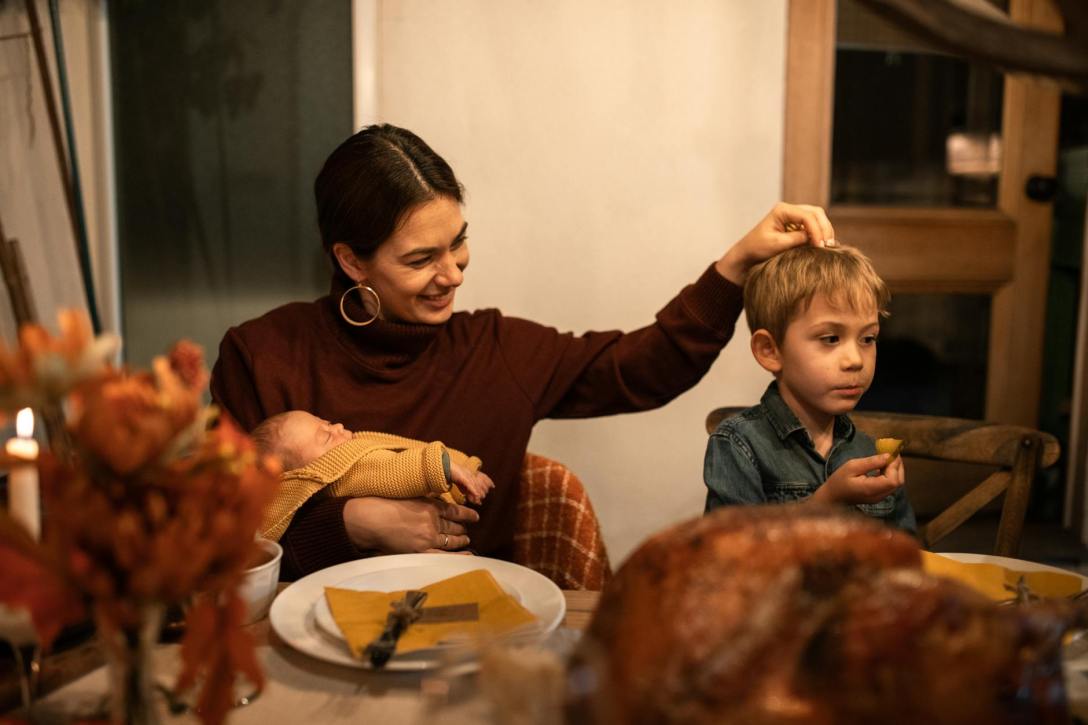
A Table Full of Gratitude

A Table Full of Gratitude

The late November sun dipped behind the hills, painting the sky in shades of amber and rose. Inside a modern lakeside home, warmth radiated from the open kitchen where the heart of Thanksgiving pulsed. Pots clanged, laughter echoed, and the aroma of roasted turkey mingled with cinnamon and nutmeg.

“Pass me the mashed potatoes, will you?” Aunt Clara called, her cheeks flushed from the oven’s heat.

“Only if you promise not to sneak another spoonful before dinner,” teased her brother, balancing a tray of golden rolls.

In the living room, children sprawled on the rug, building towers from wooden blocks. “Mine’s taller!” shouted little Emma, her voice bubbling with triumph. Grandpa chuckled from his armchair, adjusting his glasses as he watched the chaos unfold.

Cars crunched up the driveway as more family arrived. Coats were hung, hugs exchanged, and the house filled with the hum of voices. Cousin Jake carried in a basket of apples, while his sister Lily brought a bouquet of autumn flowers for the centerpiece.

“Look at this place,” Lily said, setting the flowers down. Through the wide windows, the lake shimmered under the fading light. “It feels like stepping into a dream.”

Grandma smiled from the kitchen doorway, her apron dusted with flour. “That’s the magic of Thanksgiving,” she said. “It’s not about perfection—it’s about love.”

Finally, the feast was ready. The long wooden table groaned under the weight of tradition—turkey glistening with herbs, cranberry sauce shimmering like rubies, and pies lined up like sweet soldiers awaiting their turn. Everyone gathered, chairs scraping against the floor, conversations softening into anticipation.

“Before we dig in,” said Mom, raising her glass, “let’s share what we’re thankful for.”

One by one, voices filled the room. “For family,” said Dad, his eyes crinkling with a smile. “For friends who feel like family,” added Aunt Clara. Even Emma, clutching her stuffed bunny, whispered shyly, “For hugs.”

The moment stretched, tender and golden, before laughter returned like a familiar melody. Plates clinked, stories flowed—tales of childhood Thanksgivings, dreams for the year ahead. Outside, stars pricked the velvet sky, their reflections dancing on the lake as if joining the celebration.

Later, the games began. The living room transformed into a stage for charades, with Uncle Joe acting out a turkey so convincingly that everyone doubled over with laughter. In the corner, Grandma taught Emma how to play checkers, their heads bent together in concentration.

By the fireplace, Lily strummed her guitar softly, singing old folk tunes while others joined in. The warmth of the fire mirrored the warmth in their hearts—a glow that no winter chill could dim.

When the last slice of pumpkin pie vanished and the house settled into a cozy hush, Mom stood by the window, watching the stars shimmer over the lake. Dad joined her, slipping an arm around her shoulders.

“Another Thanksgiving,” he said softly.

“And another memory,” she replied, smiling.

It wasn’t just a holiday; it was a tapestry of love, woven from shared memories and simple joys—a reminder that gratitude turns ordinary moments into treasures.

Link: https://wisdomtea.org/2025/11/27/a-table-full-of-gratitude/

Living with Dignity in a Modern Age

Living with Dignity in a Modern Age

To ask what it means to live with dignity might sound unusual today. In a world where most of us are racing to meet deadlines, pay bills, and juggle responsibilities, who has the time to reflect on something so abstract? Yet if we pause for even a moment, it becomes clear that this is not idle philosophy. The question cuts to the heart of what our lives mean, and even deeper, to the values shaping our culture. If dignity is impossible, then life has no higher purpose, and all that’s left is chasing quick thrills before the lights go out. But if dignity is possible, then we must ask whether we are living in a way that honors it, and whether our culture supports that pursuit.

At first glance, dignity seems simple. But the word has shifted over time. Older definitions emphasized “intrinsic worth” and “nobility of character,” while more recent ones lean toward prestige, status, or fame. When we talk about living with dignity, it’s that older meaning that matters: the conviction that life has inherent value, and that we carry within us the potential for moral excellence—something that resonates with the rhythm of nature and the vastness of the cosmos.

The pursuit of dignity isn’t fashionable anymore. Wealth, power, success, and celebrity dominate instead. This shift traces back to intellectual currents that challenged religious certainty: Darwin’s theory of evolution, Freud’s psychology of the unconscious, economic determinism, and even the computer model of the mind. Together, they’ve chipped away at the idea that human life has any special worth. Instead, we’re told we’re just clever animals, driven by selfish genes, navigating highways instead of trees.

These ideas have filtered into everyday culture. The free market reduces people to producers and consumers. Mass democracies turn individuals into faceless voters swayed by slogans and images. Cities sprawl into chaotic, dangerous landscapes where escape is sought in drugs or empty sex. Rising crime, corruption, fractured families, and environmental destruction all reflect not only how we treat each other but how we see ourselves. When dignity is eroded, society itself begins to unravel.

Amid this erosion of dignity, can the Dhamma help us recover a sense of meaning? The answer is yes, in two ways: by affirming our innate dignity and by showing us how to realize it. For Buddhism, human dignity doesn’t come from a relationship to God or an immortal soul. It comes from the unique place of human life in the cosmos. The Buddha teaches that the human realm is special because we have the capacity for moral choice. Though limited by conditions, we always possess a margin of freedom that allows us to change ourselves and, in doing so, change the world.

Human life, however, is not easy. It is complex, filled with conflict and ambiguity, offering enormous potential for both good and evil. This very complexity makes human existence fertile ground for spiritual growth. At each moment, we stand at a crossroads where we can rise to greatness or sink into degradation. The choice is ours.

While this capacity confers intrinsic dignity, Buddhism emphasizes the importance of acquired dignity. This is expressed in the word ariya, meaning noble. The Buddha’s teaching is the noble doctrine, aimed at transforming ordinary people into noble disciples through wisdom and practice. This transformation doesn’t come from faith alone but from walking the path, which turns weakness into strength and ignorance into knowledge.

Acquired dignity is closely tied to autonomy. Autonomy means self-mastery, freedom from passion and prejudice, and the ability to shape one’s own life. To live with dignity is to be one’s own master, guided not by craving or bias but by a thirst for truth and righteousness. The highest expression of this dignity is the arahant, the liberated one, who has broken free from greed, hatred, and delusion. Though most of us are far from that state, the path to it is already within reach: the Noble Eightfold Path. Right view shows us that our choices matter and carry consequences. Right conduct ensures those choices align with moral and spiritual excellence. Together, they lead to knowledge and liberation.

In today’s world, humanity is veering recklessly in two destructive directions: violent struggle and frivolous self-indulgence. Beneath their differences, both share a disregard for dignity—the first violates the dignity of others, the second erodes one’s own. The Buddha’s path offers a middle way, avoiding extremes. To follow it brings quiet dignity into our lives and answers the cynicism of our age with a note of affirmation.

Extending this reflection further, we can see how dignity applies not only to individuals but to communities and nations. A society that values dignity will prioritize justice, compassion, and sustainability over profit and power. It will recognize that human beings are not disposable units of labor but bearers of intrinsic worth. In practical terms, this means creating systems that support education, healthcare, and equality, while resisting the forces that reduce people to statistics or commodities. Dignity is not just a personal virtue; it is a collective responsibility.

Technology adds another layer to this challenge. In the digital age, our identities are often reduced to data points, our attention commodified, and our relationships mediated by screens. The pursuit of dignity requires us to resist being defined solely by algorithms or consumer profiles. It calls us to reclaim our humanity in spaces where efficiency and profit dominate. Even in the virtual world, dignity means treating others with respect, resisting exploitation, and remembering that behind every screen is a person with hopes, fears, and intrinsic worth.

Environmental crises also test our sense of dignity. To live with dignity is not only to honor ourselves but to honor the planet that sustains us. When we exploit nature recklessly, we undermine the dignity of future generations. The Buddhist emphasis on interdependence reminds us that dignity is inseparable from responsibility: our choices ripple outward, shaping the lives of others and the health of the earth.

Ultimately, dignity is both a gift and a task. It is something we possess by virtue of being human, but also something we must cultivate through conscious effort. The Eightfold Path offers a framework for this cultivation, guiding us toward wisdom, ethical conduct, and mental discipline. To walk this path is to affirm that life has meaning, that our choices matter, and that we can rise above the forces that seek to diminish us.

In an age of distraction, cynicism, and fragmentation, the call to live with dignity is radical. It challenges us to slow down, to reflect, and to act with integrity. It asks us to resist the reduction of human beings to consumers, voters, or data points, and to reclaim our place as moral agents capable of greatness. To live with dignity is to live with purpose, autonomy, and compassion. It is to recognize that even in the midst of chaos, we carry within us the seeds of nobility. And if enough of us choose to nurture those seeds, we may yet create a culture that honors the dignity of all.

Link: https://wisdomtea.org/2025/11/13/living-with-dignity-in-a-modern-age/

Unrepayable Love

Unrepayable Love

To live with integrity is to live in alignment with truth — not just the truth we speak, but the truth we embody. It’s a quiet, steady force that shapes our thoughts, words, and actions. Integrity is not about perfection or performance; it’s about consistency, humility, and the courage to live by our values, even when it’s inconvenient or uncomfortable.

At the heart of integrity lies a quality that is often overlooked in modern life: gratitude.

Gratitude is more than saying “thank you.” It’s a deep, inner recognition of the countless ways we are supported by others. It’s the awareness that we are not self-made, that our lives are woven from the care, labor, and love of those who came before us and those who walk beside us. Gratitude is the antidote to entitlement. It softens the ego, opens the heart, and reminds us that we are part of something larger than ourselves.

A person who lacks gratitude lives in a state of disconnection — from others, from the world, and from their own humanity. They may appear successful or self-sufficient on the outside, but inside, there is a hollowness, a sense of isolation. Gratitude, on the other hand, connects us. It roots us in relationship. It reminds us that every meal, every breath, every opportunity is a gift — not a guarantee.

Nowhere is this more evident than in our relationship with our parents.

From the moment we are conceived, our parents begin giving. They give their bodies, their time, their energy, their sleep, their dreams. They carry us, feed us, clean us, comfort us, teach us, and protect us. They make sacrifices we may never fully understand. Even when they are imperfect — and all parents are — the sheer magnitude of what they give is staggering.

And yet, in the rush of modern life, it’s easy to forget. We grow up, move out, build careers, start families of our own. We become busy, distracted, preoccupied. Sometimes we carry wounds from childhood, unresolved tensions, or misunderstandings. But even in the most complicated relationships, there remains a truth that cannot be erased: our parents gave us life. They gave us our first breath, our first nourishment, our first glimpse of the world.

To repay that gift is no small task. In fact, it’s said that even if we were to carry our mother on one shoulder and our father on the other for a hundred years — caring for them, feeding them, cleaning them, enduring every hardship — we still would not have repaid them. Even if we gave them the entire world, filled with treasures and riches, it would not be enough.

Why? Because what they gave us is beyond measure. They gave us the foundation of our existence. They gave us the chance to live, to grow, to awaken.

But there is a deeper form of repayment — one that goes beyond physical care or material offerings. If our parents lack spiritual grounding, and we help them find faith… if they struggle with ethical choices, and we guide them toward integrity… if they are closed off, and we inspire generosity… if they are confused or lost, and we help them discover wisdom… then we are offering them something truly transformative. We are not just repaying them — we are uplifting them.

This kind of repayment is not transactional. It’s not about balancing a ledger. It’s about love. It’s about honoring the sacred bond between parent and child. It’s about seeing our parents not just as caregivers, but as fellow human beings — with their own fears, hopes, and potential for growth.

In many spiritual traditions, honoring one’s parents is considered one of the highest virtues. It’s not just a cultural value — it’s a spiritual practice. It teaches us humility, compassion, and reverence. It reminds us that the path of awakening is not separate from the path of relationship. How we treat those who raised us is a reflection of how deeply we understand the teachings of love and truth.

Of course, not all parent-child relationships are easy. Some are marked by pain, neglect, or even harm. In such cases, honoring our parents may look different. It may mean setting boundaries, seeking healing, or offering forgiveness from a distance. But even then, the practice of gratitude can be a powerful force — not to excuse harm, but to acknowledge the complexity of our origins and the humanity of those who brought us into the world.

Living with integrity means remembering. It means not turning away from the people who made our lives possible. It means showing up — not just when it’s convenient, but when it’s hard. It means listening, forgiving, and offering what we can, even if it’s just our presence, our prayers, or our sincere wish for their well-being.

Gratitude is not a one-time act. It’s a way of life. It’s the lens through which we see the world — not as something we own, but as something we’ve been entrusted with. When we live with gratitude, we become stewards of kindness. We become bridges between generations. We become reminders that love is never wasted, and that every act of care ripples outward in ways we may never see.

In the end, integrity is not about grand gestures. It’s about the small, consistent choices we make every day. It’s about how we speak, how we listen, how we remember. And when we live with gratitude — when we truly honor those who gave us life — we become part of a sacred cycle of giving and receiving that sustains the world.

Link: https://wisdomtea.org/2025/11/06/unrepayable-love/